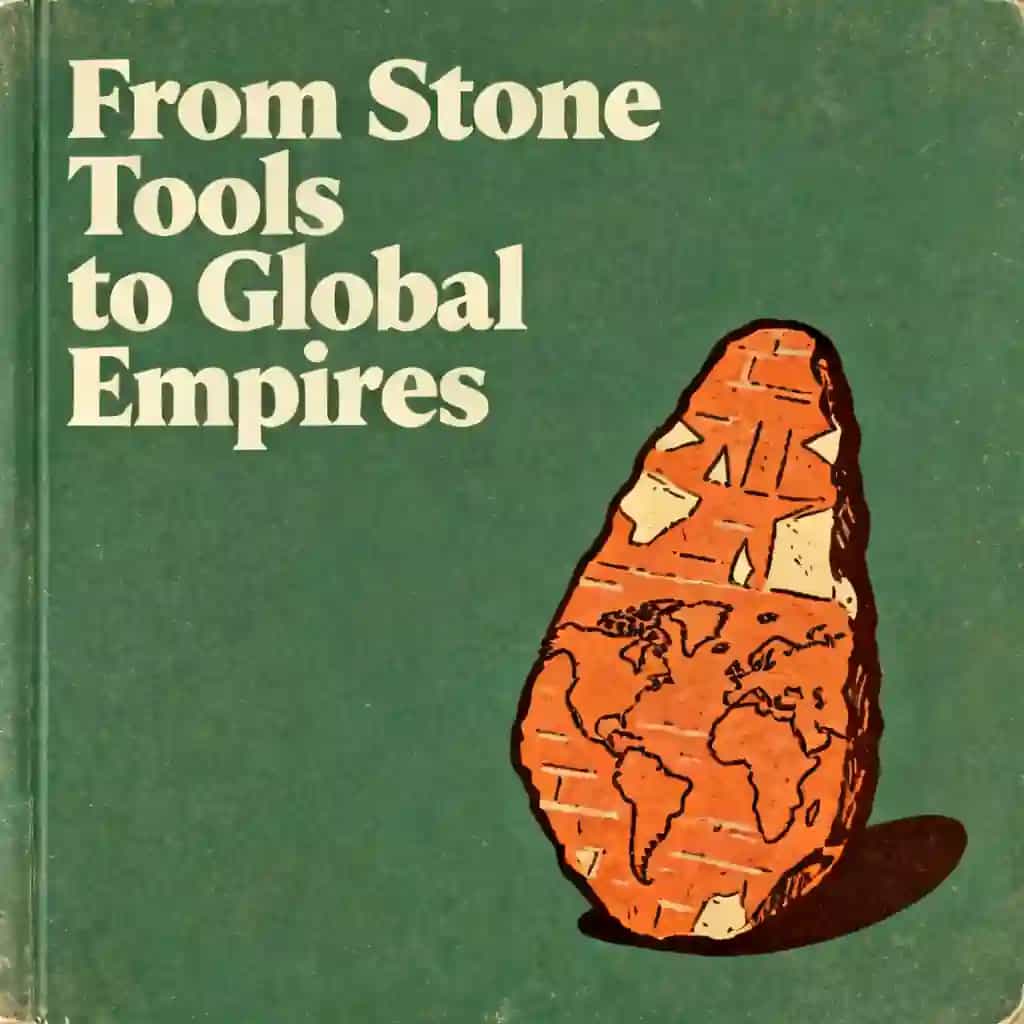
Explore the evolution of Homo sapiens, from bipedalism and fire use to global migrations and interbreeding with Neanderthals. Discover our ancient ancestors.

We didn't just replace these other species; we swallowed them up, carrying their genetic wisdom forward into the modern age.
Evolution of Homo sapiens, from our common ancestors with chimpanzees. Include migrations, walking upright, using fire, tribes, species cross breeding, how species were discovered etc

From Columbia University alumni built in San Francisco
"Instead of endless scrolling, I just hit play on BeFreed. It saves me so much time."
"I never knew where to start with nonfiction—BeFreed’s book lists turned into podcasts gave me a clear path."
"Perfect balance between learning and entertainment. Finished ‘Thinking, Fast and Slow’ on my commute this week."
"Crazy how much I learned while walking the dog. BeFreed = small habits → big gains."
"Reading used to feel like a chore. Now it’s just part of my lifestyle."
"Feels effortless compared to reading. I’ve finished 6 books this month already."
"BeFreed turned my guilty doomscrolling into something that feels productive and inspiring."
"BeFreed turned my commute into learning time. 20-min podcasts are perfect for finishing books I never had time for."
"BeFreed replaced my podcast queue. Imagine Spotify for books — that’s it. 🙌"
"It is great for me to learn something from the book without reading it."
"The themed book list podcasts help me connect ideas across authors—like a guided audio journey."
"Makes me feel smarter every time before going to work"
From Columbia University alumni built in San Francisco

Imagine you’re standing in a dense African forest six million years ago, watching a common ancestor we share with chimpanzees. That moment marks the start of a seven-million-year saga where we traded the safety of the canopy for the mystery of the open savannah. You’ll see how walking upright and mastering fire transformed us from prey into explorers with expanding brains. We weren't alone, though; our journey involved dramatic encounters and interbreeding with cousins like the Neanderthals. Today, we’ll trace how these "wise men" migrated across vanished land bridges to every corner of the Earth.
To truly understand how we became the architects of the modern world, we have to look closely at the patchwork of traits that defined our earliest ancestors. It is tempting to think of evolution as a ladder, where every step was a clear improvement on the last, but the reality is much more like a dense, tangled bush. When we look back at the timeframe between seven and four million years ago, we find ourselves in a world where the human lineage was just beginning to branch away from the ancestors of chimpanzees. This wasn't a clean break. Molecular clock estimates, which act like a genetic stopwatch calibrated against the fossil record, suggest this divergence happened roughly six to seven million years ago. But for a long time after that, our ancestors looked and moved in ways that would be deeply confusing to us today.
Take Sahelanthropus tchadensis, found in the Djurab Desert of Chad. Dated to about seven million years ago, this creature—nicknamed Toumaï—possessed a braincase roughly the size of a modern chimpanzee’s, about 360 cubic centimeters. Yet, if you looked at the base of its skull, you’d find the foramen magnum—the hole where the spinal cord connects—positioned further forward than in any ape. This is a subtle but profound clue. It suggests that even while their brains remained small and their faces ape-like, these creatures were starting to hold their heads in a way that implies an upright posture. It was an early experiment in bipedalism, happening in an environment that wasn't the wide-open grassland we often imagine. Instead, the landscape was a mosaic of gallery forests and woodlands bordering a massive lake. Our ancestors weren't running across the plains yet—they were standing up in the shadows of trees.
Then we have Orrorin tugenensis, hailing from the Tugen Hills of Kenya about six million years ago. The evidence here is even more concrete. When researchers used CT scans to look at the internal structure of Orrorin’s thigh bone, they found an asymmetric distribution of cortical bone—the outer shell of the bone was thicker on the bottom than on the top. This is a tell-tale biomechanical signature of someone who walks on two legs. And yet, this same creature had curved finger bones, the kind perfectly suited for grasping branches. This tells us that for millions of years, bipedalism and tree-climbing weren't mutually exclusive. Our ancestors were living in two worlds at once—perfecting the walk on the ground while maintaining the grip in the canopy.
One of the most vivid characters in this early drama is Ardipithecus ramidus, specifically a female known as Ardi who lived 4.4 million years ago in what is now Ethiopia. Ardi is a walking contradiction. She had a pelvis restructured for upright walking, but she also had a fully opposable big toe, similar to a thumb, designed for grasping limbs. She didn't have the arched feet we have today; her feet were flat and flexible. When she was on the ground, she likely moved with a slow, cautious waddle, but in the trees, she was a master of the woodland. The discovery of Ardi was a major plot point because it finally killed the old savanna hypothesis—the idea that we stood up because the forests disappeared. Ardi lived in a closed woodland, surrounded by monkeys and forest-dwelling owls. We didn't stand up because we had to see over tall grass; we stood up for reasons that remain a beautiful mystery, perhaps related to carrying food or infants, long before the first blade of savanna grass ever dominated the horizon.
This early period shows us that the defining traits of humanity—upright walking, small canine teeth, and large brains—did not arrive as a package deal. Instead, they appeared at different times, often millions of years apart. Bipedalism was the first to arrive, a foundational shift that happened while our brains were still no larger than a grapefruit. It was a time of intense biological experimentation, where different species were trying out various ways to exist in a changing African landscape. We see this diversity in Kenyanthropus platyops, a flat-faced hominin from 3.5 million years ago that looked remarkably different from its contemporaries. This reminds us that at any given moment in our history, we were likely not the only human-like species on the landscape. We were part of a crowded family, a collection of relatives all navigating the same world in slightly different ways.
As we move forward in time to about four million years ago, the experiment of bipedalism becomes much more refined in the genus Australopithecus. This is where we see the transition from a cautious waddle to a stride that begins to look much more like our own. The most famous representative of this group is, of course, the 3.2-million-year-old skeleton known as Lucy, found in Ethiopia. Lucy and her kind, Australopithecus afarensis, represent a pivotal moment in the human story. If you were to look at Lucy’s knee, you would see a valgus angle—the thigh bone angles inward toward the knee, which allows the feet to be placed directly under the body’s center of gravity. This is a hallmark of efficient, long-distance walking.
But the most haunting evidence of this shift isn't a bone—it’s a moment frozen in time. In Laetoli, Tanzania, a volcanic eruption roughly 3.6 million years ago left a layer of soft ash on the ground. Shortly after, a light rain fell, turning that ash into a kind of wet cement. Across that landscape, three individuals walked, leaving their footprints for us to find millions of years later. These aren't the prints of an ape; they show a clear heel-to-toe strike, a deep indentation where the heel hit first, and a push-off from the big toe. There is no sign of a grasping toe here. These individuals were walking with a gait that would have looked entirely familiar to you. They were crossing the landscape with purpose, their hands free to carry tools, food, or children.
Despite this masterful walk, Lucy still carried the echoes of her forest-dwelling past. Her arms were relatively long compared to her legs, and her finger bones still had a slight curve. It suggests that while the ground was her primary domain, the safety of the trees was still within reach. This dual-adaptive strategy was incredibly successful, allowing Australopithecus to thrive across Africa for millions of years. They were the ultimate generalists, able to forage in the woods and traverse the openings between them. During this same era, we see a separate branch of the family tree—the Paranthropus group—taking a different path. These were the "robust" cousins, equipped with massive grinding teeth and a bony ridge on the top of their skulls to anchor powerful chewing muscles. They were specialized for a diet of tough, fibrous plants, a strategy that worked for a long time but ultimately led to an evolutionary dead end.
The transition from Australopithecus to the genus Homo, around 2.8 million years ago, brought about another fundamental change: the expansion of the brain. While Lucy’s brain was about 450 cubic centimeters—not much larger than a chimpanzee’s—the early members of our genus, like Homo habilis, began to push toward 600 or 700 cubic centimeters. This brain growth wasn't just a biological fluke; it was fueled by a change in diet and the birth of technology. We see the first simple stone tools, the Oldowan industry, appearing in the record. These weren't sophisticated axes; they were simple cobbles with a few flakes knocked off to create a sharp edge. But they were enough. They allowed our ancestors to access high-energy marrow and meat that no other primate could reach.
This technological leap set the stage for Homo erectus, who appeared nearly two million years ago and truly became the first global citizen. Homo erectus was a biological marvel. They were tall, with long legs and shorter arms—the first hominins with body proportions that mirror our own. They were built for the long haul, capable of walking or running for hours in the midday sun. Their brains were significantly larger, eventually reaching up to 1100 cubic centimeters. This is the species that invented the Acheulean hand-axe, a beautiful, tear-drop-shaped stone tool that was standardized across continents. For over a million years, Homo erectus maintained this technology, a testament to a level of social learning and cognitive planning that was unprecedented. They weren't just reacting to their environment; they were shaping it, and for the first time, they began to move beyond the borders of Africa, following the migrations of game into the vastness of Eurasia.
If bipedalism gave us the world, it was fire that gave us our humanity. The control of fire is perhaps the most transformative plot point in our entire history, a technology that fundamentally reshaped our bodies and our social lives. While the exact date of the first controlled fire is debated, there is evidence suggesting that Homo erectus may have been the first to harness it. Sites like Zhoukoudian in China show potential hearths, and magnetic susceptibility measurements in certain caves suggest the presence of long-burning fires. But think less about the dates and more about the impact. Before fire, the night was a time of terror, a period where our ancestors were vulnerable to the predators of the dark. Fire changed the geography of safety.
When we brought fire into the cave or the camp, we extended the day. We created a social hearth, a place where the work of the day ended and the work of being a community began. This is where the social brain truly started to grow. Around a fire, you aren't just foraging or fleeing; you are communicating, sharing stories, and bonding. This increased social complexity required a more sophisticated brain to navigate, creating a feedback loop between technology and cognition. But fire’s influence went even deeper—it went into our very guts. Cooking is, in essence, a form of external digestion. By applying heat to meat and tubers, we break down tough fibers and neutralize toxins, making more calories available with less effort.
This shift to cooked food had profound biological consequences. Because we no longer needed to spend the entire day chewing tough raw food, our teeth and jaws began to shrink. More importantly, our digestive tracts—which are incredibly energy-expensive to maintain—could also become smaller. This "saved" energy was then diverted to the most energy-hungry organ in the body: the brain. There is a direct link between the hearth and the size of our craniums. We traded gut for brain, a deal that was only possible because of the flickering flames. Fire allowed us to move into colder climates, to survive the harsh winters of Europe and Northern Asia, and to process a wider variety of foods than any of our predecessors.
As we look at the Middle Pleistocene, roughly 700,000 years ago, we see the emergence of diverse populations across the globe, all influenced by this mastery of fire and tools. In Morocco, at Thomas Quarry I, we find fossils dated to about 773,000 years ago. These individuals lived during a period of magnetic transition—the Matuyama-Brunhes boundary—where the Earth’s magnetic poles were flipping. These Moroccan fossils show a fascinating mix of primitive and modern traits, bridging the gap between earlier Homo erectus and the later lineages that would lead to us. They represent an African lineage that was already evolving toward the modern form, long before the first Homo sapiens appeared.
This was a time of global diversification. While populations in Africa were trending toward modern humans, a lineage in Europe was adapting to the cold, eventually becoming the Neanderthals. In Asia, other groups like the Denisovans were carving out their own niches. This wasn't a world of isolated species, but a world of interconnected populations. The "Out of Africa" story is often told as a single event, but it was likely a series of pulses, with groups moving back and forth across the Saharan and Levantine corridors whenever the climate allowed. Every time the "Green Sahara" returned due to orbital shifts in the Earth’s tilt, the desert became a gateway, allowing gene flow to pulse across the continent and into the rest of the world. We are the product of those pulses, a species forged in the heat of the African sun and tempered by the social warmth of the fire.
For a long time, we viewed the Neanderthals as a failed branch of the human family—a more primitive, less intelligent version of ourselves that simply couldn't compete. But the more we look at the evidence, the more we see a species that was remarkably sophisticated. Neanderthals lived in Europe and Western Asia from about 400,000 to 40,000 years ago. They were built for the cold, with robust, heavy-set bodies and large nasal passages to warm the frigid air. They were master hunters, using the Levallois technique to create specialized stone flakes that were sharp, durable, and highly effective. They weren't just surviving; they were expressing themselves. We found cave art, symbolic use of red ochre, and intentional burials that suggest a complex emotional and spiritual life.
The most dramatic turn in our story occurred when Homo sapiens began their major migration out of Africa around 60,000 years ago and encountered these long-established residents. For decades, we wondered what happened when our species met. Was it a war of extermination? Or did we simply watch each other from across the valleys? The answer was hidden in our cells. In 2010, the first draft of the Neanderthal genome was completed, and it revealed something stunning: most people living outside of Africa today carry about 1 to 4 percent Neanderthal DNA. We didn't just meet them; we mated with them. We are, quite literally, a hybrid species.
The nature of these encounters is now coming into sharper focus through new genetic research. A study published very recently, in early 2026, has examined the X chromosome—one of the sex chromosomes—and found a striking pattern. Modern human X chromosomes are almost entirely devoid of Neanderthal DNA. Scientists call these "Neanderthal deserts." For a long time, we thought this was because Neanderthal genes on the X chromosome were biologically incompatible with ours, causing health issues and being "purged" by natural selection. But when researchers looked at Neanderthal X chromosomes, they found the exact opposite: an abundance of Homo sapiens DNA.
This suggests the interbreeding wasn't random—it was strongly sex-biased. The math and the genetic patterns suggest that these ancient pairings primarily involved Neanderthal men and Homo sapiens women. Why this occurred is one of the most provocative questions in anthropology today. It could have been due to social dynamics, like patrilocality, where women moved to join the man’s group. It could have been mate preference—perhaps Homo sapiens women found Neanderthal men to be high-status providers in a cold, harsh landscape. Or, as some researchers suggest, it may point to a darker history of conflict and coercion. Regardless of the "why," the genetic legacy is clear. When we interbred, we didn't just mix genes; we absorbed the local adaptations of our cousins. Some of the Neanderthal DNA we carry today helped our ancestors survive new diseases and adapt to lower light levels in northern latitudes.
We weren't just mixing with Neanderthals, either. In the Denisova Cave in Siberia, scientists found a tiny finger bone that belonged to a girl who lived 90,000 years ago. When they sequenced her DNA, they discovered she was a hybrid herself—her mother was a Neanderthal and her father was a Denisovan. This tells us that the ancient world was a place of constant movement and interaction. The Denisovans, known primarily from DNA and a few jawbones, left their own mark on us. Many populations in Asia, Melanesia, and Australia carry Denisovan DNA. In Tibet, a specific Denisovan gene helps people survive at high altitudes by regulating how the body uses oxygen. We didn't just replace these other species; we swallowed them up, carrying their genetic wisdom forward into the modern age.
While much of our story is centered in Africa and Europe, recent discoveries are proving that East Asia was a dynamic evolutionary crossroad, not just a distant terminus. For a long time, the "Peking Man" fossils—Homo erectus found in China—were seen as a separate lineage that eventually went extinct. But the picture is becoming much more complex. New fossils and taxonomic proposals, including the naming of Homo juluensis and Homo longi (the "Dragon Man"), suggest that China was home to multiple hominin lineages that arose, interacted, and adapted to shifting environments over the past two million years.
One of the most significant finds is the Harbin cranium, the holotype for Homo longi. This massive skull, dated to the Middle Pleistocene, shows a combination of primitive features like a low brow and huge eye sockets with more modern traits like a large brain capacity and a flatter face. Some researchers believe this lineage is more closely related to us than the Neanderthals are. Even more intriguing is the possibility that many of these Chinese fossils are actually the elusive Denisovans we’ve only known through DNA. In 2025, researchers successfully extracted Denisovan mitochondrial DNA from the dental calculus of the Harbin cranium and identified a Denisovan mandible from the Tibetan Plateau. This confirms that this group was widespread, living in environments ranging from the high-altitude steppes to the temperate forests of the east.
The cultural record in China is equally revealing. By 40,000 years ago, we see evidence of innovative ochre processing and sophisticated tool use at sites like Shiyu. We’ve found 300,000-year-old wooden tools and even evidence of rhinoceros tooth tools, showing a level of resourcefulness that challenges any idea that these ancient humans were less capable than their western counterparts. The landscape of ancient China was a mosaic of forests and deserts that shifted with the climate, acting like an evolutionary sieve that favored groups who could adapt quickly. We see this in the way Homo erectus survived in the Nihewan Basin for hundreds of thousands of years, navigating the Mid-Pleistocene climate transition with increasingly complex stone technology.
This eastern story emphasizes that human evolution was a global phenomenon. It wasn't just a single line moving out of Africa; it was a web of populations stretching from the Atlantic coast of Morocco to the shores of the Pacific. These groups were never truly isolated for long. Gene flow and cultural exchange likely pulsed across the vast expanses of Asia, carried by groups who were following the movements of animals and the opening of new environmental corridors. By the time Homo sapiens arrived in East Asia in force, they were encountering relatives who had already spent hundreds of thousands of years mastering the local terrain. The "Dragon Man" and his kin aren't just curiosities of the fossil record; they are part of the broader mosaic of our species, representing a branch of humanity that was every bit as dynamic as our own.
As we look at the totality of the fossil and genetic record in the East, the "evolutionary cul-de-sac" model is being replaced by a vision of a bustling intersection. The demographic history of China is one of persistence and interaction. Even as Homo sapiens became the dominant population, they were absorbing the genetic legacy of the people who came before them. The diversity of modern human populations in Asia today—including adaptations to high altitudes and specific immune responses—is a testament to these ancient encounters. We are the survivors not because we were the "best" in some abstract sense, but because we were the most successful at integrating the strengths of our entire family tree.
While East Asia and Europe were hosting their own evolutionary dramas, Southern Africa was serving as a crucial geographical refugium—a place of stability and deep genetic continuity that lasted for hundreds of thousands of years. Recent whole-genome sequencing of ancient individuals from South Africa, ranging from 10,000 to a few hundred years ago, has revealed a story of human origins that is uniquely stable. For at least 9,000 years, the foragers of southernmost Africa showed a genetic make-up that remained largely outside the range of variation we see in most modern humans today. This suggests that the region south of the Zambezi River was an isolated stronghold for a very long time.
This deep stratification—the separation of Southern African populations from the rest of the continent—may go back as far as 300,000 years, or possibly even a million. While other parts of Africa were experiencing constant migrations and mixing, the ancestors of groups like the Khoe-San were living in a relatively stable environment. This isolation allowed for the development of unique genetic variants, particularly those associated with kidney function and protection against ultraviolet light—essential adaptations for the arid, high-sun environments of the southern savannas. It wasn't until about 1,300 years ago that we see the first evidence of major gene flow from Eastern and Western African groups into this southern tip of the continent, coinciding with the arrival of pastoralism and farming.
The Southern African record is vital because it challenges the idea of a single, uniform point of origin for Homo sapiens. Instead, it supports a "multiregional African origin" model, where our species evolved within a network of subdivided populations across the continent. These groups were separated by vast deserts or dense forests for long periods, allowing them to develop distinct physical and genetic traits. Then, during periods of favorable climate, these "islands" of humanity would reconnect, exchanging genes and ideas before being separated again. We are not the descendants of a single small tribe, but the product of a massive, continent-wide conversation that lasted for millennia.
This Southern African refugium also highlights the "sapient paradox"—the fact that while humans looked anatomically modern by 300,000 years ago, many of the complex behaviors we associate with "modernity" seem to appear much later. However, sites like Border Cave and Blombos Cave in South Africa are pushing that timeline back. We see evidence of modern thinking—art, sophisticated bone tools, and complex hunting strategies—dating back at least 100,000 years. The deep genomic record of the South is helping us disentangle this mystery. We are finding that some of the genetic variants thought to be "fixed" in modern humans are actually variable in these ancient southern populations, suggesting that the path to becoming "modern" was much more flexible and diverse than we ever imagined.
The story of the Southern African foragers is one of incredible resilience. They maintained a large, stable population through the Last Glacial Maximum, 20,000 years ago, even as populations in other parts of the world were struggling. They are a reminder that for most of our history, the "human experience" was lived in small, highly adapted groups that were deeply connected to their specific landscapes. The genetic diversity found in these ancient southern genomes is a treasure trove of information about our species' ability to survive and thrive in isolation, and it serves as a powerful counterbalance to the more familiar stories of migration and mixing that dominate our later history.
As the climate stabilized and technology improved, the "Out of Africa" expansion became an unstoppable force. Between 70,000 and 50,000 years ago, Homo sapiens began to move into every corner of the planet. They crossed the vanished land bridges that existed when sea levels were lower—walking from Siberia into Alaska and moving across the islands of Southeast Asia toward Australia. This wasn't just a physical journey; it was a cultural one. We were carrying with us the accumulated wisdom of millions of years: the mastery of fire, the precision of stone tools, and a social structure that allowed for large-scale cooperation.
This expansion eventually led to the disappearance of our other human cousins. The Neanderthals vanished from the record around 40,000 years ago, followed by the Denisovans and smaller, more isolated groups like Homo floresiensis—the "hobbits" of Indonesia. Why they disappeared while we survived is a question that haunts anthropology. It likely wasn't a single factor, but a "perfect storm." We had a larger, more interconnected population that could bounce back from environmental disasters more easily. We had a more flexible technology that allowed us to exploit a wider range of resources. And, as we’ve seen, we were absorbing them through interbreeding. They didn't so much "go extinct" as they were diluted into the rising tide of Homo sapiens.
We see the evidence of this replacement everywhere we look. In 2024, researchers found that the first comprehensive AI laws were being passed to handle the manipulation of human narratives, but our ancient narrative is written in a much more permanent medium: our DNA. Today, every person on Earth is a carrier of this long history. If you are of non-African descent, you carry the legacy of the Neanderthal. If you are from East Asia or Oceania, you carry the ghost of the Denisovan. We are the sole survivors of a once-crowded family tree, but we carry our relatives within us. Our success as a species was not built on our ability to stand alone, but on our ability to integrate the diverse experiences and adaptations of all the "wise men" who came before us.
This global expansion also brought about the first major impacts on the planet’s ecosystems. As humans moved into new territories, we see the extinction of many large animal species—the "megafauna." Whether this was due to overhunting, climate change, or a combination of both, it marks the beginning of a new era where humans became the primary driver of environmental change. We were no longer just a part of nature; we were its masters. The same curiosity and drive that led our ancestors to stand up on the African savanna was now leading them to build civilizations, domesticate plants and animals, and eventually, look toward the stars.
The journey from the common ancestor with chimpanzees to the modern human is a story of incredible odds. It is a story of survival in the face of shifting climates, fierce predators, and the constant challenge of a changing world. It is a story of how a small-brained, upright-walking ape transformed into a global force of nature. And as we look at our world today—a world of eight billion people connected by technology and shared history—we can see the echoes of those earliest steps in every part of our lives. We are the wise men, the Homo sapiens, but we are also the heirs to every species that lived, loved, and struggled along the way.
As we reflect on this immense journey, it is easy to feel disconnected from the ancient past. But the reality is that your body and your mind are living archives of every "plot point" we’ve discussed. Understanding this history isn't just about fossils and dates; it’s about recognizing the deep, biological roots of your own behavior and potential. Here is how you can apply the insights of our ancestors' seven-million-year saga to your own life today.
First, embrace the "generalist" mindset that defined the genus Homo. For millions of years, our ancestors survived because they were flexible. They didn't just master one environment; they learned to navigate the mosaic. In our modern, highly specialized world, there is a powerful advantage in being a generalist—someone who can connect ideas across different fields, adapt to new technologies, and remain curious about the world beyond their immediate specialty. Just as Homo erectus mastered the hearth and the hand-axe to thrive on multiple continents, your ability to learn and adapt is your greatest evolutionary strength.
Second, recognize the power of the "social hearth." We are biologically wired for connection. The expansion of our brains was fueled by the hours spent around the fire, sharing information and building community. In an age of digital isolation, it is more important than ever to create your own hearths—spaces where you can engage in deep, meaningful communication with others. Whether it’s a family dinner, a collaborative project, or a local club, these social interactions are where our most "human" traits are nourished. We didn't become wise in isolation; we became wise together.
Third, appreciate the hybrid nature of your existence. You are not a "pure" anything; you are a mosaic. The genetic legacy of Neanderthals and Denisovans within us is a reminder that diversity is not a modern invention—it is the very engine of our survival. These ancient encounters gave us the tools to survive in new environments and fight off new diseases. Embracing the diversity of ideas, backgrounds, and perspectives in your own community is simply a modern extension of the strategy that saved our species from extinction tens of thousands of years ago.
Fourth, understand the biological cost of your brain. Your brain is a "high-performance" organ that requires a massive amount of energy to maintain—a trade-off our ancestors made by mastering fire and high-quality nutrition. This means that your cognitive health is deeply linked to your physical well-being. Prioritize the "external digestion" of quality information and nutrition to fuel your most important asset. The "wise men" who came before you earned that brain through millions of years of struggle; it is your responsibility to use it to its full potential.
Finally, cultivate a sense of "deep time" awareness. When you look at the challenges of the present, remember the scale of what we’ve already overcome. We have survived magnetic pole flips, ice ages, and the disappearance of our closest relatives. We are a species built for resilience. This long perspective can provide a sense of calm and purpose when facing modern uncertainties. You are part of a seven-million-year success story. Let that knowledge empower you to face the future not with fear, but with the same courageous curiosity that led our ancestors out of the trees and across the world.
Our journey today has taken us from the shadowy gallery forests of ancient Chad to the high-tech laboratories of the 21st century. We have traced the physical transition from forest canopies to the open savanna, witnessing the mastery of bipedalism and the transformative power of fire. We have explored the birth of the social hearth and the dramatic, genetic-shaping encounters with our Neanderthal and Denisovan cousins. It is a story that reminds us that we are part of something much larger than ourselves—a global, interconnected tapestry of life that has been seven million years in the making.
Take a moment to consider the sheer improbability of your existence. You are the result of an unbroken line of survivors who managed to navigate every climate shift and every environmental hurdle that Earth could throw at them. Every trait you possess—from the way your feet hit the pavement to the way your mind puzzles over a complex problem—is a gift from an ancestor who found a way to stay alive. The fossils we find in Morocco, China, and South Africa aren't just "others"; they are us. They are the drafts and chapters of the book of you.
As you move through your day, perhaps you’ll notice the echoes of this journey in small ways. When you gather with friends, remember the hearth. When you feel the urge to explore a new place or learn a new skill, remember Homo erectus. When you see the incredible diversity of people in your city, remember the ancient crossroads of Eurasia and Africa. We are the wise men, yes, but we are also the children of the forest and the savanna, the hybrids of the cold north and the southern refugium.
Thank you for spending this time exploring the depths of our shared history. It is a profound privilege to look back at the millions of years that forged us and to see the common threads that still bind us together. I encourage you to reflect on your own place in this long lineage. You are a pivotal character in the ongoing human story, carrying the wisdom of the past into the mystery of the future. Use that wisdom well, and remember that you are never truly walking alone—you are walking with the strength of seven million years of ancestors at your back.