BeFreed
    Categories>Philosophy & Spirituality>The Evolution of Philosophical Thought: From Ancient Greece to Today

    The Evolution of Philosophical Thought: From Ancient Greece to Today

    19 min
    |
    |
    Aug 23, 2026
    • Philosophy & Spirituality
    • History & Society

    Explore The Evolution of Philosophical Thought, from ancient rational inquiry in Athens to the Enlightenment. Discover how these ideas shape modern civilization.

    The Evolution of Philosophical Thought: From Ancient Greece to Today
    0:00 / 0:00
    Choose how it's told

    One episode. Many ways to hear it.

    Same ideas from The Evolution of Philosophical Thought: From Ancient Greece to Today. Pick the voice, depth, and pace that fits you. Switch anytime.

    Transcript & chapters

    Chapter 1

    The Spark of Rational Inquiry

    If you were to stand in a busy city square today, you might see a thousand different lives moving in a thousand different directions, yet almost every action taken in that crowd is shaped by invisible forces—ideas that were hammered out thousands of years ago in places like Athens, Varanasi, or Qufu. You might think your views on justice, your sense of self, or your belief in progress are just common sense, but they are actually the end products of a long, often violent, and always fascinating intellectual war. Philosophy isn't just a hobby for people in tweed jackets; it is the fundamental operating system of human civilization. Imagine for a moment that you are in Ancient Greece in the 6th century BCE. Before this point, if a storm destroyed your crops or a plague hit your city, the explanation was simple: a god was angry. But then, a few thinkers began to ask a radical, dangerous question: What if the world follows its own rules? What if we can understand the universe through reason alone, without needing a myth to explain it? This shift—from "Who did this?" to "How does this work?"—is the moment philosophy was born as a rational inquiry based on argumentation. In this episode, we are going to trace the entire arc of this human saga. We’ll look at how the Greeks tried to find the "first principle" of the cosmos, how medieval thinkers wrestled with the tension between faith and logic, and how the Enlightenment tried to rebuild the world from scratch using nothing but the human mind. You will see how these ideologies didn't just appear in a vacuum; they were reactions to the world around them, often overturning everything that came before. We’re going to explore why a 17th—century thinker like Spinoza was considered a threat to the social order for suggesting God and Nature were the same thing, and how that paved the way for the freedoms you enjoy today. By the time we’re done, you’ll see that the history of philosophy isn't a museum of dead ideas—it’s a living map of how you became who you are. So, let’s dive into that first Great Awakening in the dust of the Mediterranean, where the very first "why" was whispered against the noise of the gods.
    Chapter 2

    The First Principle and the Birth of the Self

    The story of how we think really begins with a quest for the "arche"—a Greek word for the starting point or the fundamental substance of everything. Before there were schools or textbooks, there were the Presocratics, and they were obsessed with what the world was made of. Thales, often called the first philosopher, looked around and decided the answer was water. It sounds simple, even silly now, but his breakthrough wasn't the answer—it was the method. He was trying to provide a rational explanation for the cosmos instead of a theological one. He was looking for an empirical theory. Soon, his peers were pushing this further. Anaximander thought the source was something "boundless" and beyond our perception, while Heraclitus famously argued that the only constant is change—that you can't step into the same river twice because the water is always moving and so are you. But then came Socrates, and he changed the game entirely. He wasn't interested in what the stars were made of; he wanted to know what you were made of. He didn't write books; he walked around asking questions until people realized they didn't actually know what justice or virtue meant. His student, Plato, took this and built a massive, elegant skyscraper of an ideology. Plato argued that this world we see is just a blurry, imperfect copy of a higher reality—the Realm of Forms. Think of it like this: you can see a hundred different beautiful things, but they are all just shadows cast by the one true "Form of Beauty" that exists in a perfect, eternal space. This was a turning point because it separated the mind from the body, suggesting that our reason is our link to the divine. Aristotle, Plato’s student, eventually brought us back down to earth. He rejected the idea that Forms lived in another world; he argued that form and matter are inseparable. If you want to understand a chair, you don't look at a mystical "Chair-ness" in the sky; you look at the wood and the design right in front of you. Aristotle gave us the tools of logic and the idea that everything has a "teleological" cause—a purpose it is moving toward. This Greek foundation created a tension that would last for two millennia: are we spirits trapped in a physical world, or are we biological beings meant to flourish within it? As the Greek world faded into the Roman Empire, new schools like the Stoics and Epicureans turned these big cosmic questions into survival guides for life, teaching people how to find tranquility in a chaotic world.

    Keep learning with this episode

    Take the ideas from this episode into a guided learning experience in BeFreed.

    Chapter 3

    The East and the Search for Enlightenment

    While the Greeks were debating the nature of matter and logic, a parallel revolution was happening in the East, and it’s crucial to understand this because it offers a completely different lens on the "self." In India, philosophy was never just an academic exercise; it was a spiritual technology designed to reach enlightenment. The ancient Vedas and Upanishads introduced the concepts of Atman—the eternal soul—and Brahman—the ultimate reality of the universe. The core mission was to understand the connection between the two. But then, around the 6th century BCE, a prince named Gautama Siddhartha—who we know as the Buddha—stepped out and challenged the entire system. He argued something that still feels radical today: there is no permanent, stable self. He taught that our belief in a "me" that stays the same is actually the source of all our suffering. Think of the contrast: while Plato was trying to find abstract and eternal forms or ideas, such as the forms of beauty, justice, and goodness, the Buddha was trying to show you how to let it go. Meanwhile, in China, the focus shifted from the "soul" to the "state." Confucius was looking at a society in chaos and decided that harmony came from right conduct and filial piety. For him, the family was the blueprint for the universe. If every person fulfilled their role—son, father, ruler—then the "Dao," or the Way, would be realized. But then you had Laozi and the Daoists, who looked at the rigid rules of Confucianism and said, "You’re trying too hard." They championed "wu wei," or effortless action. Laozi’s idea was that we should be like water—flowing around obstacles rather than fighting them, staying in harmony with nature rather than trying to dominate it. This Eastern tradition reminds us that while Western thought was becoming increasingly obsessed with the individual and the "knower," Eastern thought was often focused on the "whole" and the "flow." These ideologies eventually met and transformed each other—Buddhism traveled into China and became Chan (and later Zen), while Indian thinkers like Adi Shankara later developed a radical monism, arguing that the diversity we see in the world is just an illusion, a "Maya" that hides the fact that everything is actually one. This global conversation shows us that the "big questions" are universal, but the answers depend entirely on whether you value the logic of the mind or the stillness of the heart.

    Chapter 4

    The Long Shadow of the Middle Ages

    As we move into the medieval period, the story of philosophy takes a sharp turn toward the heavens. For nearly a thousand years in the West, philosophy became the "handmaiden of theology". After the Roman Empire fell, the Church became the gatekeeper of knowledge, and the big question wasn't "What is the world?" but "How does the world reflect God?". Thinkers like Augustine of Hippo took Plato’s ideas and "Christianized" them, arguing that those eternal Forms Plato talked about were actually thoughts in the mind of God. Augustine wrestled with the problem of evil: if God is all-good, where does bad stuff come from? His answer was free will—God gave us the power to choose, and we often choose poorly. But there was a missing piece in this era. Much of the Greek wisdom, especially Aristotle’s work, had been lost to the West. It was the Arabic-Persian tradition that saved it. During the Islamic Golden Age, philosophers like Avicenna and Averroes translated and interpreted Aristotle, synthesizing his logic with Islamic faith. They argued that reason and revelation were two compatible ways of arriving at the same truth. When these texts finally made it back into Europe, they sparked a movement called Scholasticism. This was a highly systematic, almost lawyer-like way of doing philosophy. Thomas Aquinas is the giant of this era. He tried to build a "Summa"—a total system—that showed how Aristotelian logic could prove things like the existence of God. He came up with the "Five Ways," which were five arguments for the existence of God. But even within this religious framework, the seeds of modern doubt were being planted. William of Ockham introduced what we now call "Ockham’s Razor"—the idea that the simplest explanation, the one that assumes fewer entities, should be preferred. He used this to argue that we shouldn't assume "universals" exist in reality, but only in our minds. This shift toward "nominalism" was like a crack in the foundation of the medieval world. It suggested that if we want to understand the world, we need to look at individual, physical things, not just abstract religious concepts. This era, often dismissed as a "dark age," was actually a massive intellectual pressure cooker, where the tools of logic were being sharpened for the explosion of thought that was about to come in the Renaissance.
    Keep learning with this episode

    Take the ideas from this episode into a guided learning experience in BeFreed.

    Chapter 5

    The Great Pivot to the Human Mind

    The Renaissance and the Early Modern period mark the moment humanity decided to take the steering wheel. During the Renaissance, there was a "rebirth" of interest in the individual. Humanism emerged, shifting the focus from the divine back to human culture and society. But the real earthquake happened in the 17th century with the Scientific Revolution. When Galileo and Newton started showing that the heavens followed mathematical laws, the old religious explanations started to feel small. This created a crisis of authority: if the Church and the ancients were wrong about the stars, what else were they wrong about? Enter René Descartes. He decided to doubt everything until he found something he couldn't doubt. He ended up with his famous "I think, therefore I am". This was a massive turning point. He ended up with his famous "I think, therefore I am". This led to two major "camps" that still define how we think today: the Rationalists and the Empiricists. The Rationalists, like Descartes, Spinoza, and Leibniz, believed that reason and innate ideas were the path to truth. Spinoza, for instance, used a "geometrical method" to argue that there is only one substance in the universe—God or Nature—and that everything, including you, is just a part of that one thing. On the other side, the Empiricists, mostly in Britain, said "Not so fast." John Locke argued that the mind is a blank slate at birth—a tabula rasa—and that all our knowledge comes from sensory experience. David Hume took this to its most radical conclusion. He argued that we don't actually "see" cause and effect; we just see one thing happen, then another, and our brains create a habit of expecting them to go together. He even questioned if the "self" exists at all, suggesting it’s just a bundle of perceptions. This was the "Age of Reason," but it was also the age of a great anxiety. If we are just observers in a mechanical universe governed by math, where do our values come from? This question set the stage for the Enlightenment, a movement that would try to use this new "reason" to rebuild every institution in society—from the church to the throne.

    Chapter 6

    The Enlightenment and the Architecture of Freedom

    The Enlightenment wasn't just a period in history; it was a project to make the world "rational." Thinkers in the 18th century believed that if we could understand the laws of physics, we could also understand the laws of politics and ethics. This was the era of the philosophes in France—men like Voltaire and Diderot—who used wit and logic to attack "the infamous" structures of superstition and tyranny. They believed in progress, individual freedom, and the power of education. The great symbol of this was the Encyclopedia, a massive attempt to categorize all human knowledge and make it available to everyone, not just the elite. But the Enlightenment also had to figure out how to ground these new values. If we don't have a king ordained by God, why should we obey the law? This led to "Social Contract" theory. Thomas Hobbes, with his pessimistic view of human nature, argued that we give up our rights to a powerful ruler—the Leviathan—to avoid a "war of all against all". John Locke, however, argued that government exists only to protect our natural rights: life, liberty, and property. If a government fails to do that, you have a right to revolt. This idea became the fuel for the English Revolution and, almost a hundred years later, the American Revolution. But the most influential figure of this time was Immanuel Kant. He realized that both the Rationalists and the Empiricists were halfway right. He argued that while our knowledge starts with experience, our minds have "pre-installed" cognitive forms—like the pure concepts of substance and cause, and the forms of intuition, space and time—that shape how we see that experience. Kant also gave us a new way to look at morality: the Categorical Imperative. He argued that you should only act on rules that you would want to become universal laws. In other words, don't do anything you wouldn't want everyone else to do. This was the peak of human confidence—the belief that through our own reason, we could finally be free, mature, and self-directing. But even as the Enlightenment reached its height, new voices were starting to ask: is "reason" enough? Are we really just logical machines, or is there something darker, more emotional, and more complex driving the human story?

    Keep learning with this episode

    Take the ideas from this episode into a guided learning experience in BeFreed.

    Chapter 7

    The 19th-Century Rebellion Against Reason

    As the 19th century dawned, the polished, logical world of the Enlightenment began to feel a bit too sterile for some. The French Revolution had ended in a "Terror," and people were starting to realize that "reason" could be used as a weapon just as easily as a tool for progress. This led to a massive reaction. In Germany, Idealists like Hegel argued that history isn't just a series of random events; it’s the "Absolute Spirit" unfolding itself toward greater freedom through a process of conflict and resolution. But then came the "suspicious" thinkers who wanted to tear that idealism down. Karl Marx took Hegel’s ideas but flipped them. He argued that it’s not "spirit" that drives history, but economics and class struggle. For Marx, your ideas don't come from some pure reason; they come from your position in the productive system. At the same time, Arthur Schopenhauer was arguing that the universe isn't rational at all—it’s driven by a blind, irrational "Will" that only brings suffering. This paved the way for Friedrich Nietzsche, the man who famously declared that "God is dead." Nietzsche wasn't celebrating; he was warning us. He believed that if we lost the religious foundation for our values, we were headed for a crisis of nihilism. He challenged the "slave morality" of Judeo-Christian philosophy and urged us to create our own values through the "Will to Power." Meanwhile, in America, a more practical school emerged: Pragmatism. Thinkers like William James and Charles Sanders Peirce argued that the truth of an idea isn't found in some abstract logic, but in its "cash value"—what does it actually do for you in the real world?. If an idea helps you navigate life better, it’s true enough. This century was a wild, intellectual rollercoaster. We went from the belief that we were perfectly rational beings to the realization that we are driven by hidden economic forces, irrational wills, and a desperate need for meaning in a world where the old gods had vanished. Philosophy was no longer about finding "The Truth" with a capital T; it was about figuring out how to survive in a world that suddenly felt very cold and very uncertain.

    Chapter 8

    The Modern Crisis and the Postmodern Turn

    In the 20th century, philosophy split into two very different worlds. In the English-speaking world, "Analytic" philosophy took over. These thinkers, like Bertrand Russell and the early Ludwig Wittgenstein, wanted to make philosophy as precise as math. They believed that most philosophical problems were actually just "language puzzles." If we could just clarify our words and use formal logic, we could solve—or dissolve—the big mysteries. But in Continental Europe, things stayed much more "human." Phenomenology emerged, led by Edmund Husserl, who wanted to describe human experience exactly as it feels from the inside. This led straight into Existentialism. After the horrors of two World Wars, thinkers like Jean-Paul Sartre and Albert Camus looked at the wreckage and concluded that life has no inherent meaning. Sartre’s famous line was "existence precedes essence"—meaning you are born first, and then you have to choose who you are. You are "condemned to be free". But as the century moved on, even this "freedom" came under fire. The "Postmodernists" like Michel Foucault and Jacques Derrida began to argue that even our sense of "self" and "freedom" are just products of power and language. Foucault showed how our ideas about madness, sexuality, and crime are shaped by institutions to control us, while Derrida’s "deconstruction" showed that language is so unstable that we can never truly nail down a single meaning in a text. This left us in a strange place: a world where "Grand Narratives"—the big stories like Progress, Religion, or even Science—are treated with deep suspicion. We also saw the rise of Feminist philosophy, with figures like Simone de Beauvoir and Judith Butler challenging the "male-centered" assumptions that had dominated thought for 2,500 years. Today, philosophy is more diverse than ever, grappling with everything from the ethics of AI to the nature of consciousness. We have come a long way from Thales identifying water as the primal source of all things, but in a way, we are still asking that same fundamental question: what is actually real, and how should we live in light of it?

    Keep learning with this episode

    Take the ideas from this episode into a guided learning experience in BeFreed.

    Chapter 9

    Your Place in the Human Saga

    We have covered a lot of ground—from the "first principles" of the Greeks to the "deconstruction" of the postmodernists. But the most important thing to take away from this 2,500-year journey is that you are not just a passive observer of these ideas; you are a participant in them. Every time you defend a friend’s right to speak, you are channeling John Locke. Every time you pause to wonder if your thoughts are being shaped by the media you consume, you’re engaging in a bit of Foucault-style critique. When you try to act in a way that you’d want everyone else to act, that’s Kant’s Categorical Imperative whispering in your ear. Philosophy is the history of the "why" behind your "what." It shows us that ideologies aren't just dry theories; they are the tools humanity has built to make sense of the "apeiron"—the boundless mystery of existence. The evolution we’ve traced is one of increasing complexity and, often, increasing humility. We started by thinking we could master the cosmos with a few logical rules; we ended by realizing how much our "reason" is tangled up with our emotions, our history, and our biology. But that doesn't mean the quest is over. In fact, it’s more vital than ever. In a world of deep fakes, algorithm-driven echo chambers, and rapid technological change, the ability to think for yourself—the very definition of "enlightenment" according to Kant—is the ultimate survival skill. I want to thank you for spending this time with me, walking through the minds of these giants. I encourage you to take one of these ideas—maybe it’s the Stoic idea of indifference to things you can’t control, or the Pragmatist idea of looking at the "cash value" of your beliefs—and try to live with it for a day. See how it changes the way you see the world. After all, the point of philosophy isn't just to understand the world; it’s to figure out how to be a better person within it. Reflect on which "school" your own mind tends to inhabit. Are you a rationalist, an empiricist, or maybe a bit of a postmodern skeptic? Knowing your own operating system is the first step toward truly owning your life. Take care of yourself, and keep asking those "why" questions.

    ★★★★★

    You made it to the end of The Evolution of Philosophical Thought: From Ancient Greece to Today

    “23 days in and I have used it every single day. It is part of my daily habit now.”

    jayallen

    Best quote from The Evolution of Philosophical Thought: From Ancient Greece to Today

    “

    Philosophy isn't just a hobby for people in tweed jackets; it is the fundamental operating system of human civilization and a living map of how you became who you are.

    ”
    S

    Generated by Satty

    Input question

    A comprehensive overview of philosophical ideologies and their evolution across history, spanning from ancient foundations through the Enlightenment to modern and postmodern shifts, highlighting how these schools of thought transformed over time.

    Host voices
    Lenaplay
    Knowledge sources
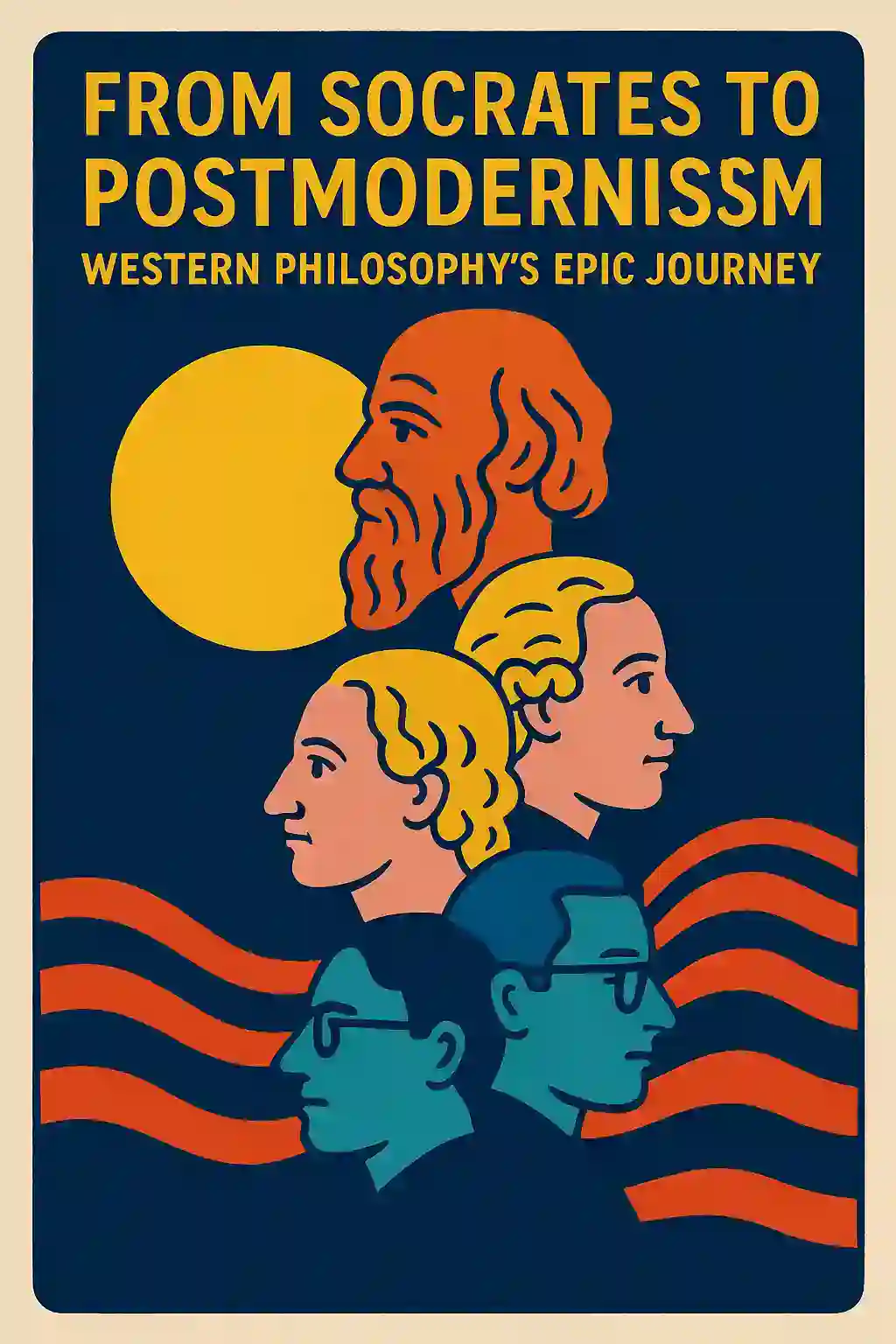
    From Socrates to Postmodernism: Western Philosophy's Epic Journey
    The Arc of Western Philosophy
    History of philosophy
    link
    https://en.wikipedia.org/wiki/History_of_philosophy
    Enlightenment (Stanford Encyclopedia of Philosophy)
    link
    https://plato.stanford.edu/entries/enlightenment/
    Postmodernism - Stanford Encyclopedia of Philosophy
    link
    https://plato.stanford.edu/entries/postmodernism/
    12.5 Postmodernism - Introduction to Philosophy | OpenStax
    link
    https://openstax.org/books/introduction-philosophy/pages/12-5-postmodernism

    Frequently Asked Questions

    The podcast explores how invisible intellectual forces from places like Athens, Varanasi, and Qufu serve as the fundamental operating system of human civilization. It traces the history of ideas from the birth of rational inquiry to the Enlightenment, examining how our views on justice and progress are the products of a long intellectual war. The episode highlights the shift from mythological explanations to understanding the universe through reason and argumentation.

    In the 6th century BCE, thinkers in Ancient Greece began asking radical questions that moved humanity away from purely mythological explanations for natural events. Instead of attributing storms or plagues to angry gods, they sought to understand if the world followed its own rules. This pivotal moment marked the birth of philosophy as a rational inquiry, shifting the focus from 'who' caused an event to 'how' the universe works through logic and first principles.

    The discussion traces a broad arc of human history, beginning with the ancient origins of thought in Greece and other global centers like Varanasi and Qufu. It follows the evolution of these ideas through the medieval period, where thinkers wrestled with the tension between faith and logic. Finally, it examines the Enlightenment's attempt to rebuild the world through reason, showing how these historical movements continue to shape our modern sense of self and society.

    From Columbia University alumni | built in San Francisco

    BeFreed Brings Together A Global Community Of Curious Minds

    4.7

    avg rating

    7.84k+ App Rating

    BeFreed Community

    Seriously I haven’t even explored this app fully yet but from using it the last few days I am so impressed... BeFreed is on a different level from any other learning app I have used. This makes it ultra engaging and can actually improve your concentration which is great for all the doom scrollers!

    @ladyInfinity

    I bought BeFreed exactly 23 days ago, and I have used it every single day since. It has completely embedded itself into my daily workflow and learning habit.

    @jayallen

    The truth is, the app has exceeded all my expectations. I can ask it to generate audio on any topic, whatever it may be, and the result is impressive. My professional field is a specialization in psychotherapy and it is multidisciplinary; however, the answers are very accurate.

    @Raguipa

    What I appreciate most is how much it's reduced my scrolling – I'm spending less time searching and more time absorbing information. The combination of full audiobooks, podcasts, the learning plans are brilliant.

    @colonyofcreatorsNGO

    I have been a PhotoReading Accelerated Learning Instructor for the past 24 years... books and reading and learning are my thing, and BeFreed has done a great job in providing an innovative approach to disseminating and delivering information in an easy to consume way.

    @BeFreed user

    It is not just a book summary app, I have used the 'fun reading' option and it's a much better summary and way to grasp ideas the traditional way, that alone is worth this deal.

    @austinakon

    I love this app. Used it for several days and I cannot stop listening. Such a great way to start.

    @jcrules328

    I really like the program; I have already tested it for around one month, and I feel that it's an amazing gem. It works so well because I can use BeFreed to create my own topics, and the voice is so good with unlimited choice of narrations.

    @DanielCZ

    Seriously I haven’t even explored this app fully yet but from using it the last few days I am so impressed... BeFreed is on a different level from any other learning app I have used. This makes it ultra engaging and can actually improve your concentration which is great for all the doom scrollers!

    @ladyInfinity

    I bought BeFreed exactly 23 days ago, and I have used it every single day since. It has completely embedded itself into my daily workflow and learning habit.

    @jayallen

    The truth is, the app has exceeded all my expectations. I can ask it to generate audio on any topic, whatever it may be, and the result is impressive. My professional field is a specialization in psychotherapy and it is multidisciplinary; however, the answers are very accurate.

    @Raguipa

    What I appreciate most is how much it's reduced my scrolling – I'm spending less time searching and more time absorbing information. The combination of full audiobooks, podcasts, the learning plans are brilliant.

    @colonyofcreatorsNGO

    I have been a PhotoReading Accelerated Learning Instructor for the past 24 years... books and reading and learning are my thing, and BeFreed has done a great job in providing an innovative approach to disseminating and delivering information in an easy to consume way.

    @BeFreed user

    It is not just a book summary app, I have used the 'fun reading' option and it's a much better summary and way to grasp ideas the traditional way, that alone is worth this deal.

    @austinakon

    I love this app. Used it for several days and I cannot stop listening. Such a great way to start.

    @jcrules328

    I really like the program; I have already tested it for around one month, and I feel that it's an amazing gem. It works so well because I can use BeFreed to create my own topics, and the voice is so good with unlimited choice of narrations.

    @DanielCZ

    I love the fact that I can get useful, condensed, information and ideas in a 8 - 15 minute podcast style audio. I'm not a general fan of podcasts because of all the fluff, but this cuts through all that.

    @BeFreed user

    I am finishing up my doctorate, and have to read a lot of unfamiliar material... With BeFreed, you simply enter a prompt, and the app finds source material for you and generates an audio podcast. I find the process in BeFreed to be more streamlined than NotebookLM.

    @Brad

    I often search YouTube for something to listen to whilst making breakfast, when I'm out walking, commuting, etc, and BeFreed has provided an even more targeted approach, without the adverts and the fluff!

    @BeFreed user

    The absolute best part about this platform is its versatility. There is literally no subject that is off-topic. It handles whatever you throw at it... It is rare to find an learning tool with zero limitations that actually delivers on its promises.

    @jayallen

    BeFreed is fantastic. The user-friendly design means I spend less time navigating and more time learning. The mix of audiobooks, podcasts, and learning plans is a genius combo that has completely changed my daily routine.

    @BeFreed user

    At the start I needed a while to understand how to create podcasts in italian language and boom! It is so great! I can ask to explain every argument and it does so well and so smartly!

    @matteo77

    BeFreed has become my daily app for audio books tools... What I like the most is the way you put your text and come with an audio that you can listen on the go.

    @kotanzu1

    I love the fact that I can get useful, condensed, information and ideas in a 8 - 15 minute podcast style audio. I'm not a general fan of podcasts because of all the fluff, but this cuts through all that.

    @BeFreed user

    I am finishing up my doctorate, and have to read a lot of unfamiliar material... With BeFreed, you simply enter a prompt, and the app finds source material for you and generates an audio podcast. I find the process in BeFreed to be more streamlined than NotebookLM.

    @Brad

    I often search YouTube for something to listen to whilst making breakfast, when I'm out walking, commuting, etc, and BeFreed has provided an even more targeted approach, without the adverts and the fluff!

    @BeFreed user

    The absolute best part about this platform is its versatility. There is literally no subject that is off-topic. It handles whatever you throw at it... It is rare to find an learning tool with zero limitations that actually delivers on its promises.

    @jayallen

    BeFreed is fantastic. The user-friendly design means I spend less time navigating and more time learning. The mix of audiobooks, podcasts, and learning plans is a genius combo that has completely changed my daily routine.

    @BeFreed user

    At the start I needed a while to understand how to create podcasts in italian language and boom! It is so great! I can ask to explain every argument and it does so well and so smartly!

    @matteo77

    BeFreed has become my daily app for audio books tools... What I like the most is the way you put your text and come with an audio that you can listen on the go.

    @kotanzu1

    See more on how BeFreed is discussed
    129.7K19.5K
    55.2K19.2K
    154.2K10827355
    48.1K2.5K
    81.2K6.6K
    82.3K1.8K
    Start your learning journey, now
    BeFreed app
    BeFreed

    Learn Anything, Personalized

    DiscordLinkedIn
    Featured book summaries
    Crucial ConversationsThe Perfect MarriageInto the WildNever Split the DifferenceAttachedGood to GreatSay Nothing
    Trending categories
    Self HelpCommunication SkillRelationshipMindfulnessPhilosophyInspirationProductivity
    Celebrities' reading list
    Elon MuskCharlie KirkBill GatesSteve JobsAndrew HubermanJoe RoganJordan Peterson
    Award winning collection
    Pulitzer PrizeNational Book AwardGoodreads Choice AwardsNobel Prize in LiteratureNew York TimesCaldecott MedalNebula Award
    Featured Topics
    ManagementAmerican HistoryWarTradingStoicismAnxietySex
    Best books by Year
    2025 Best Non Fiction Books2024 Best Non Fiction Books2023 Best Non Fiction Books
    Featured authors
    Chimamanda Ngozi AdichieGeorge OrwellO. J. SimpsonBarbara O'NeillWinston ChurchillCharlie Kirk
    BeFreed vs other apps
    BeFreed vs. Other Book Summary AppsBeFreed vs. ElevenReaderBeFreed vs. ReadwiseBeFreed vs. Anki
    Learning tools
    Knowledge VisualizerAI Podcast Generator
    Information
    About Usarrow
    Pricingarrow
    FAQarrow
    Blogarrow
    Careerarrow
    Partnershipsarrow
    Ambassador Programarrow
    Directoryarrow
    BeFreed
    Try now
    © 2026 BeFreed
    Term of UsePrivacy Policy
    BeFreed

    Learn Anything, Personalized

    DiscordLinkedIn
    Featured book summaries
    Crucial ConversationsThe Perfect MarriageInto the WildNever Split the DifferenceAttachedGood to GreatSay Nothing
    Trending categories
    Self HelpCommunication SkillRelationshipMindfulnessPhilosophyInspirationProductivity
    Celebrities' reading list
    Elon MuskCharlie KirkBill GatesSteve JobsAndrew HubermanJoe RoganJordan Peterson
    Award winning collection
    Pulitzer PrizeNational Book AwardGoodreads Choice AwardsNobel Prize in LiteratureNew York TimesCaldecott MedalNebula Award
    Featured Topics
    ManagementAmerican HistoryWarTradingStoicismAnxietySex
    Best books by Year
    2025 Best Non Fiction Books2024 Best Non Fiction Books2023 Best Non Fiction Books
    Learning tools
    Knowledge VisualizerAI Podcast Generator
    Featured authors
    Chimamanda Ngozi AdichieGeorge OrwellO. J. SimpsonBarbara O'NeillWinston ChurchillCharlie Kirk
    BeFreed vs other apps
    BeFreed vs. Other Book Summary AppsBeFreed vs. ElevenReaderBeFreed vs. ReadwiseBeFreed vs. Anki
    Information
    About Usarrow
    Pricingarrow
    FAQarrow
    Blogarrow
    Careerarrow
    Partnershipsarrow
    Ambassador Programarrow
    Directoryarrow
    BeFreed
    Try now
    © 2026 BeFreed
    Term of UsePrivacy Policy

    More like this

    The History of Human Thought book cover
    A Little History of PhilosophyBrief History of ThoughtBBC - Radio 4 - In Our TimeDoing Philosophy/Prominent Philosophers and Their Contributions - Wikiversity
    8 sources
    The History of Human Thought
    We often use words like truth and change without knowing their origins. Trace the evolution of philosophy to better understand the modern world.
    19 min
    History of philosophy and how it shapes us book cover
    A Little History of PhilosophyBrief History of ThoughtTime of the MagiciansHow to Think Like a Philosopher
    21 sources
    History of philosophy and how it shapes us
    Why do ancient ideas still matter today? Explore the shift from myth to logic and how great thinkers help us navigate the modern search for meaning.
    14 min
    The Ancient Roots of Modern Thought book cover
    4.2 Classical Philosophy - Introduction to Philosophy | OpenStaxAncient Ethical Theory (Stanford Encyclopedia of Philosophy)Ancient Greek Philosophy
    8 sources
    The Ancient Roots of Modern Thought
    Your daily perspective is built on a 2,500-year-old operating system. Trace the journey of wisdom from Egypt to Athens to find your own way of living.
    27 min
    The History of Philosophy: A Global Journey book cover
    A Little History of PhilosophyHistory of philosophy - WikipediaPhilosophy Timeline: Major Eras, Breakthroughs, and Turning Points - EnGAIAIHistory of Philosophy - Summarized & Visualized
    5 sources
    The History of Philosophy: A Global Journey
    Struggling to make sense of a chaotic world? Explore how history's greatest thinkers moved from myth to logic to help you live an examined life.
    1264 min
    Ancient Wisdom, Modern Life: Philosophy's Greatest Hits book cover
    How to Think Like a PhilosopherI Am Dynamite!A Little History of PhilosophyThe Metaphysics
    27 sources
    Ancient Wisdom, Modern Life: Philosophy's Greatest Hits
    Journey through 2,500 years of revolutionary thinkers who dared to question everything. Discover how Socrates, Aristotle, and other philosophical giants created ideas that still shape our world today.
    34 min
    The Arc of Western Philosophy book cover
    A Detailed Journey through Western Philosophy's EvolutionPostmodernism (Stanford Encyclopedia of Philosophy)Analytic versus Continental Philosophy | Issue 74 | Philosophy NowPostmodernism | Internet Encyclopedia of Philosophy
    5 sources
    The Arc of Western Philosophy
    Struggling to make sense of modern truth? Trace the evolution of thought from Ancient Greek reason to postmodern skepticism to find your own answers.
    953 min
    The whole history of philosophy, speed-run book cover
    History of philosophy - WikipediaThe History Of Philosophy - Philosophical Society.comA Detailed Journey through Western Philosophy's EvolutionOversimplified ideas of the great philosophers of all times
    8 sources
    The whole history of philosophy, speed-run
    Struggling to make sense of the world? Trace the shift from myth to logic and use 2,500 years of global thought as your personal toolkit.
    688 min
    Philosophy: The Ancient Art of Questioning Everything book cover
    The MetaphysicsPhaedoThe SymposiumA Little History of Philosophy
    19 sources
    Philosophy: The Ancient Art of Questioning Everything
    Explore how philosophy evolved from encompassing all human knowledge to asking the foundational questions that shape our understanding of reality, morality, and existence itself.
    23 min