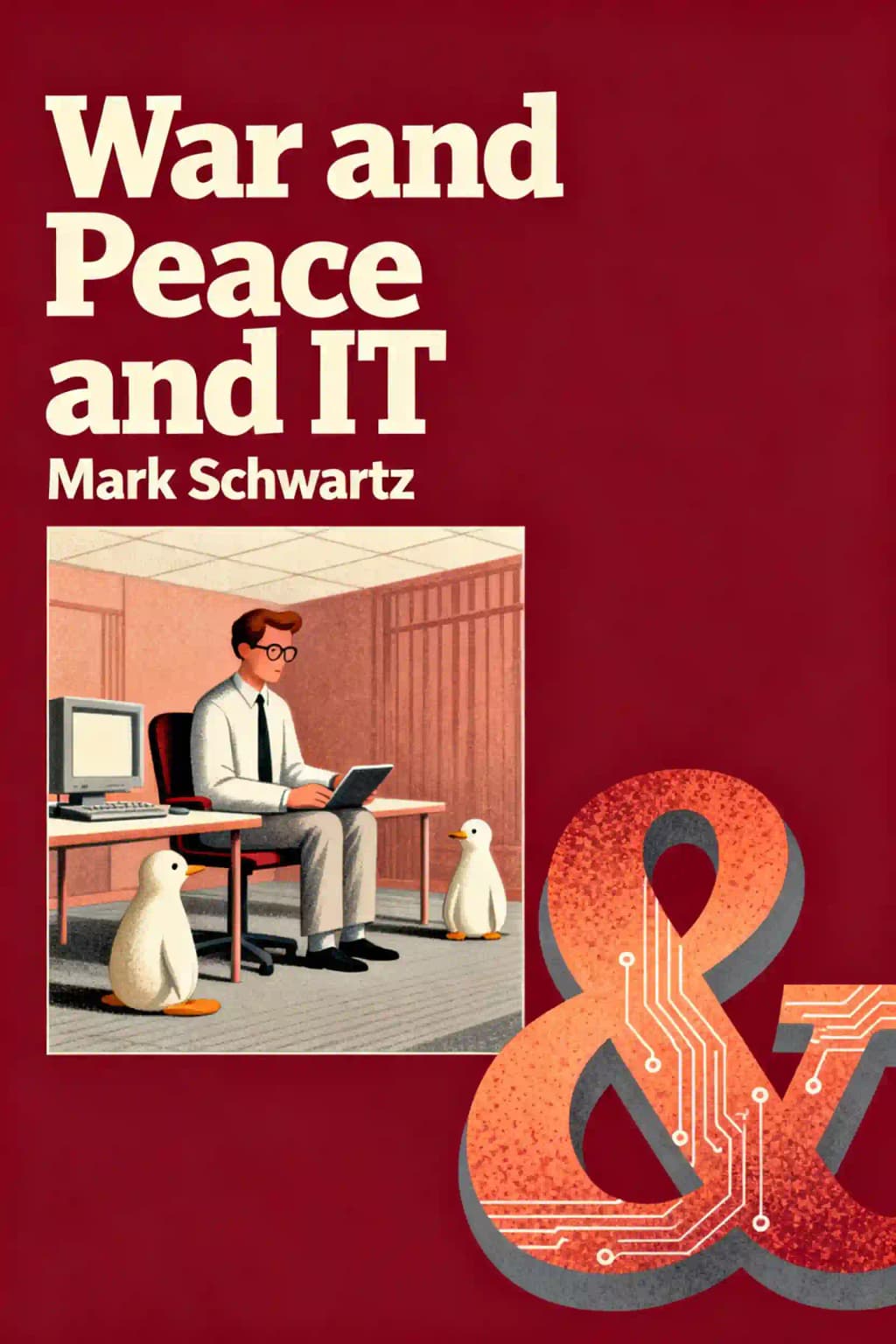
War and Peace and IT
Business Leadership, Technology, and Success in the Digital Age
Overview of War and Peace and IT
In "War and Peace and IT," Mark Schwartz bridges business-technology divides, revolutionizing digital transformation strategies. Amazon's Stephen Orban insists "every CEO and CIO should read it together" - the rare tech book that's sparked cross-functional collaboration in Fortune 500 boardrooms worldwide.

Key Themes in War and Peace and IT
- digital transformation strategy
- it business alignment
- agile enterprise leadership
- complex adaptive systems
- bureaucratic waste reduction
Quotes from War and Peace and IT
War is the realm of uncertainty.
Control becomes an illusion.
That's impossible.
The myth of visionary business leaders who predict the future is just that-a myth.
The Business and IT became distinct entities.
Characters in War and Peace and IT
- Mark SchwartzAuthor, former CIO, and Enterprise Strategist
- GeraldEccentric programmer used as a case study
- ClausewitzMilitary theorist discussed regarding uncertainty
About the Author
About the Author of War and Peace and IT
Mark Schwartz, award-winning author of War and Peace and IT: Business Leadership, Technology, and Success in the Digital Age, is a renowned IT strategist and former CIO specializing in agile transformation and cloud innovation. A Wharton MBA and Yale graduate, Schwartz blends his experience as CIO of U.S. Citizenship and Immigration Services (USCIS) and AWS Enterprise Strategist to address the intersection of bureaucracy, technology, and leadership in this business-technology manifesto.
His expertise in DevOps, digital governance, and organizational agility stems from leading large-scale transformations in highly regulated environments, including moving USCIS to the cloud.
Schwartz’s other influential works, including A Seat at the Table: IT Leadership in the Age of Agility and The Art of Business Value, establish him as a leading voice in redefining IT’s role in value creation. Recognized as a Computerworld Premier 100 IT Leader and Federal 100 awardee, his frameworks are widely cited in enterprise IT and digital strategy circles. War and Peace and IT has become a staple in executive education programs, praised for its actionable insights into aligning technology with mission-critical objectives.
Download Summary of War and Peace and IT: Business Leadership, Technology, and Success in the Digital Age
Get the War and Peace and IT: Business Leadership, Technology, and Success in the Digital Age summary as a free PDF or EPUB. Print it or read offline anytime.
FAQs About This Book
War and Peace and IT explores how business leaders can bridge the divide between IT and executive teams to drive digital transformation. Mark Schwartz argues that outdated management models hinder innovation, urging leaders to foster collaboration, adopt agile practices, and integrate technology into core business strategies. The book uses historical metaphors like the Battle of Borodino to emphasize the urgency of uniting technologists and decision-makers.
This book is ideal for C-suite executives, CIOs, and business leaders aiming to leverage IT for competitive advantage. It’s also valuable for IT managers seeking alignment with business goals. Mark Schwartz provides actionable insights for organizations struggling with digital transformation, outdated governance, or siloed teams.
Yes, for leaders navigating digital disruption. Schwartz combines practical strategies with real-world examples, offering frameworks to dismantle Business-IT barriers. The book’s focus on cultural change, product-centric IT, and agile adoption makes it a critical guide for modern enterprises.
Schwartz advocates reorganizing IT teams around specific products or services rather than technology stacks. This approach aligns IT with business objectives, fostering ownership and customer focus. For example, a team might manage a customer-facing app end-to-end, prioritizing user needs over technical silos.
The book stresses trust, experimentation, and shared mission as pillars of successful digital transformation. Schwartz argues that breaking down stereotypes between “suits” and “nerds” enables faster innovation. He recommends replacing rigid governance with adaptive frameworks that balance agility and stability.
Agile practices, when applied beyond software development, accelerate value delivery and improve responsiveness. Schwartz highlights iterative planning, cross-functional teams, and continuous feedback loops as keys to aligning IT outputs with evolving business needs.
Schwartz compares detached business leaders to Napoleon overlooking the battlefield, urging them to engage directly with technologists. The metaphor underscores that digital transformation requires hands-on leadership, not top-down directives, to succeed in modern “battlegrounds”.
The book examines AI, machine learning, and IoT, predicting they’ll deepen the integration of business and IT. Schwartz advises leaders to view these technologies as collaborative tools, not standalone solutions, to maintain competitive edge.
Unlike technical handbooks, Schwartz focuses on leadership and cultural shifts. It complements works like The Phoenix Project by addressing executive-level strategy rather than DevOps processes, making it a unique resource for decision-makers.
- Collaboration over silos: Integrate IT and business teams.
- Agile governance: Prioritize adaptability over rigid controls.
- Product-centric IT: Align technology with customer outcomes.
- Leadership engagement: Executives must actively partner with technologists.
Yes. Schwartz provides models for restructuring IT, fostering innovation cultures, and implementing agile at scale. Examples include redefining KPIs around business outcomes and creating cross-functional “mission teams” to tackle strategic initiatives.
Some reviewers note the book leans heavily on metaphors, which may oversimplify complex challenges. Others suggest it could delve deeper into midsize enterprises’ unique hurdles. However, its practical advice for leadership alignment is widely praised.