BeFreed
    Categories>History & Society>When the Nile Failed: Egypt's Climate Apocalypse

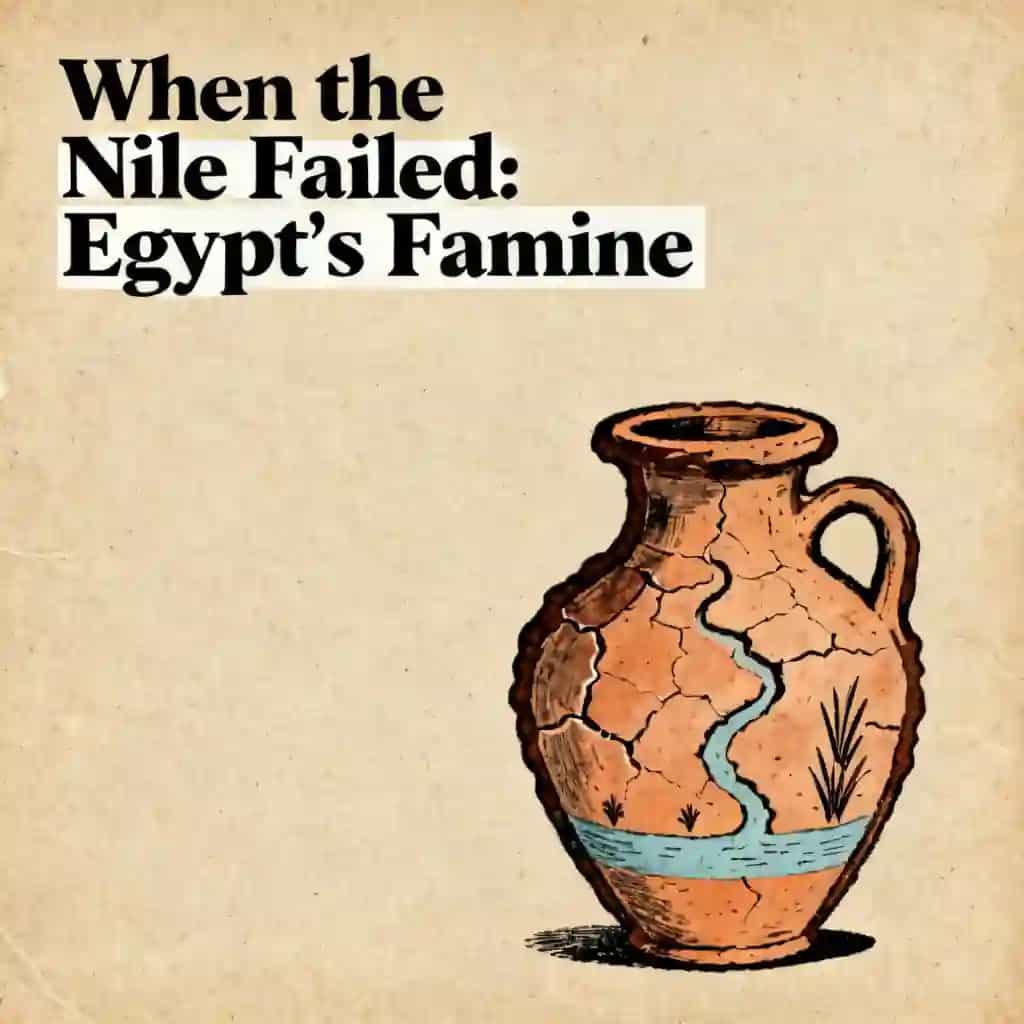
    When the Nile Failed: Egypt's Climate Apocalypse

    14 min
    |
    |
    Feb 16, 2026
    • History & Society
    • Environment

    Explore how a catastrophic climate disaster brought down Egypt's mighty Old Kingdom after 500 years of power, turning the life-giving Nile into an instrument of destruction and famine.

    When the Nile Failed: Egypt's Climate Apocalypse
    0:00 / 0:00
    Choose how it's told

    One episode. Many ways to hear it.

    Same ideas from When the Nile Failed: Egypt's Climate Apocalypse. Pick the voice, depth, and pace that fits you. Switch anytime.

    Transcript & chapters

    Chapter 1

    When Civilizations Vanish Overnight

    Lena: You know what's wild? We always think of ancient civilizations as these eternal, unchanging monuments to human achievement. But what if I told you that one of history's most powerful kingdoms - the one that built the Great Pyramids - basically vanished almost overnight?

    Miles: Right, and we're talking about Egypt's Old Kingdom here. I mean, this wasn't some small city-state that got conquered. This was a civilization that had ruled for over 500 years, had absolute divine kings, and could move two-million-ton stone blocks to build monuments that still blow our minds today.

    Lena: Exactly! And the crazy part is what brought it down. It wasn't war, it wasn't invasion - it was something much more fundamental. The very thing that had made Egypt possible in the first place.

    Miles: The Nile River. The source of all life in Egypt became the instrument of its destruction. We're talking about a climate catastrophe so severe that people were literally eating their own children to survive.

    Lena: That's horrifying but fascinating. And the evidence for this is actually written right there in ancient texts - eyewitness accounts of the collapse that read like something out of an apocalyptic movie.

    Miles: It's incredible how these ancient voices can still reach us across thousands of years. So let's dive into what actually happened when the river that built a civilization suddenly failed it.
    Chapter 2

    The River of Life Becomes a River of Death

    Lena: So let's paint the picture of what Egypt was like before everything fell apart. We're talking about the 2200s BCE—the height of the Old Kingdom. This was when pharaohs were literally considered living gods.

    Miles: And for good reason! The system worked like clockwork. Every summer, the Nile would flood, depositing rich silt across the farmland. The ancient Egyptians called it "the gift of the Nile." It was so predictable that they built their entire calendar around it.

    Lena: But here's what's chilling—that predictability was also their greatest vulnerability. The whole civilization was essentially one giant bet on the river behaving the same way forever.

    Miles: Exactly. And when climate scientists started analyzing sediment cores from Lake Tana in Ethiopia—that's where the Blue Nile originates—they found something terrifying. Around 2200 BCE, the lake levels dropped so dramatically that it basically dried up entirely.

    Lena: Wait, entirely? Like, a lake that had fed the Nile for millennia just... disappeared?

    Miles: Pretty much. The researchers found that what's called the 4.2 kiloyear event—this massive climate shift—caused a southward migration of the summer monsoons. No monsoons meant no Ethiopian highland rains, which meant no Blue Nile floods.

    Lena: And that's when the Egyptian texts start getting really dark, isn't it? I remember reading about this sage named Ipuwer who wrote what sounds like a horror story.

    Miles: Oh man, Ipuwer's account is haunting. He writes: "The river of Egypt is empty, men cross over the water on foot. The land is robbed of the kingdom by a few people who ignore custom." But it gets worse—he describes people so desperate they're ransacking graves for food.

    Keep learning with this episode

    Take the ideas from this episode into a guided learning experience in BeFreed.

    Chapter 3

    When Gods Fail Their People

    Lena: What really strikes me is how this wasn't just an economic collapse—it was a complete crisis of faith. The pharaoh was supposed to be divine, right? Responsible for making the Nile flood?

    Miles: That's the key insight. When the floods failed year after year, it wasn't just a natural disaster—it was proof that the god-king had lost his divine power. Imagine being a farmer who's watched your family starve while your supposedly divine ruler can't make the river flow.

    Lena: The political implications must have been massive. If you can't deliver the one thing your entire legitimacy is based on...

    Miles: Exactly. And we see this playing out in the historical record. After Pharaoh Pepy II—who ruled for an incredible 94 years during the late Old Kingdom—died around 2184 BCE, there were something like 18 different pharaohs in just 20 years.

    Lena: Eighteen pharaohs in twenty years? That's political chaos on an unimaginable scale.

    Miles: Right, and it gets worse. The archaeological evidence shows that during this period, tomb robbing became epidemic. Not just opportunistic theft, but systematic desecration of royal burials. People were literally tearing apart the monuments to their former god-kings.

    Lena: It's like the entire social contract just disintegrated. The promise was: worship us as gods, and we'll make the river flood and keep you fed. When that promise broke, everything else collapsed with it.

    Miles: And here's what's really sobering—this wasn't a gradual decline. The climate data shows the drought lasted for decades, maybe centuries. Entire generations lived and died having never seen a proper Nile flood.

    Chapter 4

    The Human Cost of Climate Catastrophe

    Lena: Let's talk about what this actually looked like on the ground, because the human stories here are just heartbreaking.

    Miles: The texts are brutal. There's an account from a governor named Ankhtifi who describes his region: "All of Upper Egypt was dying of hunger, to such a degree that everyone had come to eating his children." This isn't metaphorical—this is literal cannibalism.

    Lena: And these weren't isolated incidents, were they? The medieval Arab historians found similar patterns when famines hit Egypt later in history.

    Miles: That's right. Al-Baghdadi, writing about a famine in 1200 CE, describes almost identical scenes—people eating human flesh, graves being ransacked for food, entire social orders collapsing. It shows how dependent Egypt always was on that annual flood cycle.

    Lena: What really gets me is how the climate affected everything, not just agriculture. The archaeological evidence shows massive sand dune formation during this period—the desert literally started swallowing settlements.

    Miles: Yeah, at Memphis, they found layers of windblown sand that extended half a kilometer from the desert edge. The capital of the Old Kingdom was being buried alive. And remember, this is where the pharaohs lived—if the seat of divine power is disappearing under sand dunes, what message does that send?

    Lena: It's almost biblical in its scope. But here's what I find fascinating—people didn't just lie down and die. They adapted, they migrated, they fought for survival.

    Miles: Absolutely. The texts describe mass migrations, with people moving north and south searching for grain. But this also created new problems—refugee crises, competition for scarce resources, social upheaval as traditional hierarchies broke down.

    Lena: And the ripple effects went far beyond Egypt's borders, didn't they? This same climate event was affecting civilizations across the ancient world.

    Miles: Right—the Akkadian Empire in Mesopotamia collapsed around the same time, as did the Indus Valley civilization. It was like a domino effect across the ancient world, all triggered by the same climate shift.

    Keep learning with this episode

    Take the ideas from this episode into a guided learning experience in BeFreed.

    Chapter 5

    Lessons Written in Stone and Sediment

    Lena: So what can we learn from this catastrophe? I mean, obviously we can't control climate, but there must be some insights here about resilience and adaptation.

    Miles: Well, first off, it shows how dangerous it can be to build an entire civilization around a single resource or system. Egypt's strength—total dependence on the Nile—became its fatal weakness when conditions changed.

    Lena: That's such a relevant lesson today. Think about how many modern societies are built around assumptions about stable climate patterns, or reliable access to resources like oil or fresh water.

    Miles: Exactly. And what's striking is that Egypt did eventually recover. The Middle Kingdom that emerged around 2055 BCE was actually more resilient because it had learned from the collapse. They developed better storage systems, more diverse trade networks, and—crucially—a different concept of kingship.

    Lena: Right, the pharaohs were no longer seen as infallible gods, but as human leaders with real responsibilities to their people. Crisis forced innovation.

    Miles: The other lesson is about early warning systems. We now know that the climate signals for this drought were building for decades before the full collapse. If the Egyptians had understood what those signals meant...

    Lena: They might have been able to adapt instead of just hoping the bad years would pass. It makes you think about what signals we might be missing today.

    Miles: And there's something profound about how this story survived at all. Ipuwer and the other chroniclers who documented this catastrophe—they were creating a record for future generations. They wanted people to remember what happened when a civilization ignored the warning signs.

    Chapter 6

    The Echoes That Reach Us Today

    Lena: You know what really strikes me about this whole story? It's how modern it feels. The climate disruption, the political chaos, the social upheaval—it could be describing events from our own headlines.

    Miles: That's the power of studying these ancient collapses. They're like case studies in how complex systems can unravel. And the Egyptian collapse shows us that even the most successful, longest-lasting civilizations aren't immune to environmental shocks.

    Lena: What I find hopeful, though, is that people survived. Civilization didn't end—it transformed. The knowledge, the culture, the human ingenuity that built the pyramids didn't disappear. It found new forms.

    Miles: Right, and that transformation happened because some people were paying attention, learning from the crisis, adapting their assumptions about how the world works. The Middle Kingdom pharaohs explicitly learned from the Old Kingdom's mistakes.

    Lena: It makes you wonder what future archaeologists will make of our own climate challenges. Will they find evidence that we learned and adapted, or that we ignored the warning signs?

    Miles: That's the question, isn't it? We have advantages the ancient Egyptians didn't—global communication, scientific understanding of climate systems, the ability to share resources across vast distances. But we also have the same human tendency to assume that current conditions will continue forever.

    Lena: And we have the Egyptian example to learn from. Their story is both a warning and a guide—showing us what can happen when systems fail, but also how resilient and adaptable humans can be when we face reality and work together.

    Keep learning with this episode

    Take the ideas from this episode into a guided learning experience in BeFreed.

    Chapter 7

    Your Personal Resilience Playbook

    Lena: So let's get practical for a moment. What can we, as individuals living in our own complex, interconnected world, take from this ancient catastrophe?

    Miles: Great question. First thing—diversify your dependencies. The Egyptians put all their eggs in the Nile basket. Look at your own life: Are you overly dependent on a single income source, one skill set, or one geographic location?

    Lena: That's smart. I'm thinking about people who live in areas prone to natural disasters but have never developed backup plans, or folks whose entire career depends on one industry that might not exist in ten years.

    Miles: Exactly. The second lesson is about paying attention to early warning signals. The Egyptians had decades of increasingly erratic floods before the full collapse, but they kept hoping things would return to normal.

    Lena: Right, instead of adapting their systems. So for us, that might mean watching trends in our industries, our local environment, our community stability—and actually adjusting our plans based on what we see, not what we hope will happen.

    Miles: And here's a big one: build redundant systems. The Egyptians had amazing grain storage, but it was all centralized. When the central authority collapsed, so did food distribution. Think about your own backup systems—emergency funds, alternative skills, community connections.

    Lena: Community is huge, isn't it? The people who survived the Egyptian collapse were often those who had strong local networks, who could share resources and information.

    Miles: Absolutely. And there's something else—stay curious about how your world actually works. Most Egyptians probably never questioned why the Nile flooded. They just accepted it as divine will. But understanding the real mechanisms behind the systems you depend on can help you spot problems early.

    Lena: That's such good advice. Whether it's understanding your local water supply, your job market, or even your personal relationships—knowledge gives you options when things change.

    Chapter 8

    A Story That Never Ends

    Lena: As we wrap this up, I keep thinking about how the Egyptian story isn't really about ancient history at all. It's about the eternal human challenge of living with uncertainty and change.

    Miles: That's beautifully put. And what gives me hope is that humans have been facing and surviving these challenges for thousands of years. The Egyptians rebuilt. Other civilizations have faced similar collapses and found new ways forward.

    Lena: Right, and they left us this incredible gift—their stories, their warnings, their hard-won wisdom about what works and what doesn't when the world changes around you.

    Miles: The scribes who recorded Ipuwer's account, the chroniclers who documented the collapse—they were thinking about us, about future generations who might face similar challenges. They wanted their experience to matter.

    Lena: And it does matter. Every time we choose to prepare instead of just hoping, every time we build community connections instead of going it alone, every time we adapt our assumptions to new realities—we're honoring their legacy.

    Miles: For everyone listening, remember that you're part of this ongoing human story of resilience and adaptation. The challenges change, but our capacity to learn, to grow, and to support each other through difficult times—that's been constant for thousands of years.

    Lena: Thanks for joining us on this journey through ancient Egypt's greatest crisis. We'd love to hear your thoughts—what resonated with you? What connections do you see to our modern world? Drop us a line and let us know.

    Miles: And remember, the story of human civilization is still being written, and you're one of the authors. Make it a good chapter.

    ★★★★★

    You made it to the end of When the Nile Failed: Egypt's Climate Apocalypse

    “23 days in and I have used it every single day. It is part of my daily habit now.”

    jayallen

    Best quote from When the Nile Failed: Egypt's Climate Apocalypse

    “

    The whole civilization was essentially one giant bet on the river behaving the same way forever. Egypt's strength—total dependence on the Nile—became its fatal weakness when conditions changed.

    ”
    F

    Generated by Favour

    Input question

    Causes of the decline (famine) in old kingdom

    Host voices
    Lenaplay
    Milesplay
    Knowledge sources
    The Fate of Rome
    The Oxford History of Ancient Egypt (Oxford Illustrated History)
    When Republics Collapse
    Salt to Sugar
    How Democracies Die
    A History of the English Speaking Peoples

    From Columbia University alumni | built in San Francisco

    BeFreed Brings Together A Global Community Of Curious Minds

    4.7

    avg rating

    7.84k+ App Rating

    BeFreed Community

    Seriously I haven’t even explored this app fully yet but from using it the last few days I am so impressed... BeFreed is on a different level from any other learning app I have used. This makes it ultra engaging and can actually improve your concentration which is great for all the doom scrollers!

    @ladyInfinity

    I bought BeFreed exactly 23 days ago, and I have used it every single day since. It has completely embedded itself into my daily workflow and learning habit.

    @jayallen

    The truth is, the app has exceeded all my expectations. I can ask it to generate audio on any topic, whatever it may be, and the result is impressive. My professional field is a specialization in psychotherapy and it is multidisciplinary; however, the answers are very accurate.

    @Raguipa

    What I appreciate most is how much it's reduced my scrolling – I'm spending less time searching and more time absorbing information. The combination of full audiobooks, podcasts, the learning plans are brilliant.

    @colonyofcreatorsNGO

    I have been a PhotoReading Accelerated Learning Instructor for the past 24 years... books and reading and learning are my thing, and BeFreed has done a great job in providing an innovative approach to disseminating and delivering information in an easy to consume way.

    @BeFreed user

    It is not just a book summary app, I have used the 'fun reading' option and it's a much better summary and way to grasp ideas the traditional way, that alone is worth this deal.

    @austinakon

    I love this app. Used it for several days and I cannot stop listening. Such a great way to start.

    @jcrules328

    I really like the program; I have already tested it for around one month, and I feel that it's an amazing gem. It works so well because I can use BeFreed to create my own topics, and the voice is so good with unlimited choice of narrations.

    @DanielCZ

    Seriously I haven’t even explored this app fully yet but from using it the last few days I am so impressed... BeFreed is on a different level from any other learning app I have used. This makes it ultra engaging and can actually improve your concentration which is great for all the doom scrollers!

    @ladyInfinity

    I bought BeFreed exactly 23 days ago, and I have used it every single day since. It has completely embedded itself into my daily workflow and learning habit.

    @jayallen

    The truth is, the app has exceeded all my expectations. I can ask it to generate audio on any topic, whatever it may be, and the result is impressive. My professional field is a specialization in psychotherapy and it is multidisciplinary; however, the answers are very accurate.

    @Raguipa

    What I appreciate most is how much it's reduced my scrolling – I'm spending less time searching and more time absorbing information. The combination of full audiobooks, podcasts, the learning plans are brilliant.

    @colonyofcreatorsNGO

    I have been a PhotoReading Accelerated Learning Instructor for the past 24 years... books and reading and learning are my thing, and BeFreed has done a great job in providing an innovative approach to disseminating and delivering information in an easy to consume way.

    @BeFreed user

    It is not just a book summary app, I have used the 'fun reading' option and it's a much better summary and way to grasp ideas the traditional way, that alone is worth this deal.

    @austinakon

    I love this app. Used it for several days and I cannot stop listening. Such a great way to start.

    @jcrules328

    I really like the program; I have already tested it for around one month, and I feel that it's an amazing gem. It works so well because I can use BeFreed to create my own topics, and the voice is so good with unlimited choice of narrations.

    @DanielCZ

    I love the fact that I can get useful, condensed, information and ideas in a 8 - 15 minute podcast style audio. I'm not a general fan of podcasts because of all the fluff, but this cuts through all that.

    @BeFreed user

    I am finishing up my doctorate, and have to read a lot of unfamiliar material... With BeFreed, you simply enter a prompt, and the app finds source material for you and generates an audio podcast. I find the process in BeFreed to be more streamlined than NotebookLM.

    @Brad

    I often search YouTube for something to listen to whilst making breakfast, when I'm out walking, commuting, etc, and BeFreed has provided an even more targeted approach, without the adverts and the fluff!

    @BeFreed user

    The absolute best part about this platform is its versatility. There is literally no subject that is off-topic. It handles whatever you throw at it... It is rare to find an learning tool with zero limitations that actually delivers on its promises.

    @jayallen

    BeFreed is fantastic. The user-friendly design means I spend less time navigating and more time learning. The mix of audiobooks, podcasts, and learning plans is a genius combo that has completely changed my daily routine.

    @BeFreed user

    At the start I needed a while to understand how to create podcasts in italian language and boom! It is so great! I can ask to explain every argument and it does so well and so smartly!

    @matteo77

    BeFreed has become my daily app for audio books tools... What I like the most is the way you put your text and come with an audio that you can listen on the go.

    @kotanzu1

    I love the fact that I can get useful, condensed, information and ideas in a 8 - 15 minute podcast style audio. I'm not a general fan of podcasts because of all the fluff, but this cuts through all that.

    @BeFreed user

    I am finishing up my doctorate, and have to read a lot of unfamiliar material... With BeFreed, you simply enter a prompt, and the app finds source material for you and generates an audio podcast. I find the process in BeFreed to be more streamlined than NotebookLM.

    @Brad

    I often search YouTube for something to listen to whilst making breakfast, when I'm out walking, commuting, etc, and BeFreed has provided an even more targeted approach, without the adverts and the fluff!

    @BeFreed user

    The absolute best part about this platform is its versatility. There is literally no subject that is off-topic. It handles whatever you throw at it... It is rare to find an learning tool with zero limitations that actually delivers on its promises.

    @jayallen

    BeFreed is fantastic. The user-friendly design means I spend less time navigating and more time learning. The mix of audiobooks, podcasts, and learning plans is a genius combo that has completely changed my daily routine.

    @BeFreed user

    At the start I needed a while to understand how to create podcasts in italian language and boom! It is so great! I can ask to explain every argument and it does so well and so smartly!

    @matteo77

    BeFreed has become my daily app for audio books tools... What I like the most is the way you put your text and come with an audio that you can listen on the go.

    @kotanzu1

    See more on how BeFreed is discussed
    129.7K19.5K
    55.2K19.2K
    154.2K10827355
    48.1K2.5K
    81.2K6.6K
    82.3K1.8K
    Start your learning journey, now
    BeFreed app
    BeFreed

    Learn Anything, Personalized

    DiscordLinkedIn
    Featured book summaries
    Crucial ConversationsThe Perfect MarriageInto the WildNever Split the DifferenceAttachedGood to GreatSay Nothing
    Trending categories
    Self HelpCommunication SkillRelationshipMindfulnessPhilosophyInspirationProductivity
    Celebrities' reading list
    Elon MuskCharlie KirkBill GatesSteve JobsAndrew HubermanJoe RoganJordan Peterson
    Award winning collection
    Pulitzer PrizeNational Book AwardGoodreads Choice AwardsNobel Prize in LiteratureNew York TimesCaldecott MedalNebula Award
    Featured Topics
    ManagementAmerican HistoryWarTradingStoicismAnxietySex
    Best books by Year
    2025 Best Non Fiction Books2024 Best Non Fiction Books2023 Best Non Fiction Books
    Featured authors
    Chimamanda Ngozi AdichieGeorge OrwellO. J. SimpsonBarbara O'NeillWinston ChurchillCharlie Kirk
    BeFreed vs other apps
    BeFreed vs. Other Book Summary AppsBeFreed vs. ElevenReaderBeFreed vs. ReadwiseBeFreed vs. Anki
    Learning tools
    Knowledge VisualizerAI Podcast Generator
    Information
    About Usarrow
    Pricingarrow
    FAQarrow
    Blogarrow
    Careerarrow
    Partnershipsarrow
    Ambassador Programarrow
    Directoryarrow
    BeFreed
    Try now
    © 2026 BeFreed
    Term of UsePrivacy Policy
    BeFreed

    Learn Anything, Personalized

    DiscordLinkedIn
    Featured book summaries
    Crucial ConversationsThe Perfect MarriageInto the WildNever Split the DifferenceAttachedGood to GreatSay Nothing
    Trending categories
    Self HelpCommunication SkillRelationshipMindfulnessPhilosophyInspirationProductivity
    Celebrities' reading list
    Elon MuskCharlie KirkBill GatesSteve JobsAndrew HubermanJoe RoganJordan Peterson
    Award winning collection
    Pulitzer PrizeNational Book AwardGoodreads Choice AwardsNobel Prize in LiteratureNew York TimesCaldecott MedalNebula Award
    Featured Topics
    ManagementAmerican HistoryWarTradingStoicismAnxietySex
    Best books by Year
    2025 Best Non Fiction Books2024 Best Non Fiction Books2023 Best Non Fiction Books
    Learning tools
    Knowledge VisualizerAI Podcast Generator
    Featured authors
    Chimamanda Ngozi AdichieGeorge OrwellO. J. SimpsonBarbara O'NeillWinston ChurchillCharlie Kirk
    BeFreed vs other apps
    BeFreed vs. Other Book Summary AppsBeFreed vs. ElevenReaderBeFreed vs. ReadwiseBeFreed vs. Anki
    Information
    About Usarrow
    Pricingarrow
    FAQarrow
    Blogarrow
    Careerarrow
    Partnershipsarrow
    Ambassador Programarrow
    Directoryarrow
    BeFreed
    Try now
    © 2026 BeFreed
    Term of UsePrivacy Policy

    More like this

    When the Nile Failed: Egypt's Great Famine book cover
    The Fate of RomeThe Oxford History of Ancient EgyptWhen Republics Collapse: 5 Warning Signs from Ancient RomeSalt to Sugar: How 5 Foods Reshaped Human Civilization
    18 sources
    When the Nile Failed: Egypt's Great Famine
    Exploring how climate catastrophe and Nile River failures around 2200 BCE didn't destroy ancient Egypt but transformed it, revealing lessons about civilizational resilience during crisis.
    10 min
    When Pharaohs Lost Their Power book cover
    The Oxford History of Ancient EgyptThe Fate of RomeWhen Republics Collapse: 5 Warning Signs from Ancient RomeWhy Nations Fail
    24 sources
    When Pharaohs Lost Their Power
    Explore how a 200-year climate catastrophe brought down Egypt's Old Kingdom around 2200 BC, revealing striking parallels to modern civilizational challenges and the human cost of environmental collapse.
    13 min
    Ancient Egypt: 5000 Years of Divine Civilization book cover
    source 1source 2source 3source 4
    6 sources
    Ancient Egypt: 5000 Years of Divine Civilization
    Journey through Egypt's complete story-from scattered Nile settlements to divine pharaohs, monumental pyramids, and cultural transformations that shaped human civilization for millennia.
    9 min
    Ancient Climate Crisis Nearly Erased Humanity book cover
    Who We Are and How We Got HereA Brief History of Everyone Who Ever LivedThe Story of the Human Body
    18 sources
    Ancient Climate Crisis Nearly Erased Humanity
    Explore how extreme climate shifts 900,000 years ago—featuring prolonged cold periods and devastating droughts across Africa and Eurasia—nearly wiped out our ancestors, reducing human population by 98.7% for over 100,000 years.
    21 min
    Rome's Rise and Fall: Climate, Power, and Empire book cover
    Roman Empire | Definition, History, Time Period, Map, & FactsThe Top Roman Achievements - Roman EmpireRoman Daily Life - World History EncyclopediaThe Twelve Caesars
    6 sources
    Rome's Rise and Fall: Climate, Power, and Empire
    Explore the Roman Empire's thousand-year journey from climate-blessed superpower to environmental collapse. Discover daily life, corrupt Caesars, and how nature ultimately brought down history's greatest civilization.
    13 min
    Ancient Egypt: The First Time book cover
    (PDF) The Zep Tepi Hypothesis: Saharan Cultural Memory and the Origins of Egyptian Sacred Symbolism
    5 sources
    Ancient Egypt: The First Time
    How did a few farming villages become a unified empire? Explore the creation myths and Nile rituals that turned chaotic waters into a lasting identity.
    1148 min
    Atlantis and the Great Amnesia book cover
    Why Archaeologists Are Not Looking For Atlantis | IFLScienceAtlantis: A Grain of Truth Behind the Fiction?Why Plato's Atlantis Was Never Meant to Be FoundYounger Dryas impact hypothesis
    6 sources
    Atlantis and the Great Amnesia
    Standard history may be missing a foundational piece. Explore the evidence for a lost civilization and the climate cataclysm that could prove the myth.
    1030 min
    Rome's Rise and Fall: Timeless Civilization Lessons book cover
    source 1The Rise and Fall of the Roman Empire: Lessons for Modern TimesWhat Caused the Rise and Fall of the Roman Empire? - TheCollectorsource 4
    6 sources
    Rome's Rise and Fall: Timeless Civilization Lessons
    Journey through Rome's epic 1000-year story from climate-fueled success to pandemic collapse. Discover how environmental crises, economic mismanagement, and leadership failures destroyed history's greatest empire-and what these patterns mean for our modern world.
    33 min

    Recommended Learning Plans

    Pharaohs and the Duat
    LEARNING PLAN

    Pharaohs and the Duat

    This plan offers a deep dive into the intersection of divine rule and the afterlife in ancient Egypt. It is ideal for history enthusiasts and students seeking to understand how mythology shaped one of the world's greatest civilizations.

    3 h 27 m•4 Sections
    The Bronze Age Catastrophe
    LEARNING PLAN

    The Bronze Age Catastrophe

    This plan is essential for history enthusiasts and strategic thinkers who want to understand how globalized systems can suddenly fail. It offers a deep dive into the fragile interdependence of ancient empires and the external pressures that brought them down.

    2 h•4 Sections
    Le lin au temps des Pharaons
    LEARNING PLAN

    Le lin au temps des Pharaons

    Ce parcours est essentiel pour comprendre l'intersection entre agriculture, artisanat et spiritualité en Égypte ancienne. Il s'adresse aux passionnés d'histoire, d'archéologie et de textile souhaitant explorer comment une simple plante est devenue le pilier de l'éternité pharaonique.

    1 h 30 m•3 Sections
    Cleopatra: The Strategist Behind the Myth
    LEARNING PLAN

    Cleopatra: The Strategist Behind the Myth

    This plan reclaims Cleopatra's legacy as a brilliant political mind rather than a mere romantic figure. It is ideal for history enthusiasts and aspiring leaders interested in power dynamics, strategic diplomacy, and crisis management.

    1 h 45 m•3 Sections
    Lost Atlantis history
    LEARNING PLAN

    Lost Atlantis history

    This learning plan bridges ancient philosophy, archaeology, and mythology to explore one of history's most enduring mysteries while developing critical analysis skills. It's ideal for history enthusiasts, students of classical studies, and anyone fascinated by how ancient civilizations recorded and transformed catastrophic events into lasting cultural narratives. Learners will gain valuable skills in evaluating historical sources and understanding how myth and reality intertwine in human storytelling.

    3 h 7 m•3 Sections
    Ancient Empires and Lost Worlds
    LEARNING PLAN

    Ancient Empires and Lost Worlds

    This plan offers a deep dive into the foundations of human society by blending archaeology with cultural history. It is ideal for history enthusiasts and lifelong learners who want to understand how ancient power dynamics and daily life continue to influence the modern world.

    1 h 45 m•4 Sections
    L'effondrement de l'âge du bronze
    LEARNING PLAN

    L'effondrement de l'âge du bronze

    Ce parcours est essentiel pour comprendre comment les civilisations les plus avancées peuvent s'effondrer face à des crises convergentes. Il s'adresse aux passionnés d'histoire, d'archéologie et de géopolitique souhaitant tirer des leçons du passé pour analyser les vulnérabilités de notre propre monde moderne.

    1 h 30 m•3 Sections
    Roman Empire: Rise to Fall
    LEARNING PLAN

    Roman Empire: Rise to Fall

    Understanding the Roman Empire provides essential context for modern Western civilization, as Rome's innovations in law, governance, engineering, and military organization continue to influence contemporary institutions. This learning plan is ideal for history enthusiasts, students of political science and law, leaders seeking insights from historical patterns of power and decline, and anyone curious about how ancient civilizations shape our present world.

    2 h 56 m•4 Sections