BeFreed
    Categories>History & Society>Ancient Egypt: The First Time and Zp Tpj Creation Myths

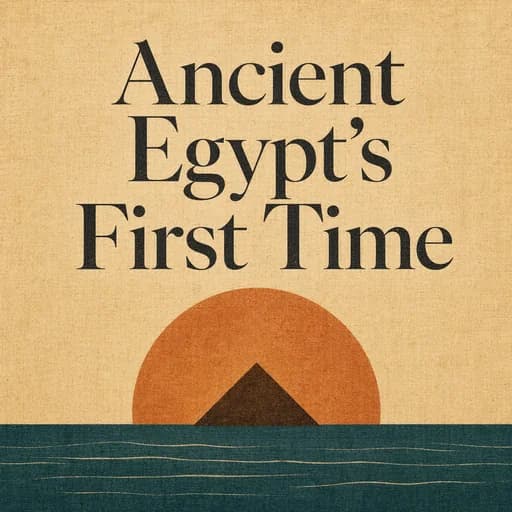
    Ancient Egypt: The First Time and Zp Tpj Creation Myths

    19 min
    |
    |
    Jul 5, 2026
    • History & Society
    • Fiction
    • Philosophy & Spirituality

    Explore the origins of Ancient Egypt through the concept of Zp Tpj. Learn how the Nile Valley's first creation myths and Pyramid Texts shaped a cultural identity.

    Ancient Egypt: The First Time and Zp Tpj Creation Myths
    0:00 / 0:00
    Choose how it's told

    One episode. Many ways to hear it.

    Same ideas from Ancient Egypt: The First Time and Zp Tpj Creation Myths. Pick the voice, depth, and pace that fits you. Switch anytime.

    Transcript & chapters

    Chapter 1

    The First Time and the Emergence of an Identity

    Imagine standing on the edge of a vast, silent plain where the only sound is the rhythmic, heavy pulse of a rising river. For the people living in the Nile Valley over five thousand years ago, this wasn't just a seasonal event—it was the physical manifestation of the beginning of the universe itself. They had a specific term for this transition from chaotic nothingness to an ordered world: zp tpj, or "the first time" . You might think of ancient Egypt as a static collection of pyramids and pharaohs, but its earliest cultural memories reveal a society that was obsessively focused on how order emerges from chaos. This wasn't just abstract philosophy for them; it was a survival strategy. By looking at their earliest creation myths, we can see how they used the natural world—the flooding Nile, the first mounds of earth appearing as waters receded—to build a framework for their entire civilization .

    What makes this worth your time today is that these aren't just dusty legends. They represent the first recorded religious compilations in human history, found in the Pyramid Texts dating back as far as 2700 BC . But more importantly, they show you how a culture builds its "cultural memory"—a shared narrative that tells a people who they are and why their society works the way it does . In this episode, we are going to dive into the watery chaos of the primeval ocean known as Nu, explore the competing yet complementary creation stories from cities like Heliopolis and Memphis, and see how these cosmic ideas actually dictated the daily lives and even the funerary rites of ordinary people in rural communities like Adaïma . We'll see how the concept of a "Divine Ruler" became the glue that held it all together, transforming a collection of farming villages into a unified state that lasted for millennia .

    Every sentence of this journey delivers a piece of a puzzle that explains how humans first learned to organize themselves on a grand scale. You'll notice that for the Egyptians, the "First Time" wasn't a distant historical event—it was something that happened every single morning when the sun rose and every year when the Nile flooded . So let's dive into the primeval waters and see how the world began through their eyes.
    Chapter 2

    The Primeval Waters and the Mound of Creation

    Before there was light, or air, or even the gods themselves, there was Nu—the lifeless, infinite, and chaotic waters of the primeval sea . To the ancient Egyptian mind, this wasn't just "water" as you know it; it was a stagnant, unknowable abyss that held all the potential for life but none of the structure . If you've ever stood by the Nile during its annual inundation, you can visualize the inspiration for this myth. The floodwaters would cover the landscape in a brown, swirling mass of silt and moisture. As those waters receded, the very first thing to appear would be the highest points of land—small, muddy mounds emerging from the chaos . This physical reality gave birth to the concept of the benben, the primordial, pyramid-shaped mound that was the first solid thing to exist in the universe .

    This connection between the environment and the divine is the foundation of Egyptian cultural memory. They didn't just invent stories; they mapped their world onto the cosmos. In the city of Hermopolis, this pre-creation state was personified by the Ogdoad—a group of eight gods representing the qualities of the primeval waters . You have Nu and Naunet for the water itself, Huh and Hauhet for infinity, Kek and Kauket for the darkness, and Amun and Amaunet for the hidden, unknowable nature of the abyss . These weren't just names; they were the "DNA" of chaos. Interestingly, the males were often depicted as frogs and the females as snakes—creatures that live in the mud and water of the Nile, symbolizing that first stirrings of life in the muck .

    From this convergence of chaotic forces, a great upheaval occurred, and the benben mound rose. It’s here that the sun god, often called Ra or Atum, first appeared to bring light to the world . Some versions of the myth say the sun emerged from a lotus flower that grew on the mound; others say a cosmic egg was laid there by a goose known as the "Great Cackler" . Regardless of the specific imagery, the core idea for you to grasp is that creation was a transition from the stagnant "nothingness" of Nu to the vibrant, ordered existence of the sun . This rise of the sun from the mound wasn't just a one-time event; it was a daily re-enactment of the creation of the world . This is why the pyramid shape became so sacred—it was a permanent stone memory of that first mound of earth, a "material memory" of the moment life began .

    Keep learning with this episode

    Take the ideas from this episode into a guided learning experience in BeFreed.

    Chapter 3

    The Evolution of the Divine Family

    Once the mound emerged and the sun god Atum took his place, the process of creation shifted from elemental forces to a genealogical "evolution" of the gods. In the city of Heliopolis—the "City of the Sun"—the priesthood developed a sophisticated system known as the Ennead, a group of nine deities who represented the unfolding of the physical world . Atum, the self-engendered creator who existed as a potential being within the waters of Nu, began the process by producing the first pair of gods: Shu, the god of air, and Tefnut, the goddess of moisture . You can think of this as the creation of "space"—the air and the moisture needed to fill the void between the waters and the sky .

    The myth uses some quite visceral metaphors to explain how Atum, acting alone, could produce these two. He is said to have sneezed out Shu and spat out Tefnut—puns on their names—or even created them through an act of masturbation, with his hand representing the female principle inherent within his own divine self . From Shu and Tefnut came the next generation: Geb, the earth god, and Nut, the sky goddess . Their union defined the limits of the habitable world. In Egyptian art, you'll often see Geb lying flat on the ground while Nut arches over him, her body covered in stars, separated only by their father Shu, the air . This isn't just a pretty picture; it’s a diagram of the universe as the Egyptians understood it—a bubble of air and earth protected from the chaotic waters above and below .

    Finally, Geb and Nut produced four children who represented the forces of life within that world: Osiris, Isis, Set, and Nephthys . Osiris was the god of fertility and regeneration, while his consort Isis represented motherhood. Their brother Set embodied chaos and the harsh desert, and Nephthys was a goddess of protection . This family tree wasn't just a religious list; it was the "family tree of the Egyptian king" . The struggle between Horus—the son of Osiris and Isis—and his uncle Set over the throne of Egypt became the ultimate narrative for why kingship existed . It linked the physical cosmos to the political structure of the state. When you understand that the pharaoh was seen as the living Horus, you see how these early cultural memories were used to make the government seem as natural and inevitable as the rising sun .

    Chapter 4

    The Word and the Mind in Memphite Theology

    While the priests at Heliopolis were focused on physical evolution and divine families, the city of Memphis offered a strikingly different, more intellectual perspective on creation. This is known as the Memphite Theology, and it centers on the god Ptah, the patron of craftsmen . If you've ever watched a master carpenter or a potter at work, you know that the object doesn't just appear; it begins as an idea in the mind and is then given form by the hands. The Memphite creation myth applies this "craftsman’s logic" to the entire universe . It suggests that the world wasn't a product of physical acts like spitting or masturbation, but an intellectual creation by the "Word and the Mind of God" .

    In this version, the ideas for everything in existence first developed within Ptah's heart—which the Egyptians regarded as the seat of human thought and understanding . These ideas were then given physical form when Ptah named them with his tongue. By speaking the names of the gods, the animals, and the very land itself, Ptah brought them into being . The Shabaka Stone, a basalt slab from the 25th Dynasty that preserves this much older theology, tells us that "every word of the god came about through what the heart devised and the tongue commanded" . This is a profound shift. It moves the origin of the world from the realm of biological accident to the realm of conscious, intelligent design .

    This "intellectual" creation also serves a very practical political purpose. Ptah is credited with establishing the entire structure of Egyptian society—he made the towns, established the administrative districts called "nomes," and placed the gods in their shrines . He basically "built" the state the way a craftsman builds a temple. For the average Egyptian, this meant that the laws they lived by and the taxes they paid were part of the divine order created by Ptah’s spoken word . It also created a system where "internal equality" existed despite "external inequality" . Because every person possessed a heart and a tongue—the tools of Ptah—every person could, in their own small way, emulate the creator god by being competent in their own craft or domain . This idea that "competence is power" was a core part of the Egyptian character, a way for an individual to find dignity within a highly hierarchical society .

    Keep learning with this episode

    Take the ideas from this episode into a guided learning experience in BeFreed.

    Chapter 5

    The Architecture of Memory and the Temple Microcosm

    You might wonder how these abstract cosmic myths actually felt to a person living in the Nile Valley thousands of years ago. The answer lies in the architecture of their temples. To the Egyptians, a temple wasn't just a place of worship; it was a "microcosm" of the world at the very moment of creation . When you walked through the gates of a temple, you were literally stepping back into the "First Time." The massive gateways, called pylons, were shaped like the hieroglyph for "horizon"—two hills with the sun rising between them . Standing before these gates were often pairs of obelisks, stone needles capped with small pyramids that caught the first rays of dawn, symbolizing the benben mound where the sun god first appeared .

    As you moved deeper into the temple, the floor would often rise slightly while the ceiling became lower, mimicking the slope of the primordial mound . The columns surrounding you weren't just stone supports; their capitals were carved in the shape of papyrus and lotus plants, echoing the marshy vegetation that emerged from the receding floodwaters at the beginning of time . The innermost sanctuary—the darkest, most private part of the temple where the god’s statue lived—represented the mound itself . When the priests opened the doors of the shrine during the morning rituals, they weren't just starting their workday; they were re-enacting the first dawn and the birth of the sun god .

    Even the outer walls of the temple played a role in this "material memory." They were often built with bricks laid in a wavy, undulating pattern, symbolizing the chaotic waters of Nu that were being held at bay by the sacred space of the temple . This tells you something critical about the Egyptian worldview: creation wasn't a finished event. It was a fragile state of order that had to be actively maintained every single day through ritual and the correct behavior of the king and the people . The temple was the "anchor" for this memory, a physical proof that the world was ordered and that the gods were present . For the listener, this means that every time you see a picture of a papyrus column or a pyramid, you are seeing a piece of a five-thousand-year-old technology designed to keep the universe from falling back into chaos .

    Chapter 6

    Ritual and the Rural Community of Adaïma

    While the great temples at cities like Memphis and Heliopolis were the centers of official theology, the way these myths filtered down into the lives of ordinary people is perhaps even more fascinating. Recent archaeological work at the rural site of Adaïma in Upper Egypt gives us a rare, unvarnished look at how these cosmic ideas were lived out on the ground . Adaïma was a farming community, not a royal capital, yet its cemetery reveals a deep engagement with the celestial patterns that defined the Egyptian state . Between 3300 and 2700 BC, during the very centuries when the Egyptian state was forming, the people at Adaïma were aligning their burials with the stars and the solstices .

    One of the most striking discoveries is a focal tomb, known as S166, which dates to the early First Dynasty . It contains the body of an adolescent girl whose right arm had been deliberately severed and then carefully repositioned before burial . This sounds gruesome to us, but it likely represents an "ancestral memory" of a ritual practice that would eventually be transformed into the myth of Osiris—the god whose body was dismembered and then reassembled by his sister Isis . This tomb wasn't just a grave; it was a ritual "focus." Its orientation was perfectly aligned with the sunset at the winter solstice, and a diagonal line drawn from the corner of her mud coffin pointed toward the heliacal rising of Sirius—the star that signaled the coming of the Nile flood .

    What this shows you is that the "high" mythology of the pharaohs didn't just drop from the sky; it was "co-opted" from local traditions and ritual patterns that had been practiced in rural villages for generations . The state took these materially grounded beliefs—like the symbolic reassembly of a body—and abstracted them into the grand religious concepts of the Old Kingdom . You can see a "transition" happening in the Adaïma cemetery as it moves from the First to the Third Dynasty. Funerary practices became more varied and complex, with a "remarkable alignment" occurring between the rising of Sirius, the summer solstice, and the Nile inundation . By the time Adaïma was abandoned in the Fifth Dynasty, the material motifs of dismemberment had been reworked into the myth of Isis as a protective goddess who reassembles her husband . This is how a state consolidates power: by taking the local, rural memories and reframing them as universal, celestial truths that only the king can truly mediate .

    Keep learning with this episode

    Take the ideas from this episode into a guided learning experience in BeFreed.

    Chapter 7

    The Molding Power of Divine Kingship

    At the heart of all these creation myths and ritual practices lies a single, powerful concept: Divine Kingship. For the ancient Egyptians, the pharaoh wasn't just a political leader; he was a "charismatic amalgam" of sacral authority, ideological values, economic and military power . This concept, which was already perceivable as early as the Naqada I period—long before the pyramids were built—became the "identity-focusing point" for the entire civilization . The king was the living embodiment of the god Horus, and his primary job was to maintain Maat—the divine order of the universe .

    This ideology was incredibly effective because it was "display-oriented." Think of the Narmer Palette, one of the earliest documents of a unified Egypt . It shows the king brandishing a mace, physically overpowering his enemies, while the standards of the different regions of Egypt are carried before him . This wasn't just propaganda; it was a visual statement that the king was the one who could control the "generative chaos of the soul" and the "chaotic natural world" . The annual Nile flooding provided a cyclic "sense of order" that the king was credited with maintaining . If the flood was good, the king was doing his job. If it wasn't, the ritual order was failing.

    This "divine ruler" concept molded the social tissue of relationships and obligations. It justified warfare to obtain resources and enhanced territorial expansion because the king was seen as expanding the realm of order at the expense of the realm of chaos . But it also created a unique psychological archetype for the individual. Because the king was the ideal "Hero King," every Egyptian was encouraged to imitate that behavior in their own lives . To be "god-like" was to be competent, cognitive, and commanding in whatever you did, whether you were a high official or a village potter . This was the "monistic" idea of god that was internalized by every individual, creating a sense of "internal equality" that helped stabilize a society built on extreme "external inequality" . The king was the "personality of the state," and by following him, the individual could find their own place in the cosmic order .
    Chapter 8

    The Playbook of Ptahhotep and Daily Life

    If you want to know how an ancient Egyptian actually navigated this world of cosmic gods and divine kings, you have to look at the "Instruction of Ptahhotep" . Written during the Old Kingdom, this text is a collection of wisdom passed from a vizier—the highest-ranking official under the pharaoh—to his son . It provides a "practical playbook" for living a successful life within the Egyptian value system. What’s remarkable is how closely it mirrors the creation myths. Ptahhotep emphasizes three core values: integrated tradition, social cohesion, and controlled individual expression .

    The value of "integrated tradition" is basically the psychological equivalent of the myth of Osiris. Ptahhotep tells his son to "instruct him then in the sayings of the past... no one is born wise" . Success comes from imitating the "Hero King" behavior of the ancestors . But this is balanced by the need for "social cohesion." Ptahhotep gives very specific advice on how to behave in public: if you are at a dinner with a superior, "do not speak to him until he summons" . This isn't just about being polite; it’s about "personal self-mastery"—overcoming your natural instincts to show that you can control your own "inner chaos" .

    Finally, he talks about "controlled individual expression." In a society where the king has ultimate power, how do you express yourself? Ptahhotep’s answer is to "speak after you have mastered the craft!" . Competence is the only legitimate basis for individual expression. Whether you were a farmer at Adaïma aligning your child's grave with the stars or a scribe in Memphis writing a tax record, your "divinity" was expressed through your skill and your ability to maintain order in your own domain . This "habitual ideal individual behavior" was the true ancient Egyptian conception of god . It wasn't about believing in a list of gods; it was about "acting out" the order of the universe in every task you performed. For you today, the takeaway is that the Egyptians built one of history’s longest-lasting civilizations by convincing every citizen that their personal integrity was the bedrock of the entire cosmic order .

    Keep learning with this episode

    Take the ideas from this episode into a guided learning experience in BeFreed.

    Chapter 9

    Reflecting on the First Time in the Modern World

    As we pull all these threads together—from the watery abyss of Nu to the practical advice of an Old Kingdom vizier—the shape of the ancient Egyptian world becomes clear. Their origin stories weren't just imaginative tales to explain where they came from; they were the blueprints for their society . By linking the geography of the Nile Valley to the genealogy of the gods, they created a "cultural memory" that was reinforced by every temple pylon and every rising sun . We’ve seen how the intellectual "word" of Ptah gave dignity to the craftsman, and how the rural rituals at Adaïma may have provided the raw material for the grand myths of the state .

    The deeper point is that for the Egyptians, order was never a given. It was something that had to be "re-created" every day through competent action and a shared narrative . This "monistic" idea—that there is one underlying pattern of ideal behavior, embodied by the king but accessible to everyone—is what allowed them to maintain a stable identity for over three thousand years . It’s a powerful reminder of how a shared story can mold the social tissue of a people and transform a chaotic natural environment into a flourishing civilization .

    Take a moment to reflect on your own "order." How much of your daily life is built on traditions or shared narratives that you might take for granted? The next time you see a sunrise or notice a pattern in the world around you, think of zp tpj—the First Time—and the ancient effort to find meaning in the receding waters of chaos. Thank you for spending this time exploring the early memories of the Nile Valley with me. I encourage you to look at the structures in your own life and ask yourself: what is the "mound of creation" that I am building on today? Enjoy the clarity that comes from understanding where we’ve been.

    ★★★★★

    You made it to the end of Ancient Egypt: The First Time and Zp Tpj Creation Myths

    “23 days in and I have used it every single day. It is part of my daily habit now.”

    jayallen

    Best quote from Ancient Egypt: The First Time and Zp Tpj Creation Myths

    “

    For the ancient Egyptians, creation wasn't a finished event, but a fragile state of order that had to be actively maintained every single day through ritual and correct behavior.

    ”
    W

    Generated by White

    Input question

    Ancient civilizations with a focus on the origin stories and daily life of Ancient Egypt, specifically exploring its early cultural memories.

    Host voices
    Lenaplay
    Knowledge sources
    (PDF) The Zep Tepi Hypothesis: Saharan Cultural Memory and the Origins of Egyptian Sacred Symbolism
    link
    https://www.academia.edu/165195231/The_Zep_Tepi_Hypothesis_Saharan_Cultural_Memory_and_the_Origins_of_Egyptian_Sacred_Symbolism
    Handbook of Egyptian Mythology
    link
    https://dn790009.ca.archive.org/0/items/handbook-of-egyptian-mythology/handbook%20of%20egyptian%20mythology.pdf
    Daily life in Memphis, Egypt during the Old Kingdom (c. 2686-2181 BCE)
    link
    https://dailylifehistory.com/ancient/egypt/memphis/old-kingdom/
    Predynastic Period of Egypt: Complete Guide to Egypt's Origins
    link
    https://egyptfuntours.com/blog/predynastic-period-egypt/
    Religion in the Lives of the Ancient Egyptians
    link
    https://fathom.lib.uchicago.edu/1/777777190168/

    Frequently Asked Questions

    Zp Tpj translates to "the first time," representing the transition from chaotic nothingness to an ordered world. For the people of the Nile Valley, this wasn't just an abstract philosophy but a framework for their entire civilization. It was physically mirrored in their environment, specifically through the receding floodwaters of the Nile and the emergence of the first mounds of earth, which served as a survival strategy and a foundation for their societal order.

    The Pyramid Texts are the first recorded religious compilations in human history, with some dating back as far as 2700 BC. These texts are vital because they document the earliest cultural memories and creation myths of Ancient Egypt. By studying these records, we can understand how early inhabitants of the Nile Valley built a shared narrative, or cultural memory, that defined their identity and explained the functional logic of their society.

    The rhythmic pulse of the rising and receding Nile River was seen as a physical manifestation of the beginning of the universe. Ancient Egyptians used the natural world to build their religious framework, viewing the watery chaos of the primeval ocean, known as Nu, as the starting point of existence. As the floodwaters receded to reveal land, it symbolized the emergence of order from chaos, a central theme in their earliest legends and cultural identity.

    Nu refers to the watery chaos of the primeval ocean that existed before the world was formed. In the context of Zp Tpj, or the first time, Nu represents the state of nothingness from which the ordered universe emerged. This concept is explored through competing yet complementary creation stories found in ancient history, illustrating how the Egyptian people visualized the transition from a chaotic void to a structured civilization centered around the Nile Valley.

    From Columbia University alumni | built in San Francisco

    BeFreed Brings Together A Global Community Of Curious Minds

    4.7

    avg rating

    7.84k+ App Rating

    BeFreed Community

    Seriously I haven’t even explored this app fully yet but from using it the last few days I am so impressed... BeFreed is on a different level from any other learning app I have used. This makes it ultra engaging and can actually improve your concentration which is great for all the doom scrollers!

    @ladyInfinity

    I bought BeFreed exactly 23 days ago, and I have used it every single day since. It has completely embedded itself into my daily workflow and learning habit.

    @jayallen

    The truth is, the app has exceeded all my expectations. I can ask it to generate audio on any topic, whatever it may be, and the result is impressive. My professional field is a specialization in psychotherapy and it is multidisciplinary; however, the answers are very accurate.

    @Raguipa

    What I appreciate most is how much it's reduced my scrolling – I'm spending less time searching and more time absorbing information. The combination of full audiobooks, podcasts, the learning plans are brilliant.

    @colonyofcreatorsNGO

    I have been a PhotoReading Accelerated Learning Instructor for the past 24 years... books and reading and learning are my thing, and BeFreed has done a great job in providing an innovative approach to disseminating and delivering information in an easy to consume way.

    @BeFreed user

    It is not just a book summary app, I have used the 'fun reading' option and it's a much better summary and way to grasp ideas the traditional way, that alone is worth this deal.

    @austinakon

    I love this app. Used it for several days and I cannot stop listening. Such a great way to start.

    @jcrules328

    I really like the program; I have already tested it for around one month, and I feel that it's an amazing gem. It works so well because I can use BeFreed to create my own topics, and the voice is so good with unlimited choice of narrations.

    @DanielCZ

    Seriously I haven’t even explored this app fully yet but from using it the last few days I am so impressed... BeFreed is on a different level from any other learning app I have used. This makes it ultra engaging and can actually improve your concentration which is great for all the doom scrollers!

    @ladyInfinity

    I bought BeFreed exactly 23 days ago, and I have used it every single day since. It has completely embedded itself into my daily workflow and learning habit.

    @jayallen

    The truth is, the app has exceeded all my expectations. I can ask it to generate audio on any topic, whatever it may be, and the result is impressive. My professional field is a specialization in psychotherapy and it is multidisciplinary; however, the answers are very accurate.

    @Raguipa

    What I appreciate most is how much it's reduced my scrolling – I'm spending less time searching and more time absorbing information. The combination of full audiobooks, podcasts, the learning plans are brilliant.

    @colonyofcreatorsNGO

    I have been a PhotoReading Accelerated Learning Instructor for the past 24 years... books and reading and learning are my thing, and BeFreed has done a great job in providing an innovative approach to disseminating and delivering information in an easy to consume way.

    @BeFreed user

    It is not just a book summary app, I have used the 'fun reading' option and it's a much better summary and way to grasp ideas the traditional way, that alone is worth this deal.

    @austinakon

    I love this app. Used it for several days and I cannot stop listening. Such a great way to start.

    @jcrules328

    I really like the program; I have already tested it for around one month, and I feel that it's an amazing gem. It works so well because I can use BeFreed to create my own topics, and the voice is so good with unlimited choice of narrations.

    @DanielCZ

    I love the fact that I can get useful, condensed, information and ideas in a 8 - 15 minute podcast style audio. I'm not a general fan of podcasts because of all the fluff, but this cuts through all that.

    @BeFreed user

    I am finishing up my doctorate, and have to read a lot of unfamiliar material... With BeFreed, you simply enter a prompt, and the app finds source material for you and generates an audio podcast. I find the process in BeFreed to be more streamlined than NotebookLM.

    @Brad

    I often search YouTube for something to listen to whilst making breakfast, when I'm out walking, commuting, etc, and BeFreed has provided an even more targeted approach, without the adverts and the fluff!

    @BeFreed user

    The absolute best part about this platform is its versatility. There is literally no subject that is off-topic. It handles whatever you throw at it... It is rare to find an learning tool with zero limitations that actually delivers on its promises.

    @jayallen

    BeFreed is fantastic. The user-friendly design means I spend less time navigating and more time learning. The mix of audiobooks, podcasts, and learning plans is a genius combo that has completely changed my daily routine.

    @BeFreed user

    At the start I needed a while to understand how to create podcasts in italian language and boom! It is so great! I can ask to explain every argument and it does so well and so smartly!

    @matteo77

    BeFreed has become my daily app for audio books tools... What I like the most is the way you put your text and come with an audio that you can listen on the go.

    @kotanzu1

    I love the fact that I can get useful, condensed, information and ideas in a 8 - 15 minute podcast style audio. I'm not a general fan of podcasts because of all the fluff, but this cuts through all that.

    @BeFreed user

    I am finishing up my doctorate, and have to read a lot of unfamiliar material... With BeFreed, you simply enter a prompt, and the app finds source material for you and generates an audio podcast. I find the process in BeFreed to be more streamlined than NotebookLM.

    @Brad

    I often search YouTube for something to listen to whilst making breakfast, when I'm out walking, commuting, etc, and BeFreed has provided an even more targeted approach, without the adverts and the fluff!

    @BeFreed user

    The absolute best part about this platform is its versatility. There is literally no subject that is off-topic. It handles whatever you throw at it... It is rare to find an learning tool with zero limitations that actually delivers on its promises.

    @jayallen

    BeFreed is fantastic. The user-friendly design means I spend less time navigating and more time learning. The mix of audiobooks, podcasts, and learning plans is a genius combo that has completely changed my daily routine.

    @BeFreed user

    At the start I needed a while to understand how to create podcasts in italian language and boom! It is so great! I can ask to explain every argument and it does so well and so smartly!

    @matteo77

    BeFreed has become my daily app for audio books tools... What I like the most is the way you put your text and come with an audio that you can listen on the go.

    @kotanzu1

    See more on how BeFreed is discussed
    129.7K19.5K
    55.2K19.2K
    154.2K10827355
    48.1K2.5K
    81.2K6.6K
    82.3K1.8K
    Start your learning journey, now
    BeFreed app
    BeFreed

    Learn Anything, Personalized

    DiscordLinkedIn
    Featured book summaries
    Crucial ConversationsThe Perfect MarriageInto the WildNever Split the DifferenceAttachedGood to GreatSay Nothing
    Trending categories
    Self HelpCommunication SkillRelationshipMindfulnessPhilosophyInspirationProductivity
    Celebrities' reading list
    Elon MuskCharlie KirkBill GatesSteve JobsAndrew HubermanJoe RoganJordan Peterson
    Award winning collection
    Pulitzer PrizeNational Book AwardGoodreads Choice AwardsNobel Prize in LiteratureNew York TimesCaldecott MedalNebula Award
    Featured Topics
    ManagementAmerican HistoryWarTradingStoicismAnxietySex
    Best books by Year
    2025 Best Non Fiction Books2024 Best Non Fiction Books2023 Best Non Fiction Books
    Featured authors
    Chimamanda Ngozi AdichieGeorge OrwellO. J. SimpsonBarbara O'NeillWinston ChurchillCharlie Kirk
    BeFreed vs other apps
    BeFreed vs. Other Book Summary AppsBeFreed vs. ElevenReaderBeFreed vs. ReadwiseBeFreed vs. Anki
    Learning tools
    Knowledge VisualizerAI Podcast Generator
    Information
    About Usarrow
    Pricingarrow
    FAQarrow
    Blogarrow
    Careerarrow
    Partnershipsarrow
    Ambassador Programarrow
    Directoryarrow
    BeFreed
    Try now
    © 2026 BeFreed
    Term of UsePrivacy Policy
    BeFreed

    Learn Anything, Personalized

    DiscordLinkedIn
    Featured book summaries
    Crucial ConversationsThe Perfect MarriageInto the WildNever Split the DifferenceAttachedGood to GreatSay Nothing
    Trending categories
    Self HelpCommunication SkillRelationshipMindfulnessPhilosophyInspirationProductivity
    Celebrities' reading list
    Elon MuskCharlie KirkBill GatesSteve JobsAndrew HubermanJoe RoganJordan Peterson
    Award winning collection
    Pulitzer PrizeNational Book AwardGoodreads Choice AwardsNobel Prize in LiteratureNew York TimesCaldecott MedalNebula Award
    Featured Topics
    ManagementAmerican HistoryWarTradingStoicismAnxietySex
    Best books by Year
    2025 Best Non Fiction Books2024 Best Non Fiction Books2023 Best Non Fiction Books
    Learning tools
    Knowledge VisualizerAI Podcast Generator
    Featured authors
    Chimamanda Ngozi AdichieGeorge OrwellO. J. SimpsonBarbara O'NeillWinston ChurchillCharlie Kirk
    BeFreed vs other apps
    BeFreed vs. Other Book Summary AppsBeFreed vs. ElevenReaderBeFreed vs. ReadwiseBeFreed vs. Anki
    Information
    About Usarrow
    Pricingarrow
    FAQarrow
    Blogarrow
    Careerarrow
    Partnershipsarrow
    Ambassador Programarrow
    Directoryarrow
    BeFreed
    Try now
    © 2026 BeFreed
    Term of UsePrivacy Policy

    More like this

    Ancient Egypt: 5000 Years of Divine Civilization book cover
    source 1source 2source 3source 4
    6 sources
    Ancient Egypt: 5000 Years of Divine Civilization
    Journey through Egypt's complete story-from scattered Nile settlements to divine pharaohs, monumental pyramids, and cultural transformations that shaped human civilization for millennia.
    9 min
    The Ennead: Egypt’s Original Gods book cover
    EnneadGod and goddesses in ancient Egypt: creationThe Gods of Ancient Egypt -- The OgdoadKemetism
    8 sources
    The Ennead: Egypt’s Original Gods
    Before the pyramids, there was the watery abyss of Nun. Trace the rise of the first Egyptian deities from the primordial mound to modern Kemetism.
    19 min
    When Pharaohs Lost Their Power book cover
    The Oxford History of Ancient EgyptThe Fate of RomeWhen Republics Collapse: 5 Warning Signs from Ancient RomeWhy Nations Fail
    24 sources
    When Pharaohs Lost Their Power
    Explore how a 200-year climate catastrophe brought down Egypt's Old Kingdom around 2200 BC, revealing striking parallels to modern civilizational challenges and the human cost of environmental collapse.
    13 min
    Rome: From Village to Empire book cover
    The Oxford History of Ancient EgyptThe Anglo-SaxonsPowers and ThronesThe Twelve Caesars
    18 sources
    Rome: From Village to Empire
    A comprehensive journey through Rome's evolution from humble beginnings to world domination, exploring the myths, revolutionary governance, military conquests, and lasting global influence of history's most enduring empire.
    43 min
    True Ancient World: Foundations of Human Civilization book cover
    The Oxford History of Ancient Egypt1491The Peloponnesian WarThe Cambridge Ancient History
    6 sources
    True Ancient World: Foundations of Human Civilization
    Explore how ancient civilizations from Egypt to Mesopotamia, China to the Americas built the innovations, governance systems, and cultural foundations that still shape our modern world today.
    7 min
    When the Nile Failed: Egypt's Climate Apocalypse book cover
    The Fate of RomeThe Oxford History of Ancient EgyptWhen Republics Collapse: 5 Warning Signs from Ancient RomeSalt to Sugar: How 5 Foods Reshaped Human Civilization
    16 sources
    When the Nile Failed: Egypt's Climate Apocalypse
    Explore how a catastrophic climate disaster brought down Egypt's mighty Old Kingdom after 500 years of power, turning the life-giving Nile into an instrument of destruction and famine.
    14 min
    Ancient Civilizations: Engineering Marvels That Changed History book cover
    source 1History of technology - Ancient World, Innovations, InventionsAncient technology - Wikipedia7 Ancient Cultures That Were Masters of Engineering - World Atlas
    6 sources
    Ancient Civilizations: Engineering Marvels That Changed History
    Explore how ancient societies along major rivers created incredible engineering feats and urban innovations that still amaze us today. Discover the human stories behind pyramids, Roman concrete, and sophisticated water systems that lasted millennia.
    9 min
    Ancient Beauty: Egypt and Rome book cover
    Beauty and cosmetics in ancient EgyptHow vain were the Romans? | History TodayCosmetics in ancient Rome„The mother of chemical peeling“ – Oder: Wie Kleopatra zum Bad in Eselsmilch kam
							| thersites. Journal for Transcultural Presences & Diachronic Identities from Antiquity to Date
    11 sources
    Ancient Beauty: Egypt and Rome
    Was ancient makeup a spiritual act or a social trap? Explore the chemistry and politics behind the beauty regimes of the Nile and the Roman Empire.
    921 min