BeFreed
    Categories>Communication>Speak more eloquently by avoiding credibility killers

    Speak more eloquently by avoiding credibility killers

    25 min
    |
    |
    Apr 3, 2026
    • Communication
    • Career & Business
    • Leadership & Corp Culture

    Struggling to sound professional? Learn how to use the Clarity Triangle to stop apologizing for your ideas and start communicating with natural authority.

    Speak more eloquently by avoiding credibility killers
    0:00 / 0:00
    Choose how it's told

    One episode. Many ways to hear it.

    Same ideas from Speak more eloquently by avoiding credibility killers. Pick the voice, depth, and pace that fits you. Switch anytime.

    Transcript & chapters

    Chapter 1

    The Secret to Professional Presence

    Lena: Miles, I was just looking at some recent workplace data, and it’s wild—apparently, 54% of global recruiters now rank effective verbal communication as the single most sought-after skill. Yet, so many of us feel like our ideas get lost because we don’t "sound" the part.

    Miles: It’s so true. Most people think they need to swallow a dictionary to sound professional, but it’s actually the opposite. The biggest mistake is using "credibility killers" like "I think maybe" or "This might be a stupid question." Those hedges actually signal to a listener that you don't believe your own words before you've even finished the sentence!

    Lena: Right, it’s like we’re apologizing for having an opinion! So, if it's not about big words, what is the secret sauce?

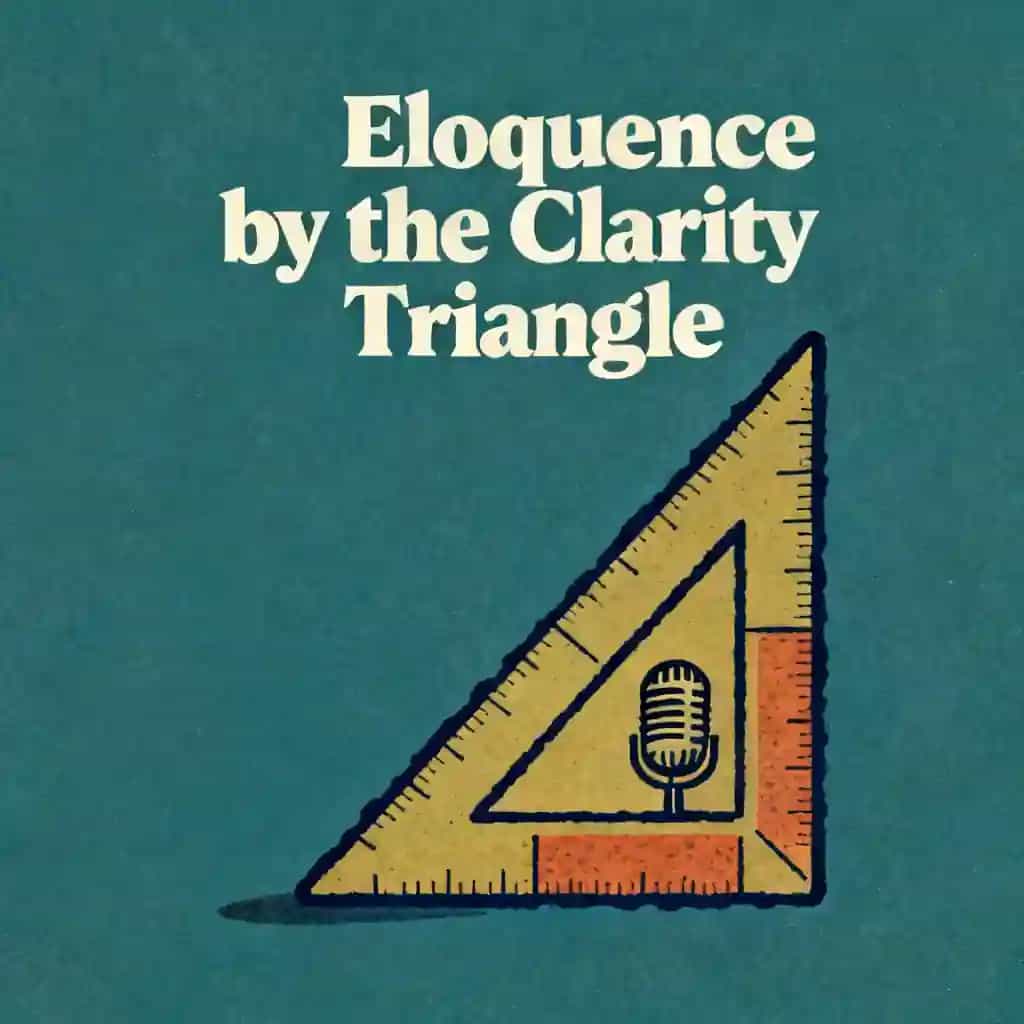
    Miles: It’s all about a framework called the Clarity Triangle: Sound, Rhythm, and Language. Let's explore how these three pillars can completely transform your professional presence.

    Chapter 2

    The Clarity Triangle in Action

    Lena: So, Miles, you mentioned this Clarity Triangle—Sound, Rhythm, and Language. It sounds like a total toolkit for anyone who feels like they’re being overlooked in meetings. How do we actually start using it without sounding like we're trying too hard?

    Miles: It’s all about building that foundation so your ideas can finally shine. Think of the first pillar—Sound—as the bedrock. It’s not about losing your accent—actually, we should be clear that the goal is clarity, not conformity. Your accent is part of your identity. But Sound is about the precise articulation of those consonants and vowels. If you drop the 't' at the end of "project" or miss the 's' on a plural, your listener’s brain has to work harder to fill in the gaps. That’s "listener fatigue," and it’s a silent killer of professional authority.

    Lena: "Listener fatigue"—I love that term because it’s so true! If I’m straining to understand the literal words, I’m definitely not processing the strategy behind them. So, if Sound is the bedrock, what’s the "music" part you mentioned?

    Miles: That’s the second pillar: Rhythm. This is where American English gets its signature flow. It’s a "stress-timed" language, which basically means we punch certain words and let others slide by. If you speak with a flat, monotone rhythm, even the most brilliant insight sounds robotic. But when you master the music—the stressed and unstressed syllables—you suddenly sound natural and engaging. It’s like the difference between a metronome and a jazz song.

    Lena: And I’m guessing Language is the final piece that ties it all together?

    Miles: Exactly. Language is your choice of words and phrasing. It’s moving away from vague, hesitant "hedging" and toward precise, authoritative vocabulary. It’s the difference between saying "I think things are going okay" and "Our analysis indicates a 12% improvement in retention." One sounds like a guess; the other sounds like expertise.

    Lena: It’s interesting because when those three work together, you’re not just being understood—you’re actually influencing the room. But I’ll be honest, Miles, for a lot of people, the "Rhythm" part feels the most elusive. How do you actually "find the beat" in a business meeting?

    Miles: It’s all about sentence stress. Think of stressed words as the peaks of your sentences and the unstressed ones as the valleys. If you’re giving a project update, you want to punch the nouns and verbs. Instead of saying, "I finished the report this morning and sent it to the client" in one flat line, you’d emphasize finished, report, morning, and client.

    Lena: Oh, I see! By hitting those "peak" words, you’re basically highlighting the most important info for the listener’s brain. It makes the message pop.

    Miles: Exactly. It’s strategic. And when you combine that with "falling intonation"—dropping your pitch at the end of a sentence—you sound decisive. A common trap, especially for non-native speakers, is "uptalk," where your voice goes up at the end of a statement. It makes a definitive point sound like a tentative question. If you say, "We need to finalize the budget by Friday?" with a rising pitch, it sounds like you’re asking for permission. But drop that pitch on "Friday," and suddenly, you’re the one in charge.

    Lena: That is such a subtle shift, but I can hear the difference immediately. It’s like you’re signaling, "I’m done speaking, and I stand by what I said."

    Miles: Right. And research actually backs this up—over 80% of business students consider oral communication skills "very important" once they enter the workforce. It’s not just a nice-to-have; it’s the engine of your career.

    Keep learning with this episode

    Take the ideas from this episode into a guided learning experience in BeFreed.

    Chapter 3

    Playing Detective with Your Own Speech

    Lena: Okay, so we have the Clarity Triangle—Sound, Rhythm, and Language. But Miles, if I want to improve, I first need to know where I’m actually tripping up. It’s so hard to hear yourself objectively while you’re in the middle of a high-pressure presentation, right?

    Miles: It is nearly impossible. Our brains are too busy trying to remember the data to listen to our own vowels! That’s why the smartest move is to play detective. You need objective data on your own speech patterns. And the single most powerful tool you have for this is right in your pocket: your smartphone.

    Lena: Oh, the dreaded "record and listen" technique? I think most people would rather do their own taxes than listen to a recording of their own voice!

    Miles: I know, I know—it’s cringey at first! But professional coaches do this all the time. The goal isn’t to find every tiny mistake. That’s a fast track to feeling overwhelmed. Instead, you’re looking for the "high-impact" areas. Most of the time, fixing just 10 to 12 recurring patterns gives you the biggest boost in clarity.

    Lena: So, I shouldn't just record myself ordering coffee. I need a "diagnostic recording" that actually mimics my work life, right?

    Miles: Precisely. Record a one-minute mock presentation intro, or pretend you’re giving a project update in a team meeting. Then—and this is the key—listen back with a critical but constructive ear. Don't judge yourself. Just observe. Are you dropping the 't' at the end of words like "project"? Are you swapping 'v' and 'w' sounds?

    Lena: And what about the "music" we talked about? Can I hear my own rhythm on a recording?

    Miles: Absolutely. Listen for whether your speech sounds choppy or flat. Are you stressing the key words to guide the listener? And watch out for that "uptalk" we mentioned. Does your pitch go up at the end of statements? If you hear yourself doing that, you’ve just found a major opportunity to boost your authority.

    Lena: It’s like a self-audit. I actually saw a "Quick Self-Audit" framework for executive speaking that asks questions like, "Do people ever ask me to repeat myself?" or "When I finish speaking, is my key takeaway crystal clear?"

    Miles: Those are perfect questions. And if the answer is "no," you can look at the "Sound" or "Rhythm" pillars to see why. Maybe you’re speaking too quickly because you’re nervous. That’s a huge one. When we’re anxious, our heart rate spikes and our speech speeds up. But to an audience, that just signals uncertainty.

    Lena: So, if I notice I’m rushing on my recording, what’s the fix? Is it just "slowing down," or is there more to it?

    Miles: It’s about "Vocal Authority." One exercise I love is finding your "resonant sweet spot." Place your hand on your chest and say "uh-huh" like you’re agreeing with a friend. Feel that vibration? That’s your natural, relaxed pitch. Now try speaking your presentation intro while aiming for that same vibration. It keeps your voice from getting high and thin, which is what happens when we’re stressed.

    Lena: That’s fascinating. So, by finding that resonance, I’m literally using my body to sound more grounded and authoritative.

    Miles: Exactly. And remember, 38% of your communication impact comes from your vocal tone. The actual words only account for about 7%. So, the "how" really is just as important as the "what."

    Lena: It’s a bit of a reality check! But it’s also empowering because these are mechanical things we can actually change. It’s not a personality trait; it’s a physical skill.

    Miles: Spot on. Once you’ve done that audit and identified your patterns, you stop wasting time on generic practice and start doing a "surgical" improvement plan. That’s how you move from being misunderstood to being the person everyone listens to.

    Chapter 4

    Moving from Tactical to Strategic Framing

    Lena: We’ve talked a lot about the sound of authority, but Miles, let's talk about the substance. I’ve noticed that sometimes people speak very clearly, but they still get labeled as "tactical" instead of "strategic." What’s the linguistic shift there?

    Miles: Oh, this is a huge one for anyone aiming for a leadership role. Tactical communicators talk about tasks, processes, and "how the engine works." Strategic communicators—the ones who sound like executives—talk about outcomes, business impact, and alignment. It’s all about "altitude." Executives operate at 30,000 feet. They want to know where the plane is headed, not every nut and bolt in the fuselage.

    Lena: I love that analogy. So, instead of saying, "We spent six hours updating the CRM database because it was buggy," what does the strategic version look like?

    Miles: You’d lead with the "Bottom Line Up Front"—or the BLUF method. You’d say, "Upgrading our CRM will reduce our sales cycle by 15%, directly supporting our Q4 targets." See the difference? You’ve moved from complaining about bugs to talking about revenue and targets.

    Lena: Wow. It’s the same activity, but the second version makes you sound like a partner in the business, not just someone doing a chore.

    Miles: Exactly. There’s actually a "Strategic Framing Formula" you can use. You look for three things: Business Impact (what does this mean for revenue or risk?), Alignment (how does this connect to our current goals?), and the Decision Point (what needs to happen next?). If your update doesn't answer the question "So what?", you're still at the tactical level.

    Lena: "So what?"—that’s a tough question to ask yourself before every email or meeting, but I can see how it forces you to be more eloquent. It’s like you’re distilling the complexity into clarity.

    Miles: And brevity is a power skill here. Executives are mentally triaging a thousand things at once. Microsoft found that the average human attention span has dropped to about 8 seconds. In a boardroom, that window is even smaller! If you take four minutes to give "context" before you get to your recommendation, you’ve already lost them.

    Lena: So, the goal is to be the person who can explain a complex initiative in three sentences?

    Miles: Precisely. If you can deliver your core point in 15 seconds or less, you’ve nailed the BLUF method. It signals that you really understand the subject. When someone rambles for ten minutes, it actually signals the opposite—that they aren't quite sure what the "salient" point is.

    Lena: "Salient"—that’s a great word. I was reading a list of words that elevate your professional vocabulary, and "salient" was on there. Instead of saying "the most important point," you say "the salient point." It just sounds more precise.

    Miles: It does! And "precision signals expertise." Think about words like "ameliorate" instead of "improve," or "obviate" instead of "eliminate." Or my favorite: "nascent." Instead of saying a market is "new," you say it’s "nascent." It implies you’re seeing the potential of something just coming into existence.

    Lena: It’s almost like these words act as a shorthand for strategic thinking. But I have to ask—is there a danger of sounding... I don't know, a bit "stiff" or like you're trying too hard to sound smart?

    Miles: That’s a great point. The goal isn't to sound like you swallowed a dictionary. It’s about "deliberate vocabulary shifts." You don't want to use jargon just for the sake of it. You want to use the right word for the situation. If you’re in a 1-to-1 with a close colleague, you might stay in "Conversational Professional" mode. But if you’re presenting to the board, you shift up to "Formal Professional."

    Lena: So, it's a scale? You’re calibrating your language based on who’s in the room?

    Miles: Exactly. Most workplace talk happens in the middle of that scale. The mistake people make is staying too "casual"—using slang or incomplete sentences—which can undermine their credibility when they’re trying to make a serious point. But if you can marry that "strategic framing" with precise words and a calm, resonant voice... that’s when you start commanding the room.

    Keep learning with this episode

    Take the ideas from this episode into a guided learning experience in BeFreed.

    Chapter 5

    The Psychology of Decisive Language

    Lena: Miles, I want to dig into something you mentioned earlier—those "credibility killers." I’ve been catching myself saying things like, "Does that make sense?" at the end of my ideas. I thought I was being helpful, but now I’m wondering if I’m actually sabotaging myself.

    Miles: You aren't alone, Lena. We often use those phrases to be "polite" or to check in, but psychologically, they can signal a lack of conviction. Phrases like "I’m no expert, but..." or "I just wanted to..." are basically preemptive apologies. You’re discounting your own idea before anyone else can even evaluate it!

    Lena: It’s like I’m giving them permission to ignore me. That’s a painful realization!

    Miles: It’s a habit we can break, though. Research from the University of Texas found that people who use "hedging" language like "I think maybe" or "sort of" are perceived as 25 to 35% less competent than those who make direct statements—even when the content is exactly the same!

    Lena: Wow, 35%? That is a huge penalty just for adding a few extra words! So, what’s the "Decisive Language Swap"?

    Miles: It’s about being direct. Instead of "I feel like we should," you say "We should." Instead of "Can I suggest something?", you say "Here’s my recommendation." And my favorite swap: instead of "Does that make sense?", try "What are your thoughts on this approach?"

    Lena: Oh, I see! The first one sounds like I'm worried I was confusing. The second one assumes I was clear and invites a strategic discussion.

    Miles: Exactly! It shifts the focus from your performance to the idea itself. And that’s a core executive skill: "It’s never about you; it's about the stakeholder." You’re framing everything around what they care about—revenue, risk, or speed.

    Lena: That reminds me of the "Stakeholder Mapping" method. Before you even open your mouth, you ask: "What does this person care about most? What are they worried about right now?"

    Miles: Right. A project update sounds completely different to a CFO than it does to a CTO. To the CFO, you talk about the 8-month payback period. To the CTO, you talk about how the solution integrates with the existing tech stack. Same project, but you’re speaking their language. That’s strategic empathy.

    Lena: Strategic empathy—I love that. It’s not just about being "nice"; it’s about being effective. And speaking of being effective, how do you handle it when things get tense? I feel like my "eloquence" usually goes out the window the second someone challenges me.

    Miles: That’s where "Emotional Regulation" comes in. Executives are judged by how they hold themselves under pressure. When a VP calls your timeline "unrealistic" in a meeting, the reactive response is to get defensive—maybe say, "Well, if I had the resources I asked for..." But that just looks like blame-shifting.

    Lena: So, what’s the "Executive" way to handle that?

    Miles: You use the "3-Second Reset." You pause for three seconds—which interrupts your brain’s fight-or-flight response—take one deliberate breath, and then choose a frame that serves your long-term credibility. You might say, "That’s a fair concern. The timeline is aggressive. Here’s how I’ve accounted for that risk."

    Lena: That sounds so much more composed. You’re acknowledging the concern without letting it rattle you. You’re staying in control of the narrative.

    Miles: And everyone in the room notices who stayed calm. Composure is authority. It’s the difference between a "Dilettante" approach and deep expertise.

    Lena: "Dilettante"—another great vocabulary word! I can see how all of this ties back to that "Executive Presence" we’re all after. It’s structure, it’s precision, and it’s that unshakable calm.

    Chapter 6

    Commanding the Room Through Body Language

    Lena: Miles, we’ve covered the "Sound" and the "Language," but we can't ignore the "Visual." I’ve seen people who have a great script but they’re swaying or fidgeting, and it just... it pulls all the power out of their words.

    Miles: You’re hitting on a huge blind spot. Your body language often broadcasts your internal state—whether it’s confidence or anxiety—long before you even say a word. If your non-verbal cues are "leaking" nervous energy, it doesn't matter how strategic your BLUF is. People will subconsciously feel like you aren't sure of yourself.

    Lena: "Leaking energy"—that’s such a vivid way to put it. So, how do we "plug the leaks"?

    Miles: It starts with your "Speaker’s Stance." Anxious energy makes us want to move—sway, shift weight, or pace aimlessly. The antidote is intentional stillness. Plant your feet shoulder-width apart, weight evenly distributed. It anchors you. It signals stability. Think of it like a "grounded" posture.

    Lena: And what about the classic question—what do I do with my hands? I always feel like they’re just... in the way!

    Miles: Everyone asks that! The key is the "Gesture Box"—the area from your chest to your waist. Keep your hands there. Don't hide them in your pockets or clasp them behind your back—those are defensive "credibility killers." Instead, use "purposeful" gestures. Use your hands to emphasize a key point or to illustrate a concept, like "on the one hand" and "on the other."

    Lena: And an open-palmed gesture is generally seen as more honest, right?

    Miles: Exactly. It’s inviting. But then there’s the big one for our hybrid world: eye contact. In a room, you want to land on one person for a full thought before moving to the next. But on a video call? Most people look at the faces on the screen.

    Lena: Guilty! I’m always looking at the little boxes of people.

    Miles: We all do! But to the people on the other end, it looks like you’re looking down. To create genuine "eye contact" virtually, you have to look directly at that little camera lens. It feels weird and unnatural, like you're talking to a piece of plastic, but to your audience, it feels like you're looking them in the eye.

    Lena: It’s a total mental shift. It’s like you’re "reading the room" through the screen but "speaking to the room" through the lens.

    Miles: Exactly. And don't forget your facial expressions. If you’re delivering a serious strategy but you’re smiling nervously, there’s a "role incongruity." Your body and your words are telling two different stories. You want your physical presence to match the weight of your message.

    Lena: This all sounds like a lot to think about while you’re also trying to remember your data! Is this where "Strategic Rehearsal" comes in?

    Miles: It’s the only way it works. You have to move from "memorization" to "internalization." If you just memorize a script word-for-word, you sound like a robot. And if you forget one line, the whole thing collapses!

    Lena: So, how do you "internalize" instead of "memorize"?

    Miles: You practice in phases. First, just the logic and structure—your PREP or your Pyramid. Can you explain the why without a script? Then, you record yourself and analyze your delivery—the Sound and Rhythm. And finally, you "pressure-test" it. Have a colleague interrupt you with tough questions.

    Lena: Oh, like a mock Q&A? That sounds stressful but incredibly useful.

    Miles: It’s the best way to build "mental agility." If you’ve already practiced handling a skeptical question, you won't get rattled when it happens for real. Research shows that this kind of rigorous preparation can neutralize up to 90% of public speaking anxiety!

    Lena: 90%? That’s practically a superpower. So, the "eloquence" we see in top leaders isn't necessarily a natural gift—it’s just the result of a really disciplined rehearsal plan.

    Miles: Every single time. Even the most "effortless" communicators are usually the ones who have practiced the most. They’ve built the muscle memory so that when they step into the room, they can stop worrying about how they’re speaking and focus entirely on who they’re helping.

    Keep learning with this episode

    Take the ideas from this episode into a guided learning experience in BeFreed.

    Chapter 7

    Your Practical Playbook for Eloquence

    Lena: Miles, we’ve covered so much ground—from the Clarity Triangle and the BLUF method to the "Speaker's Stance" and the 3-Second Reset. For our listeners who want to start sounding more professional tomorrow morning, what is the first move?

    Miles: The very first move? Start a "Personal Business Glossary." We talked about how precision signals expertise. Identify the common vague words you use—like "improve," "big," or "fix"—and find their precise alternatives: "ameliorate," "substantial," "resolve."

    Lena: I love that. It’s like an "Upgrade List" for your everyday vocabulary.

    Miles: Exactly. And the second move: The 15-Second Brief. Before your next meeting or even a phone call, try to summarize your main point in 15 seconds. If you can’t, you haven't found the "salient" point yet. Keep cutting it down until it’s crystal clear. That’s your "Bottom Line Up Front."

    Lena: And if they want to fix their "Rhythm" and "Sound"?

    Miles: Use the "Listen and Echo" drill. Find a short clip of a professional speaker you admire—maybe a TED talk or an executive interview—and listen to just one sentence. Then, pause it and try to mimic their exact rhythm, their pauses, and their falling intonation. It builds that muscle memory for the "music" of American English.

    Lena: It’s like practicing an instrument. And don't forget the self-audit! Record yourself giving a one-minute project update and listen for those "credibility killers."

    Miles: Right. Count the "ums" and the "I thinks." Once you’re aware of them, they become much easier to eliminate. And for a quick win on authority? Work on that downward inflection. Practice making your statements sound like statements, not questions.

    Lena: "We should prioritize retention." (Pause) "We should prioritize retention?" I can hear the difference! One is a leader; the other is a follower.

    Miles: You nailed it. And for those high-stakes moments, remember the "PREP" framework. Point, Reason, Example, Point. It’s the ultimate mental model for being eloquent on the fly.

    Lena: I can see how these small, "surgical" adjustments start to stack up. You aren't changing who you are; you’re just giving your unique professional voice the clarity it deserves.

    Miles: That’s the most important takeaway. It’s not about losing your accent or sounding like a corporate drone. It’s about being "intentional" with your communication so that your brilliant ideas aren't just heard, but actually respected and acted upon.

    Lena: It’s about "transforming expertise into influence."

    Miles: Exactly. And the data is clear—better communication skills could boost overall team productivity by as much as 30%. When you speak more eloquently, you aren't just helping your own career; you’re helping everyone around you work more effectively.

    Lena: It’s a win-win. And it all starts with that first 15-second brief and a few deliberate word choices.

    Miles: It’s a journey, not a destination. But with consistent, deliberate practice—even just 15 minutes a day—most professionals see a real shift in their confidence within 8 to 12 weeks.

    Lena: 8 to 12 weeks to a whole new level of professional presence? I think that’s an investment anyone would be willing to make.

    Chapter 8

    Closing Reflection and Final Thoughts

    Lena: As we wrap things up today, Miles, I’m reflecting on how "professionalism" is so much more than just the suit you wear or the titles on your resume. It’s really about how you show up in the air between you and the other person.

    Miles: It truly is. Eloquence isn't about being fancy; it’s about being "generous" to your listener. When you speak with clarity, structure, and precision, you’re making it easy for them to understand you. You’re respecting their time and their attention.

    Lena: That’s a beautiful way to think about it. It’s an act of service. By doing the hard work of distilling your thoughts, you’re freeing up the other person to focus on the value of your ideas.

    Miles: And that’s what builds trust. People trust the person who sounds like they’ve done the work, who stands their ground with a calm voice, and who leads with the bottom line.

    Lena: So, for everyone listening, here is a final challenge: in your very next work interaction—whether it’s an email or a quick hallway chat—try to use just one piece of the "Clarity Triangle." Maybe it’s a more precise word, or maybe it’s just a deliberate pause instead of an "um."

    Miles: Just one small shift. See how it feels. Notice if people react differently. You’ll be surprised at how quickly those small wins start to build your "Executive Presence."

    Lena: It’s about moving from being "understood" to being "influential." And we all have the tools to do it.

    Miles: Absolutely. Your words are a direct reflection of your thinking. So, make every single one of them count.

    Lena: Thank you so much for joining us for this deep dive into professional communication. It’s been a fascinating look at how the "science" of speech can unlock so much career potential.

    Miles: It’s been a blast. I hope everyone feels a little more empowered to go out there and own the room.

    Lena: Take a moment today to reflect on your own "Clarity Triangle." Which pillar is your strongest, and which one is your biggest opportunity? Just starting that detective work is the first step toward the next version of your professional self. Thanks for listening!

    ★★★★★

    You made it to the end of Speak more eloquently by avoiding credibility killers

    “23 days in and I have used it every single day. It is part of my daily habit now.”

    jayallen

    Best quote from Speak more eloquently by avoiding credibility killers

    “

    Eloquence isn't about being fancy; it’s about being generous to your listener. When you speak with clarity, structure, and precision, you’re respecting their time and making it easy for them to understand the value of your ideas.

    ”
    C

    Generated by CM

    Input question

    Speak more eloquently and professional

    Host voices
    Lenaplay
    Milesplay
    Knowledge sources
    Speak Like a CEO Toolkit
    Words That Work
    Business Writing Tips
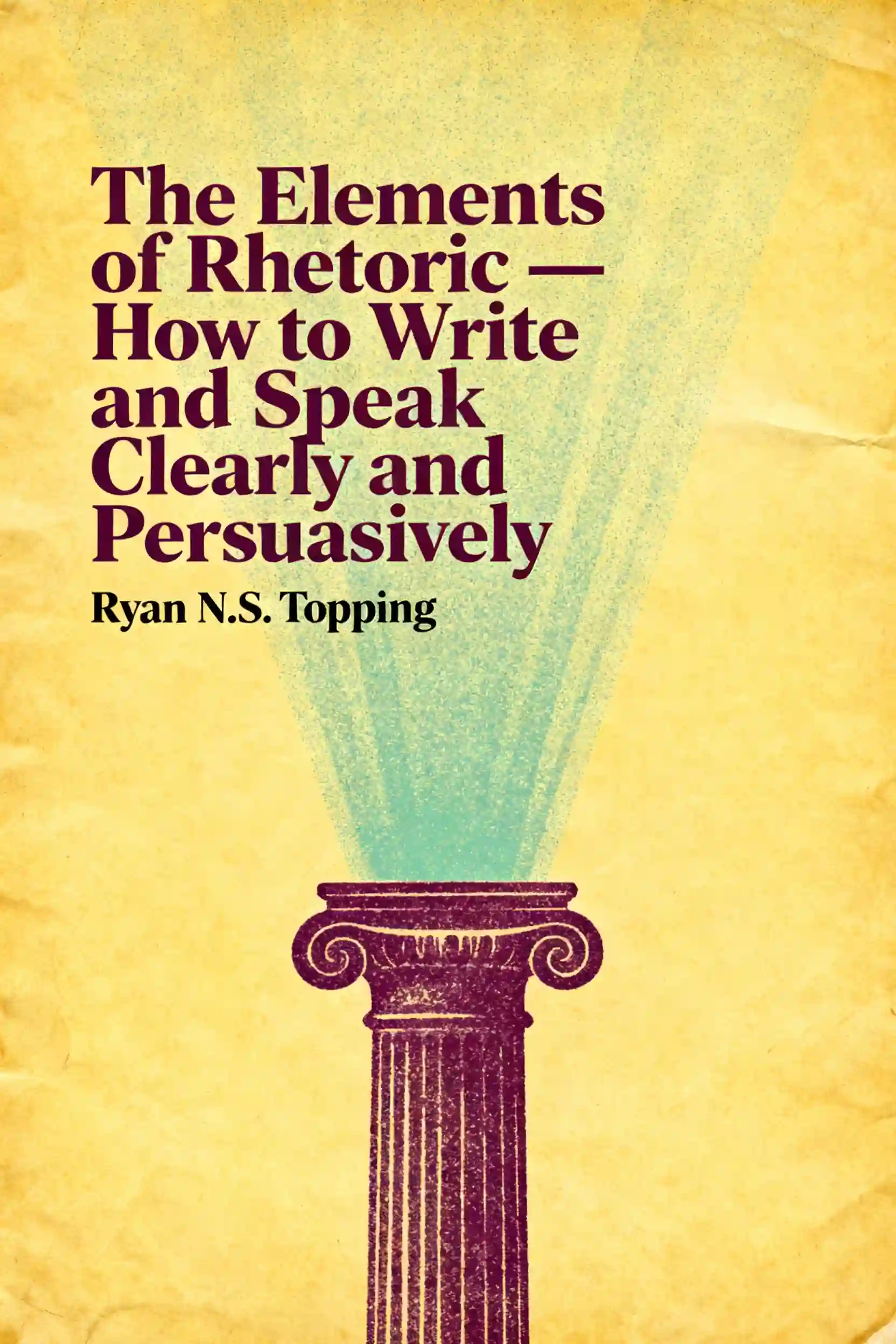
    The Elements of Rhetoric -- How to Write and Speak Clearly and Persuasively
    Magic Words
    The Power of Presence

    Frequently Asked Questions

    The Clarity Triangle is a framework consisting of three pillars: Sound, Rhythm, and Language. Sound focuses on precise articulation to prevent "listener fatigue," ensuring the audience doesn't have to strain to understand literal words. Rhythm involves mastering the "music" of language, such as using stressed and unstressed syllables to sound natural rather than monotone. Language refers to choosing precise, authoritative vocabulary while avoiding "hedging" phrases that undermine credibility. Together, these pillars ensure that a speaker's ideas are not only heard but are influential and respected.

    Credibility killers are hesitant phrases or "hedges" like "I think maybe," "I’m no expert, but," or "Does that make sense?" which signal a lack of conviction and can make a speaker appear up to 35% less competent. To project more authority, these should be replaced with "Decisive Language Swaps." For example, instead of asking if something makes sense, a speaker should ask, "What are your thoughts on this approach?" This shift moves the focus from the speaker's potential confusion to a strategic discussion of the idea itself.

    Tactical communication focuses on the "nuts and bolts" of tasks and processes, such as explaining the technical steps of a project. In contrast, strategic communication operates at a higher "altitude," focusing on outcomes, business impact, and alignment with company goals. A key tool for this is the BLUF method (Bottom Line Up Front), where the most important conclusion or recommendation is delivered in the first 15 seconds. This approach signals expertise by distilling complex information into salient points that matter to executive stakeholders.

    Commanding a room requires "plugging the leaks" of nervous energy through intentional stillness and posture. Speakers should use a "Speaker’s Stance," with feet shoulder-width apart to signal stability, and keep hand gestures within a "Gesture Box" from the chest to the waist. Additionally, finding a "resonant sweet spot" by speaking from a relaxed, grounded pitch prevents the voice from sounding high and thin under stress. For virtual meetings, eye contact must be simulated by looking directly at the camera lens rather than the faces on the screen.

    From Columbia University alumni | built in San Francisco

    BeFreed Brings Together A Global Community Of Curious Minds

    4.7

    avg rating

    7.84k+ App Rating

    BeFreed Community

    Seriously I haven’t even explored this app fully yet but from using it the last few days I am so impressed... BeFreed is on a different level from any other learning app I have used. This makes it ultra engaging and can actually improve your concentration which is great for all the doom scrollers!

    @ladyInfinity

    I bought BeFreed exactly 23 days ago, and I have used it every single day since. It has completely embedded itself into my daily workflow and learning habit.

    @jayallen

    The truth is, the app has exceeded all my expectations. I can ask it to generate audio on any topic, whatever it may be, and the result is impressive. My professional field is a specialization in psychotherapy and it is multidisciplinary; however, the answers are very accurate.

    @Raguipa

    What I appreciate most is how much it's reduced my scrolling – I'm spending less time searching and more time absorbing information. The combination of full audiobooks, podcasts, the learning plans are brilliant.

    @colonyofcreatorsNGO

    I have been a PhotoReading Accelerated Learning Instructor for the past 24 years... books and reading and learning are my thing, and BeFreed has done a great job in providing an innovative approach to disseminating and delivering information in an easy to consume way.

    @BeFreed user

    It is not just a book summary app, I have used the 'fun reading' option and it's a much better summary and way to grasp ideas the traditional way, that alone is worth this deal.

    @austinakon

    I love this app. Used it for several days and I cannot stop listening. Such a great way to start.

    @jcrules328

    I really like the program; I have already tested it for around one month, and I feel that it's an amazing gem. It works so well because I can use BeFreed to create my own topics, and the voice is so good with unlimited choice of narrations.

    @DanielCZ

    Seriously I haven’t even explored this app fully yet but from using it the last few days I am so impressed... BeFreed is on a different level from any other learning app I have used. This makes it ultra engaging and can actually improve your concentration which is great for all the doom scrollers!

    @ladyInfinity

    I bought BeFreed exactly 23 days ago, and I have used it every single day since. It has completely embedded itself into my daily workflow and learning habit.

    @jayallen

    The truth is, the app has exceeded all my expectations. I can ask it to generate audio on any topic, whatever it may be, and the result is impressive. My professional field is a specialization in psychotherapy and it is multidisciplinary; however, the answers are very accurate.

    @Raguipa

    What I appreciate most is how much it's reduced my scrolling – I'm spending less time searching and more time absorbing information. The combination of full audiobooks, podcasts, the learning plans are brilliant.

    @colonyofcreatorsNGO

    I have been a PhotoReading Accelerated Learning Instructor for the past 24 years... books and reading and learning are my thing, and BeFreed has done a great job in providing an innovative approach to disseminating and delivering information in an easy to consume way.

    @BeFreed user

    It is not just a book summary app, I have used the 'fun reading' option and it's a much better summary and way to grasp ideas the traditional way, that alone is worth this deal.

    @austinakon

    I love this app. Used it for several days and I cannot stop listening. Such a great way to start.
    @jcrules328

    I really like the program; I have already tested it for around one month, and I feel that it's an amazing gem. It works so well because I can use BeFreed to create my own topics, and the voice is so good with unlimited choice of narrations.

    @DanielCZ

    I love the fact that I can get useful, condensed, information and ideas in a 8 - 15 minute podcast style audio. I'm not a general fan of podcasts because of all the fluff, but this cuts through all that.

    @BeFreed user

    I am finishing up my doctorate, and have to read a lot of unfamiliar material... With BeFreed, you simply enter a prompt, and the app finds source material for you and generates an audio podcast. I find the process in BeFreed to be more streamlined than NotebookLM.

    @Brad

    I often search YouTube for something to listen to whilst making breakfast, when I'm out walking, commuting, etc, and BeFreed has provided an even more targeted approach, without the adverts and the fluff!

    @BeFreed user

    The absolute best part about this platform is its versatility. There is literally no subject that is off-topic. It handles whatever you throw at it... It is rare to find an learning tool with zero limitations that actually delivers on its promises.

    @jayallen

    BeFreed is fantastic. The user-friendly design means I spend less time navigating and more time learning. The mix of audiobooks, podcasts, and learning plans is a genius combo that has completely changed my daily routine.

    @BeFreed user

    At the start I needed a while to understand how to create podcasts in italian language and boom! It is so great! I can ask to explain every argument and it does so well and so smartly!

    @matteo77

    BeFreed has become my daily app for audio books tools... What I like the most is the way you put your text and come with an audio that you can listen on the go.

    @kotanzu1

    I love the fact that I can get useful, condensed, information and ideas in a 8 - 15 minute podcast style audio. I'm not a general fan of podcasts because of all the fluff, but this cuts through all that.

    @BeFreed user

    I am finishing up my doctorate, and have to read a lot of unfamiliar material... With BeFreed, you simply enter a prompt, and the app finds source material for you and generates an audio podcast. I find the process in BeFreed to be more streamlined than NotebookLM.

    @Brad

    I often search YouTube for something to listen to whilst making breakfast, when I'm out walking, commuting, etc, and BeFreed has provided an even more targeted approach, without the adverts and the fluff!

    @BeFreed user

    The absolute best part about this platform is its versatility. There is literally no subject that is off-topic. It handles whatever you throw at it... It is rare to find an learning tool with zero limitations that actually delivers on its promises.

    @jayallen

    BeFreed is fantastic. The user-friendly design means I spend less time navigating and more time learning. The mix of audiobooks, podcasts, and learning plans is a genius combo that has completely changed my daily routine.

    @BeFreed user

    At the start I needed a while to understand how to create podcasts in italian language and boom! It is so great! I can ask to explain every argument and it does so well and so smartly!

    @matteo77

    BeFreed has become my daily app for audio books tools... What I like the most is the way you put your text and come with an audio that you can listen on the go.

    @kotanzu1

    See more on how BeFreed is discussed
    129.7K19.5K
    55.2K19.2K
    154.2K10827355
    48.1K2.5K
    81.2K6.6K
    82.3K1.8K
    Start your learning journey, now
    BeFreed app
    BeFreed

    Learn Anything, Personalized

    DiscordLinkedIn
    Featured book summaries
    Crucial ConversationsThe Perfect MarriageInto the WildNever Split the DifferenceAttachedGood to GreatSay Nothing
    Trending categories
    Self HelpCommunication SkillRelationshipMindfulnessPhilosophyInspirationProductivity
    Celebrities' reading list
    Elon MuskCharlie KirkBill GatesSteve JobsAndrew HubermanJoe RoganJordan Peterson
    Award winning collection
    Pulitzer PrizeNational Book AwardGoodreads Choice AwardsNobel Prize in LiteratureNew York TimesCaldecott MedalNebula Award
    Featured Topics
    ManagementAmerican HistoryWarTradingStoicismAnxietySex
    Best books by Year
    2025 Best Non Fiction Books2024 Best Non Fiction Books2023 Best Non Fiction Books
    Featured authors
    Chimamanda Ngozi AdichieGeorge OrwellO. J. SimpsonBarbara O'NeillWinston ChurchillCharlie Kirk
    BeFreed vs other apps
    BeFreed vs. Other Book Summary AppsBeFreed vs. ElevenReaderBeFreed vs. ReadwiseBeFreed vs. Anki
    Learning tools
    Knowledge VisualizerAI Podcast Generator
    Information
    About Usarrow
    Pricingarrow
    FAQarrow
    Blogarrow
    Careerarrow
    Partnershipsarrow
    Ambassador Programarrow
    Directoryarrow
    BeFreed
    Try now
    © 2026 BeFreed
    Term of UsePrivacy Policy
    BeFreed

    Learn Anything, Personalized

    DiscordLinkedIn
    Featured book summaries
    Crucial ConversationsThe Perfect MarriageInto the WildNever Split the DifferenceAttachedGood to GreatSay Nothing
    Trending categories
    Self HelpCommunication SkillRelationshipMindfulnessPhilosophyInspirationProductivity
    Celebrities' reading list
    Elon MuskCharlie KirkBill GatesSteve JobsAndrew HubermanJoe RoganJordan Peterson
    Award winning collection
    Pulitzer PrizeNational Book AwardGoodreads Choice AwardsNobel Prize in LiteratureNew York TimesCaldecott MedalNebula Award
    Featured Topics
    ManagementAmerican HistoryWarTradingStoicismAnxietySex
    Best books by Year
    2025 Best Non Fiction Books2024 Best Non Fiction Books2023 Best Non Fiction Books
    Learning tools
    Knowledge VisualizerAI Podcast Generator
    Featured authors
    Chimamanda Ngozi AdichieGeorge OrwellO. J. SimpsonBarbara O'NeillWinston ChurchillCharlie Kirk
    BeFreed vs other apps
    BeFreed vs. Other Book Summary AppsBeFreed vs. ElevenReaderBeFreed vs. ReadwiseBeFreed vs. Anki
    Information
    About Usarrow
    Pricingarrow
    FAQarrow
    Blogarrow
    Careerarrow
    Partnershipsarrow
    Ambassador Programarrow
    Directoryarrow
    BeFreed
    Try now
    © 2026 BeFreed
    Term of UsePrivacy Policy

    More like this

    Speak more clearly so people actually listen book cover
    Exactly what to sayArt of Public SpeakingAssertivenessPublic Speaking for Success
    27 sources
    Speak more clearly so people actually listen
    Mumbling can make you seem less credible. Learn how to use the Clarity Triangle and strategic pauses to improve your articulation and command authority.
    24 min
    Speak more clearly to build instant credibility book cover
    How to Speak Like the Top 1%Art of Public SpeakingPublic Speaking for SuccessThe Elements of Rhetoric -- How to Write and Speak Clearly and Persuasively
    23 sources
    Speak more clearly to build instant credibility
    Struggling to be heard in meetings? Learn how mastering a few key sounds and slowing your pace can make you sound more knowledgeable and professional.
    20 min
    Speak With Clarity and Confidence book cover
    The Art of Public SpeakingPublic Speaking for SuccessThe Elements of Rhetoric -- How to Write and Speak Clearly and PersuasivelyHow to Speak Like the Top 1%: The Science of Elite Communication
    23 sources
    Speak With Clarity and Confidence
    Discover practical strategies to become more articulate, from developing your 'greatest hits' of core ideas to mastering the rhythm of speech and building vocabulary that serves your message.
    11 min
    Clear Speech and Credibility book cover
    How to Speak Clearly: 10 Techniques for Better Speech | SayNow AIExercises To Improve Clarity And Diction In SpeechHow to Enunciate Better: Tips for Clear CommunicationHow to Enunciate Better and Speak With Clarity
    5 sources
    Clear Speech and Credibility
    Struggling to land your ideas? Learn how to fix mumbling and rushing with physical exercises that turn your articulation into a tool for influence.
    20 min
    Mastering the Clarity Triangle for Elite Eloquence book cover
    The Art of Public SpeakingHow to Speak Like the Top 1%: The Science of Elite CommunicationPublic Speaking for SuccessThe Elements of Rhetoric -- How to Write and Speak Clearly and Persuasively
    28 sources
    Mastering the Clarity Triangle for Elite Eloquence
    Transform your communication by mastering vocal precision, mental structuring, and nonverbal cues. This guide provides practical drills to eliminate filler words and command any room with charismatic, intelligent presence.
    30 min
    Mastering the Clarity Triangle for Authoritative Speech book cover
    The Art of Public SpeakingPublic Speaking for SuccessHow to Speak Like the Top 1%: The Science of Elite CommunicationThe Elements of Rhetoric -- How to Write and Speak Clearly and Persuasively
    25 sources
    Mastering the Clarity Triangle for Authoritative Speech
    Stop wasting time on miscommunications by mastering the physical, rhythmic, and strategic elements of clear speech to command respect in every conversation.
    28 min
    Speak With Authority: Master Your Executive Presence book cover
    The Art of Public SpeakingPublic Speaking for SuccessThe Elements of Rhetoric -- How to Write and Speak Clearly and PersuasivelySpeak Like a CEO
    29 sources
    Speak With Authority: Master Your Executive Presence
    Stop undermining your ideas with weak fillers. Learn to command any room by upgrading your vocabulary, mastering present-tense phrasing, and using the neuroscience of confidence.
    22 min
    Speak with Power and Clarity book cover
    The Art of Public SpeakingPublic Speaking for SuccessThe Elements of Rhetoric -- How to Write and Speak Clearly and PersuasivelySpeak Like a CEO
    8 sources
    Speak with Power and Clarity
    Discover how to transform jumbled thoughts into articulate speech through practical daily exercises. Learn to bridge the brain-mouth gap and develop a confident, persuasive speaking style that connects with any audience.
    31 min

    Recommended Learning Plans

    Speak eloquently with confidence & precision
    LEARNING PLAN

    Speak eloquently with confidence & precision

    Effective communication is the cornerstone of professional success, yet many talented individuals struggle to articulate their ideas with the clarity and confidence their expertise deserves. This learning plan is ideal for professionals, leaders, and aspiring executives who want to elevate their speaking abilities, strengthen their influence, and be recognized as articulate, intelligent communicators in high-stakes environments.

    5 h•4 Sections
    I want to sound more articulate when I speak
    LEARNING PLAN

    I want to sound more articulate when I speak

    In today’s professional landscape, the ability to communicate with precision and authority is a primary driver of career growth. This plan is ideal for professionals and aspiring leaders who want to bridge the gap between their ideas and their verbal delivery.

    4 h 41 m•4 Sections
    Speak Grounded and Clear
    LEARNING PLAN

    Speak Grounded and Clear

    In high-stakes environments, the ability to remain composed and articulate is a critical leadership skill. This plan is designed for professionals who want to replace nervous habits with authoritative presence and clear, structured communication.

    2 h•4 Sections
    Speak with Impact and Authority
    LEARNING PLAN

    Speak with Impact and Authority

    Effective communication is the cornerstone of leadership, yet many professionals struggle with anxiety and disorganized thoughts. This plan is designed for aspiring leaders and executives who need to project authority and clarity in high-stakes environments.

    1 h 24 m•4 Sections
    Improve professional speech and articulation
    LEARNING PLAN

    Improve professional speech and articulation

    In today's competitive landscape, clear and authoritative communication is a prerequisite for leadership. This plan is designed for professionals and aspiring executives who want to transform their vocal delivery from hesitant to commanding.

    4 h 30 m•4 Sections
    Speak with Quiet Confidence
    LEARNING PLAN

    Speak with Quiet Confidence

    In high-stakes professional environments, true influence comes from a place of calm authority rather than volume. This plan is designed for emerging leaders and specialists who need to navigate difficult conversations and executive presentations with poised, quiet confidence.

    1 h 36 m•4 Sections
    Speak Natural, Write Polished
    LEARNING PLAN

    Speak Natural, Write Polished

    Effective communication is the cornerstone of professional success and leadership. This plan is designed for professionals looking to eliminate writing anxiety, refine their digital etiquette, and use persuasive language to influence workplace outcomes.

    2 h•4 Sections
    To learn how to speak fluently in public
    LEARNING PLAN

    To learn how to speak fluently in public

    Effective communication is the cornerstone of leadership and professional success. This plan is designed for aspiring leaders and professionals who want to transform their stage presence from fearful to influential.

    5 h 5 m•4 Sections