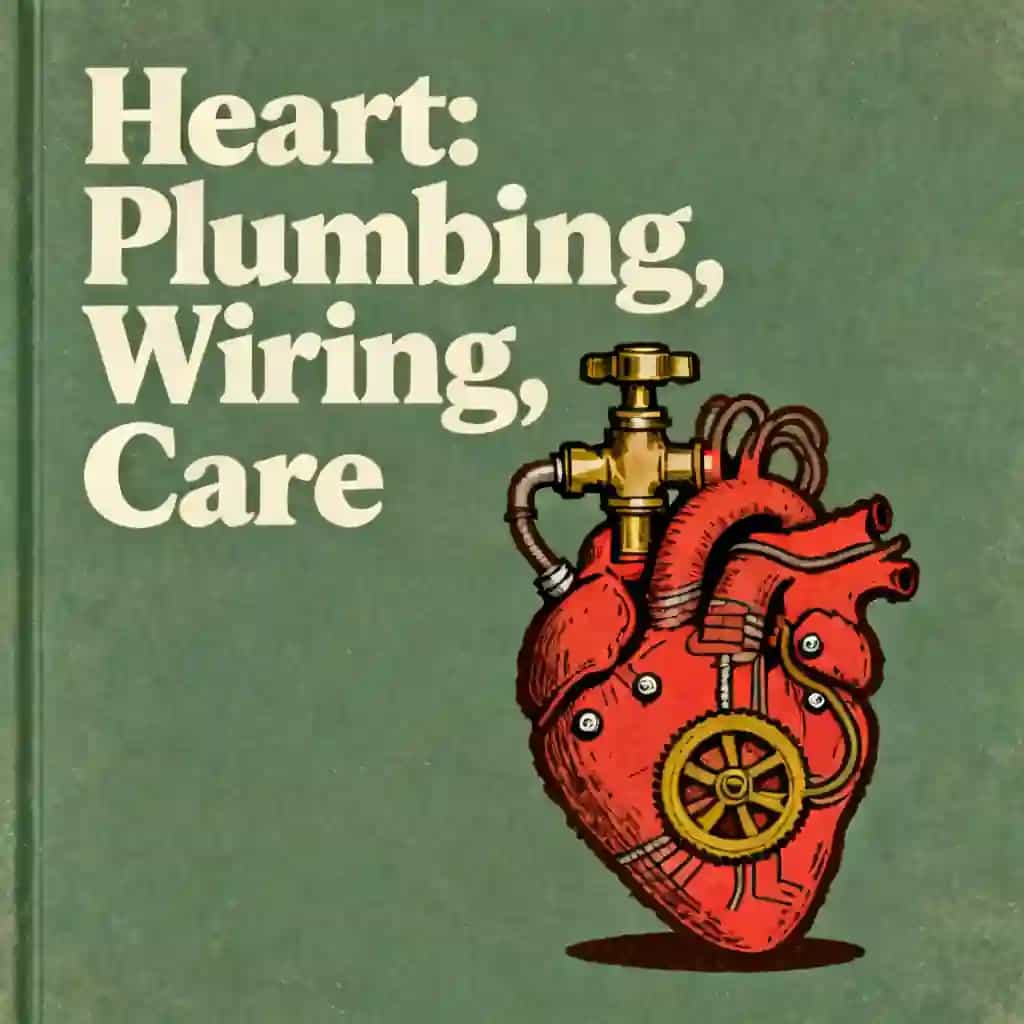
Think your heart is just a pump? Discover how its internal electrical system and pacemaker cells coordinate 100,000 daily beats to keep you alive.
Best quote from How the heart works as a biological circuit
“
The heart is a finely tuned chemical-electrical balancing act that happens 3 billion times over a lifetime, translating electrical language into mechanical action through a high-stakes microscopic dance.
”
M
Generated by Matthew
Input question
How the heart works
Host voices
Lena
Miles
Knowledge sources
Frequently Asked Questions
The heart possesses its own internal electrical system and specialized pacemaker cells, primarily located in the sinoatrial (SA) node. This "biological circuit board" generates its own electrical rhythm independently of the central nervous system. While the brain can send signals to speed up or slow down the heart rate via the autonomic nervous system, the heart's intrinsic conduction system is self-powered and capable of maintaining a contraction sequence on its own.
The atrioventricular (AV) node acts as a "gatekeeper" that deliberately slows down the electrical signal as it moves from the upper chambers (atria) to the lower chambers (ventricles). This millisecond of delay is a critical functional feature because it ensures the atria have enough time to fully contract and push blood into the ventricles. Without this pause, the ventricles would contract before they were completely full, significantly reducing the heart's pumping efficiency.
This process, known as excitation-contraction coupling, relies on calcium as a molecular translator. When an electrical signal hits a heart muscle cell, a small amount of "trigger" calcium enters, prompting a massive release of stored calcium from the sarcoplasmic reticulum. This flood of calcium binds to the protein troponin, which moves a protective "guard rail" (tropomyosin) out of the way. This allows the muscle proteins actin and myosin to bind and pull against each other, creating a mechanical squeeze.
An ECG records the total electrical activity of the heart through a specific sequence of waves. The P wave represents the depolarization and subsequent contraction of the atria. The QRS complex is the largest spike, representing the powerful electrical impulse that triggers the ventricles to contract. Finally, the T wave represents the ventricles "repolarizing" or resetting their electrical charge, which allows the muscle to relax and prepare for the next beat.
Preload refers to the amount of "stretch" the heart muscle experiences as it fills with blood; according to the Frank-Starling Law, a greater stretch leads to a more powerful contraction. Afterload is the resistance or pressure the heart must push against to eject blood into the arteries. High afterload, often caused by high blood pressure, forces the heart to work much harder to open the aortic valve, which can eventually lead to the heart muscle becoming thick, stiff, and less efficient over time.
From Columbia University alumni | built in San Francisco
BeFreed Brings Together A Global Community Of Curious Minds
4.7
avg rating
7.84k+ App Rating
BeFreed Community
Seriously I haven’t even explored this app fully yet but from using it the last few days I am so impressed... BeFreed is on a different level from any other learning app I have used. This makes it ultra engaging and can actually improve your concentration which is great for all the doom scrollers!
@ladyInfinity
I bought BeFreed exactly 23 days ago, and I have used it every single day since. It has completely embedded itself into my daily workflow and learning habit.
@jayallen
The truth is, the app has exceeded all my expectations. I can ask it to generate audio on any topic, whatever it may be, and the result is impressive. My professional field is a specialization in psychotherapy and it is multidisciplinary; however, the answers are very accurate.
@Raguipa
What I appreciate most is how much it's reduced my scrolling – I'm spending less time searching and more time absorbing information. The combination of full audiobooks, podcasts, the learning plans are brilliant.
@colonyofcreatorsNGO
I have been a PhotoReading Accelerated Learning Instructor for the past 24 years... books and reading and learning are my thing, and BeFreed has done a great job in providing an innovative approach to disseminating and delivering information in an easy to consume way.
@BeFreed user
It is not just a book summary app, I have used the 'fun reading' option and it's a much better summary and way to grasp ideas the traditional way, that alone is worth this deal.
@austinakon
I love this app. Used it for several days and I cannot stop listening. Such a great way to start.
@jcrules328
I really like the program; I have already tested it for around one month, and I feel that it's an amazing gem. It works so well because I can use BeFreed to create my own topics, and the voice is so good with unlimited choice of narrations.
@DanielCZ
Seriously I haven’t even explored this app fully yet but from using it the last few days I am so impressed... BeFreed is on a different level from any other learning app I have used. This makes it ultra engaging and can actually improve your concentration which is great for all the doom scrollers!
@ladyInfinity
I bought BeFreed exactly 23 days ago, and I have used it every single day since. It has completely embedded itself into my daily workflow and learning habit.
@jayallen
The truth is, the app has exceeded all my expectations. I can ask it to generate audio on any topic, whatever it may be, and the result is impressive. My professional field is a specialization in psychotherapy and it is multidisciplinary; however, the answers are very accurate.
@Raguipa
What I appreciate most is how much it's reduced my scrolling – I'm spending less time searching and more time absorbing information. The combination of full audiobooks, podcasts, the learning plans are brilliant.
@colonyofcreatorsNGO
I have been a PhotoReading Accelerated Learning Instructor for the past 24 years... books and reading and learning are my thing, and BeFreed has done a great job in providing an innovative approach to disseminating and delivering information in an easy to consume way.
@BeFreed user
It is not just a book summary app, I have used the 'fun reading' option and it's a much better summary and way to grasp ideas the traditional way, that alone is worth this deal.
@austinakon
I love this app. Used it for several days and I cannot stop listening. Such a great way to start.
@jcrules328
I really like the program; I have already tested it for around one month, and I feel that it's an amazing gem. It works so well because I can use BeFreed to create my own topics, and the voice is so good with unlimited choice of narrations.
@DanielCZ
I love the fact that I can get useful, condensed, information and ideas in a 8 - 15 minute podcast style audio. I'm not a general fan of podcasts because of all the fluff, but this cuts through all that.
@BeFreed user
I am finishing up my doctorate, and have to read a lot of unfamiliar material... With BeFreed, you simply enter a prompt, and the app finds source material for you and generates an audio podcast. I find the process in BeFreed to be more streamlined than NotebookLM.
@Brad
I often search YouTube for something to listen to whilst making breakfast, when I'm out walking, commuting, etc, and BeFreed has provided an even more targeted approach, without the adverts and the fluff!
@BeFreed user
The absolute best part about this platform is its versatility. There is literally no subject that is off-topic. It handles whatever you throw at it... It is rare to find an learning tool with zero limitations that actually delivers on its promises.
@jayallen
BeFreed is fantastic. The user-friendly design means I spend less time navigating and more time learning. The mix of audiobooks, podcasts, and learning plans is a genius combo that has completely changed my daily routine.
@BeFreed user
At the start I needed a while to understand how to create podcasts in italian language and boom! It is so great! I can ask to explain every argument and it does so well and so smartly!
@matteo77
BeFreed has become my daily app for audio books tools... What I like the most is the way you put your text and come with an audio that you can listen on the go.
@kotanzu1
I love the fact that I can get useful, condensed, information and ideas in a 8 - 15 minute podcast style audio. I'm not a general fan of podcasts because of all the fluff, but this cuts through all that.
@BeFreed user
I am finishing up my doctorate, and have to read a lot of unfamiliar material... With BeFreed, you simply enter a prompt, and the app finds source material for you and generates an audio podcast. I find the process in BeFreed to be more streamlined than NotebookLM.
@Brad
I often search YouTube for something to listen to whilst making breakfast, when I'm out walking, commuting, etc, and BeFreed has provided an even more targeted approach, without the adverts and the fluff!
@BeFreed user
The absolute best part about this platform is its versatility. There is literally no subject that is off-topic. It handles whatever you throw at it... It is rare to find an learning tool with zero limitations that actually delivers on its promises.
@jayallen
BeFreed is fantastic. The user-friendly design means I spend less time navigating and more time learning. The mix of audiobooks, podcasts, and learning plans is a genius combo that has completely changed my daily routine.
@BeFreed user
At the start I needed a while to understand how to create podcasts in italian language and boom! It is so great! I can ask to explain every argument and it does so well and so smartly!
@matteo77
BeFreed has become my daily app for audio books tools... What I like the most is the way you put your text and come with an audio that you can listen on the go.
We often treat body parts as separate, but they function as a coordinated orchestra. Learn how your organ systems maintain balance to keep you running.
We often take our health for granted until something feels off. Explore the eleven systems keeping you alive and how they balance to maintain your health.
We often ignore the biological miracle of breathing. Discover the physics and chemistry behind every breath and how your brain manages this vital system.
Ever wonder how a tiny machine measures time without electronics? Learn how coiled springs and gears create a mechanical pulse to keep you on schedule.
Explore how your body's remarkable systems maintain balance and function, from cellular processes to organ systems, revealing the dynamic instruction manual that keeps you alive without conscious effort.