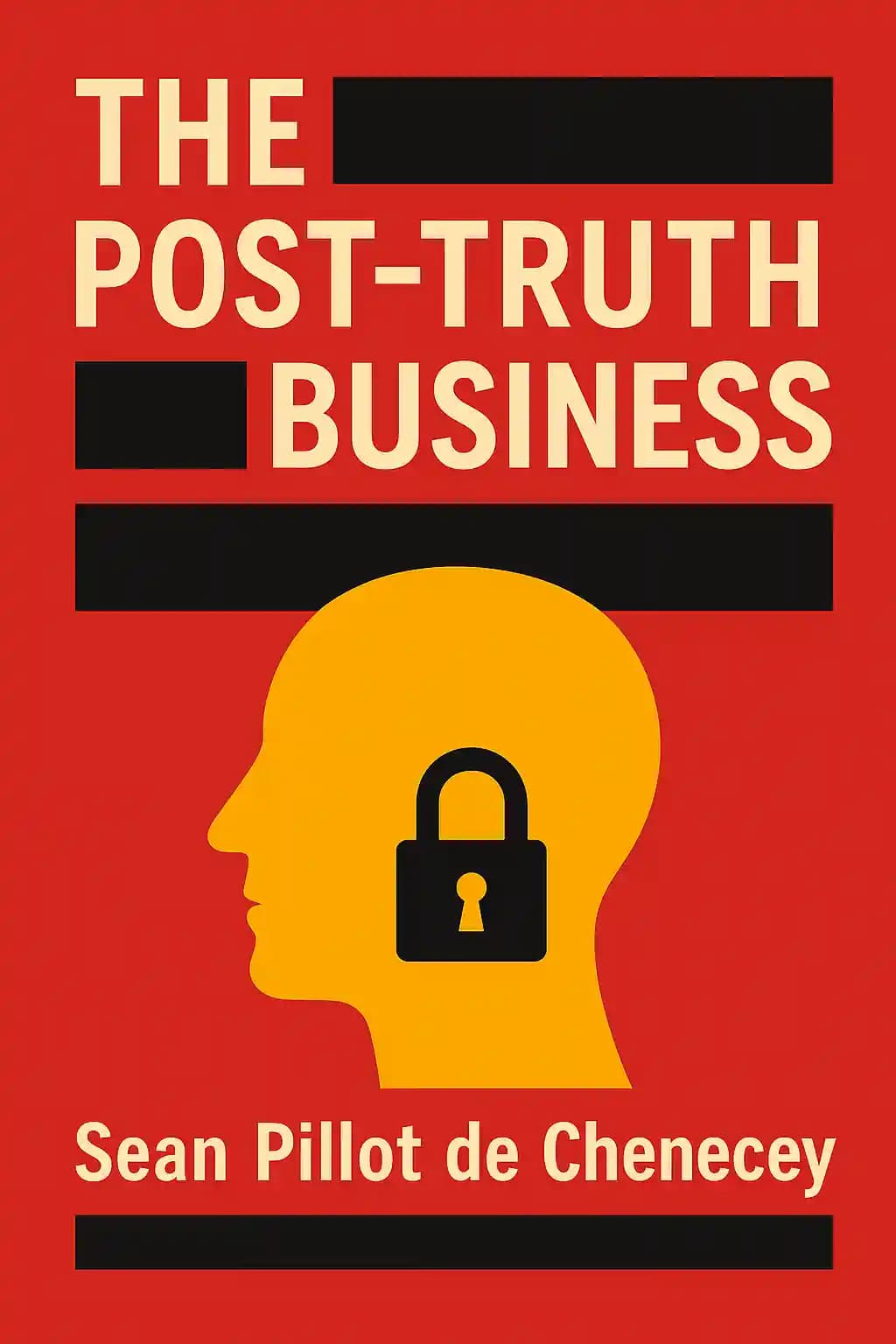
In a world where trust has plummeted from 72% to 32%, "The Post-Truth Business" reveals how brands can rebuild authenticity amid rampant misinformation. This 2019 Business Book Award finalist offers essential strategies for thriving in our global crisis of truth.
Sean Pillot de Chenecey is the bestselling author of The Post-Truth Business and a leading authority on brand ethics, strategic foresight, and consumer trust in the digital age. A futures consultant and dynamic keynote speaker, he combines two decades of experience advising global brands like Unilever, Microsoft, and Visa with his role as UK Partner at the Copenhagen Institute for Futures Studies.
His work explores the intersection of authenticity, corporate responsibility, and disruptive trends—themes amplified in his follow-up book Influencers & Revolutionaries, shortlisted for Business Book of the Year Awards.
Renowned for bridging academic insight with real-world applications, Pillot de Chenecey hosts the acclaimed The New Abnormal podcast (250,000+ downloads) and contributes to platforms like the World Economic Forum. His speeches at venues ranging from the Tate Modern to the Empire State Building reinforce his status as a thought leader on PESTLE challenges. The Post-Truth Business became an instant No. 1 business bestseller and 2019 Business Book of the Year finalist, establishing frameworks now used by Fortune 500 companies to navigate reputation management in crisis-prone markets.
The Post-Truth Business explores how brands can rebuild trust and ethical integrity in an era of disinformation, fake news, and societal polarization. It combines rigorous research, expert interviews, and case studies to provide actionable strategies for navigating challenges like corporate transparency, reputation management, and moral leadership. The book serves as a "field manual" for marketers and leaders seeking to future-proof their organizations.
This book is essential for marketers, CEOs, brand strategists, and policymakers grappling with trust deficits in modern business. It’s particularly valuable for professionals in sectors like retail, tech, and finance who need frameworks for ethical decision-making and crisis communication. Academics studying corporate ethics or media literacy will also benefit from its interdisciplinary insights.
Yes—it reached No. 1 in business-bestseller charts and is praised as the "ultimate handbook" for reputation management. Sean Pillot de Chenecey’s blend of anthropological research, trend forecasting, and real-world examples (e.g., Unilever, Visa) offers practical tools for addressing post-truth challenges. Updated editions are planned for 2026, ensuring ongoing relevance.
Key ideas include:
The book argues that ethical brands must move beyond "virtue signaling" to implement systemic changes, such as equitable supply chains and data privacy safeguards. It critiques superficial ESG efforts and highlights companies like Patagonia and Ben & Jerry’s as benchmarks for authentic social responsibility.
Pillot de Chenecey introduces:
It expands on themes from his podcast #TheNewAbnormal and complements his second book, Influencers & Revolutionaries, which analyzes cultural trendsetters. Together, they provide a blueprint for balancing ethical governance with innovation.
Some readers note its broad scope—covering politics, tech, and sociology—might overwhelm niche practitioners. However, its interdisciplinary approach is widely praised for mirroring the complexity of modern business challenges.
With AI-driven deepfakes, climate disinformation, and polarized consumers, the book’s strategies for combating misinformation and fostering stakeholder trust remain critical. Its 2026 update will address emerging tools like blockchain verification and generative AI ethics.
Unlike Atomic Habits (personal routines) or Sapiens (historical anthropology), this book focuses specifically on organizational ethics in the digital age. It’s closer to Trust and Inspire by Stephen M.R. Covey but with a stronger emphasis on futurism and cultural trends.
Examples include:
저자의 목소리로 책을 느껴보세요
지식을 흥미롭고 예시가 풍부한 인사이트로 전환
핵심 아이디어를 빠르게 캡처하여 신속하게 학습
재미있고 매력적인 방식으로 책을 즐기세요
We're living in a media landscape where truth is deliberately manipulated.
Trust forms the foundation of every business relationship.
Privacy has become a central battleground in modern marketing.
Most consumers wouldn't care if 74% of brands they use vanished.
We must not surrender to this post-truth reality.
Post-Truth Business의 핵심 아이디어를 이해하기 쉬운 포인트로 분해하여 혁신적인 팀이 어떻게 창조하고, 협력하고, 성장하는지 이해합니다.
Post-Truth Business을 빠른 기억 단서로 압축하여 솔직함, 팀워크, 창의적 회복력의 핵심 원칙을 강조합니다.

생생한 스토리텔링을 통해 Post-Truth Business을 경험하고, 혁신 교훈을 기억에 남고 적용할 수 있는 순간으로 바꿉니다.
무엇이든 물어보고, 목소리를 선택하고, 진정으로 공감되는 인사이트를 함께 만들어보세요.

샌프란시스코에서 컬럼비아 대학교 동문들이 만들었습니다
"Instead of endless scrolling, I just hit play on BeFreed. It saves me so much time."
"I never knew where to start with nonfiction—BeFreed’s book lists turned into podcasts gave me a clear path."
"Perfect balance between learning and entertainment. Finished ‘Thinking, Fast and Slow’ on my commute this week."
"Crazy how much I learned while walking the dog. BeFreed = small habits → big gains."
"Reading used to feel like a chore. Now it’s just part of my lifestyle."
"Feels effortless compared to reading. I’ve finished 6 books this month already."
"BeFreed turned my guilty doomscrolling into something that feels productive and inspiring."
"BeFreed turned my commute into learning time. 20-min podcasts are perfect for finishing books I never had time for."
"BeFreed replaced my podcast queue. Imagine Spotify for books — that’s it. 🙌"
"It is great for me to learn something from the book without reading it."
"The themed book list podcasts help me connect ideas across authors—like a guided audio journey."
"Makes me feel smarter every time before going to work"
샌프란시스코에서 컬럼비아 대학교 동문들이 만들었습니다

Post-Truth Business 요약을 무료 PDF 또는 EPUB으로 받으세요. 인쇄하거나 오프라인에서 언제든 읽을 수 있습니다.
A president admits his "heart and best intentions" contradict the facts-and his popularity soars. Russian troll farms flood social media with fake news that reaches 130 million Americans. Your phone serves you ads for products you only mentioned in private conversation. Welcome to the post-truth era, where lies spread six times faster than truth, and trust has become the scarcest commodity in business. We're not just living through a crisis of information-we're experiencing the collapse of reality itself as a shared concept. What happens when consumers can no longer distinguish truth from fiction, and brands built on trust find themselves operating in a world where truth is optional? The answer isn't just troubling for democracy-it's an existential threat to every organization that depends on consumer confidence.