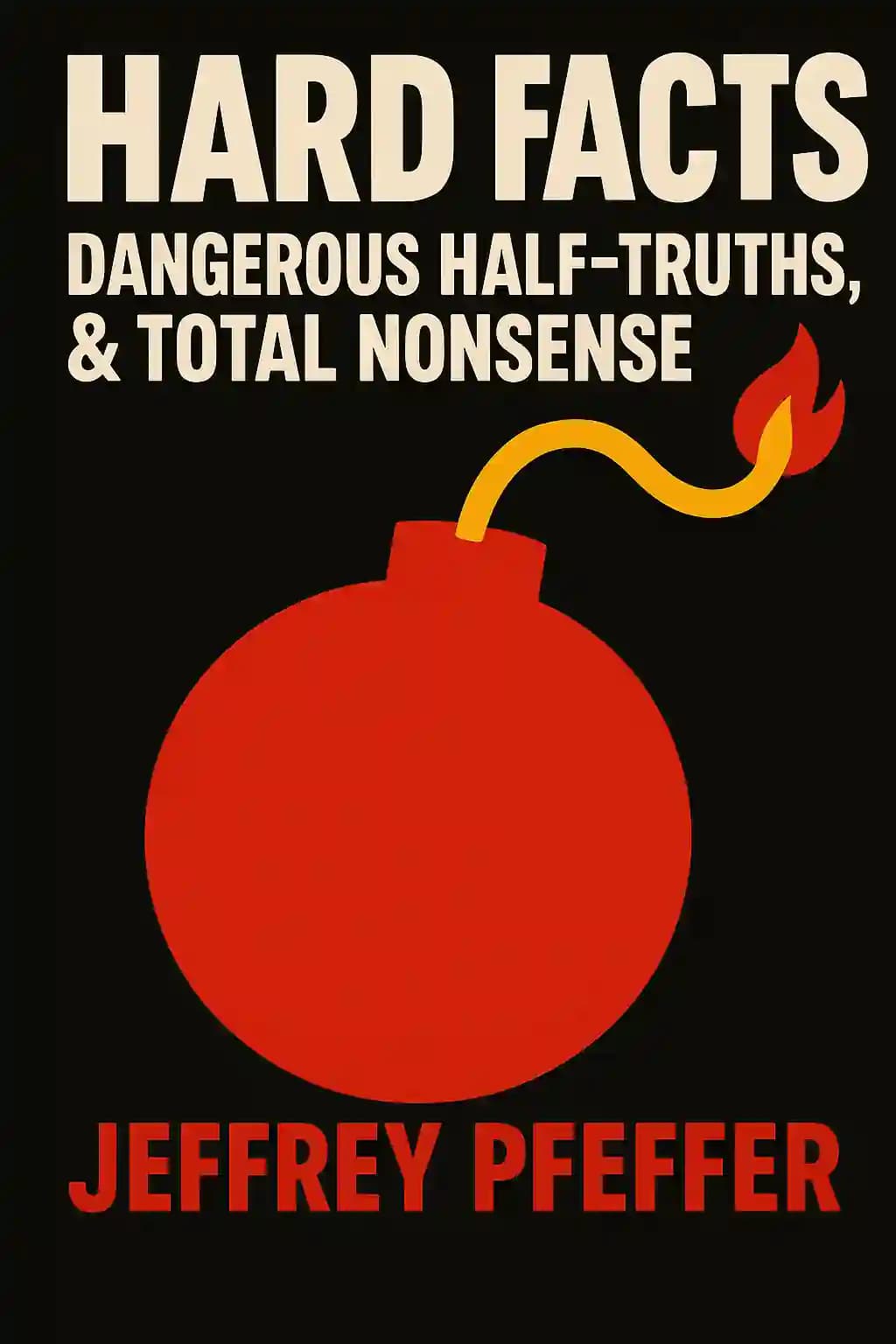
Challenging business dogma, "Hard Facts" exposes management myths that cost companies millions. Clayton Christensen calls it essential reading, while Google's leadership studies confirm its core premise: evidence trumps intuition. What dangerous half-truth is sabotaging your company right now?
Jeffrey Pfeffer and Robert I. Sutton, co-authors of Hard Facts, Dangerous Half-Truths, and Total Nonsense: Profiting from Evidence-Based Management, are leading voices in organizational behavior and data-driven leadership.
Pfeffer, the Thomas D. Dee II Professor at Stanford Graduate School of Business, and Sutton, a Stanford professor of management science and New York Times bestselling author, combine decades of research to challenge management myths. Their work emphasizes rigorous analysis over conventional wisdom, reflected in co-authored classics like The Knowing-Doing Gap and Sutton’s solo bestseller The No Asshole Rule.
Pfeffer’s influential books, including Power: Why Some People Have It—and Others Don’t, and Sutton’s blog Work Matters further establish their authority in merging academic insights with practical solutions. Hard Facts won the 2008 Prix du livre Ressources Humaines in France and was named The Globe and Mail’s best book of 2006, with translations spanning multiple languages. The duo’s frameworks are taught in top MBA programs and applied by executives worldwide.
Hard Facts, Dangerous Half-Truths, and Total Nonsense challenges flawed management myths and advocates for evidence-based decision-making. Authors Jeffrey Pfeffer and Robert I. Sutton dismantle six widespread but misguided beliefs about leadership, financial incentives, talent management, and organizational change, urging leaders to prioritize data over trends or outdated practices. The book provides actionable frameworks to replace guesswork with proven strategies.
This book is essential for managers, executives, and business leaders seeking to improve decision-making through data-driven insights. It’s also valuable for HR professionals, consultants, and students studying organizational behavior who want to avoid common management pitfalls and adopt evidence-based practices.
The book is co-authored by Jeffrey Pfeffer, a Stanford University professor and influential organizational behavior expert, and Robert I. Sutton, a renowned management scholar. Both have written extensively on leadership, workplace dynamics, and evidence-based practices.
Yes—this book is a critical resource for anyone tired of management fads. It combines rigorous research with practical advice, debunking myths like “financial incentives always boost performance” and “the best talent guarantees success.” Readers gain tools to make decisions rooted in data rather than hearsay.
Key concepts include:
The book critiques six dangerous half-truths, such as “change or die” mandates and the myth that charismatic leaders always succeed. Pfeffer and Sutton use case studies and research to show how these ideas lead to poor outcomes, offering alternatives like iterative testing and localized problem-solving.
Evidence-based management involves using data, scientific findings, and critical analysis to guide decisions. The authors argue against relying on anecdotes, ideologies, or superficial benchmarks, advocating instead for practices validated by reproducible results and contextual relevance.
Some readers argue the book’s academic tone may deter casual audiences, while others note that implementing evidence-based practices requires resources smaller organizations might lack. However, most praise its rigorous approach to dismantling harmful management norms.
The book remains relevant in 2025, particularly amid trends like AI-driven analytics and remote work. Its focus on data over dogma aligns with today’s emphasis on measurable outcomes, offering timeless strategies for navigating uncertainty and reducing bias in decision-making.
Like Pfeffer’s Leadership B.S. and Sutton’s The No Asshole Rule, Hard Facts emphasizes practicality over platitudes. However, it uniquely targets systemic myths in management, whereas their other books focus more on leadership behaviors and workplace culture.
In an era of misinformation and rapid change, the book’s call for critical thinking and evidence-based action resonates strongly. Its lessons help organizations avoid costly missteps, such as misguided mergers or ineffective incentive programs, by grounding decisions in reality.
저자의 목소리로 책을 느껴보세요
지식을 흥미롭고 예시가 풍부한 인사이트로 전환
핵심 아이디어를 빠르게 캡처하여 신속하게 학습
재미있고 매력적인 방식으로 책을 즐기세요
The best organizations are driven by the evidence, and they use it to get better.
Treat your organization as an unfinished prototype.
If doctors practiced medicine the way many companies practice management, there would be far more casualties.
The obsession with finding revolutionary ideas rarely produces actual results.
Hard facts, dangerous half-truths, and total nonsense의 핵심 아이디어를 이해하기 쉬운 포인트로 분해하여 혁신적인 팀이 어떻게 창조하고, 협력하고, 성장하는지 이해합니다.
Hard facts, dangerous half-truths, and total nonsense을 빠른 기억 단서로 압축하여 솔직함, 팀워크, 창의적 회복력의 핵심 원칙을 강조합니다.

생생한 스토리텔링을 통해 Hard facts, dangerous half-truths, and total nonsense을 경험하고, 혁신 교훈을 기억에 남고 적용할 수 있는 순간으로 바꿉니다.
무엇이든 물어보고, 목소리를 선택하고, 진정으로 공감되는 인사이트를 함께 만들어보세요.

샌프란시스코에서 컬럼비아 대학교 동문들이 만들었습니다
"Instead of endless scrolling, I just hit play on BeFreed. It saves me so much time."
"I never knew where to start with nonfiction—BeFreed’s book lists turned into podcasts gave me a clear path."
"Perfect balance between learning and entertainment. Finished ‘Thinking, Fast and Slow’ on my commute this week."
"Crazy how much I learned while walking the dog. BeFreed = small habits → big gains."
"Reading used to feel like a chore. Now it’s just part of my lifestyle."
"Feels effortless compared to reading. I’ve finished 6 books this month already."
"BeFreed turned my guilty doomscrolling into something that feels productive and inspiring."
"BeFreed turned my commute into learning time. 20-min podcasts are perfect for finishing books I never had time for."
"BeFreed replaced my podcast queue. Imagine Spotify for books — that’s it. 🙌"
"It is great for me to learn something from the book without reading it."
"The themed book list podcasts help me connect ideas across authors—like a guided audio journey."
"Makes me feel smarter every time before going to work"
샌프란시스코에서 컬럼비아 대학교 동문들이 만들었습니다

Hard facts, dangerous half-truths, and total nonsense 요약을 무료 PDF 또는 EPUB으로 받으세요. 인쇄하거나 오프라인에서 언제든 읽을 수 있습니다.
Imagine walking into a corporate boardroom where executives are about to make a multimillion-dollar decision based on what worked for a competitor, what they read in a business magazine, or simply what "feels right." This scenario plays out daily across the business world, and it's precisely what Stanford professors Jeffrey Pfeffer and Robert Sutton challenge in their groundbreaking work. Their central argument is both simple and revolutionary: most business decisions are based on hope, fear, imitation, or ideology rather than solid evidence. What if medicine were practiced this way? We'd consider it malpractice. Yet in management, this approach is not only tolerated but often celebrated. Consider the contrasting tales of two tech mergers: one spectacularly fails while Cisco successfully acquires dozens of companies without a hitch. The difference isn't luck or genius-it's evidence-based management. By systematically testing assumptions against data, companies like Harrah's transformed from industry followers to leaders. When Gary Loveman became COO, he famously declared three ways to get fired: stealing, harassing women, or implementing programs without experimental testing. This commitment to evidence over intuition helped Harrah's discover that local retirees were more profitable than high-rollers and that $60 in free chips generated more revenue than $125 packages with rooms and meals.