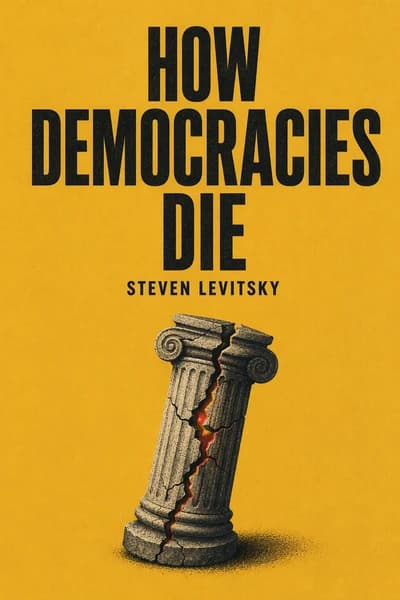
How Democracies Die
Overview of How Democracies Die
Harvard professors reveal how democracies collapse from within, not through violent coups but elected leaders eroding norms. Endorsed by Eric Holder, this NYT bestseller offers chilling historical parallels between Hitler, Chavez, and modern politics - a warning that's sparked global debate on democracy's fragility.

Key Themes in How Democracies Die
- democratic erosion
- political gatekeeping
- authoritarian warning signs
- unwritten political norms
- institutional guardrails
Quotes from How Democracies Die
Is our democracy in danger?
Democracy rarely dies through violent coups.
Establishment politicians invite populist outsiders into power.
Nobody thought that Mr. Chavez had even the remotest chance of becoming president.
Americans have long had an authoritarian streak.
Characters in How Democracies Die
- Steven LevitskyAuthor and scholar of democratic collapse
- Hugo ChavezVenezuelan populist leader and case study
- Rafael CalderaFormer Venezuelan president who enabled Chavez
- Huey LongLouisiana Governor and American populist figure
About the Author
About the Author of How Democracies Die
Steven Levitsky is a renowned political scientist, Harvard University professor, and bestselling author of How Democracies Die, a groundbreaking analysis of democratic erosion and authoritarian resurgence. As Director of Harvard’s David Rockefeller Center for Latin American Studies, his decades of research on political institutions, party systems, and authoritarian regimes—particularly in Latin America—inform the book’s examination of how democracies unravel from within.
Levitsky co-authored this prescient work with Daniel Ziblatt, blending historical case studies with contemporary insights to warn of threats to democratic norms.
A prolific scholar, Levitsky has written or edited over a dozen books, including Tyranny of the Minority and Competitive Authoritarianism (with Lucan Way), which explore institutional vulnerabilities and hybrid regimes. His commentary regularly appears in The New York Times, The Washington Post, and The Atlantic, and he advises organizations like Protect Democracy on safeguarding electoral integrity.
How Democracies Die has sold millions of copies worldwide, been translated into 30 languages, and remains a critical resource in political science and public discourse on governance.
Download Summary of How Democracies Die
Get the How Democracies Die summary as a free PDF or EPUB. Print it or read offline anytime.
FAQs About This Book
How Democracies Die examines how modern democracies erode from within through elected leaders who undermine institutions, norms, and civil liberties. The authors argue that democracies today collapse incrementally via legal maneuvers, media manipulation, and polarization—not coups—using case studies like Trump’s presidency, Chávez’s Venezuela, and Hitler’s Germany. Key themes include the erosion of mutual tolerance and institutional forbearance as critical democratic guardrails.
This book is essential for political science students, policymakers, and citizens concerned with preserving democratic systems. It offers insights for those analyzing authoritarian trends, historical parallels, or strategies to combat polarization. Readers interested in U.S. politics, Latin American democratization, or global populism will find its comparative approach valuable.
Yes—it provides a data-driven framework to recognize authoritarian tactics, emphasizing that democracies often fail through elected leaders’ gradual power grabs. Its blend of historical analysis (e.g., Hitler, Fujimori) and modern examples (Trump, Orbán) makes it both timely and actionable. The book has been widely cited in academic and public discourse on democratic resilience.
The authors identify four behavioral red flags:
- Rejecting democratic rules (e.g., questioning election validity).
- Denying opponents’ legitimacy (labeling rivals as threats).
- Encouraging political violence.
- Restricting opponents’ civil liberties, including press freedom.
These indicators help assess leaders’ authoritarian tendencies, from Hitler to Trump.
- Mutual tolerance: Accepting political opponents as legitimate, even when disagreeing.
- Institutional forbearance: Restraining from exploiting legal loopholes for partisan gain (e.g., avoiding extreme gerrymandering).
The authors argue these norms, not just laws, protect democracies from collapsing into partisan warfare.
The book analyzes Hitler’s rise via Weimar Germany’s crises, Chávez’s dismantling of Venezuela’s checks and balances, and Fujimori’s autocratic shift in Peru. These cases show how leaders exploit economic instability, polarization, and institutional weakness to consolidate power.
Polarization erodes democratic norms by framing opponents as existential threats, incentivizing extremism. The authors highlight how U.S. politicians since the 1990s engaged in “constitutional hardball” (e.g., blocking Supreme Court nominations), weakening bipartisan cooperation.
Recommendations include strengthening bipartisan coalitions, rebuilding guardrail norms, and marginalizing extremist factions. The authors stress civic engagement, independent journalism, and institutional reforms to reduce polarization.
Unlike works focusing on military coups (The Third Wave), Levitsky/Ziblatt emphasize elected autocrats’ legalistic tactics. It complements Crisis and Leviathan by linking democratic erosion to crises exploited by leaders.
Some scholars argue it overemphasizes elite behavior over structural factors like inequality. Others note its U.S.-centric lens underplays global variation in democratic erosion. Still, its framework remains influential in political science.
With rising authoritarianism in Hungary, Turkey, and beyond, the book’s lessons on norm erosion and institutional safeguards remain urgent. Its analysis of disinformation and partisan media resonates in an era of AI-driven polarization.
While critiquing elite gatekeepers’ failures, the authors caution against overreliance on voters to curb extremism. They advocate civic education and grassroots movements to reinforce democratic norms amid populist threats.