Capítulo 1
Breaking the Boundaries of Your Mental Models
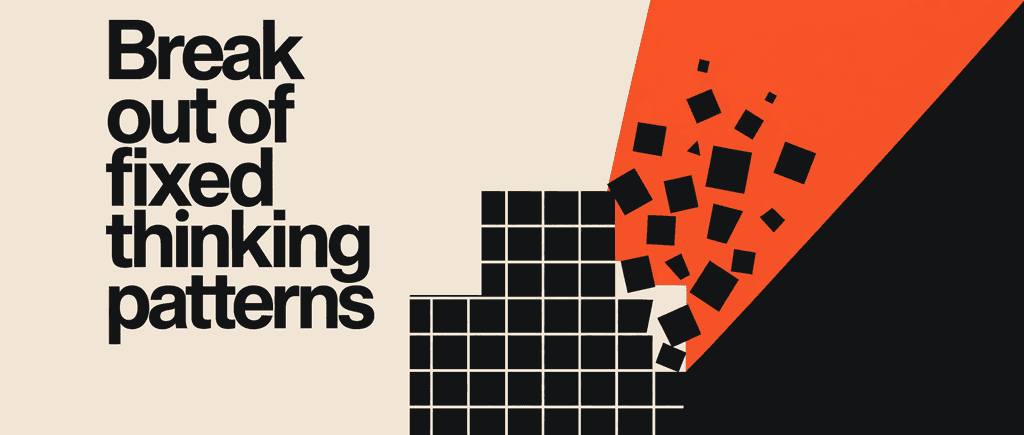
Have you ever noticed a dog continuing to jump over an imaginary fence even after it's been removed? This phenomenon isn't limited to our four-legged friends. We humans create countless mental "boxes" that help us understand our complex world-but these same models can prevent us from seeing opportunities when circumstances change. As the world accelerates, our ability to "think in new boxes" has become the crucial differentiator between those who thrive and those who merely survive. Unlike the popular but flawed advice to "think outside the box," this approach recognizes that we can't think without boxes-we need mental models. The key is developing the skill to create fresh ones when needed. This revolutionary framework, developed through decades of consulting with global organizations, offers a systematic approach to achieving productive creativity that transforms how we interpret challenges and solve problems-potentially helping you create the next Post-it note or iPad while preparing for multiple possible futures.
Capítulo 2
The Essential Nature of Mental Boxes
Our minds constantly build mental models to simplify the infinite complexity around us. Consider the rainbow-commonly taught as having seven distinct colors despite actually being a continuous spectrum. This simplification illustrates how we create "boxes" to manage reality. These boxes range from small categorizations ("consumer electronics companies") to paradigms so large we forget they're constructs ("democracy").
The problem isn't that we use boxes-we must use them to think at all. The problem arises when we forget they're merely simplified representations of reality. When circumstances change, our existing boxes can become limitations rather than assets. This explains why "thinking outside the box" is inadequate advice-it's nearly impossible to escape existing mental models, challenging to determine which specific box needs escaping, and even if you succeed, you still need a new box to replace it.
The phrase "thinking outside the box" likely originated from the nine-dot puzzle popular in corporate culture of the 1960s-70s. The puzzle requires drawing four straight lines through nine dots without lifting your pen, which can only be solved by extending lines beyond the grid's boundaries. While this puzzle prompted important questions about mental constraints, it failed to address the crucial next step-creating new frameworks.
True creativity requires understanding your existing boxes, developing a range of new ones, and choosing which to use. This approach has powered history's greatest innovations, from BIC's evolution from pen manufacturer to maker of "disposable plastic items" (leading to successful expansions into lighters and shavers), to Apple's transformation of the mobile phone industry.
Our minds employ two essential thinking modes: deduction (using existing boxes to find limited correct solutions) and induction (making new associations, taking risks, and imagining). Deduction applies models to act in the world, while induction observes the world to create or update models. Both are essential for practical creativity, though they serve different purposes.
Capítulo 3
The Five-Step Approach to New Mental Models
The five-step framework builds on understanding how human minds think and reason, providing tools to free ourselves from existing beliefs and discover original perspectives:
1. Doubt Everything: Challenge all your existing knowledge and mental boxes, recognizing they're merely hypotheses. Question how you define problems, step outside your cognitive comfort zone, and frame issues in provocative new ways.
2. Probe the Possible: Examine your world with refreshed awareness, identifying essential changes likely to shape your field. Explore future clients' needs, competitor actions, and global megatrends. This step helps ask the right questions rather than seeking right answers.
3. Diverge: Generate numerous ideas, models, and hypotheses without immediate judgment. This step frees your mind to consider even seemingly foolish concepts through various divergence exercises.
4. Converge: Switch from open-minded ideation to analytical testing, transforming your long list into a select group of implementable ideas with breakthrough potential.
5. Reevaluate Relentlessly: Recognize that no idea remains good forever in our changing world. Monitor "weak signals" indicating when current thinking approaches obsolescence, and maintain agility to take thoughtful risks and learn from failure.
This process works flexibly-steps can be used in different orders or repeated multiple times as needed. The approach should be adapted to your specific needs, embracing the interplay between objective analysis and subjective risk-taking to find the right questions rather than just thinking "outside the box."
Capítulo 4
Questioning What You Think You Know
The first step toward thinking in new boxes requires doubting everything-your fundamental beliefs, perceptions of reality, and assumptions about the future. This builds on Descartes' methodological skepticism, requiring personal humility about your existing thought patterns. When you question first impressions and accept you can't always know the "right" answer, creativity flourishes. Even Steve Jobs acknowledged creativity is largely about connecting experiences and synthesizing new things, requiring humility about one's own boxes.
Changing existing ideas proves much harder than generating new ones, which explains why industry outsiders often have breakthrough moments-like Facebook implementing social networking rather than AOL. Step 1 involves acknowledging the comfort of your current boxes, as people are often blind to their automatic responses and assumptions.
Consider Dick Fosbury, who revolutionized high jumping with his back-first technique that initially looked ridiculous. Unable to win using conventional methods, Fosbury experimented and discovered he could clear six inches higher than his previous best by lifting his hips and laying flat on his back. Despite being mocked as "a guy being pushed out of a 30-story window," Fosbury won gold by clearing 7'4.25". Today virtually all Olympic high jump medalists use the Fosbury flop-illustrating how people's unspoken affection for familiar boxes creates resistance to genuinely new approaches.
To foster creativity, we must recognize how cognitive biases shape our mental models. Our brains, while marvelous, are also lazy-defaulting to automatic, simplified processing. Optical illusions reveal how our minds can deceive us. This tendency toward simplification serves us well in many contexts but can limit creative thinking. Step 1 teaches us to question our assumptions, embrace complexity, and consider multiple perspectives.
Capítulo 5
Investigating the World in Front of You
Step 2 requires becoming an explorer of the uncharted seas before you. Having identified existing mental models and biases in Step 1, you can now investigate reality with heightened focus and sensitivity. This isn't about understanding everything (which is impossible) but about seeking to understand through better questions.
While spontaneous creativity exists, true innovation requires thorough research and preparation. Even apparent "Eureka" moments-from early television to Apple's revolutionary products-occurred only after innovators had deeply immersed themselves in existing knowledge.
The investigation process focuses on three concentric spheres: the broad global environment, your industry or field, and your specific organization or personal context. Within these spheres, three critical areas of inquiry are highlighted:
1. Consumer Insight: Developing deep customer knowledge means questioning who your customers really are-existing, potential, and unlikely ones. Categorize them into segments, understand their unique relationships with your products, and identify their true motivations. The Jungheinrich Group discovered their forklift customers valued comfort and service over just power and reliability, leading them to place yellow sofas in sales offices (for customers only) and focus on remote diagnostics-dramatically increasing profits.
2. Competitive Intelligence: You must question whether those you consider competitors see themselves in the same business, and understand the unstated factors guiding their strategies. PepsiCo and Coca-Cola illustrate this complexity-while they compete in beverages, PepsiCo derives nearly 50% of its $65 billion revenue from food brands like Frito-Lay and Quaker, making Coke ($47 billion from drinks alone) not PepsiCo's primary competitor.
3. Megatrends: Large social, economic, political, environmental, or technological changes likely to have major impacts across many areas. Unlike fads, megatrends play out over extended periods (typically five to ten years) and have wide-reaching potential impacts that demand strategic responses. Urbanization exemplifies a powerful megatrend-in 1950, only 29% of people lived in cities; by 2000, this had grown to 47%; and projections suggest 70% by 2050.
When analyzing megatrends, first compile a broad list, then distill it to identify the key vectors shaping your future. Consider which seemingly irrelevant trends might become surprisingly critical. Look for "wild cards"-unexpected events with enormous impact that seem obvious only in retrospect-as well as "boiling frogs" (slow-moving changes that often go unnoticed until it's too late) and "elephants in the room" (obvious issues that don't receive proper attention).
Philips exemplifies how to leverage trends, customer insights, and competitive intelligence to create "meaningful innovation." Their AirFloss product emerged from recognizing that while people know they should floss, many find it too difficult. Rather than focusing on effectiveness or speed, Philips deliberately framed the challenge around ease: "How can we find a way to clean between teeth in an easy way?" Similarly, the Airfryer addressed rising obesity rates alongside consumers' desire for tasty yet healthy food, becoming a success in over 80 countries.
Capítulo 6
The Art of Divergence
Divergence is about encouraging the expression of diverse and sometimes wildly opposing ideas-even those that seem absurd. NASA's Mars Pathfinder landing using airbags to bounce rather than make a traditional landing exemplifies this creative thinking. Similarly, Linus Torvalds' creation of the free Linux operating system challenged fundamental business assumptions about proprietary software.
But effective divergence isn't random brainstorming. It requires carefully framed questions that focus creativity within meaningful boundaries. Questions like "What would it take for 60% of Americans to set your website as their home page?" provide specific direction while encouraging expansive thinking.
The "low-cost" concept has transformed industries from airlines to publishing, but could it work for something as critical as heart surgery? Dr. Devi Shetty proved it could by creating a revolutionary hospital model in Bangalore. Inspired by Mother Teresa and troubled by patients turning away from healthcare they couldn't afford, Dr. Shetty applied economies of scale to cardiac care. His 1,000-bed hospital uses inexpensive supplies where possible while maintaining top-quality diagnostic equipment. Surgeons perform 2-3 procedures daily, six days weekly, becoming exceptional specialists through volume. The result? Heart surgeries costing $2,000 versus $20,000-$100,000 in America.
Divergence works best with others, generating a wider range of results than working alone. Choose a setting physically or psychologically removed from your everyday environment to free yourself from distractions and associations. During this phase, focus on quantity rather than quality-the best way to have good ideas is to have many ideas. No proposal, however seemingly absurd, should be immediately rejected.
The greatest impediment to developing exciting ideas is the "Yes...but..." attitude that quickly shuts down creativity. Instead, embrace "Yes, and..." which builds upon ideas rather than dismissing them. This isn't about being politically correct-it's a logical approach that forces idea development.
Before diving into divergence, warm up your imagination with creative introductions where participants share something unusual about themselves or their work. These warm-ups help sensitize participants to how existing mental models and subconscious biases constrain thinking.
After warming up, it's time to dive into divergence exercises that stimulate fresh thinking about your central question:
1. Describe Your Company Without Using Five Key Words: This forces you to abandon fundamental perceptions about your organization. When champagne producer Castellane avoided words like "champagne," "alcohol," and "bottle," they realized their true purpose was "contributing to the success of parties and celebrations." This insight spawned numerous innovations.
2. Break Constraints: This exercise methodically shatters existing mental models by identifying constraints and deliberately breaking them. Solar power companies brilliantly broke the constraint of high upfront installation costs by creating a leasing model.
3. Imagine Your Company Has Disappeared: This forces creative future thinking by imagining your organization no longer exists in 2025, then speculating why.
4. Break Your Company in Two: This asks you to hypothetically divide your organization into two mutually exclusive but comprehensive parts, revealing new perspectives on organizational structure.
5. Imagine a Forced Joint Venture: This begins by listing well-known companies from unrelated industries, then randomly selecting one to imagine potential joint ventures with your organization.
6. Adopt a New Perspective: This involves immersing yourself in a completely different viewpoint to generate fresh ideas.
7. Write Your Own Newspaper Headlines: This asks participants to imagine future newspaper headlines about their organization in specific publications.
8. Build on Oxymorons: This uses contradictory word combinations like "virtual reality" to provoke radical departures from conventional thinking.
After generating ideas through divergence exercises, it's time to edit and "crush" them. This phase emphasizes "Yes, and..." conversations rather than criticism. "Crushing" involves systematically transforming ideas using verb commands like "make it bigger," "make it sparkle," or "add nostalgic appeal."
Capítulo 7
The Critical Convergence
Divergence and convergence represent fundamentally separate thinking processes that cannot be pursued simultaneously. While divergence unleashes creativity without judgment, convergence requires evaluation, prioritization and decision-making to determine which ideas have the best chance to succeed.
Before beginning convergence in earnest, determine three critical elements: (1) key "make it or break it" practical constraints like budget limitations or regulatory requirements; (2) subjective criteria for evaluating ideas, such as cost, time, organizational fit, and required expertise; and (3) selection and voting procedures, including how to prioritize ideas and weight different criteria.
When evaluating new boxes, consider:
1. Alignment: Does the idea align with your organization's strategic outlook, leverage your competencies, and comport with your values and culture?
2. Feasibility: Can the new idea succeed with your current resources, fit your time horizon, produce sufficient financial returns, work with your marketing infrastructure, meet geographical requirements, satisfy regulatory standards, align with your technological capabilities, and operate within your research resources?
3. Impact: How does the idea affect your reputation and brand, create competitive advantage, influence external stakeholders, improve operational efficiency, and what are the risks and consequences of failure?
To make final decisions, review your key objective, all proposed ideas, relevant constraints, and criteria, then outline your approach to prioritize and evaluate. Remember that there's rarely one "right" answer-selecting which box to pursue is inductive, not deductive. Even the best strategy remains a working hypothesis.
Taking your best ideas through additional rounds of divergence and convergence is invaluable, especially when you've created a broad box that needs to be filled with specific execution ideas. This isn't about repeating the same exercises, but building upon your output with fresh perspectives, combining ideas, or expanding promising concepts.
Capítulo 8
Reevaluating Relentlessly
No idea is good forever. No matter how brilliant or effective, every box you conceive will need modification, improvement and eventual replacement. The creative process is constant, with our five steps remaining in continuous play.
Reuters exemplifies brilliant box evolution since its 1850 founding. While maintaining its overarching box of message and news delivery, the company continuously implemented new technologies-starting with homing pigeons to bridge telegraph gaps between Aachen and Brussels, then embracing the telegraph fully after moving to London in 1851. By 1882, they adopted the telex for longer communications, followed by radio transmissions in 1923, satellites in the 1960s, and internet applications in the 1990s.
Knowing when to replace your boxes is critical for survival. Netflix's 2011 decision to split into two companies-Netflix for streaming and Qwikster for DVD mailings-demonstrates acting too quickly. CEO Reed Hastings misjudged customer readiness to abandon physical DVDs, resulting in 800,000 subscriber losses and a 25% stock price drop. Conversely, many organizations cling to outdated boxes too long. The business landscape demands increasing adaptability-in 1960, top companies remained leaders for about forty years; by 1990, this dropped to fourteen years; today it's often fewer than ten.
Knowing when to replace existing boxes requires developing a prospective mindset-becoming attuned to potential future changes and detecting their early signals. The signs of necessary change exist along a spectrum: from obvious paradoxes and Caramba moments that demand immediate response, to subtle "weak signals" that your current biases might cause you to overlook or dismiss.
When you experience a Caramba moment-being hit over the head with change like a cellphone manufacturer confronting the iPhone-it's time to rethink your boxes. Paradoxes also signal the need for new boxes, as when observations contradict your mental models.
Beyond obvious Caramba moments, you must monitor subtle indicators that your boxes need updating. Create a customized list of weak signals relevant to your organization and industry. Watch for changing value propositions, unmet consumer needs, new competitors disrupting your market, breakthrough technologies, concerning shifts in core metrics, unfulfilled opportunities, broad disruptive events, and team premonitions.
Even when your company operates perfectly with excellent revenues and profits, your role isn't to "sit back and relax" but to reevaluate relentlessly, determining which new boxes to implement next and when to do so. Ferran Adria exemplifies this mindset-despite running elBulli, named "best restaurant in the world" with two million reservation requests annually, he closed for six months each year specifically to refresh his boxes and maintain creative edge.
Capítulo 9
Creating Bold New Boxes for the Future
What mental shifts must occur before the seemingly impossible becomes possible? When Swiss daredevil Remo Lang flew sixteen miles across the Swiss Alps in a wing suit at speeds exceeding 300 mph, he first had to replace the box that said "Humans cannot fly on their own" with one that said "Of course humans can fly, why not?"
Creating paradigm-shifting boxes requires working toward greater freedom of thought. Boxes exist within larger boxes, like Russian dolls, and as you create more specific "boxes within boxes," they lead to more focused objectives and useful ideas. Moving between these various levels requires constant reexamination and modification of your thinking-these perceptual shifts are the essential fuel of creativity.
When faced with horrifying gun violence statistics-211 Chicago Public Schools students shot (23 fatally) in 2007-2008, rising to 290 shot (32 fatally) the following year-school leaders needed a radical perceptual shift. Their established strategy focused on vigilance through surveillance cameras and security guards, but as deaths mounted, they began doubting this approach's sufficiency. Working with consultants, they shifted from a surveillance paradigm to a prevention model by analyzing data from over 500 shooting incidents. This allowed them to assign specific risk probabilities to each student, identifying about 200 "ultra-high risk" students (20% chance of being shot) and 1,000 "very high risk" students (7.5-20% chance). With this new prevention box, they implemented targeted interventions including mentoring, enhanced security in risky neighborhoods, and "safe passage" programs. The result: a 16% drop in shootings the following year.
Cognitive shifts that create new boxes vary in scale and impact. Some alter the "big picture," while others seem subtle but remain powerful. A slight modification like broadening "We make hamburgers with 100 percent beef" to "We make patties" could triple revenues through mushroom, turkey, or lentil alternatives. Seeing previously unrelated concepts as complementary can create exciting new boxes, like Hershey's Reese's campaign combining chocolate and peanut butter.
A strategic vision is an ambitious image of a radically preferable future that serves as a powerful mental model for organizations. Unlike vague, generic statements that any competitor could use, effective visions like AT&T Labs' goal "to design and create in this decade the new global network" provide clear direction. A well-framed vision statement contains three key components: the vision itself (fundamental aspirations), the values upon which the firm is built, and the promises to stakeholders.
Capítulo 10
Preparing for Multiple Futures
Scenarios are a powerful application of thinking in new boxes-creating alternate possible but unlikely futures to prepare organizations for unpredictable conditions. While underused, they help improve strategic thinking and long-range planning by expanding what we consider possible. Typically involving three or four distinct plausible futures, scenarios aren't predictions but tools to broaden perspective and develop shared language among colleagues.
Consider an AMC Theatres executive workshop developing scenarios for moviegoing in 2025. One scenario, "Fit Family World," reimagines theaters offering fitness benefits instead of sedentary experiences. Another, "Custom Leisure World," envisions personalized multisensory experiences in communal spaces using virtual reality technology. Organizations often implement elements from multiple scenarios rather than adopting any single one completely.
Creating scenarios requires four key building blocks: (1) inputs like major trends affecting your industry; (2) wild cards or extreme possibilities that would significantly impact those trends; (3) variables representing real-life situations where trends would play out; and (4) hypotheses about what could happen in each situation.
When analyzing megatrends, organizations often rely on instinct or deductive reasoning based on past relevance rather than expansive inductive thinking. A more effective approach starts with a comprehensive list spanning multiple categories (demographic, regulatory, technological, economic, consumer, etc.) before narrowing down based on impact potential, certainty, and organizational readiness.
Scenario planning isn't about predicting the future with certainty-it's about embracing ambiguity and using inductive reasoning to move from observable trends to constructed mental models. While some analytical minds try to impose excessive order by listing hundreds of trends or developing too many scenarios, this can lead to diminishing returns and even paralysis. Einstein's wisdom applies: "Everything should be made as simple as possible, but not simpler."
Capítulo 11
Implementing the Five Steps in Your Life
While you can apply these creative techniques alone, particularly for personal problems, you'll generate better solutions by involving others in the diverging process. Even small groups of three to four people can produce amazing results. The power of multiple minds produces a wider range of ideas, which is essential for sustainable creativity.
Include people with different backgrounds, perspectives, and experiences when organizing creativity sessions. This diversity leads to a greater range of ideas and overall imaginativeness. Set a tone that allows everyone to speak up regardless of status, and consider breaking down hierarchies through warm-up exercises.
Before beginning the creative process, clearly define your specific objectives. Consider whether you're seeking a long list of ideas or need to prioritize a few top concepts. Are you developing new products, improving operations, or reimagining your business model? Most importantly, frame your questions to provoke maximum creativity.
The ideal creative environment is somewhere off-site, comfortable, and unfamiliar. New surroundings provide fresh perspectives that stimulate new thinking. This could be a boutique hotel, a retreat in nature, a sports venue, or simply a local restaurant. Even with limited resources, you can meet in a park, someone's home, or an unexpected part of your office.
Avoid rushing the creative process. Often the best ideas emerge toward the end of sessions when people have relaxed and begun to see things differently. While effective sessions can range from two hours to a week, most clients spend a full day on the first four steps, with at least three hours for divergence and one to two hours for convergence.
Thinking in new boxes is fundamentally about increasing your awareness of how we create and use mental models. This paradigm emphasizes the interplay between broad new boxes and the smaller ones that fill them, with unlimited creative potential. Your challenge is to embrace the unexpected, take creative risks, and free yourself from existing mental constraints. As Sartre said, "freedom is what you do with what's been done to you." Whether addressing climate change, personal relationships, or business goals, it's your mind and your boxes that will take you there. You have the freedom to shape the future by breaking constraints and seeing the world in new ways.