Capítulo 1
Unleashing Your Creative Genius: The Path to Innovative Thinking
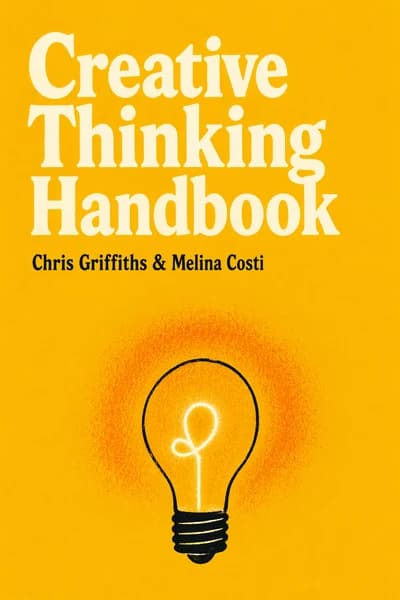
When was the last time you had a truly original idea? If you're like most adults, your answer might be troubling. According to a NASA study, while 98% of five-year-olds score in the "highly creative" range, only 2% of adults over 25 retain this ability. This striking statistic reveals a sobering truth that Chris Griffiths explores in "The Creative Thinking Handbook": creativity isn't something we lose-it's something we neglect. This practical guide has become required reading at companies like Microsoft and Disney, where innovation isn't just encouraged but essential for survival. As the business landscape evolves at breakneck speed, with the average lifespan of S&P 500 companies plummeting from 61 years to just 18, Griffiths offers a systematic approach to reclaiming our innate creative abilities before we become the next Blockbuster or Blackberry-companies that failed to innovate and paid the ultimate price.
Capítulo 2
The Creativity Crisis: Why Knowledge Alone No Longer Guarantees Success
In today's rapidly evolving business environment, simply knowing things is no longer enough. The traditional adage that "knowledge is power" has become outdated. Instead, creativity-the ability to generate novel and useful ideas-has emerged as the true currency of competitive advantage.
This shift represents a fundamental change in how we must approach problems. Consider a simple exercise: try listing the months of the year in alphabetical order. Most people struggle with this task because it requires breaking familiar patterns. Our minds have been trained to think of months chronologically, and shifting to an alphabetical perspective feels unnatural. This small example illustrates a much larger point: 21st-century problems contain too many variables to be solved with existing knowledge alone.
The statistics paint a concerning picture. Research shows that while 82% of companies believe creativity strongly connects to business results, 61% of senior managers don't see their companies as creative. Only 11% believe their practices align with creative approaches, and a shocking 10% feel their organizational practices directly oppose creativity. This "creativity gap" represents a significant blind spot for modern businesses.
Why does this gap exist? Our educational system bears much of the responsibility. From an early age, we're taught to memorize "right answers" rather than generate new ideas. We learn that mistakes are bad and develop a fear of unconventional thinking. Unlike children who approach problems with boundless curiosity, adults become bound by rigid conventions and assumptions.
The good news is that creativity isn't permanently lost-it simply withers through neglect, like an unexercised muscle. With deliberate practice and the right techniques, anyone can redevelop their creative capabilities. The key is learning to think "without the box" altogether-eliminating the assumptions, habits, biases, and default thinking patterns that limit innovation.
When Apple developed the iPhone without a keypad, they weren't thinking "outside the box"-they eliminated the box entirely, disrupting the market and toppling Nokia. This kind of breakthrough requires overcoming the common brainstorming blunders that plague most organizations: retreating to safe options, analyzing prematurely, adopting a negative outlook, or latching onto the first seemingly good idea without proper exploration.
As Thomas Dewar wisely noted, "Minds are like parachutes. They function only when open." The challenge lies in identifying and removing the mental locks restricting your thinking-the common errors that will be described throughout this book, along with strategies to reduce their impact.
Capítulo 3
Understanding Metacognition: The Foundation of Creative Problem-Solving
Our minds operate largely on autopilot. Every day, we process enormous amounts of information through pattern recognition and mental shortcuts that help us navigate routine tasks efficiently. While these automatic responses are useful for daily activities, they can severely restrict our creative potential when facing new challenges.
Consider how you get dressed in the morning or drive to work-these activities require little conscious thought because they follow familiar patterns. Similarly, in business, we develop default approaches to handling situations based on past experiences. These patterns save time and energy but can entrench us in single-path thinking that blinds us to new opportunities.
This is where metacognition-thinking about your thinking-becomes essential. Just as we strategize about diet, fitness, and appearance, we need to consciously manage our thinking processes. Research has linked metacognition to intelligence and successful problem-solving, yet few people apply the same strategic approach to their thinking that they do to other aspects of self-improvement.
The Decision Radar profiling tool offers a practical way to understand your thinking patterns. It assesses five key factors that influence creative decision-making:
1. Understanding: How well you define problems
2. Ideation: Your ability to generate new ideas
3. Reasoning: Your logical thinking habits
4. Analysis: How effectively you evaluate alternatives
5. Direction: Your skill in implementing decisions
After completing the assessment, you receive a visual pentagon showing your performance in each area. The closer to the outer green ring, the better; proximity to the inner red ring indicates areas needing improvement. This visual representation helps pinpoint specific weaknesses so you can target your development efforts more effectively.
The good news is that these thinking patterns aren't fixed-the brain can be trained for better outcomes. Organizations that work to reduce bias in decision-making achieve significantly higher returns (up to seven percentage points according to McKinsey). Similarly, companies with innovation-focused cultures saw net income increases of 756% compared to just 1% for those without creative thinking philosophies.
By identifying your thinking strengths and weaknesses, you can minimize risk areas, apply specific techniques to improve, and consider how team members might complement each other's thinking styles. After implementing the Solution Finder process outlined in this book, retaking the assessment will help measure your progress and continued growth.
Capítulo 4
Breaking Free from Selective Thinking: The Bias That Binds
Our minds can be remarkably capable yet deeply flawed when making decisions or solving problems. Psychology and behavioral science reveal we are "predictably irrational" in our thinking patterns, with selective thinking being perhaps the most harmful aspect of brainstorming and decision-making.
Selective thinking causes us to validate certain ideas while discounting others-like a camera filter that only allows certain light to pass through. When we believe we have a great option, we immediately seek to justify rather than question it. As philosopher Emile Chartier warned, "Nothing is more dangerous than an idea when it's the only one we have."
This bias manifests in multiple ways:
Selective attention causes us to see what we expect to see-like believing referees are biased against your favorite team while ignoring calls that favor them.
Selective recall means we remember only what we want to, as when two people recall the same event entirely differently.
Selective observation leads us to accept information that supports our position while ignoring counterarguments-what psychologists call "counting hits and forgetting misses."
These biases can affect anyone, including professionals like doctors, accountants, and politicians. They lead to several critical thinking errors:
1. Ignoring facts right in front of you, as Henry Ford did when he insisted customers could have "any color that he wants as long as it is black" despite clear market demand for variety-allowing General Motors to seize leadership with their "car for every purse and purpose" strategy.
2. Stopping at the first "right" answer, conditioned by education systems that train us to find the one correct solution rather than exploring multiple possibilities.
3. Becoming attached to pet ideas, like Kodak clinging to film-based products while digital photography revolutionized their market, leading to a 96% stock decline.
4. Being duped by expectations-we literally see what we expect to see, as demonstrated when researchers showed identical video footage to two groups but told one to expect HD quality, resulting in that group reporting seeing higher quality images.
5. Loss aversion-people hate losses about 2-2.5 times more than they enjoy equivalent gains, making us slow to sell losing investments and choose inaction over potential opportunities.
To overcome selective thinking, we must consciously challenge our natural tendencies. This means actively seeking disconfirming evidence, exploring multiple solutions even when we think we've found "the answer," and recognizing when our expectations are coloring our perception of reality.
Capítulo 5
The Reactive Mind: When Speed Undermines Creativity
In our digital age, we're conditioned to operate at increasingly frantic paces, rushing from task to task without adequate reflection. This reactive thinking-making quick, instinctive decisions without proper consideration-severely undermines our creative potential.
Daniel Kahneman's dual-process theory helps explain this phenomenon by dividing our thinking into two systems:
System 1 (fast, instinctive, emotional) processes information automatically using mental shortcuts, providing approximately correct answers quickly.
System 2 (slower, methodical, logical) follows a systematic approach, handling complex concepts and correcting System 1's errors when necessary.
While we like to believe we operate primarily through reasoned System 2 thinking, in reality, our reactive System 1 handles far more decisions than we care to admit, often at the expense of deeper analysis. The Cognitive Reflection Test demonstrates this perfectly-when asked questions like "A bat and ball cost $1.10 in total. The bat costs $1.00 more than the ball. How much does the ball cost?" most people immediately answer "10 cents" (the intuitive but incorrect System 1 response) rather than working out the correct answer of 5 cents (the analytical System 2 solution).
Reactive thinking introduces several systematic flaws that undermine effective decision-making:
1. First-mover disadvantage: Despite conventional wisdom about first-mover advantage, pioneering new products often proves costly and risky. First movers frequently launch prematurely with average features, allowing competitors to learn from their mistakes-as happened with Microsoft's tablet PC (eclipsed by iPad), Overture search engine (overshadowed by Google), and Friendster (outpaced by Facebook).
2. Mindless imitation: Like neighborhood dogs all barking after one starts, businesses often copy competitors without strategic thought, trapping themselves in a problem-reaction loop that makes planned innovation difficult.
3. Blindly following customer feedback: While understanding customer needs is essential, the "customer is always right" mantra can lock businesses into reactive mode. The New Coke fiasco perfectly demonstrates this-extensive consumer taste tests showed preference for the new formula but failed to reveal customers' emotional attachment to the original.
4. Information overload: In our digital age, we're drowning in a relentless flood of information that triggers reactive thinking and crushes creativity. UK adults spend eight hours daily consuming media-half their waking life. This constant bombardment forces quick, reactive decisions rather than thoughtful ones, as our working memory can only hold about seven items before struggling.
The solution lies in creating space for deeper thinking. Knowledge workers spend 25% of their day dealing with information overload, while only 5% is dedicated to thought and reflection. By eliminating distractions and simplifying our approach to problems, we create room for creativity and better decisions.
Capítulo 6
Challenging Assumptions: The Mental Shortcuts That Limit Innovation
Assumptions are mental shortcuts that help us make quick decisions without taxing our brains. While often useful, they can become our worst enemy when taken for granted. They limit perception, stifle creativity, and keep us retreading familiar paths instead of exploring new terrain.
These unquestioned beliefs permeate our thinking-instilled by parents, teachers, workplaces, and society. In business, they're implicit beliefs about customers, products, processes, and markets. Like mental shotguns, assumptions provide quick answers without hard mental work. While sometimes accurate, they become dangerous when unquestioned, making us think we know more than we do and preventing us from exploring alternatives.
To challenge assumptions effectively, follow this three-step process:
1. Clearly state your problem (e.g., "Set up a restaurant business").
2. Map out all your assumptions-what seems so obvious you wouldn't question it.
3. Challenge each assumption by asking what would happen if you deliberately broke the rule.
For a restaurant, challenging assumptions yields creative alternatives: a menu could be replaced by customer-suggested dishes or verbal offerings; instead of offering food, the restaurant could provide experiences or charge for bringing your own food; staff could be replaced by vending machines or self-service. Japan's Jihanki Shokudo (Automat Diner) operates entirely without staff through vending machines-a concept that emerged from challenging basic assumptions about how restaurants must operate.
Assumptions can derail thinking in several ways:
1. Treating assumptions as facts is dangerous-like news stories that are rarely fact-checked (80% of "quality press" articles are based on unchecked second-hand material). Business assumptions like "customers expect a local presence" become accepted truths without validation.
2. Self-imposed limits based on our specializations prevent us from seeing beyond our comfort zones-as demonstrated by Xerox's failure to capitalize on their pioneering computer interface innovations that Apple later developed into the revolutionary Macintosh.
3. Out-of-date thinking based on past experience doesn't guarantee future outcomes, as illustrated by Bertrand Russell's turkey story-fed daily at sunrise until Christmas morning when it was slaughtered instead. Encyclopedia Britannica learned this lesson when digital sources like Wikipedia disrupted their 240-year print business model.
4. Rules that outlive their purpose yet remain unchallenged, like the QWERTY keyboard layout designed in the 1870s to slow typing and prevent mechanical typewriter jams, which persists despite faster alternatives now being possible with modern technology.
Richard Branson demonstrated rule-breaking's power when launching Virgin Atlantic-eliminating first class while giving first-class service to business passengers and introducing perks for economy travelers. Established companies often get trapped in workarounds and bureaucracy while newcomers enter with fresh perspectives, as Japanese automakers did by making small, fuel-efficient cars when American manufacturers refused to consider alternatives to large vehicles.
Capítulo 7
The Solution Finder: A Systematic Approach to Creative Problem Solving
Creative problem solving requires breaking free from traditional thinking patterns. Unlike market-driven companies that look backward and respond to existing conditions, market-drivers like Amazon, IKEA, and Starbucks consistently predict customer needs and deliver unexpected value. They are visionary risk-takers who proactively shape markets rather than reactively following them.
Innovation isn't a one-time event but an ongoing process requiring systematic approaches to transform insights into practical solutions. Even accidental innovations need a formal process to develop from insight to implementation. Like a casino's approach to securing good outcomes through process focus, creative thinking needs deliberate structure to find robust opportunities.
The Solution Finder framework provides this structure through four essential steps:
1. Understanding: Define the challenge
2. Ideation: Generate ideas
3. Analysis: Evaluate ideas
4. Direction: Implement solutions
This process draws on Guilford's concept of divergent thinking (expansive, free-flowing, metaphorical, playful) and convergent thinking (logical, precise, analytical, focused). Most people struggle with truly divergent thinking, allowing analysis and judgment to infiltrate too early in the creative process. We need to follow the proper order: first diverge to generate many ideas without judgment, then converge to evaluate and select the best options.
For effective problem solving, we must engage both our analytical "left brain" and creative "right brain" faculties working harmoniously together for whole brain thinking. While the strict left/right brain dichotomy has been somewhat discredited, research confirms the brain's hemispheres do process information differently. What's most important is that both sides become active in a complementary fashion during creative activities.
Our workplace conditioning keeps us in logical, critical thinking mode, making it difficult to switch to creative brainstorming. When generating ideas, we must temporarily suspend judgment and analysis-they're hopeless at producing creative solutions. Self-doubt and negative thinking patterns severely impair creative performance through harmful tendencies like black-or-white thinking, comparative thinking, overgeneralization, mind-reading, labeling, catastrophizing, and fortune telling.
Building creative confidence requires practice and guidance. The Decision Radar and Solution Finder create the right context for creativity to emerge, offering user-friendly tools specially chosen for each stage of problem-solving. These techniques, tested in solo and group environments, are designed to match specific problems and inject fun into the process.
Capítulo 8
Defining the Challenge: The Critical First Step in Creative Problem Solving
Most people rush straight to solutions, but investing time in understanding the problem is essential. As Bertrand Russell noted, "The greatest challenge to any thinker is stating the problem in a way that will allow a solution." Without proper problem definition, you risk solving the wrong problem or merely addressing symptoms.
How we define our problem sets the direction for our creative efforts and influences the ideas we consider. Purposeful innovation requires asking "Why are we doing this in the first place?" to ensure changes are relevant to achieving your goals. Taking time to understand your challenge prevents hasty judgments, challenges assumptions, provides insight into underlying causes, and helps identify priorities.
The Understanding toolkit provides practical frameworks to achieve laser-like focus on your problem:
1. The Define and Understand Canvas helps teams immerse themselves in the problem for better contextual understanding. The process involves identifying your challenge with "invitational stem language" that opens the mind to divergent thinking, describing desired outcomes, noting initial opinions and obstacles, reframing the challenge in multiple ways, and uncovering assumptions. As Einstein reportedly said, "If I had an hour to solve a problem, I would spend 55 minutes thinking about the problem and 5 minutes thinking about solutions."
2. The 5W1H Canvas helps gather data to understand the 'real' problem using universal question prompts (What? Why? Where? Who? When? How?). The "Five Whys" technique, popularized by Toyota, involves repeatedly asking "why?" to drill down to root causes rather than symptoms. As Eric Schmidt noted, "We run the company by questions, not by answers."
3. The Changing Perspectives Canvas breaks mental constraints by temporarily adopting someone else's viewpoint. Since your perspective provides just one view of a situation, borrowing another person's reference point can spark creative approaches. The canvas guides you to identify diverse points of reference-from colleagues to celebrities, fictional characters, or archetypes-and explore how each would view your challenge. The more varied your chosen perspectives (mother, clown, racing driver, doctor), the broader your solution base becomes.
The Understanding checklist serves as a guardrail for creative problem-solving sessions. The "Do" side emphasizes identifying the real problem rather than symptoms, gathering facts, setting boundaries, restating challenges in multiple ways, and demanding evidence for claims. The "Don't" side warns against starting with conclusions, assuming anything, looking for consensus, reacting quickly, or using traditional measurements.
By investing time in properly defining your challenge, you create a solid foundation for the creative process that follows. This initial investment pays dividends throughout the remaining steps of the Solution Finder process.
Capítulo 9
Mastering Ideation: Generating Creative Solutions Through Structured Techniques
While spontaneous "Eureka" moments happen, successful innovation more often emerges from deliberate ideation techniques and properly structured brainstorming sessions. Step 2 of the Solution Finder focuses on generating creative ideas for your defined challenge through systematic processes that emphasize stretching reality, unleashing wild ideas, connecting existing concepts in new ways, and building on others' contributions.
Traditional brainstorming has been the default creative technique since Alex Osborn introduced it in 1953, but research shows individuals working alone generate more and better-quality ideas than groups-84 ideas on average (13 high-quality) versus just 32 ideas (3 high-quality) for groups in a 15-minute session. This productivity loss stems from several factors: domination by strong personalities, evaluation apprehension (fear of sharing "crazy" ideas), social loafing (riding on others' contributions), and production blocking (waiting for turns to speak).
However, modern analysis presents a more nuanced view. Stanford professor Robert Sutton argues that most studies fail to reflect real-world conditions. The supposed "productivity loss" in groups stems from listening time-people speaking alone can generate more ideas than those taking turns in groups. However, this ignores that listening exposes participants to considerably more ideas per unit of time than solo work. Effective creativity requires both individual ideation and collective acknowledgment.
The secret to effective brainstorming lies in capturing individual contributions while leveraging group synergy through a three-phase approach:
1. Individual ideation first (allowing quiet thinking without social pressure)
2. Small group collaboration (3-5 people sharing and building in a safe space)
3. Whole-group discussion (where a facilitator systematically gathers all ideas)
This progressive approach minimizes groupthink while maximizing creative output.
Despite our tendency to see rules as creativity killers, brainstorming requires specific guidelines to succeed:
1. Go for quantity-innovation is a numbers game, so set quotas like 50 ideas for individuals or 150-200 for groups
2. Welcome wild ideas-embrace madcap notions since even far-fetched concepts can be refined later
3. Postpone judgment-criticism kills potential solutions and prevents risk-taking
4. Combine and build on ideas-take seeds of concepts and improve them
The most creative ideas typically emerge in the final third of your brainstorming session, after obvious and ridiculous ideas have been exhausted.
Incubation-taking breaks from active problem-solving-dramatically boosts creativity. Research from the University of Sydney found that participants who were interrupted with an unrelated task generated significantly more ideas (9.8 on average) than those who worked continuously (6.9). Rather than marathon brainstorming sessions, spread ideation across multiple shorter sessions with breaks between. The unconscious mind continues processing during these intervals, leading to breakthrough insights.
Mind Maps offer a superior alternative to linear lists for capturing brainstorming output. These visual diagrams radiate from a central topic, with ideas arranged on connected branches, mirroring our natural associative thinking patterns. Unlike conventional lists, Mind Maps expand outward without limitation, allowing you to visually identify connections between seemingly separate ideas.
Capítulo 10
Creative Thinking Tools: Practical Techniques to Spark Innovation
As adults, most people struggle to see themselves as naturally creative or innovative. When faced with generating ideas, a blank page can be daunting-49% of UK workers believe creativity skills would make them more effective, yet 75% lack relevant training and tools. This section presents practical creativity tools designed to stimulate ideas and overcome mental blocks by helping people think divergently and laterally.
The Reverse Brainstorming Canvas flips conventional thinking by approaching problems from the opposite direction. Instead of asking "how do we solve this problem?" you ask "how could we cause or worsen this problem?" For example, instead of brainstorming "how do we provide better customer service?" you'd ask "how do we provide awful customer service?" This technique helps break out of predictable thinking patterns by forcing a completely different perspective.
The process works in three steps: First, state the reverse of your problem. Second, brainstorm solutions to the reversed problem (like "don't answer telephones" or "judge worker performance by number of calls answered"). Finally, flip these reversed solutions to find positive approaches to your original problem. This exercise often reveals what you're doing wrong and generates surprising insights about what needs to change.
The Metaphoric Thinking Canvas liberates us from conventional thinking by forcing us to understand one problem in terms of another. The process works in four clear steps: First, identify your challenge (e.g., "I want more customers"). Second, reframe it as a metaphor by changing both verb and noun (e.g., "How to catch a fish"). Third, solve the metaphorical problem without thinking about your original challenge. Finally, map those metaphorical solutions back to your original problem.
The technique works because metaphors trigger the mind to find similarities between seemingly unrelated concepts. For instance, "use correct bait" becomes "use appropriate advertising," while "use a net" translates to "spread web links and find affiliates." The best metaphors involve action (cooking a meal, growing plants, playing a sport) and create enough distance from the original problem to remove emotional blocks while still maintaining some connection.
The Combinational Creativity Canvas harnesses our brain's natural drive to create connections between different ideas. This technique follows a three-stage process that takes ideation from mundane to innovative. First, participants generate sensible, practical ideas that quickly resonate but lack uniqueness. Then they progress to non-sensible, outlandish ideas that might seem impractical but contain seeds of innovation. Finally, they combine elements from both categories to create powerful hybrid solutions.
This technique recognizes that most innovations aren't spontaneous "light bulb" moments but rather clever recombinations of existing elements-like Gutenberg combining a wine press with coin-imprinting to create the printing press, or Mercedes-Benz partnering with Swatch to create the Smart car.
When conventional thinking limits your brainstorming, asking "What if...?" questions can trigger bolder options. This technique enhances visionary thinking by encouraging speculation about possibilities regardless of how far-fetched they seem. Placing yourself in a future success scenario-"Two years from now, if we were celebrating our success, what would have happened?"-can transform seemingly insane ideas into genuine opportunities.
Capítulo 11
From Ideas to Action: Evaluating and Implementing Creative Solutions
Analysis is the crucial convergent stage that transforms brainstorming's creative chaos into actionable solutions. As Steve Jobs noted, "Innovation is saying 'no' to 1,000 ideas." This phase requires sorting through masses of information to identify viable concepts, with research suggesting it takes up to 3,000 raw ideas to produce one commercially successful solution.
The Analysis toolkit provides a structured approach to evaluating ideas using a three-stage process:
1. Sort: This initial stage helps edit ideas down to a manageable shortlist of three to six options. For large volumes of ideas (50-100), categorizing them into meaningful clusters based on themes like innovation type, design elements, or time/cost requirements makes evaluation more efficient. Using "positive judgment" with "yes, if..." rather than "no, because..." or "yes, but..." statements keeps the focus on potential rather than limitations.
2. Screen: Screening moves beyond simplistic criteria checklists to employ whole-brain evaluation. The Heart/Head Pros/Cons Canvas enables balanced left- and right-brain analysis by examining both emotional and logical responses to each idea. First, rate each idea on a 10-point scale for both "heart" (gut feeling, excitement) and "head" (logical sense, robustness). Then analyze pros ("greens") and cons ("reds"), considering financial, marketing and organizational implications.
3. Select: The final stage is choosing your solution. After thorough screening, one or two options typically stand out. In group settings, use simple voting systems-colored sticky dots, show of hands, or secret ballots for sensitive issues. Always refer back to your original challenge definition to ensure solutions meet objectives. Knockout ideas possess essential FAD characteristics: Feasibility (we can do it), Acceptability (satisfactory return), and Desirability (people want it).
The Force Field Evaluation Canvas helps assess implementation viability by weighing driving forces against resisting forces. This structured approach identifies what will help the idea succeed versus what might hinder it, with each factor scored 1-5. You can then develop strategies to strengthen positive forces and mitigate negative ones, ensuring your final decision balances both opportunity and risk.
The final stage of the Solution Finder focuses on implementation-turning ideas into action. This crucial phase transforms ideas into positive change across processes, products, or ways of working. With a thoroughly vetted idea from the previous three steps, it's time to give it concrete shape through goal setting and action planning.
Implementation requires motivation, discipline and perseverance-the "99% perspiration" that Thomas Edison famously described. Rovio's Angry Birds is cited as an example, requiring thousands of iterations before becoming the world's most successful mobile app. The implementation phase demands persistence through inevitable challenges, as demonstrated by innovators like Walt Disney (rejected 302 times before financing Disney World), James Dyson (5,127 prototypes over 15 years), and Thomas Edison (9,000 light bulb designs).
The Direction toolkit provides practical frameworks for implementing ideas, including the Building Solutions Canvas (to transform initial ideas into robust, workable solutions), SMART Goals Canvas (creating well-defined goals that are Specific, Measurable, Attainable, Relevant, and Timely), and Action Plan Canvas (breaking down big ideas into manageable steps through proactive planning).
Capítulo 12
Creative Leadership: Fostering Innovation Throughout Your Organization
Innovation has become a core leadership requirement for organizations of all sizes. Without a consistent flow of new ideas, companies quickly become obsolete. Effective creative leadership means empowering everyone in the organization to adopt solution-finding behaviors in their daily work. Innovation isn't just about breakthrough products or services-it encompasses any idea that improves operations, from cost-cutting production methods to organizational structure refinements.
The biggest challenge in creative leadership is motivating people to see themselves as creative and involved in innovation, especially when organizational systems often stifle creativity. One powerful motivational approach is connecting to your higher meaning-your purposeful mission and big-picture vision. Your mission represents what you're doing today, while your vision embodies your future ambition.
Your business must have meaning beyond money-something people can embrace and believe in. According to an American Express survey, most millennials want to make a positive difference and believe successful future businesses will have genuine purpose. A well-defined mission represents the soul of the organization and generates power, like LEGO's mission "to inspire and develop the builders of tomorrow."
A creative leader paints an inspiring picture of the future that excites others to follow. Your vision should transcend financial targets-make it memorable and bold, like Amazon's aim "to be the Earth's most customer-centric company." People accept change more readily when empowered to use their creativity to forge the path forward, which requires a clear, transparent vision.
Creativity thrives in a climate of adventure and experimentation fed by risk-taking. Yet many companies fear the unknown, especially successful ones with more to lose. They seek the impossible: brand new ideas that somehow come with proven track records. But as the saying goes, "If you're not failing every now and again, it's a sign you're not trying anything very innovative."
Our mistakes often teach us the most. Pixar endured a 16-year journey of experiments and failures before releasing Toy Story. Pfizer's "failed" blood pressure medication became Viagra after researchers noticed an unexpected side effect. For these innovators, failure was a stepping stone that helped forge their unique paths.
To manage mistakes effectively, reframe how you talk about failure-Four Seasons Hotels uses "glitch" instead of "mistake" and holds daily "Glitch Report" meetings to identify improvement areas. Cultivate a "no blame" culture and empower your team to take managed risks. As Pixar's president Ed Catmull notes: "We will fail, and we need to make it safe for you to do that."
Play is often dismissed in the workplace as childish or time-wasting, but it's actually one of the most powerful idea generators. Research from the University of Western Ontario demonstrates that positive moods significantly enhance creative problem-solving abilities. Participants exposed to uplifting music and videos showed more flexible thinking and wider perspectives when tackling difficult problems.
Innovation efforts often fail because of corporate pessimism and resistance to change. Statements like "It costs too much," "We've always done it this way," and "We don't have the time" reflect what's known as status quo bias-the tendency to maintain current conditions even when change would be beneficial. Optimism is the antidote to this negative thinking and is crucial for driving innovation.
Capítulo 13
Committing to Think Differently: Making Creativity a Lifelong Practice
The journey of creative thinking demands full commitment. As Pat Riley noted, "You're either in or out. There's no such thing as a life in between." Half-hearted efforts rarely succeed.
The Solution Finder Matrix integrates all elements we've explored - from the Decision Radar that reveals thinking patterns to structured problem-solving approaches. Underlying these is Reasoning - the metacognitive skill of thinking about thinking - which enables us to choose the right approach for each situation.
Making these skills stick requires consistent practice. The Commitment Traffic Lights exercise helps make this concrete: identify what to stop (red), continue (amber), and start doing (green) for creative decision making.
While many claim they lack time for creativity, research shows knowledge workers spend 41% of time on low-value tasks. The solution is making small but consistent investments in creative thinking during peak performance periods. According to research, Tuesday is typically the most productive workday, with Monday serving as catch-up time.
Your optimal creative window depends on your natural rhythm. Morning people peak between 6-8am when distractions are minimal. Night owls find their creative sweet spot between 10am-noon and 6-11pm.
For innovation projects, break them into manageable chunks and identify which tasks require creativity versus productivity. Four 30-minute sessions prove more effective than one 120-minute stretch, creating momentum through quick wins.
Effective daydreaming must be purposeful and goal-oriented. When daydreaming, our brains activate both the default network (relaxed state) and executive network (focused thinking), making our minds most creative during purposeful wandering. The process works best in two steps: thoroughly research your problem, then switch off through relaxing activities like walking or listening to music. This incubation period allows your mind to make unexpected connections.
Our decisions shape our lives, with choosing to change being among the most crucial. While the creative process involves inevitable setbacks, these shouldn't discourage us. Instead, learn from challenges while celebrating victories. Regular use of the Decision Radar and consistent application of these methods builds confidence as better decisions transform ideas into tangible successes.