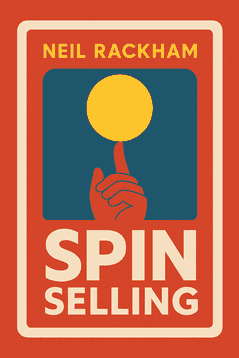
SPIN selling by Neil Rackham Summary

Overview of SPIN selling
"SPIN Selling" revolutionized sales with research spanning 35,000 calls across 23 countries. Rackham's counterintuitive approach - asking strategic questions instead of pushing - transformed how top companies close complex deals. Want to know why traditional closing techniques actually kill major sales?
- Successful major sales rely on implied-to-explicit need conversion through strategic questioning
- SPIN methodology replaces feature-pushing with situation-problem-implication-need-payoff question sequencing
- High-value sales require understanding problem consequences, not just surface-level pain points
- Major sales fail when reps prioritize quick closes over building diagnostic conversations
- Implied needs become actionable through implication questions about operational/financial ripple effects
- Need-payoff questions help customers self-articulate solutions, creating internal buy-in for proposals
- Small sales tactics (price discounts/urgency) damage trust in complex enterprise deals
- Rackham’s 35,000-call research proved top performers ask fewer but deeper problem questions
- Effective sales professionals frame solutions as customer-driven initiatives, not vendor pitches
- The SPIN model prioritizes diagnostic accuracy over charismatic persuasion techniques
- Major sales cycles accelerate when reps focus on need-payoff before presenting features
- Neil Rackham’s Value Equation proves ROI clarity beats product superiority in enterprise deals
About the Author of SPIN selling
Neil Rackham, author of the international bestseller SPIN Selling, is a pioneering sales researcher and consultant renowned for revolutionizing high-end sales strategies.
A former research fellow at the University of Sheffield, Rackham spent 12 years leading the largest-ever study of sales effectiveness, analyzing 35,000 sales calls across 20 countries to develop the evidence-based SPIN (Situation, Problem, Implication, Need-payoff) methodology.
His groundbreaking work in consultative selling, documented in SPIN Selling and Major Account Sales Strategy, has shaped modern B2B sales practices through its focus on problem-solving dialogue over traditional persuasion tactics. As founder of Huthwaite Research Group, Rackham advised Fortune 100 companies like IBM and Xerox.
His sales training programs earned lifetime achievement recognition from the Instructional Systems Association. Translated into over 50 languages, SPIN Selling has sold millions of copies worldwide and remains required reading in professional sales curricula.
FAQs About SPIN selling
What is SPIN Selling about?
SPIN Selling by Neil Rackham outlines a research-backed sales methodology for complex, high-value deals. It emphasizes using four strategic question types—Situation, Problem, Implication, Need-Payoff—to uncover customer needs, build trust, and guide buyers toward solutions. Unlike traditional tactics focused on quick closes, SPIN Selling prioritizes consultative conversations to address long sales cycles and multi-stakeholder decisions.
Who should read SPIN Selling?
This book is essential for B2B sales professionals, account managers, and leaders handling high-stakes deals (e.g., enterprise software, consulting services). It’s also valuable for marketers and customer success teams seeking to align with buyer needs. The techniques are less relevant for low-value, transactional sales.
Is SPIN Selling worth reading in 2025?
Yes. Despite being published in 1988, its focus on relationship-driven selling remains critical in today’s complex B2B landscape. With 90% of buyers following non-linear paths (Highspot), SPIN’s emphasis on questioning over pitching aligns with modern demands for personalized, value-centric sales approaches.
What are the four types of SPIN questions?
- Situation: Gather background (e.g., “What’s your current process?”).
- Problem: Identify pain points (e.g., “What challenges does this create?”).
- Implication: Explore consequences (e.g., “How does this affect efficiency?”).
- Need-Payoff: Highlight solution benefits (e.g., “How would resolving this help?”).
These questions turn vague buyer dissatisfaction into actionable needs.
How does SPIN Selling differ from traditional sales methods?
Traditional methods focus on features, benefits, and quick closes, which fail in complex sales. SPIN Selling uses consultative dialogue to help buyers self-identify problems and solutions. Research shows it improves close rates by up to 17% in major sales (Highspot).
What’s the difference between “major sales” and “small sales” in SPIN Selling?
- Major sales: High-value, multi-call deals with long cycles (e.g., $150k software contracts). Success hinges on trust and navigating stakeholder dynamics.
- Small sales: Low-cost, single-call transactions (e.g., retail products). Traditional closing tactics work here.
SPIN techniques are designed exclusively for major sales.
Can SPIN Selling be applied to modern remote sales?
Absolutely. The framework’s emphasis on active listening and needs-discovery translates seamlessly to virtual settings. For example, implication questions (“How does this delay impact remote teams?”) help uncover hidden challenges in digital buyer interactions.
What are common criticisms of SPIN Selling?
Critics argue it overlooks emotional buying triggers and requires significant training to master. Some find the questioning structure rigid, though supporters stress adaptability. It’s also less effective in industries with standardized purchasing processes.
How does SPIN Selling compare to other sales methodologies?
Unlike Challenger Sale (teaching buyers) or Solution Selling (prescribing fixes), SPIN focuses on guiding buyers to self-realization. This makes it particularly effective for consultative roles where long-term relationships matter.
What’s a key quote from SPIN Selling?
“In major sales, the most successful people aren’t those who talk the most about features—they’re the ones who ask the right questions.” This underscores the book’s core thesis: questioning drives complex sales success.
How can managers implement SPIN Selling in their teams?
- Train reps to categorize questions into SPIN types.
- Role-play implication and need-payoff scenarios.
- Track question usage in CRM call logs.
- Prioritize deal quality over short-term metrics.
Why is SPIN Selling still relevant for AI-driven sales?
While AI handles data analysis, human-driven SPIN questioning remains crucial for uncovering nuanced needs and building trust. The methodology complements tech tools by focusing on irreplaceable interpersonal skills.
Feel the book through the author's voice
Turn knowledge into engaging, example-rich insights
Capture key ideas in a flash for fast learning
Enjoy the book in a fun and engaging way
Key Themes in SPIN selling
Quotes from SPIN selling
Questions persuade more powerfully than any other form of verbal behavior.
The ABC of selling is Always Be Closing.
Closing techniques strongly correlate with success.
The problem isn't that traditional sales techniques are outdated-they simply don't transfer to major sales.
The fear of making a public mistake often outweighs price considerations.
Characters in SPIN selling
Quick Summary Mode - Read or listen to SPIN selling Summary in 9 Minutes

Break down key ideas from SPIN selling into bite-sized takeaways to understand how innovative teams create, collaborate, and grow.

Flash Card Mode - Top 8 Insights from SPIN selling in a Nutshell

Distill SPIN selling into rapid-fire memory cues that highlight key principles of candor, teamwork, and creative resilience.

Fun Mode - SPIN selling Lessons Told Through 21-Min Stories

Experience SPIN selling through vivid storytelling that turns innovation lessons into moments you'll remember and apply.
Personalize Mode - Read or listen to SPIN selling Summary in 0 Minutes

Ask anything, pick the voice, and co-create insights that truly resonate with you.

From Columbia University alumni built in San Francisco
"Instead of endless scrolling, I just hit play on BeFreed. It saves me so much time."


"I never knew where to start with nonfiction—BeFreed’s book lists turned into podcasts gave me a clear path."


"Perfect balance between learning and entertainment. Finished ‘Thinking, Fast and Slow’ on my commute this week."
"Crazy how much I learned while walking the dog. BeFreed = small habits → big gains."
"Reading used to feel like a chore. Now it’s just part of my lifestyle."

"Feels effortless compared to reading. I’ve finished 6 books this month already."
"BeFreed turned my guilty doomscrolling into something that feels productive and inspiring."

"BeFreed turned my commute into learning time. 20-min podcasts are perfect for finishing books I never had time for."
"BeFreed replaced my podcast queue. Imagine Spotify for books — that’s it. 🙌"

"It is great for me to learn something from the book without reading it."
"The themed book list podcasts help me connect ideas across authors—like a guided audio journey."
"Makes me feel smarter every time before going to work"
From Columbia University alumni built in San Francisco
"Instead of endless scrolling, I just hit play on BeFreed. It saves me so much time."
"I never knew where to start with nonfiction—BeFreed’s book lists turned into podcasts gave me a clear path."
"Perfect balance between learning and entertainment. Finished ‘Thinking, Fast and Slow’ on my commute this week."
"Crazy how much I learned while walking the dog. BeFreed = small habits → big gains."
"Reading used to feel like a chore. Now it’s just part of my lifestyle."
"Feels effortless compared to reading. I’ve finished 6 books this month already."
"BeFreed turned my guilty doomscrolling into something that feels productive and inspiring."
"BeFreed turned my commute into learning time. 20-min podcasts are perfect for finishing books I never had time for."
"BeFreed replaced my podcast queue. Imagine Spotify for books — that’s it. 🙌"
"It is great for me to learn something from the book without reading it."
"The themed book list podcasts help me connect ideas across authors—like a guided audio journey."
"Makes me feel smarter every time before going to work"
"Instead of endless scrolling, I just hit play on BeFreed. It saves me so much time."
"I never knew where to start with nonfiction—BeFreed’s book lists turned into podcasts gave me a clear path."
"Perfect balance between learning and entertainment. Finished ‘Thinking, Fast and Slow’ on my commute this week."
"Crazy how much I learned while walking the dog. BeFreed = small habits → big gains."
"Reading used to feel like a chore. Now it’s just part of my lifestyle."
"Feels effortless compared to reading. I’ve finished 6 books this month already."
"BeFreed turned my guilty doomscrolling into something that feels productive and inspiring."
"BeFreed turned my commute into learning time. 20-min podcasts are perfect for finishing books I never had time for."
"BeFreed replaced my podcast queue. Imagine Spotify for books — that’s it. 🙌"
"It is great for me to learn something from the book without reading it."
"The themed book list podcasts help me connect ideas across authors—like a guided audio journey."
"Makes me feel smarter every time before going to work"
"Instead of endless scrolling, I just hit play on BeFreed. It saves me so much time."
"I never knew where to start with nonfiction—BeFreed’s book lists turned into podcasts gave me a clear path."
"Perfect balance between learning and entertainment. Finished ‘Thinking, Fast and Slow’ on my commute this week."
"Crazy how much I learned while walking the dog. BeFreed = small habits → big gains."
"Reading used to feel like a chore. Now it’s just part of my lifestyle."
"Feels effortless compared to reading. I’ve finished 6 books this month already."
"BeFreed turned my guilty doomscrolling into something that feels productive and inspiring."
"BeFreed turned my commute into learning time. 20-min podcasts are perfect for finishing books I never had time for."
"BeFreed replaced my podcast queue. Imagine Spotify for books — that’s it. 🙌"
"It is great for me to learn something from the book without reading it."
"The themed book list podcasts help me connect ideas across authors—like a guided audio journey."
"Makes me feel smarter every time before going to work"

Get the SPIN selling summary as a free PDF or EPUB. Print it or read offline anytime.