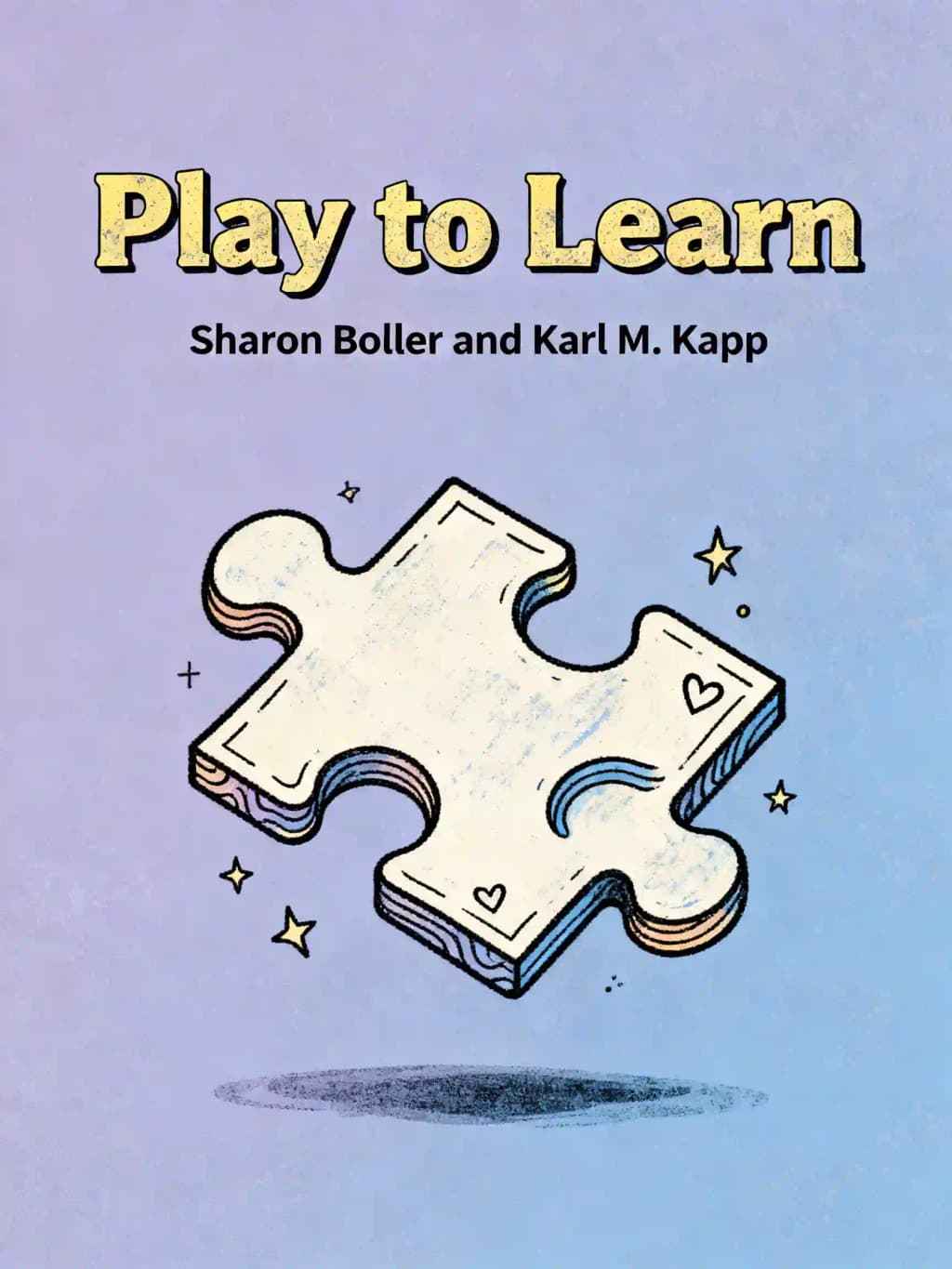
Transform corporate training with "Play to Learn" - the ultimate guide to designing effective learning games. Named among LinkedIn's Top Voices in Education, co-author Karl Kapp reveals why gamification is revolutionizing how Fortune 500 companies train their talent. Ready to make learning addictive?
Sharon Boller, a renowned learning design expert and co-author of Play to Learn: Everything You Need to Know About Designing Effective Learning Games, is president of Bottom-Line Performance, a firm specializing in innovative learning solutions.
With over two decades in instructional design, she co-created the award-winning Knowledge Guru platform, which earned a Brandon Hall Gold award for game-based learning technology. Boller’s work bridges corporate training and educational game design, emphasizing practical, science-backed methodologies. Her insights are featured in industry publications and keynote speeches for organizations like ATD and the eLearning Guild.
Karl M. Kapp, a pioneering gamification strategist and professor at Bloomsburg University, co-authored Play to Learn to merge game mechanics with instructional theory. Known for foundational books like The Gamification of Learning and Instruction, he has shaped modern educational practices through TEDx talks and global consulting. His research-driven approach helps organizations transform traditional training into engaging, interactive experiences.
Together, Boller and Kapp combine decades of hands-on experience, offering actionable frameworks for creating impactful learning games. Play to Learn is widely adopted in corporate and academic settings, recognized for blending creativity with evidence-based design. The book has become a staple in instructional design curricula and professional development programs worldwide.
Play to Learn explores how game-based learning enhances engagement, skill retention, and problem-solving in educational and corporate settings. Sharon Boller and Karl Kapp provide a nine-step framework for designing effective learning games that balance entertainment with educational outcomes, emphasizing iterative play-testing and alignment with instructional goals. The book bridges theory and practice, offering strategies to create immersive, low-pressure learning environments.
This book is ideal for instructional designers, corporate trainers, educators, and anyone seeking to integrate play into learning programs. It’s particularly valuable for professionals grappling with low engagement in traditional training methods, offering actionable insights for fostering collaboration, creativity, and real-world skill application through games.
Yes, for its evidence-based approach to merging play and education. The book combines research, case studies, and a structured design process, making it a practical guide for creating impactful learning experiences. It’s praised for its focus on balancing fun with measurable outcomes, addressing common pitfalls like overemphasis on entertainment.
Key ideas include:
A learning game combines a game goal (e.g., winning) with an instructional goal (e.g., mastering a skill). It uses elements like fantasy and abstraction to teach concepts in a low-stakes environment. Unlike gamification (adding points/badges to existing content), learning games are standalone experiences designed to achieve specific educational outcomes.
The steps include:
The authors advise prioritizing instructional goals first, then integrating engaging elements like storytelling, challenges, and rewards. Games should be “hard fun”—
The book showcases how games improve employee engagement and knowledge retention by allowing practice in risk-free environments. Examples include role-playing exercises for soft skills and puzzle-solving for critical thinking. It also addresses scaling game-based learning across organizations.
Some note the framework’s complexity for beginners or time-constrained teams. Others highlight the challenge of measuring ROI on game development efforts. However, the book counters these by stressing scalability through templates and iterative testing.
With remote work and digital learning expanding, the book’s strategies for virtual collaboration and adaptive skill-building remain critical. Its emphasis on engagement aligns with trends in personalized learning and AI-driven training tools.
While Kapp’s earlier work focuses on gamifying existing content, Play to Learn delves into creating standalone games with embedded learning objectives. Both emphasize engagement but differ in scope: gamification vs. game design.
通过作者的声音感受这本书
将知识转化为引人入胜、富含实例的见解
快速捕捉核心观点,高效学习
以有趣互动的方式享受这本书
People play games because they enjoy the core dynamic.
If players don't learn, it's not a learning game, regardless of how fun it is.
Winning must be contingent on learning rather than luck.
Poorly designed games yield poor learning outcomes.
将《Play to Learn》的核心观点拆解为易于理解的要点,了解创新团队如何创造、协作和成长。
将《Play to Learn》提炼为快速记忆要点,突出坦诚、团队合作和创造力的关键原则。

通过生动的故事体验《Play to Learn》,将创新经验转化为令人难忘且可应用的精彩时刻。
随心提问,选择声音,共同创造真正与你产生共鸣的见解。

"Instead of endless scrolling, I just hit play on BeFreed. It saves me so much time."
"I never knew where to start with nonfiction—BeFreed’s book lists turned into podcasts gave me a clear path."
"Perfect balance between learning and entertainment. Finished ‘Thinking, Fast and Slow’ on my commute this week."
"Crazy how much I learned while walking the dog. BeFreed = small habits → big gains."
"Reading used to feel like a chore. Now it’s just part of my lifestyle."
"Feels effortless compared to reading. I’ve finished 6 books this month already."
"BeFreed turned my guilty doomscrolling into something that feels productive and inspiring."
"BeFreed turned my commute into learning time. 20-min podcasts are perfect for finishing books I never had time for."
"BeFreed replaced my podcast queue. Imagine Spotify for books — that’s it. 🙌"
"It is great for me to learn something from the book without reading it."
"The themed book list podcasts help me connect ideas across authors—like a guided audio journey."
"Makes me feel smarter every time before going to work"

免费获取《Play to Learn》摘要的 PDF 或 EPUB 版本。可打印或随时离线阅读。
Imagine sitting with 30 colleagues playing "A Paycheck Away," a game about homelessness. The room buzzes with energy as players make difficult choices about housing, food, and employment that mirror real-life challenges. When the game ends, participants walk away with profound insights and transformed perspectives. This is the transformative power of learning games. Research consistently shows game-based learning outperforms traditional approaches, producing 11% higher declarative knowledge, 14% better procedural knowledge, and 9% improved retention. No wonder organizations from Microsoft to the U.S. military have embraced games for training everything from technical skills to cultural awareness. What makes learning games so effective isn't just entertainment value - it's their ability to create personalized experiences where learners experiment, review content, try different strategies, and achieve meaningful outcomes. In our attention-scarce world, games capture and maintain focus in ways lectures simply cannot. They create what designers call a "magic circle" - a special space with its own rules that transforms abstract concepts into concrete experiences that stick with learners long after the game ends. When done right, learning games create what psychologists call "state-dependent learning" - knowledge deeply connected to the emotional state experienced during acquisition. This explains why many adults can still recite facts learned through childhood games but struggle to remember content from college lectures. The power of games lies in their ability to transform abstract concepts into concrete experiences. Well-designed learning games provide safe spaces to experiment, fail, and try again - essential elements for deep learning.