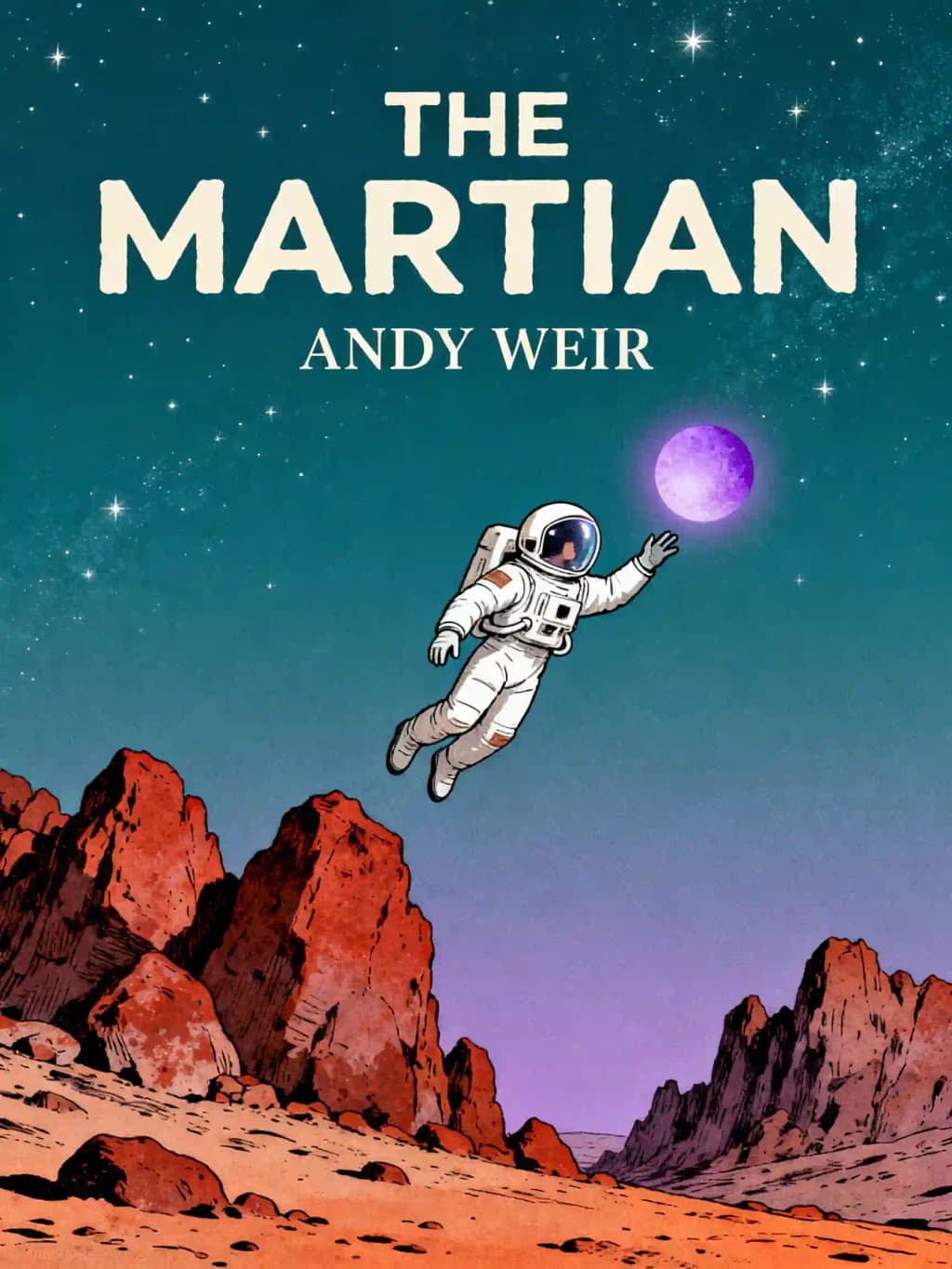
The Martian
A Novel
Overview of The Martian
Stranded on Mars, one astronaut's ingenious survival story captivated Bill Gates and millions worldwide. From self-published phenomenon to blockbuster film starring Matt Damon, "The Martian" blends meticulous science with gripping storytelling. How would you survive with nothing but wit and duct tape?

Key Themes in The Martian
- scientific problem solving
- extraterrestrial survival
- interplanetary rescue mission
- human isolation
- botany and engineering
Quotes from The Martian
I'm going to science the shit out of this.
Yes, of course duct tape works in a near-vacuum. Duct tape works anywhere. Duct tape is magic and should be worshiped.
I'm pretty much fucked.
Mars will come to fear my botany powers.
Characters in The Martian
- Mark WatneyAstronaut, botanist, and mechanical engineer
- Andy WeirAuthor and creator of the story
- Ridley ScottDirector of the film adaptation
- Matt DamonActor who portrayed the protagonist in the film
About the Author
About the Author of The Martian
Andy Taylor Weir, bestselling author of The Martian and former software engineer, combines his expertise in programming with a lifelong passion for space exploration to craft rigorously researched science fiction.
His breakout novel—a gripping tale of human ingenuity and survival on Mars—draws from his career at tech giants like Blizzard Entertainment and his deep knowledge of orbital mechanics.
Weir's works, including Project Hail Mary and Artemis, blend scientific accuracy with witty narration, earning him the 2016 John W. Campbell Award for Best New Writer. A self-described "space nerd," he frequently discusses relativistic physics and aerospace history in interviews and panels.
The Martian sold over 3 million copies and inspired Ridley Scott's Oscar-nominated film adaptation, cementing Weir's status as a pioneer of modern hard sci-fi.
Download Summary of The Martian
Get the The Martian summary as a free PDF or EPUB. Print it or read offline anytime.
FAQs About This Book
The Martian follows astronaut Mark Watney, stranded on Mars after his crew evacuates during a dust storm. Using botany and engineering skills, he battles isolation, equipment failures, and resource scarcity to survive while NASA orchestrates a risky rescue. The novel blends gripping survival drama with scientific problem-solving and dark humor.
Fans of science fiction, survival stories, and STEM-driven narratives will enjoy this book. It appeals to readers seeking a mix of technical detail (e.g., space agriculture, chemistry) and character-driven resilience. Suitable for ages 16+, it’s ideal for those who appreciate witty protagonists and realistic space exploration scenarios.
Yes—The Martian is praised for its fast-paced plot, accurate science, and Mark Watney’s humor under pressure. Critics highlight its balance of tension and optimism, making it a standout in modern sci-fi. The novel’s film adaptation also boosts its popularity, but the book offers deeper technical insights.
Key themes include resilience (Watney’s relentless problem-solving), collaboration (global efforts to rescue him), and human ingenuity (using science to overcome Mars’ harsh environment). The story emphasizes adaptability and logical thinking in crises, reflecting Weir’s focus on STEM-driven solutions.
Weir extensively researched orbital mechanics, botany, and chemistry to ensure plausibility. While some scenarios are dramatized (e.g., dust storm intensity), NASA scientists praised its realism. Concepts like hydrazine conversion for water and potato farming under controlled conditions are grounded in real science.
- Food scarcity: He grows potatoes using Martian soil and crew waste.
- Communication failure: Repairs a rover to contact NASA.
- Equipment breakdowns: Fixes Hab leaks and repurposes machinery.
- Launch risks: Modifies the MAV (Mars Ascent Vehicle) for escape.
Like Project Hail Mary, it features lone protagonists solving sci-fi crises with science, but The Martian focuses more on engineering challenges than interstellar diplomacy. Weir’s debut is less dialogue-driven but retains his signature humor and meticulous research.
No—it’s fictional but inspired by real Mars mission concepts. NASA’s Ares program and technologies like the Hab and MAV mirror actual proposals. Weir’s focus on plausible science led to collaborations with space agencies post-publication.
The Hab (habitat module) is Watney’s primary shelter, providing life support, temperature control, and space for potato farming. Its breaches and repairs drive key survival scenes, symbolizing humanity’s fragile yet tenacious hold on hostile environments.
Watney’s log entries (“I’m not gonna die here”) showcase his mindset: breaking colossal problems into manageable tasks. His failures (e.g., potato crop loss) highlight perseverance, while NASA’s willingness to risk crews underscores collective resilience.
- “I’m gonna have to science the shit out of this”: Watney’s mantra for problem-solving.
- “In space, no one can hear you scream…martian, no one can hear you plot”: Dark humor amid crisis.
- “Work the problem”: A NASA philosophy central to the plot.
Some note limited character development outside Watney and a heavy focus on technical detail over emotional depth. However, most praise balances these with pacing and humor. The lack of antagonistic forces (beyond Mars itself) polarizes readers seeking interpersonal conflict.





