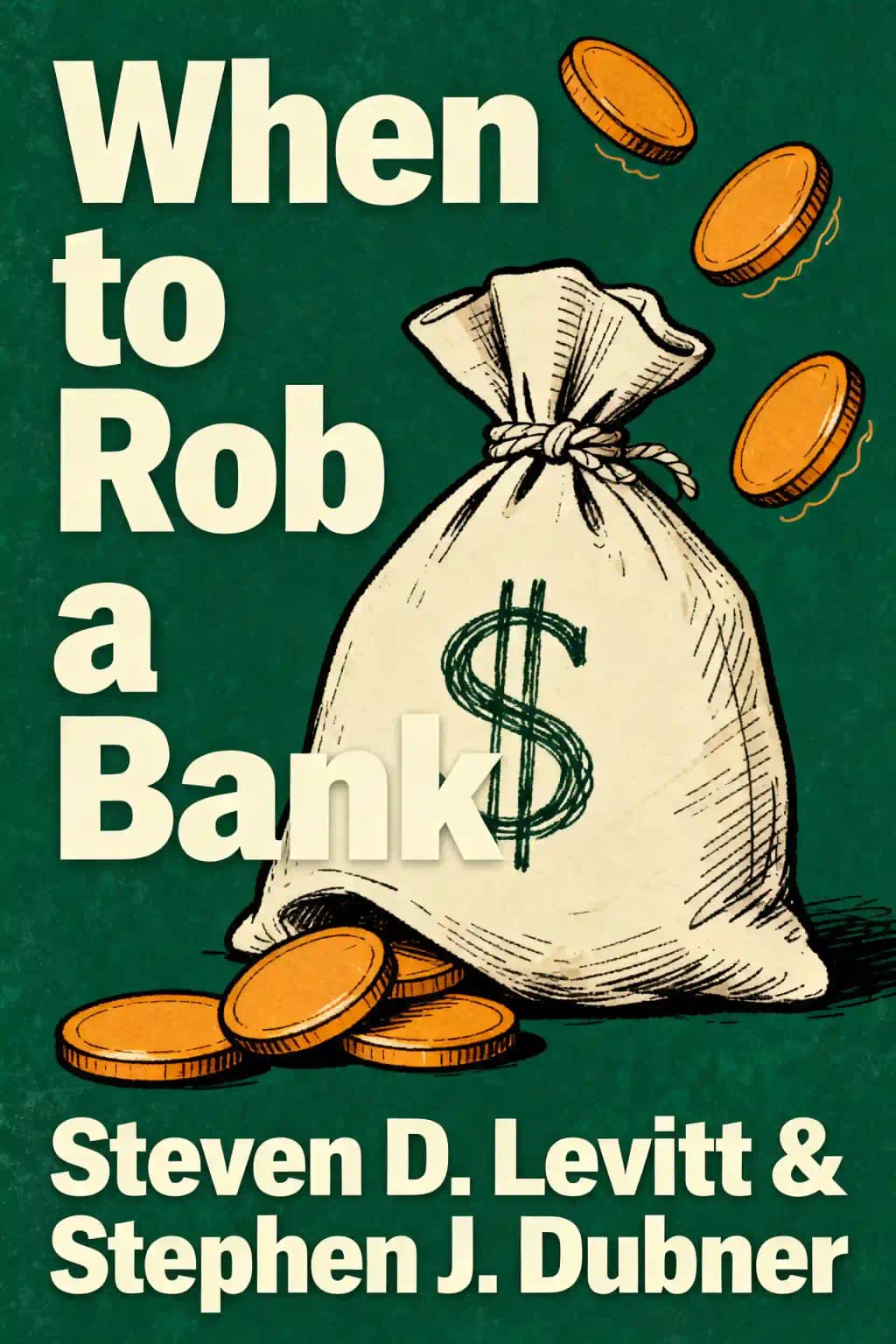
When to rob a bank book cover

When to rob a bank

Steven D. Levitt & Stephen J. Dubner
3.48 (25 Reviews)

Overview of When to rob a bank

Freakonomics duo Levitt and Dubner return with mind-bending questions like "when's the best time to rob a bank?" Referenced on TV's "House," these counterintuitive economic insights have influenced business strategies worldwide. Prepare for 131 delightfully warped perspectives that challenge everything you think you know.

Key Themes in When to rob a bank

  • incentive structures
  • counterintuitive logic
  • unintended consequences
  • information asymmetry
  • behavioral patterns

Quotes from When to rob a bank

  • Tenure mainly protects scholars doing no work or terrible work.

  • Economists see prices as the organizing logic of our world.

Characters in When to rob a bank

  • Steven D. LevittCo-author and economist known for provocative ideas
  • Stephen J. DubnerCo-author and journalist who explores economics
  • Charles RossottiFormer IRS commissioner discussed as a case study
  • Sonny SandovalRock star whose daughter's name sparked a trend
  • Dr. Cyril WolfPhysician who studied generic drug price gaps

About the Author

About the Author of When to rob a bank

Steven D. Levitt & Stephen J. Dubner, bestselling authors of When to Rob a Bank: ...And 131 More Warped Suggestions and Well-Intended Rants, are renowned for blending economics with unconventional insights. Levitt, a University of Chicago economics professor and recipient of the John Bates Clark Medal, partners with Dubner, an award-winning journalist and podcast host, to explore quirky intersections of data-driven analysis and human behavior.

Their collaboration began with the groundbreaking Freakonomics series, which has sold over 7 million copies worldwide and inspired a top-rated podcast with 150 million downloads. This book compiles provocative essays from their long-running Freakonomics blog, dissecting topics like crime patterns, pricing oddities, and societal incentives through an economic lens.

Both authors frequently contribute to The New York Times and appear on platforms like NPR and TED Talks. Their earlier works, including Freakonomics and SuperFreakonomics, remain staples in behavioral economics literature. Translated into 40 languages, their books have redefined how readers engage with everyday decision-making.

Download Summary of When to rob a bank

Get the When to rob a bank summary as a free PDF or EPUB. Print it or read offline anytime.

FAQs About This Book

When to Rob a Bank is a curated collection of blog posts from the Freakonomics authors, offering unconventional economic insights into everyday topics. It challenges conventional wisdom with questions like why KFC runs out of fried chicken, whether flight attendants should be tipped, and the economics of terrorism. The book blends humor, data, and counterintuitive analysis to explore hidden incentives shaping human behavior.

Fans of Freakonomics, economics enthusiasts, and readers who enjoy bite-sized, thought-provoking content will appreciate this book. It’s ideal for those curious about applying economic principles to quirky real-world scenarios, such as gambling, environmental decisions, or pricing oddities. The casual, blog-style format suits readers seeking quick, engaging insights rather than dense academic analysis.

Yes, if you enjoy accessible economics with a twist of humor. While some critics note the lack of cohesion compared to the authors’ earlier books, the blog-style entries provide digestible insights into topics like lying patterns, gun control, and environmental trade-offs. It’s best for readers who prefer eclectic, conversationally styled content over structured narratives.

The title stems from a blog post analyzing the poor ROI of bank robbery (spoiler: never rob one). It exemplifies the authors’ approach of using economic logic to debunk myths, highlighting how data often contradicts intuition. This theme recurs in explorations of crime, pricing strategies, and risk perception.

The authors suggest KFC intentionally limits supply to maintain perceived freshness and urgency, leveraging scarcity as a marketing tactic. This mirrors economic principles seen in artificial product shortages (e.g., limited-edition releases) to drive demand and customer loyalty.

  • Unintended consequences: Policies like the Endangered Species Act sometimes harm what they aim to protect.
  • Incentive-driven behavior: People lie even when irrational, and terrorists optimize for media impact.
  • Pricing irrationality: Third chicken wings occasionally costing more than the first two.

Unlike Freakonomics’ structured narratives, this book compiles blog posts, resulting in a more fragmented but diverse read. It retains the trademark curiosity-driven analysis but favors brevity over depth, making it a lighter companion to their earlier works.

Critics argue the blog format leads to uneven quality, with some entries feeling underdeveloped or anecdotal. Unlike their previous books, fewer topics are backed by rigorous experiments, relying more on observational humor and hypotheticals.

The book controversially argues driving can be eco-friendlier than walking in some contexts, factoring in food production energy (e.g., calories burned walking require extra food consumption). This exemplifies its approach of re-examining “obvious” truths through data.

The authors humorously suggest taxing sex to reduce unintended pregnancies and STDs, illustrating how economic incentives could alter behavior. While not a serious policy proposal, it underscores their theme of applying cost-benefit analysis to taboo topics.

The book’s exploration of misinformation, risk perception, and behavioral economics remains timely amid debates about AI, climate policy, and media literacy. Its lessons on data-driven decision-making apply to contemporary issues like gig economy dynamics and pandemic response strategies.

Yes, a chapter humorously analyzes historical pirate crews as early democracies with profit-sharing models and worker compensation systems. This ties into broader themes of how incentives shape organizational behavior, even in unconventional settings.

Explore Your Way of Learning

When to rob a bank isn't just a book — it's a masterclass in Economics. To help you absorb its lessons in the way that works best for you, we offer five unique learning modes. Whether you're a deep thinker, a fast learner, or a story lover, there's a mode designed to fit your style.

Quick Summary Mode

Read or listen to When to rob a bank Summary in 9 Minutes

Break down key ideas from When to rob a bank into bite-sized takeaways to understand how innovative teams create, collaborate, and grow.

play
00:00
00:00

Fun Mode

When to rob a bank Lessons Told Through 25-Min Stories

Experience When to rob a bank through vivid storytelling that turns innovation lessons into moments you'll remember and apply.

play
00:00
00:00

Personalize Mode

Experience When to rob a bank in your own learning style

Ask anything, choose your learning style, and co-create insights that truly resonate with you.

Personalize Mode

From Columbia University alumni built in San Francisco

BeFreed Brings Together A Global Community Of 1,000,000 Curious Minds

"Instead of endless scrolling, I just hit play on BeFreed. It saves me so much time."

@Moemenn
platform
star
star
star
star
star

"I never knew where to start with nonfiction—BeFreed’s book lists turned into podcasts gave me a clear path."

@Chloe, Solo founder, LA
platform
comments
12
likes
117

"Perfect balance between learning and entertainment. Finished ‘Thinking, Fast and Slow’ on my commute this week."

@Raaaaaachelw
platform
star
star
star
star
star

"Crazy how much I learned while walking the dog. BeFreed = small habits → big gains."

@Matt, YC alum
platform
comments
12
likes
108

"Reading used to feel like a chore. Now it’s just part of my lifestyle."

@Erin, Investment Banking Associate , NYC
platform
comments
254
likes
17

"Feels effortless compared to reading. I’ve finished 6 books this month already."

@djmikemoore
platform
star
star
star
star
star

"BeFreed turned my guilty doomscrolling into something that feels productive and inspiring."

@Pitiful
platform
comments
96
likes
4.5K

"BeFreed turned my commute into learning time. 20-min podcasts are perfect for finishing books I never had time for."

@SofiaP
platform
star
star
star
star
star

"BeFreed replaced my podcast queue. Imagine Spotify for books — that’s it. 🙌"

@Jaded_Falcon
platform
comments
201
thumbsUp
16

"It is great for me to learn something from the book without reading it."

@OojasSalunke
platform
star
star
star
star
star

"The themed book list podcasts help me connect ideas across authors—like a guided audio journey."

@Leo, Law Student, UPenn
platform
comments
37
likes
483

"Makes me feel smarter every time before going to work"

@Cashflowbubu
platform
star
star
star
star
star

"Instead of endless scrolling, I just hit play on BeFreed. It saves me so much time."

@Moemenn
platform
star
star
star
star
star

"I never knew where to start with nonfiction—BeFreed’s book lists turned into podcasts gave me a clear path."

@Chloe, Solo founder, LA
platform
comments
12
likes
117

"Perfect balance between learning and entertainment. Finished ‘Thinking, Fast and Slow’ on my commute this week."

@Raaaaaachelw
platform
star
star
star
star
star

"Crazy how much I learned while walking the dog. BeFreed = small habits → big gains."

@Matt, YC alum
platform
comments
12
likes
108

"Reading used to feel like a chore. Now it’s just part of my lifestyle."

@Erin, Investment Banking Associate , NYC
platform
comments
254
likes
17

"Feels effortless compared to reading. I’ve finished 6 books this month already."

@djmikemoore
platform
star
star
star
star
star

"BeFreed turned my guilty doomscrolling into something that feels productive and inspiring."

@Pitiful
platform
comments
96
likes
4.5K

"BeFreed turned my commute into learning time. 20-min podcasts are perfect for finishing books I never had time for."

@SofiaP
platform
star
star
star
star
star

"BeFreed replaced my podcast queue. Imagine Spotify for books — that’s it. 🙌"

@Jaded_Falcon
platform
comments
201
thumbsUp
16

"It is great for me to learn something from the book without reading it."

@OojasSalunke
platform
star
star
star
star
star

"The themed book list podcasts help me connect ideas across authors—like a guided audio journey."

@Leo, Law Student, UPenn
platform
comments
37
likes
483

"Makes me feel smarter every time before going to work"

@Cashflowbubu
platform
star
star
star
star
star

"Instead of endless scrolling, I just hit play on BeFreed. It saves me so much time."

@Moemenn
platform
star
star
star
star
star

"I never knew where to start with nonfiction—BeFreed’s book lists turned into podcasts gave me a clear path."

@Chloe, Solo founder, LA
platform
comments
12
likes
117

"Perfect balance between learning and entertainment. Finished ‘Thinking, Fast and Slow’ on my commute this week."

@Raaaaaachelw
platform
star
star
star
star
star

"Crazy how much I learned while walking the dog. BeFreed = small habits → big gains."

@Matt, YC alum
platform
comments
12
likes
108

"Reading used to feel like a chore. Now it’s just part of my lifestyle."

@Erin, Investment Banking Associate , NYC
platform
comments
254
likes
17

"Feels effortless compared to reading. I’ve finished 6 books this month already."

@djmikemoore
platform
star
star
star
star
star

"BeFreed turned my guilty doomscrolling into something that feels productive and inspiring."

@Pitiful
platform
comments
96
likes
4.5K

"BeFreed turned my commute into learning time. 20-min podcasts are perfect for finishing books I never had time for."

@SofiaP
platform
star
star
star
star
star

"BeFreed replaced my podcast queue. Imagine Spotify for books — that’s it. 🙌"

@Jaded_Falcon
platform
comments
201
thumbsUp
16

"It is great for me to learn something from the book without reading it."

@OojasSalunke
platform
star
star
star
star
star

"The themed book list podcasts help me connect ideas across authors—like a guided audio journey."

@Leo, Law Student, UPenn
platform
comments
37
likes
483

"Makes me feel smarter every time before going to work"

@Cashflowbubu
platform
star
star
star
star
star

See More Stories?

How people are talking about BeFreed across the web
1.5K Ratings4.7
Start your learning journey, now