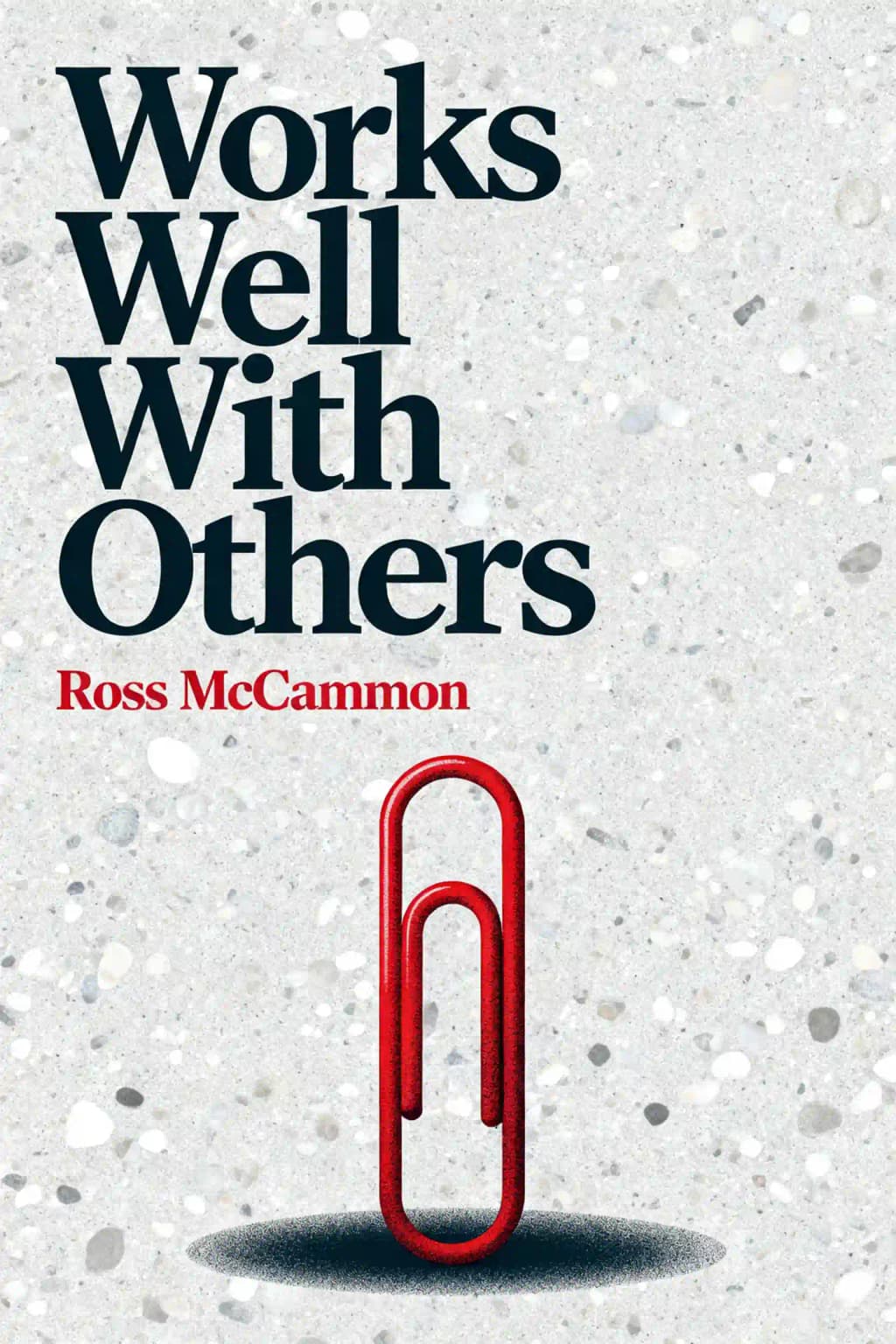
Ever wondered why no one teaches the unwritten rules of office survival? "Works Well With Others" is your hilarious insider's guide to workplace etiquette, praised by professionals for its candid approach to handling everything from awkward handshakes to office jerks with surprising grace.
Ross McCammon, author of Works Well with Others: An Outsider's Guide to Shaking Hands, Shutting Up, Handling Jerks, and Other Crucial Skills in Business That No One Ever Teaches You, is a bestselling author and workplace etiquette expert with decades of editorial leadership at Texas Monthly, Esquire, and GQ.
Blending humor with actionable advice, his book tackles professional development through the lens of confidence-building and office navigation—themes honed during his career shaping iconic men’s lifestyle publications.
McCammon extends his insights as Entrepreneur magazine’s business etiquette columnist and co-author of Buchanan-Smith’s Handbook to the Axe, a celebrated guide to craftsmanship.
Praised by The New York Times as “charmingly finicky” and endorsed by cultural figures like Patton Oswalt and organizational psychologist Adam Grant, his work balances irreverence with practical wisdom.
The creator of the widely shared “2 Beers and a Puppy” interpersonal test, McCammon’s guide has been translated into six languages and remains a staple for professionals seeking to thrive in collaborative environments.
Works Well with Others by Ross McCammon is a candid guide to navigating workplace dynamics, blending humor with actionable advice on confidence-building, professional etiquette, and handling challenging colleagues. It covers practical skills like shaking hands, making small talk, and managing imposter syndrome, framed through McCammon’s experiences as an editor at Esquire and GQ.
This book is ideal for early-career professionals, introverts, or anyone transitioning into corporate environments. It’s particularly valuable for those seeking to improve workplace relationships, master office politics, or overcome social anxiety in business settings. McCammon’s relatable tone resonates with millennials and Gen Z readers.
Yes, particularly for its humor and practical frameworks like the “2 Beers and a Puppy” test for assessing workplace fit. Reviewers praise its balance of motivational insights and real-world tactics, with The New York Times calling it “charmingly finicky” and Patton Oswalt deeming it “indispensable.”
McCammon’s famous test evaluates workplace compatibility:
This framework helps assess colleagues’ reliability and likability, emphasizing emotional intelligence in professional relationships.
Notable lines include:
These underscore the book’s theme of embracing vulnerability as a strength in career growth.
McCammon reframes imposter syndrome as a tool for humility and growth, advising readers to channel self-doubt into preparation and authenticity. He shares personal anecdotes about overcoming feelings of inadequacy in high-pressure editorial roles.
While written pre-pandemic, its principles on communication, virtual empathy, and managing jerks translate well to hybrid/remote settings. For example, McCammon’s rules for “digital small talk” help maintain rapport in Zoom-dominated workplaces.
Some reviewers note the advice skews toward corporate America and may lack diversity in workplace examples. Others find its humorous tone occasionally undermines deeper psychological insights, making it better suited for entry-level professionals than executives.
Drawing from his editorial roles at Esquire, GQ, and Texas Monthly, McCammon infuses the book with media industry anecdotes. His experience mentoring writers and navigating celebrity interviews provides credibility to its interpersonal strategies.
Unlike formulaic guides, it combines self-deprecating humor with unorthodox tactics—like using silence strategically in meetings or embracing awkwardness. This approach disarms readers while teaching resilience in professional settings.
McCammon advocates for “confident curiosity”—asking questions rather than making demands. He provides scripts for discussing raises tactfully, emphasizing preparation and timing over confrontation.
As workplaces evolve with AI and shifting generational dynamics, its focus on human-centric skills—emotional intelligence, adaptability, and authentic communication—remains critical. The book’s principles complement tech-driven productivity tools.
Почувствуйте книгу через голос автора
Превратите знания в увлекательные, богатые примерами идеи
Захватите ключевые идеи мгновенно для быстрого обучения
Наслаждайтесь книгой в весёлой и увлекательной форме
Skills can be taught, but personality is permanent.
Jobs aren't prizes to be won but matches to be made.
My outsider status hadn't been a disadvantage at all.
Focus conversations on how you can contribute value.
Authenticity resonated with the very people I'd feared.
Разбейте ключевые идеи Works Well with Others на понятные тезисы, чтобы понять, как инновационные команды создают, сотрудничают и растут.
Выделите из Works Well with Others быстрые подсказки для запоминания, подчёркивающие ключевые принципы открытости, командной работы и творческой устойчивости.

Погрузитесь в Works Well with Others через яркие истории, превращающие уроки инноваций в запоминающиеся и применимые моменты.
Задавайте любые вопросы, выбирайте голос и совместно создавайте идеи, которые действительно находят у вас отклик.

Создано выпускниками Колумбийского университета в Сан-Франциско
"Instead of endless scrolling, I just hit play on BeFreed. It saves me so much time."
"I never knew where to start with nonfiction—BeFreed’s book lists turned into podcasts gave me a clear path."
"Perfect balance between learning and entertainment. Finished ‘Thinking, Fast and Slow’ on my commute this week."
"Crazy how much I learned while walking the dog. BeFreed = small habits → big gains."
"Reading used to feel like a chore. Now it’s just part of my lifestyle."
"Feels effortless compared to reading. I’ve finished 6 books this month already."
"BeFreed turned my guilty doomscrolling into something that feels productive and inspiring."
"BeFreed turned my commute into learning time. 20-min podcasts are perfect for finishing books I never had time for."
"BeFreed replaced my podcast queue. Imagine Spotify for books — that’s it. 🙌"
"It is great for me to learn something from the book without reading it."
"The themed book list podcasts help me connect ideas across authors—like a guided audio journey."
"Makes me feel smarter every time before going to work"
Создано выпускниками Колумбийского университета в Сан-Франциско

Получите резюме книги «Works Well with Others» в формате PDF или EPUB бесплатно. Распечатайте или читайте офлайн в любое время.
Have you ever felt like an impostor in your professional life? You're not alone. When Esquire magazine unexpectedly called me in 2005, I was convinced they'd discover my inadequacy within a month. Despite being editor-in-chief at Southwest Airlines' in-flight magazine, I cataloged all my supposed shortcomings: growing up on the "wrong side" of Dallas, attending a tiny evangelical school, graduating from University of North Texas instead of somewhere prestigious. This "impostor phenomenon," first identified by psychologists in 1978, affects even the most accomplished individuals - Meryl Streep, Tina Fey, and Supreme Court Justice Sonia Sotomayor have all admitted to feeling like frauds. What I discovered through my journey is that professional discomfort isn't something to overcome - it's a powerful force that can become your greatest strength when channeled correctly. Standing nervously at Columbus Circle before my Esquire interview, I realized I'd forgotten a suit jacket - a fashion disaster for a style magazine interview. In the elevator to the thirteenth floor, facing Ewan McGregor's judgmental stare from a framed magazine cover, my palms were sweating profusely. The gleaming hallways seemed to mock my small-town background. But something unexpected happened during those interviews. The editors were normal, warm, interested - not elitist or dismissive. They evaluated my personality through casual conversation rather than intense questioning. One editor shared stories about his own humble beginnings in journalism. Another admitted to being intimidated when he first started at Esquire. I left thinking substance mattered more than my missing jacket or pedigree.