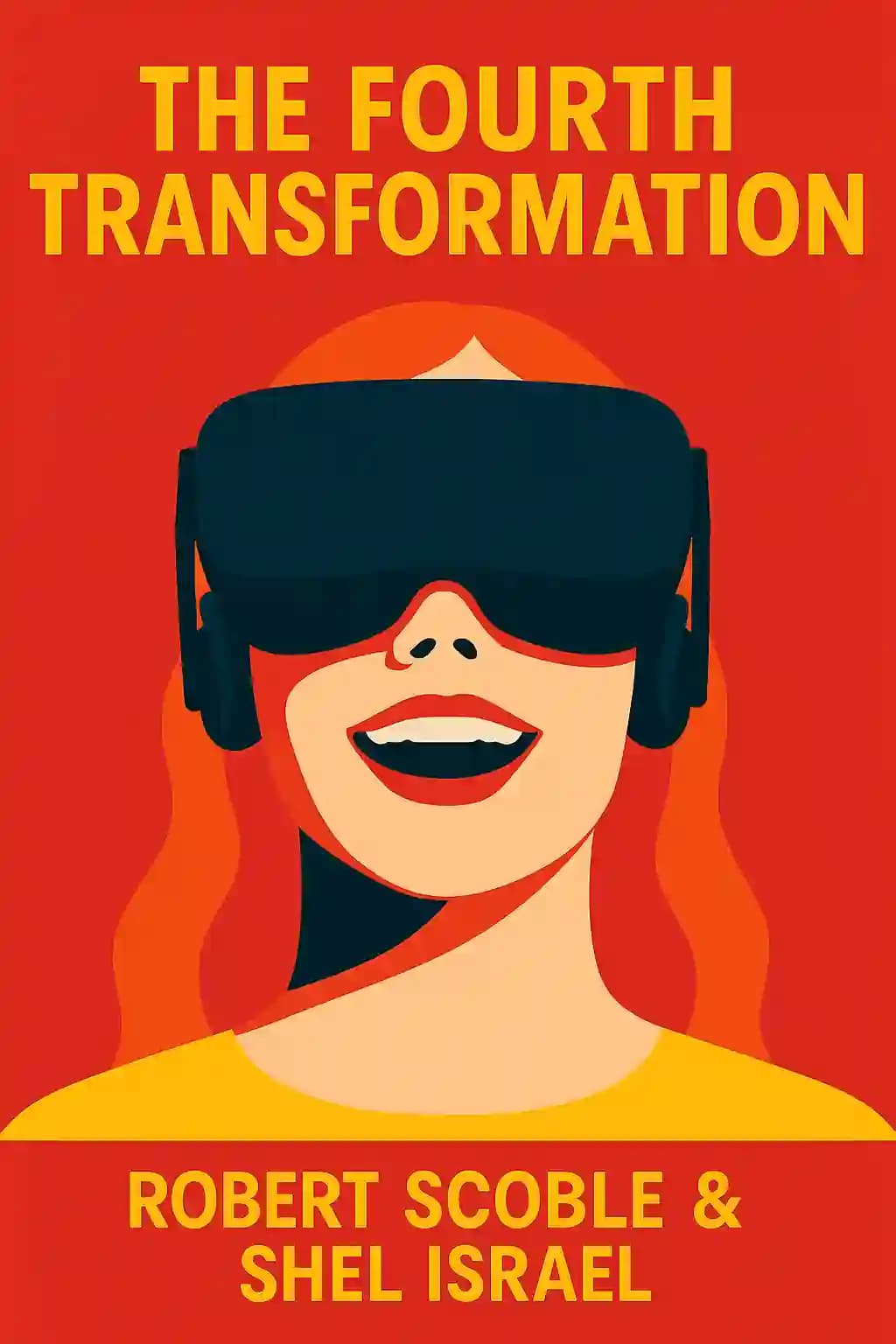
The Fourth Transformation
Overview of The Fourth Transformation
Step into the future where AR, VR, and AI revolutionize everything. Endorsed by Gary Vaynerchuk, "The Fourth Transformation" reveals how spatial computing will transform retail, healthcare, and education. What happens when your physical world becomes the interface? Business leaders can't afford to miss this.

Key Themes in The Fourth Transformation
- spatial computing
- mixed reality revolution
- human-computer interaction
- minecraft generation
- wearable interface design
Quotes from The Fourth Transformation
We'll no longer look at screens but through them.
The technology will become invisible.
Children don't just use technology - they communicate with it.
What begins in games inevitably shapes business and society.
VR storytelling dissolves as viewers determine their own experience.
Characters in The Fourth Transformation
- Robert ScobleCo-author and tech strategist
- Shel IsraelCo-author and writer on social media and tech
- Markus PerssonFounder of Minecraft
- Ivan SutherlandMIT pioneer of spatial computing
About the Author
About the Author of The Fourth Transformation
Robert Scoble and Shel Israel, co-authors of The Fourth Transformation: How Augmented Reality and Artificial Intelligence Change Everything, are pioneering voices in technology and its societal impact.
Scoble, a renowned tech evangelist and former Microsoft blogger, built credibility through his influential blog Scobleizer and roles at Rackspace and Fast Company. Israel, a veteran PR strategist and innovation speaker, brings decades of expertise in how emerging technologies reshape industries.
Together, they previously co-authored the bestselling Naked Conversations and Age of Context, exploring social media’s transformative power. Their latest work blends firsthand research at leading AR/AI companies with insights from Scoble’s global tech reporting and Israel’s corporate consulting.
The book’s rapid six-week publishing timeline—unheard of in traditional publishing—highlights their agile approach. Praised for its forward-looking analysis, The Fourth Transformation has earned 32 five-star Amazon reviews, solidifying their reputation as trusted guides to technology’s future.
Download Summary of The Fourth Transformation
Get the The Fourth Transformation summary as a free PDF or EPUB. Print it or read offline anytime.
FAQs About This Book
The Fourth Transformation explores how augmented reality (AR) and artificial intelligence (AI) will revolutionize technology, shifting from handheld devices to wearables like smart glasses. The book divides into three parts: technological evolution, business impacts (retail, healthcare, education), and societal challenges like privacy erosion and job displacement. It balances optimistic visions with ethical warnings, framing AR/AI as tools that will reshape human-computer interaction by 2030.
Tech innovators, business leaders, and futurists will gain actionable insights into adapting to spatial computing. The book also appeals to general readers interested in how AR glasses, AI-driven healthcare, and immersive education could redefine daily life by the 2030s. Critics praise its dual perspective on opportunities (e.g., virtual medical training) and risks (e.g., privacy concerns).
The authors focus on spatial computing (AR/VR), AI-driven interfaces (eye-tracking, brainwave controls), and the Visual Web—a 100x larger internet navigated via images, not text. Examples include haptic feedback for virtual touch and AI diagnosing illnesses faster than humans. These technologies aim to make devices "invisible" by embedding them into wearables.
Companies must prioritize wearable-tech integration (e.g., AR glasses for retail) and AI-enhanced workflows (e.g., virtual oil rig training). The book urges industries like healthcare to adopt VR surgery simulations and schools to replace textbooks with immersive history lessons. Scoble and Israel warn that laggards risk obsolescence.
The authors highlight privacy risks (always-on AR recording public spaces), job loss from AI automation, and truth manipulation via deepfakes. They argue for proactive regulation to prevent societal fractures, noting how tech’s benefits—like remote医疗—might only aid wealthy nations initially.
The Visual Web refers to a future internet where users search via images (e.g., snapping a photo to buy a product) and brands dominate through logos recognized by AR glasses. This shift could democratize global commerce but marginalize text-based platforms.
Unlike niche tech manuals, Scoble and Israel blend journalistic storytelling (based on 400+ expert interviews) with practical forecasts for businesses. It’s broader than Snow Crash (fiction) and more accessible than academic texts like Augmented Human. Critics call it a “Silicon Valley playbook” for non-experts.
Some reviewers argue the authors underestimate adoption barriers, like high costs of AR glasses, and overstate near-term impacts. Others note the “dark side” analysis (e.g., job loss) feels less developed than the optimistic tech scenarios.
- “We’ll make things happen by moving our eyes or by brainwaves” —emphasizing seamless tech interaction.
- “Language will be irrelevant” —highlighting the Visual Web’s global reach.
- “The social cost will be high and uneven” —cautioning about inequality in tech access.
By 2030, the authors foresee:
- VR classrooms replacing textbooks with virtual field trips.
- Haptic suits enabling long-distance physical touch.
- AI therapists treating mental health via AR interfaces.
- Smart glasses replacing smartphones for navigation, shopping, and socializing.
With AR glasses (like Apple Vision Pro) and AI chatbots now mainstream, the book’s 2016 predictions about wearable adoption and ethical debates feel prescient. Its framework helps readers contextualize breakthroughs like neural interfaces and AI-generated virtual worlds.
Scoble and Israel previously forecasted trends in Naked Conversations (social media, 2006) and Age of Context (IoT/wearables, 2013). This book extends their analysis to AR/AI, cementing their reputation as tech futurists who bridge Silicon Valley innovation and mainstream accessibility.