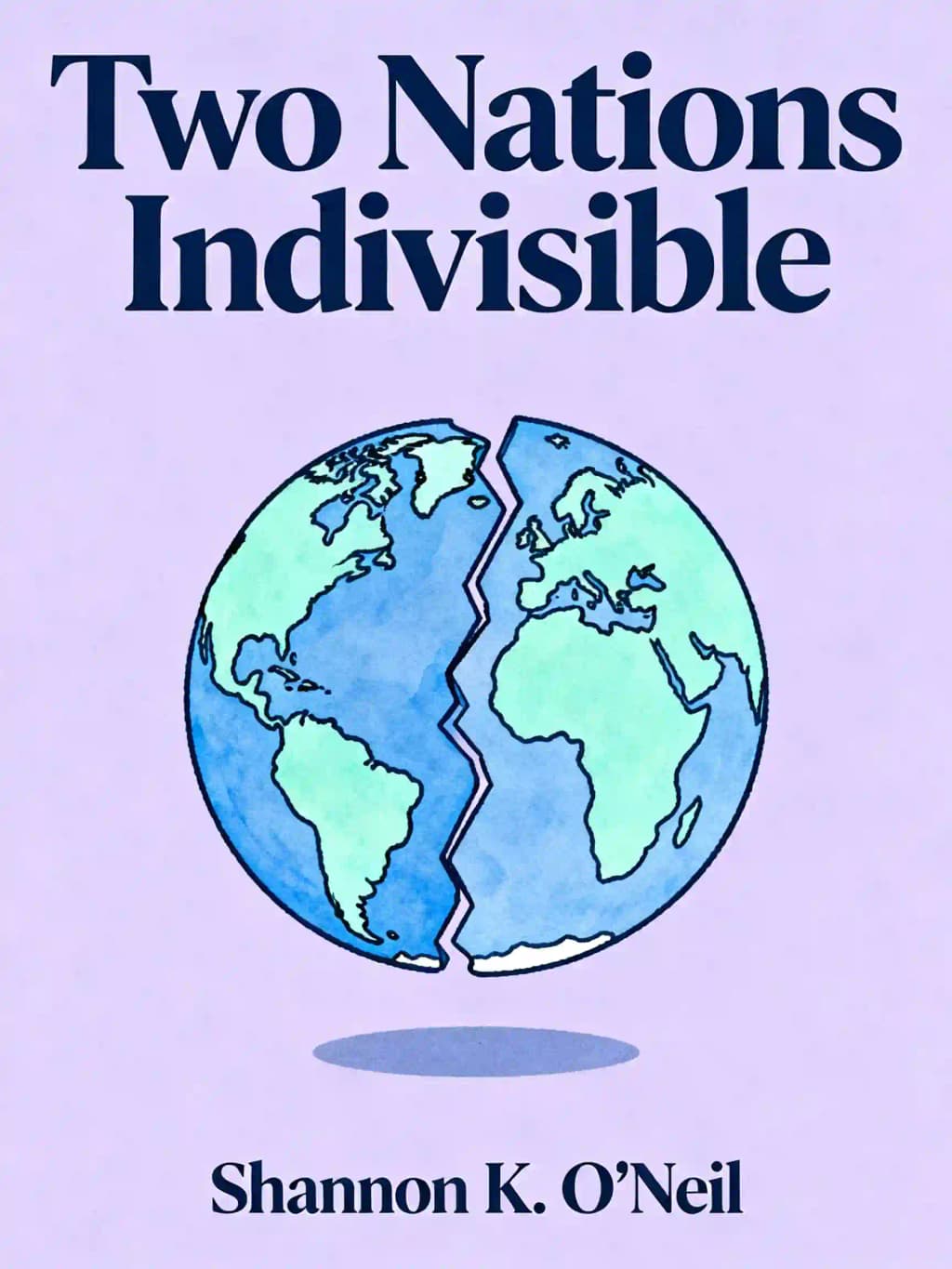
Two Nations Indivisible
Mexico, the United States, and the Road Ahead
Visão geral de Two Nations Indivisible
While headlines scream "drug violence," Shannon K. O'Neil reveals Mexico's overlooked economic renaissance. This Yale-Harvard scholar challenges media narratives, offering policymakers a roadmap beyond NAFTA. What if our closest neighbor isn't the crisis zone you've been led to believe?

Temas principais em Two Nations Indivisible
- binational interdependence
- north american integration
- borderland security
- economic cross-pollination
- democratic institutional stability
Citações de Two Nations Indivisible
Mexico defies simple characterization.
Building a wall won't solve shared problems.
Achieving transformed relations remains elusive.
Mexicans seeing it as might triumphing over right.
Only partnership can address drug-related violence.
Personagens de Two Nations Indivisible
- Shannon K. O’NeilAuthor and expert on U.S.-Mexico relations
- Carlos PascualFormer U.S. Ambassador to Mexico
- Santa AnnaMexican general and political leader
- Benito JuarezExiled leader who overthrew Emperor Maximilian
- Porfirio DiazMexican president who attracted American capital
Baixar resumo de Two Nations Indivisible
Obtenha o resumo de Two Nations Indivisible como PDF ou EPUB gratuito. Imprima ou leia offline a qualquer momento.
Perguntas Frequentes Sobre Este Livro
Two Nations Indivisible analyzes Mexico’s profound social, political, and economic transformations since the 1980s, challenging the U.S. media’s focus on violence and immigration. O’Neil highlights Mexico’s emergence as a democratic, globally integrated middle-class nation and argues for reimagined U.S. collaboration on trade, security, and immigration to reflect these changes.
This book is essential for policymakers, business leaders, and students of U.S.-Mexico relations. It offers actionable insights for those interested in North American trade dynamics, immigration reform, or Mexico’s democratic evolution, combining academic rigor with accessible analysis of binational interdependencies.
Yes – O’Neil’s data-driven perspective dismantles stereotypes, revealing a modernizing Mexico often overlooked in U.S. discourse. The book provides a roadmap for policymakers and counters fatalistic narratives with evidence of Mexico’s middle-class growth, economic diversification, and democratic progress since the 1990s.
O’Neil traces Mexico’s shift from oil-dependent isolation to a manufacturing powerhouse integrated into global supply chains. Key drivers include NAFTA, competitive industries like automotive and aerospace, and a growing middle class now comprising nearly 50% of the population – trends reshaping U.S. economic and immigration policies.
While acknowledging 60,000+ drug-war deaths (2006–2012), O’Neil contextualizes violence within Mexico’s economic modernization. She advocates for U.S. policy shifts – reducing drug demand, regulating firearms, and supporting judicial reforms – rather than militarized approaches that exacerbate instability.
The 2000 election ending PRI’s 71-year rule marked a turning point. O’Neil details subsequent reforms: independent electoral institutions, expanded press freedoms, and grassroots activism. However, she notes ongoing challenges like corruption and uneven security enforcement that test institutional resilience.
Proposals include expanding legal work visas, integrating Mexican immigrants via education/job programs, and jointly addressing Central American migration drivers. O’Neil argues current enforcement-focused strategies ignore economic interdependencies, with 80% of Mexican exports going to the U.S.
O’Neil criticizes Washington’s narrow focus on border security and drugs, urging recognition of Mexico as a strategic economic partner. The book highlights missed opportunities in energy collaboration, cross-border infrastructure, and joint innovation initiatives that could boost North American competitiveness.
Some scholars argue O’Neil underestimates structural issues like wealth inequality (45% poverty rate in 2013) and cartels’ infiltration of local governments. Critics note her pro-trade stance downplays environmental and labor concerns in manufacturing sectors.
While The Globalization Myth examines regional supply chains globally, Two Nations Indivisible focuses specifically on North America. Both emphasize regional economic integration, but the latter offers granular policy prescriptions for U.S.-Mexico collaboration missing from her broader work.
With Mexico now the U.S.’s top trading partner, surpassing China, the book’s insights on nearshoring, energy collaboration, and managed migration remain critical. Updated analyses might address López Obrador’s policies and shifting security dynamics under Biden’s administration.
Juárez – stereotyped as violent – is recast as a tech manufacturing hub. Pemex’s decline symbolizes Mexico’s shift from oil nationalism to diversified exports. These case studies illustrate systemic changes obscured by sensationalist media coverage.


