Capítulo 1
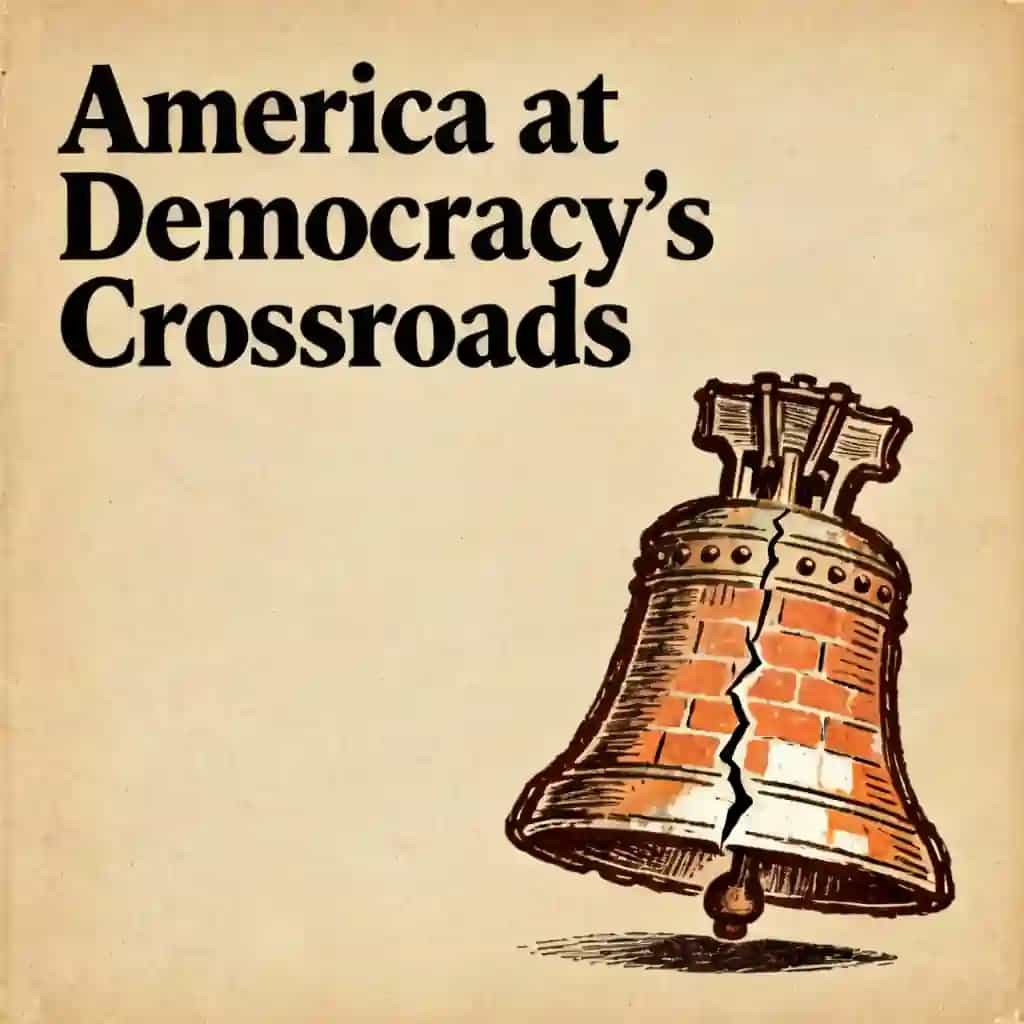
America at a Crossroads: The Battle for Democracy's Soul
What happens when a democracy begins to die? Not with a dramatic coup, but through ballot boxes and legal maneuvers that slowly erode the foundations of equality? In Heather Cox Richardson's "Democracy Awakening," we confront this chilling reality-America teetering on the precipice of authoritarianism. The book arrives at a pivotal moment in American history, having become a #1 New York Times bestseller and required reading among political analysts and historians. Richardson, whose daily "Letters from an American" newsletter reaches millions, masterfully connects today's political crisis to a centuries-old struggle between equality and hierarchy that dates back to America's paradoxical founding-a nation proclaiming equality while simultaneously denying it to many. As Barack Obama noted, this work "reminds us that the fight for democracy is never finished," while celebrities from George Clooney to Taylor Swift have praised its urgent message about democracy's fragility and the power of ordinary citizens to defend it.
Capítulo 2
The Conservative Paradox: Redefining America's Political Traditions
Today's crisis has deep roots in the 1930s when opponents of FDR's New Deal began rebranding themselves as "conservatives" while fighting against government regulation. This marked a profound distortion of conservatism's original meaning in American politics. In 1855, Chicago Tribune editor Joseph Medill claimed the word "conservative" for the cause of equality when challenging President Pierce's assertion that America was exclusively a white man's republic. Medill pointed out that the Declaration of Independence made no mention of "free white men" or "subject races," but instead proclaimed the "inalienable right of ALL men to Freedom."
Abraham Lincoln embraced this truly conservative stance when forming the Republican Party, arguing at Cooper Union in 1860 that Republicans were the genuine conservatives by adhering to the Founders' opposition to slavery. "What is conservatism?" Lincoln asked, "Is it not adherence to the old and tried, against the new and untried?" His election led to policies giving poorer men access to resources through homesteads, public universities, and ultimately the end of slavery.
By 1865, Lincoln's Republicans had put into practice their conservative position that America must embrace the Declaration's principles of equality and opportunity-the same position that would later underpin the New Deal. Those opposing business regulation and racial advances in the 1930s were not true American conservatives but the dangerous radicals Lincoln had warned against-individuals seeking to preserve hierarchies of wealth and race rather than the founding principles of equality.
This redefinition of conservatism created a powerful narrative tool that continues to shape American politics today, allowing opponents of equality to claim they're defending tradition when they're actually undermining the nation's foundational values.
Capítulo 3
The Liberal Consensus: America's Golden Age
The New Deal transformed America despite fierce opposition and initial struggles. When FDR cut spending in 1937 due to deficit concerns and right-wing pressure, unemployment rose and markets fell, threatening the program's survival. But Pearl Harbor changed everything. After Japan's December 7, 1941 attack killed or wounded over 3,500 Americans, the nation rallied behind democracy as the war effort showcased America's diverse strength.
Over 16 million Americans served in World War II, including 1.2 million Black Americans, 500,000 Latinos, 550,000 Jews, and a higher percentage of Native Americans than any other group. The home front saw Americans from all backgrounds supporting the war effort, and the economy boomed under massive deficit spending that proved government investment could create prosperity.
By 1945, most Republicans had joined Democrats in supporting regulated business, basic social safety nets, and infrastructure investment. This consensus wasn't perfect-the war's celebration of equality highlighted America's persistent inequalities like segregated military units, race riots, women's secondary roles, and Japanese American incarceration. The 1944 gang rape of Recy Taylor by six white men who weren't indicted despite confessing prompted NAACP action, with Rosa Parks organizing the "Committee for Equal Justice for Mrs. Recy Taylor."
Under Republican President Eisenhower, Chief Justice Earl Warren's Supreme Court began enforcing equality through decisions like Brown v. Board of Education (1954). By 1956, Republican Arthur Larson described an "Authentic American Center" that blended Democratic policies with traditional Republicanism, creating a uniquely American political consensus that would last for decades.
Imagine living in this era-a time when both parties accepted that government should work for all citizens, when infrastructure was built, education expanded, and the middle class grew rapidly. This wasn't socialism; it was pragmatic Americanism that recognized democracy functions best when prosperity is widely shared.
Capítulo 4
The Civil Rights Revolution: Bringing the Declaration to Life
The 1954 Brown v. Board decision declaring racial segregation unconstitutional marked a turning point. Black Americans who had fought for democracy worldwide demanded more than promises-they wanted actual equality. Organizations like the NAACP mobilized to generate public attention and political pressure for minority rights.
What truly catalyzed white lawmakers' engagement with civil rights was a brutal attack on Isaac Woodard, a decorated Black World War II veteran still in uniform. In February 1946, when Woodard asked a bus driver to stop for a restroom break and objected to being called "boy," saying "I'm a man, just like you," the driver had him removed. Police Chief Lynwood Shull arrested Woodard and viciously beat him, using a billy club to blind him in both eyes before jailing him overnight.
The NAACP spread Woodard's story widely, with Orson Welles reading his affidavit on his popular radio show. NAACP Executive Secretary Walter Francis White brought the case directly to President Truman, who was deeply troubled despite his southern upbringing. Truman ordered a Justice Department investigation, but even after federal indictment, an all-white jury acquitted Shull after just thirty minutes of deliberation.
This injustice spurred both Judge Julius Waties Waring and President Truman to action. Truman established the President's Committee on Civil Rights and used executive authority to ban discrimination in the military, civil service, and defense contracts. He shocked the political establishment by campaigning in Harlem and winning reelection despite southern "Dixiecrat" opposition.
The movement gained momentum when Senator Lyndon Johnson intervened to arrange burial with full military honors at Arlington Cemetery for Felix Longoria, a Mexican American soldier whose family had been denied funeral services in segregated Texas. The civil rights movement found further support when President Eisenhower appointed Earl Warren as Chief Justice, leading to the landmark Brown v. Board decision.
White resistance intensified with horrific violence, exemplified by the brutal murder of fourteen-year-old Emmett Till in Mississippi. Till's mother's decision to hold an open-casket funeral exposed racism's brutality to the nation. The Montgomery bus boycott, led by figures including Rosa Parks and Martin Luther King Jr., further galvanized the movement despite violent opposition.
By 1957, federal power stood firmly behind civil rights, with Eisenhower sending troops to enforce school integration in Little Rock and Congress passing the Civil Rights Act with bipartisan support despite Strom Thurmond's record-setting filibuster. The federal government had committed to protecting citizens' rights from states that refused to recognize equality.
Capítulo 5
The Southern Strategy: Race, Taxes, and Political Realignment
The liberal consensus that dominated American politics from 1946 to 1964 seemed unshakable, but the 1954 Brown v. Board decision revealed a crucial vulnerability by explicitly connecting the active federal government to civil rights rather than just economic equality for white Americans.
Opponents seized this opportunity to resurrect a different historical narrative rooted in racial hierarchy. They argued that the federal government was misusing tax dollars from hardworking white men to promote undeserving Black people's civil rights. This framing gained traction amid Cold War fears, as they labeled civil rights enforcement as wealth redistribution and "virtually socialism."
What's fascinating is that this American fear of "socialism" wasn't new but rather resurrected white supremacist rhetoric from the Reconstruction era. Unlike international socialism based on Marxist theory (which never gained significant traction in America), this uniquely American definition emerged in 1871 when white southerners reframed their opposition to Black voting rights.
After Congress passed the Military Reconstruction Act and the Fifteenth Amendment protected Black men's right to vote, white supremacists initially used terror tactics like the Ku Klux Klan to suppress Black voters. When the federal government created the Department of Justice to protect voting rights, these white southerners strategically shifted their argument from explicitly racial grounds to economic ones. They claimed they opposed Black voting because formerly enslaved people would vote for public investments like roads and hospitals that required taxes from property-owning whites. This framing of Black voting as wealth redistribution was explicitly labeled "Socialism in South Carolina" in popular magazines of the time.
This strategy proved devastatingly effective a century later when Richard Nixon implemented his "southern strategy," deliberately courting white supremacist Democrats orphaned by their party's embrace of civil rights. Nixon personally wooed Strom Thurmond and promised to stop federal desegregation enforcement. As President Johnson presciently observed, "If you can convince the lowest white man he's better than the best colored man, he won't notice you're picking his pocket."
Nixon's campaign strategy deliberately appealed to voters' emotions rather than reason, creating division between "good Americans" and those allegedly seeking to destroy the nation. His team found perfect foils in Black activists and the New Left, particularly college students protesting racial inequality and the Vietnam War. This polarization justified extraordinary measures-including Nixon's secret undermining of Vietnam peace talks to hurt Democrats-because if Democrats were dangerous "others," anything to keep them from power seemed justified.
Capítulo 6
The Reagan Revolution: Perfecting the Politics of Division
Six years after Nixon's resignation, Ronald Reagan traveled the road to the White House that Goldwater and Nixon had paved, continuing the process of rolling back the liberal consensus while refining Nixon's divisive rhetoric with a softer voice and folksy storytelling. Reagan perfected the art of pitting hardworking white Americans against a grasping government serving "special interests" and nonexistent Black welfare cheats.
Cultivating a cowboy image with its antigovernment and traditionalist associations, Reagan constructed a deliberately false image of Democrats as advocates of wasteful government spending. Despite portraying America in dire economic straits, the economy had actually boomed in the 1950s and continued growing in the 1960s, with poverty rates falling significantly. However, corporate mergers and manufacturing jobs moving south or overseas were hollowing out northern industrial cities, creating real economic anxiety that Reagan exploited.
Reagan built his coalition by appealing to racial resentment, launching his presidential campaign in Philadelphia, Mississippi-where three civil rights workers had been murdered by the Klan sixteen years earlier-with a speech supporting "states' rights." He promoted the myth of a Chicago "welfare queen" using coded racial language, while the Republican platform promised to protect segregation academies.
His coalition also included traditionalists alarmed by women's changing roles and right-wing religious groups, particularly the newly fundamentalist-controlled Southern Baptist Convention and Jerry Falwell's Moral Majority. His campaign's slogan to "make America great again" invited voters to remember a time before Black, Brown, and female voices claimed equal rights.
When Reagan implemented supply-side economics, his budget director David Stockman had to reprogram computers when they projected massive deficits, admitting "None of us really understands what's going on with all these numbers." The theory was "premised on faith."
The results were dramatic. From 1933-1980, the wealth gap had narrowed in "the great compression," but after 1981 came "the great divergence." Tax cuts slashed top rates from 70% to 30% while defense spending soared from $267.1 billion to $393.1 billion. The national debt tripled to $2.1 trillion, turning America from the world's largest creditor to its largest debtor.
Have you ever wondered why American politics became so divisive? By 1990, Newt Gingrich's GOPAC was instructing Republicans to use words like "corrupt," "pathetic," and "traitors" when referring to Democrats. Pat Buchanan's 1992 convention speech declared a "culture war" for "the soul of America," framing Democrats as the enemy of American values. This wasn't just political disagreement-it was a deliberate strategy to make compromise impossible.
Capítulo 7
Undermining Democracy: The Systematic Assault on American Institutions
Republicans discovered a key psychological advantage in their rhetoric: it put Democrats perpetually on defense, explaining themselves rather than countering attacks. This allowed Movement Conservatives to systematically weaken democratic mechanisms when voters refused to embrace their ideology.
In 1986, Grover Norquist formed Americans for Tax Reform, formalizing Nixon's coalition of business interests, evangelicals, and social conservatives. Republicans began talking about "ballot integrity" measures that party operatives privately hoped would disenfranchise Black voters. After Democrats passed the Motor Voter Act in 1993 making registration easier, Republicans accused them of enabling "illegal" immigrant voters. Losing Republican candidates began claiming "voter fraud," launching yearlong investigations that found nothing but planted doubts in public consciousness.
This strategy paid off dramatically in Florida, where a 1997 law purged up to 100,000 Black voters from rolls. During the 2000 presidential election, with Bush leading Gore by just 537 votes in Florida, Republican operatives including Roger Stone staged the "Brooks Brothers riot" to stop the recount. The Supreme Court, led by five Republican-appointed justices, intervened to decide the winner, despite a later investigation revealing "an extraordinarily high and inexcusable level of disenfranchisement" of Democratic African American voters.
In February 1986, DOJ lawyer Samuel Alito proposed using presidential "signing statements" to let presidents "interpret" laws rather than simply signing or vetoing them. He acknowledged this would be controversial as it increased presidential power relative to Congress, recommending they establish the precedent quietly. Reagan implemented this strategy in 1987, attaching a signing statement to a debt bill declaring his right to interpret it as he wished. This advanced the "unitary executive" theory claiming that congressional oversight of the presidency is unconstitutional-a radical departure from precedent established since Washington.
Republicans attacked Supreme Court decisions that had used the Fourteenth Amendment to apply constitutional protections at the state level, calling this "judicial activism" and "legislating from the bench." They advocated "originalism," arguing the federal government could only do what was explicitly written in the 1787 Constitution-effectively prohibiting business regulation, social safety nets, infrastructure development, and civil rights protections.
Reagan's attorney general Edwin Meese aimed to "institutionalize the Reagan revolution so it can't be set aside no matter what happens in future presidential elections" by screening judicial nominees for ideological purity. Reagan nominated Antonin Scalia, the intellectual leader of the originalists, to the Supreme Court in 1986, followed by extremist Robert Bork in 1987. Bork had called the ban on whites-only lunch counters "unsurpassed ugliness," and was so extreme that six Republicans joined Democrats in rejecting his Supreme Court appointment.
Capítulo 8
The Trump Presidency: Authoritarianism Arrives
On June 16, 2015, Donald Trump descended the golden escalator at Trump Tower to announce his presidential campaign, bringing reality TV sensibilities to politics. Trump presented himself as the embodiment of the Republican success story-a self-made billionaire with luxury properties-though the reality was far different. His father had bankrolled him with $413 million in today's dollars, his companies had repeatedly declared bankruptcy, and by the 2000s he was "billions of dollars in debt."
Trump understood what Republican base voters wanted far better than establishment politicians. He stripped away pretense, offering extremists a hierarchical world where they would dominate women and minorities. Speaking simply with emotionally charged language, he promised to restore a mythological past where his supporters called the shots. He claimed America had "no victories anymore," attacked Mexican immigrants as criminals, promised a border wall, and vowed to make America "great again."
His authoritarian message aligned with rising global authoritarianism, particularly Vladimir Putin's Russia. Trump's campaign maintained concerning ties with Russian interests, including a June 2016 Trump Tower meeting between campaign officials and Russian operatives offering damaging material on Hillary Clinton. Despite losing the popular vote by 2.8 million, Trump secured an Electoral College victory and delivered an inaugural address describing American "carnage" while promising forgotten Americans: "I will fight for you with every breath in my body."
Trump's drive toward authoritarianism became clear immediately when he insisted his inaugural crowd was bigger than Obama's. This wasn't just a lie but a demonstration of dominance through "alternative facts"-a gaslighting technique forcing subordinates to surrender either their integrity or their own perceptions. As Steve Bannon put it, they would "flood the zone with sh*t" to exhaust and disorient the public.
Trump's sudden travel ban on primarily Muslim countries further demonstrated his intention to destabilize the government. When Acting Attorney General Sally Yates refused to defend the ban, Trump promptly fired her. Behind the scenes, Stephen Miller and allies were already working on separating refugee children from their parents at the southern border, overriding normal policy processes and excluding career officials who objected.
Americans began awakening to these attacks on democratic principles. The Women's March-the largest single-day demonstration in world history-brought together diverse activists concerned about the country's direction under Trump. As Gloria Steinem declared: "We are linked. We are not ranked."
Capítulo 9
January 6th and Beyond: Democracy in the Balance
The assault on the Capitol on January 6, 2021, represented the culmination of decades of Republican embrace of hierarchical American history. As legal challenges to the 2020 election failed, Trump's allies developed a plan where fake electors from battleground states would submit false slates to Congress. When Vice President Pence refused to participate, Trump attempted to name Jeffrey Clark as attorney general to announce false DOJ investigations into election irregularities.
On January 6, Trump told supporters at the "Stop the Steal" rally that they needed to "fight like hell" to "save our democracy," directing his armed supporters to march to the Capitol. The ensuing violent attack saw one rioter carrying the Confederate flag into the Capitol-a symbol that had never entered those halls even during the Civil War. Trump refused to call off supporters for over three hours, finally telling them "We love you. You're very special" and to "Remember this day forever!"
After the Capitol attack, Trump initially seemed politically toxic, losing access to social media platforms while facing calls for removal. However, he refused to retreat, telling supporters "our incredible journey is only just beginning." Only 10 House Republicans voted for impeachment, and just 7 Republican senators voted to convict.
Trump's insistence that he'd been cheated became what scholars call a "Big Lie"-a falsehood so enormous people believe it because they cannot imagine someone inventing something so outrageous. Like Hitler's propaganda tactics, Trump's Big Lie became a loyalty test for Republicans, who gradually purged members who opposed him.
This led to nineteen Republican-dominated states changing election laws to restrict voting access, particularly targeting Black voters, while some transferred certification authority to partisan boards. Republicans embraced the fringe "independent state legislature doctrine" that would allow state legislatures to control presidential electors regardless of state constitutions or courts.
The Supreme Court, stacked with originalists, reinforced states' rights by overturning Roe v. Wade and limiting federal regulatory power, enabling Republican-controlled state legislatures to pass extreme legislation on abortion, guns, and education. The Court's embrace of the "major questions theory" in West Virginia v. EPA effectively ended federal business regulation dating back to Washington's presidency, while using deeply flawed historical reasoning to strike down gun restrictions.
Capítulo 10
Reclaiming America's Democratic Promise
Today's democracy crisis returns us to the Founders' fundamental question: Can we create a nation where everyone is truly equal before the law? The Declaration of Independence was radically daring, rejecting European traditions of hierarchy by declaring "all men are created equal" and that governments require the consent of the governed. Yet these same men owned slaves and excluded women, Indigenous people, and Black Americans from their definition of equality.
This contradiction has fueled competing visions of America's founding-the 1619 Project emphasizing slavery's centrality versus Trump's 1776 Commission glorifying founding principles while glossing over inequalities. Antidemocratic leaders have exploited this tension, convincing followers that returning to hierarchy represents America's true tradition.
But America's story is also one of constant struggle by marginalized people to fulfill the Declaration's promise-from Lincoln to Harriet Beecher Stowe, from Sitting Bull to Fannie Lou Hamer. Unlike the mythologized individualistic cowboy, America's strength has always been communities working together across differences.
The Biden administration has attempted to rebuild democratic norms by expanding liberalism to meet contemporary challenges, just as Lincoln, Theodore Roosevelt, FDR, and LBJ had done before. His administration centered policy around children and caregivers rather than traditional nuclear families, expanded tax credits, passed gun safety legislation, protected interracial and gay marriage, and helped veterans exposed to toxic burn pits.
Internationally, Biden rejoined global alliances and organizations abandoned under Trump, rebuilding NATO and forming new partnerships in Asia and Africa. When Putin invaded Ukraine in 2022, the international community's coordinated response discredited the argument that autocracy was more efficient than democracy, as Russia's corruption-weakened military faltered against Ukrainian resistance.
Despite these democratic defenses, authoritarianism persists. The Supreme Court, packed with three Trump-appointed justices, overturned Roe v. Wade, putting other civil rights protections at risk. Republican governors openly use government power to reward friends and punish enemies while manufacturing anti-immigrant and anti-LGBTQ sentiment, mimicking Putin and Orban's tactics.
America's true history is one of continuous democratic evolution-people honoring the idea that a nation can be based not on land, religion, race, or hierarchies, but on human equality. Reclaiming this history of noble struggle undermines authoritarianism's appeal. In 1776, the Founders proposed creating a nation based on the rule of law rather than religion, race, or tradition-a system where every person could be equal before the law and have a voice in government.
Though democracy appeared to win in Lincoln's era, Americans failed to completely eliminate the hierarchical strand of our history, leaving it available for future autocrats to exploit. The Founders' hopes have never been fully realized, but neither have they been proven wrong. We face another time of testing, and the outcome rests, as it always has, in our own hands.