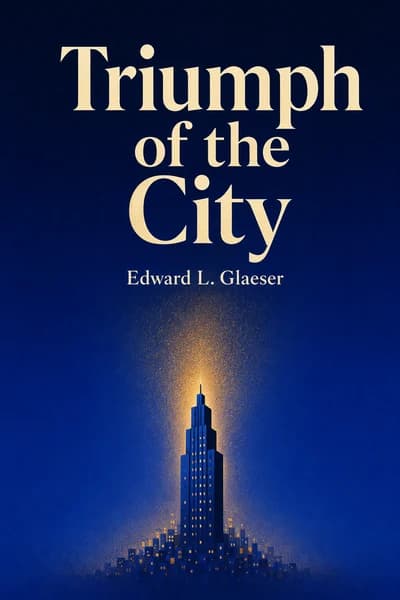
Glaeser's masterpiece reveals why cities - our greatest invention - make us richer, smarter, and happier. Praised by "Freakonomics" author Steven Levitt as "brilliant," this counterintuitive urban manifesto challenges everything you thought about city living. What if concrete jungles are actually our greenest option?
Edward L. Glaeser, author of Triumph of the City: How Our Greatest Invention Makes Us Richer, Smarter, Greener, Healthier, and Happier, is a leading economist and urban studies expert renowned for his research on city growth and urban innovation.
A Harvard University professor since 1992, where he holds the Fred and Eleanor Glimp Chair in Economics, Glaeser combines academic rigor with accessible insights into how cities shape economies, cultures, and environmental sustainability.
His work, including co-authored books like Survival of the City and Fighting Poverty in the U.S. and Europe, explores themes of urban resilience, inequality, and policy design. A frequent contributor to The New York Times Economix blog and The Boston Globe, Glaeser’s analyses bridge academic research and public discourse.
Triumph of the City, a New York Times bestseller translated into multiple languages, remains a seminal text in urban economics and is widely cited in policy debates. His research on zoning’s impact on housing affordability and historical economic hubs has influenced global urban development strategies.
Triumph of the City argues that cities are humanity’s greatest invention, driving economic growth, innovation, and cultural richness through density and human collaboration. Edward Glaeser, a Harvard urban economist, highlights how cities like New York and Paris thrive by fostering idea exchange, entrepreneurship, and efficient resource use. He addresses challenges like housing affordability and transportation while advocating for policies that encourage growth, education, and smart urban planning.
This book is ideal for urban planners, policymakers, economists, and anyone interested in urbanization’s impact on society. It offers insights for professionals tackling housing affordability, transportation, or sustainability issues. Readers curious about the historical evolution of cities or solutions to modern urban challenges will find actionable ideas grounded in economic research.
Yes, for its compelling blend of economics, history, and policy analysis. Glaeser’s accessible writing demystifies complex urban systems, making it a staple for understanding how cities shape prosperity. Critics praise its data-driven arguments, though some note its focus on high-density cities may not apply universally.
Glaeser champions skyscrapers as solutions to housing shortages and environmental challenges. By building upward, cities like San Francisco can preserve green spaces while accommodating growth. However, critics argue this approach suits only a few high-demand cities, not regions where sprawl dominates.
He links strict zoning regulations to skyrocketing housing costs, arguing they stifle affordability and economic mobility. For example, limiting vertical growth in cities like New York exacerbates inequality by reducing housing supply.
Glaeser analyzes 20th-century urban decay caused by suburbanization, crime, and flawed policies. He contrasts Detroit’s collapse with the resilience of cities like Boston, which pivoted to education and technology.
Educated populations attract innovation-driven industries, making cities adaptable to economic shifts. Glaeser cites Boston’s tech boom as evidence that investing in human capital ensures long-term growth.
While both celebrate vibrant streets and density, Glaeser emphasizes economic frameworks and policy reform, whereas Jacobs focused on organic community dynamics. Critics note Glaeser’s approach leans more toward market-driven solutions than grassroots activism.
Some argue Glaeser overstates cities’ universal appeal, ignoring suburban and rural preferences. Others contend his market-centric views downplay the need for affordable housing subsidies or climate resilience investments.
Though written pre-pandemic, Glaeser’s emphasis on face-to-face collaboration remains relevant. Cities must adapt by balancing hybrid work models with incentives to retain cultural and economic hubs.
Pair with Glaeser’s Survival of the City (2021) for post-pandemic insights or Jane Jacobs’ The Death and Life of Great American Cities for a community-centric perspective. For policy contrast, try Matthew Desmond’s Evicted.
Sinta o livro através da voz do autor
Transforme conhecimento em insights envolventes e ricos em exemplos
Capture ideias-chave em um instante para aprendizado rápido
Aproveite o livro de uma forma divertida e envolvente
Cities are the absence of physical space between people and companies.
Cities reflect our fundamental nature as social creatures who thrive through connection.
Ideas don't require roads to cross continents.
Human capital, far more than physical infrastructure, determines which cities prosper.
The exodus from the Rust Belt isn't an indictment of urban living but of cities that abandoned vital features of urban life.
Divida as ideias-chave de Triumph of the City em pontos fáceis de entender para compreender como equipes inovadoras criam, colaboram e crescem.
Destile Triumph of the City em dicas de memória rápidas que destacam os princípios-chave de franqueza, trabalho em equipe e resiliência criativa.

Experimente Triumph of the City através de narrativas vívidas que transformam lições de inovação em momentos que você lembrará e aplicará.
Pergunte qualquer coisa, escolha a voz e co-crie insights que realmente ressoem com você.

Criado por ex-alunos da Universidade de Columbia em San Francisco
"Instead of endless scrolling, I just hit play on BeFreed. It saves me so much time."
"I never knew where to start with nonfiction—BeFreed’s book lists turned into podcasts gave me a clear path."
"Perfect balance between learning and entertainment. Finished ‘Thinking, Fast and Slow’ on my commute this week."
"Crazy how much I learned while walking the dog. BeFreed = small habits → big gains."
"Reading used to feel like a chore. Now it’s just part of my lifestyle."
"Feels effortless compared to reading. I’ve finished 6 books this month already."
"BeFreed turned my guilty doomscrolling into something that feels productive and inspiring."
"BeFreed turned my commute into learning time. 20-min podcasts are perfect for finishing books I never had time for."
"BeFreed replaced my podcast queue. Imagine Spotify for books — that’s it. 🙌"
"It is great for me to learn something from the book without reading it."
"The themed book list podcasts help me connect ideas across authors—like a guided audio journey."
"Makes me feel smarter every time before going to work"
Criado por ex-alunos da Universidade de Columbia em San Francisco

Obtenha o resumo de Triumph of the City como PDF ou EPUB gratuito. Imprima ou leia offline a qualquer momento.
Picture walking through Mumbai's Dharavi slum, where a million people squeeze into 530 acres, then stepping into a gleaming Bangalore tech campus, and finally strolling London's Bond Street past Graff diamonds and Chanel boutiques. These vastly different urban landscapes share something profound: they all exist because humans instinctively seek each other out. Despite having endless space available, 243 million Americans cram into just 3% of the country's land. Every month, five million people flood into developing world cities. This isn't madness-it's the story of human progress. Ancient Athens gave us philosophy, Florence birthed the Renaissance, and Birmingham sparked the Industrial Revolution, all because ideas collide and multiply when minds gather in shared space. Cities aren't just buildings and roads; they're living ecosystems where innovation happens, opportunities emerge, and the remarkable potential of human connection unfolds. The real question isn't why cities exist, but why we ever doubted their power.