Capítulo 1
The Catallaxy of Human Progress
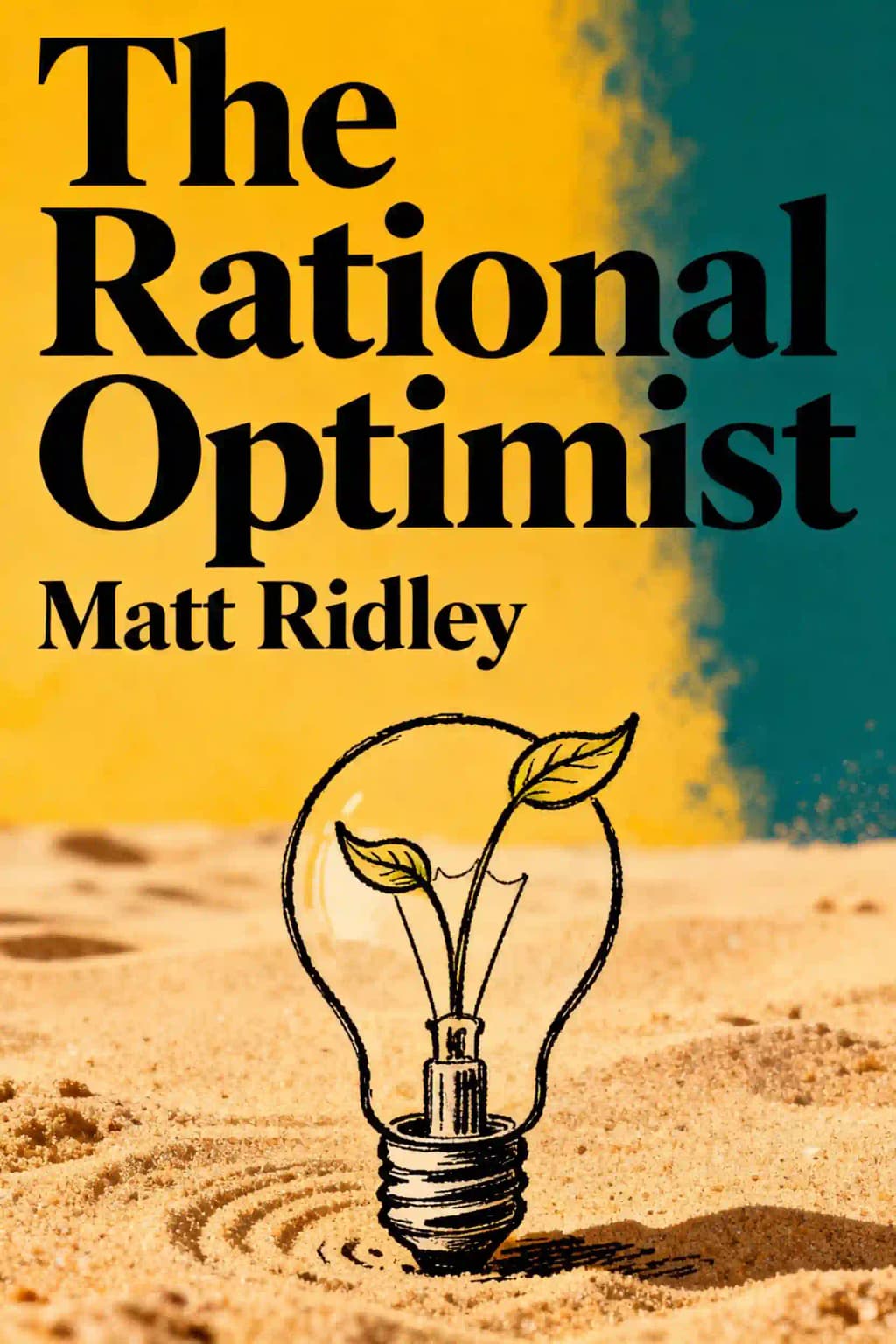
Have you ever wondered why, despite the constant drumbeat of doom and gloom in our daily news cycle, humanity continues to thrive? Matt Ridley's "The Rational Optimist" offers a refreshing counterpoint to prevailing pessimism. This provocative bestseller, which has influenced tech titans like Bill Gates and Mark Zuckerberg, challenges our natural tendency toward catastrophic thinking. Named one of the "Books of the Year" by both The Economist and Financial Times, Ridley's work has sparked heated debates across political spectrums since its 2010 publication. Drawing on disciplines from anthropology to economics, he presents a compelling case for optimism based not on blind faith, but on the extraordinary power of human exchange and specialization-what he calls the "catallaxy" of ideas having sex with one another.
Capítulo 2
When Ideas Have Sex: The Engine of Human Progress
What fundamentally separates humans from other animals? It's not our brains-Neanderthals had similar cranial capacity. It's not language or tool use, which other species demonstrate in limited forms. The true differentiator is our unique capacity for exchange and specialization. While human nature remains constant-we still seek food, desire sex, and compete for status just as our ancestors did-our collective intelligence has transformed our species in ways no other animal experiences.
The magic happens when ideas meet and mate. Just as sex makes biological evolution cumulative by bringing together genes from different individuals, the exchange of ideas makes cultural evolution cumulative. When humans began exchanging things, culture suddenly became progressive and human economic advancement began. This specialization encouraged innovation, saved time, and created prosperity proportional to the division of labor.
Consider the stone hand axe versus a computer mouse. The hand axe remained virtually unchanged for over a million years despite our ancestors having brains nearly as large as ours. The mouse, by contrast, represents the culmination of countless innovations from countless minds. This difference isn't just about big brains but something that happened between brains-our ideas began to meet and mate.
The more people specialize and exchange, the wealthier we all become-with no inevitable end to this process. Despite challenges like economic crashes, population growth, and climate change, humanity continues its remarkable ascent. This isn't mere technological determinism; it's about the emergent properties of human exchange networks that create what economists call "increasing returns"-the more we connect and share ideas, the faster innovation happens.
This insight builds on Adam Smith's observations from 1776, but with important modern extensions. Unlike Smith, we now understand how this process resembles biological evolution-a bottom-up, decentralized system that creates order without design. The human world isn't just about competition, but about cooperation through mutual self-interest, creating an ever-expanding web of specialization and exchange.
Capítulo 3
The Unprecedented Present: How Far We've Come
In just 10,000 years, humanity has expanded from fewer than 10 million to nearly 10 billion people. Though some still live in misery worse than Stone Age conditions, the vast majority enjoy unprecedented prosperity-better fed, sheltered, entertained, protected against disease, and longer-lived than any ancestors before them.
The statistics are staggering. Since 1800, world population has multiplied six times, yet average life expectancy has more than doubled and real income has risen more than ninefold. The last fifty years alone show remarkable progress: compared to 1955, the average human now earns three times more money, eats one-third more calories, buries one-third fewer children, and lives one-third longer. People are less likely to die from war, disease, accidents, or natural disasters. Cancer, heart disease, and stroke rates have declined. Literacy, education, and access to basic amenities have all improved dramatically-even as population doubled.
This improvement spans nearly every region, with only a handful of countries showing any decline in living standards. Even the poor have prospered, growing their consumption twice as fast as the world average between 1980-2000. At current rates of poverty reduction, absolute poverty could theoretically reach zero by 2035.
The true measure of something's worth is time-how many hours of work it takes to acquire it. Prosperity means increasing what you can earn with the same amount of work. Consider artificial light: earning an hour of reading light required six hours of work in 1800 but merely half a second today-a 43,200-fold improvement. These calculations don't even account for modern lighting's greater convenience, cleanliness, and safety.
The improvements are everywhere: a stagecoach journey from Paris to Bordeaux once cost a clerk's monthly wages; milk requires 30% less working time than in 1970; a cross-country phone call that once required 90 hours of work now takes minutes. Even the "robber barons" got rich by making things cheaper-Vanderbilt permanently reduced rail fares, Carnegie cut steel prices by 75%, Rockefeller slashed oil prices by 80%, and Ford made cars affordable for ordinary people.
This is how prosperity spreads-by granting people dollops of free time through cheaper goods and services. The average American now spends just $37 of every $100 on food, clothing, and shelter, down from $76 in 1900. A few hours of work secures these necessities, leaving time to earn for luxuries, entertainment, and other improvements.
Capítulo 4
The Collective Brain: How Exchange Creates Intelligence
Modern consumers benefit not just from others' labor but from their inventions too. Every product we use embodies the knowledge of countless innovators-from television pioneers to Neolithic farmers. While Louis XIV had 498 servants preparing his meals, today's average person commands the services of thousands of people through the market system.
The key difference is that modern workers each produce one specialized thing while consuming thousands of diverse products-the hallmark of a high standard of living. This "collective brain" distributes knowledge across society rather than concentrating it in any single mind, allowing for unprecedented efficiency and innovation.
Self-sufficiency is poverty, not virtue. If you had to be completely self-sufficient, your day would be consumed by subsistence tasks-gardening, gathering fuel, making clothing, and maintaining shelter. You'd have no time for reading, travel, or innovation. The only historical path to improvement was to lower someone else's standard of living by buying slaves.
Today's interdependence makes modern life sustainable by spreading risk and preventing local shortages. When wheat prices tripled in 2006-8, nobody starved, unlike similar price spikes in pre-railway Europe when people became refugees rather than pay exorbitant food import costs.
This collective intelligence emerged gradually. Around 65,000 years ago, a small group of several hundred people left Africa, crossing the Red Sea and expanding eastward along Asia's southern coast. These maritime pioneers navigated by canoe, island-hopping through Indonesia until reaching Australia-New Guinea around 45,000 years ago.
As humans spread across Eurasia, their technological innovation accelerated dramatically. From 45,000 years ago, they revolutionized toolmaking, striking sharp blades from rock cores-producing ten times more cutting edge than previous methods. By 34,000 years ago, they crafted bone spear points, followed by needles, atlatls, and eventually bows and arrows.
Evidence of long-distance trade appeared, with Black Sea shells and Baltic amber found at Ukrainian sites 18,000 years ago. Unlike Neanderthals, who used only local materials, these humans exchanged goods over vast distances. This trade stimulated innovation, generating more invention between 80,000-20,000 years ago than in the previous million. Exchange became the catalyst for technological advancement, just as sex drives evolution-both stimulate novelty.
Capítulo 5
The Manufacture of Virtue: How Commerce Creates Trust
The Ultimatum Game reveals surprising human generosity-people typically offer close to half their money rather than the minimum rational amount. More surprisingly, those most immersed in modern commerce are the most generous. When fifteen tribal societies played the game, those with least experience dealing with outsiders made the smallest offers, while those integrated into markets typically offered half.
Exchange doesn't teach kindness per se; it teaches that enlightened self-interest lies in cooperation. This explains humans' unique ability to deal with strangers and extend division of labor even to enemies. While commerce fosters trust, it isn't sufficient alone. Societies need both tools and rules. Innovations that civilized the world include institutions like the golden rule, rule of law, property rights, democratic government, impartial courts, and social conventions.
Economic freedom predicts prosperity better than mineral wealth, education, or infrastructure. Among 127 countries studied, those with greater economic freedom had four times the income per capita and nearly double the growth rate. A World Bank study of "intangible wealth" found Americans have ten times more intangible capital than Mexicans, explaining why a Mexican crossing the border quadruples productivity immediately through access to better institutions and rules.
But these rules and institutions themselves evolved bottom-up rather than being imposed top-down. Merchant law emerged from traders' customs before kings codified it. Human history is driven by a co-evolution of rules and tools, with increasing specialization and exchange as the root cause of innovation in both spheres.
Trust in modern society extends miraculously to unknown shopkeepers through invisible guarantors: sealed packaging, warranties, consumer legislation, brands, and currency. These mechanisms create a "shadow of the future" where reputation matters more than immediate gain. The internet, rather than becoming a den of fraud, has proven remarkably effective at enabling trust between strangers through simple feedback mechanisms.
Despite the liberating effects of commerce, most modern critics see corporations as threats to human freedom. Yet large corporations are becoming more vulnerable to nimble competitors, and are increasingly frail, fragile, and frightened-of the press, pressure groups, government, and customers. Corporate turnover is accelerating dramatically, with the average American company shrinking from twenty-five employees to just ten in twenty-five years.
Capítulo 6
The Feeding of the Nine Billion: Agricultural Innovation
Agriculture represents the extension of specialization and exchange to include other species. Farming fundamentally diverts other species' labor to human service-cattle and goats gather grass and convert it to leather and meat, wheat plants gather sunlight and produce grain. This symbiotic relationship extends beyond simple domestication to include complex ecological partnerships, where humans provide protection and optimal growing conditions in exchange for food, fiber, and other resources.
Contrary to conventional wisdom, early farming settlements were also trading centers. From 14,000 years ago, obsidian from Anatolian volcanoes was transported through the Jordan Valley, with seashells moving in the opposite direction. The first farming settlements emerged precisely along these trade routes at oases like Catalhoyuk and Jericho. Archaeological evidence reveals sophisticated trading networks spanning hundreds of miles, with artifacts showing exchange of not just tools and ornaments, but also seeds, breeding stock, and agricultural knowledge.
Trade came first, not last-farming worked precisely because it was embedded in trading networks that allowed specialization and surplus exchange. The signature of prosperity is increasing specialization; poverty drives people back to self-sufficiency. This pattern continues today, where the most successful agricultural regions are deeply integrated into global trade networks, allowing them to focus on crops best suited to their climate and soil conditions.
The Neolithic Revolution provided nearly limitless calories, allowing human populations to expand beyond hunter-gatherer densities. When Malthus predicted in 1798 that food supply couldn't keep pace with population growth, he couldn't foresee several innovations that would prove him wrong, including mechanical irrigation, synthetic fertilizers, and genetic improvements in crop varieties.
Norman Borlaug transformed agriculture by introducing dwarf wheat varieties that tripled yields. In the 1960s, when India faced potential famine, Borlaug's wheat-developed from Japanese Norin 10 seeds with a mutation that made plants shorter and less prone to falling over when fertilized-revolutionized production despite bureaucratic resistance. The semi-dwarf varieties not only stood up better to wind and rain but also devoted more energy to grain production rather than stem growth. By 1968, India's wheat harvest was extraordinary, and by 1974, India became a net wheat exporter, completely contradicting Paul Ehrlich's pessimistic predictions in "The Population Bomb."
Intensive farming has spared vast tracts of wilderness through what's known as the "land-sparing effect." If 1961 yields had prevailed in 1998, feeding six billion people would have required 7.9 billion acres instead of the actual 3.7 billion-an additional area the size of South America minus Chile. Today, humans farm just 38% of Earth's land area, whereas with 1961 yields we'd need 82%. This intensification has saved 44% of the planet for wilderness, allowing over two billion acres of secondary tropical rainforest to regrow. Modern precision agriculture, using GPS guidance, drone monitoring, and sophisticated irrigation systems, continues this trend of producing more food on less land while reducing environmental impact through targeted application of inputs.
Capítulo 7
Cities as Engines of Exchange and Innovation
Cities exist fundamentally for trade-they are places where people gather to divide labor, specialize and exchange. They grow when trade expands (Hong Kong's population increased thirtyfold in the twentieth century) and shrink when trade diminishes (Rome declined from one million inhabitants to less than 20,000).
Urban civilizations emerged independently across river valleys worldwide. Egypt's Nile-fed agriculture produced abundant wheat but became stifled by "leaden authoritarianism." The Indus civilization built standardized cities with advanced sanitation and extensive trade networks. Peru's Norte Chico civilization challenges conventional wisdom about city formation-it lacked ceramics, cereals, and defensive structures. Instead, trade drove urbanization: coastal settlements harvested fish while interior towns grew cotton for nets, creating mutual gain through specialization.
Trade intensification preceded emperors and agricultural surpluses, not the reverse. Farmers produced surpluses because trade offered valuable goods in exchange. Despite Karl Polanyi's claims that ancient economies lacked true markets, evidence shows Bronze Age merchants were surprisingly modern entrepreneurs operating for profit with fluctuating prices and interest rates.
Political fragmentation often benefits economic advancement by limiting power and authority. The Phoenician cities prospered as a loose federation rather than a unified empire. Similarly, the Greek city-states grew wealthy through trade networks without imperial unification. Limited, republican, or fragmented governments foster economic progress because strong governments inevitably become complacent monopolies that stifle innovation and entrepreneurship.
China's economic trajectory stands in stark contrast to Europe's. From technological exuberance around AD 1000, China descended into dense population, agrarian backwardness, and desperate poverty by 1950-the only world region with lower GDP per capita in 1950 than in 1000. Government bears the blame. China prospered most during fragmentation, not unity. The Ming emperors nationalized industry, created state monopolies, interfered in daily life, and censored expression. Officials with high status but low salaries bred corruption.
Cities, despite their apparent squalor, represent liberation and opportunity. Modern Indian women leave rural villages for Mumbai slums to escape drudgery, family control, and merciless outdoor labor. By 2008, over half the world's population lived in cities-not a tragedy but economic progress, as two-thirds of economic growth happens in urban areas. This urbanization benefits the planet-city dwellers use less space, less energy, and impact natural ecosystems less than rural populations.
Capítulo 8
Escaping the Malthusian Trap: Population and Energy
Human population dynamics differ fundamentally from other animals. While animals simply multiply until predators, parasites, or starvation crash their numbers, human populations often recover to higher densities after crashes. The subsistence level keeps rising erratically but inexorably-modern Egypt supports far more people than in Ramses II's time.
The unique human pattern involves specialization and exchange. As food becomes abundant, some people specialize in non-food occupations while others produce food for sale. But when food supply tightens, fewer people sell surplus food, forcing specialists to return to subsistence farming. This creates cycles of rising and falling specialization.
The mid-twentieth century saw coercive population control policies championed by Western experts. Yet these brutal policies proved both unnecessary and counterproductive-birth rates were already falling voluntarily across Asia. Bangladesh's birth rate plummeted from 6.8 children per woman in 1955 to 2.7 today, while India's fell from 5.9 to 2.6. This pattern repeats globally-no country has a higher birth rate than in 1960, and nearly half the world now has fertility below replacement level.
The demographic transition-the shift from high mortality and high fertility to low mortality and low fertility-remains mysteriously predictable yet poorly understood. It appears to emerge organically from the bottom up rather than by government decree. The strongest driver appears to be economic freedom. Seth Norton found birth rates more than twice as high in countries with little economic freedom (4.27 children per woman) compared to those with high economic freedom (1.82).
The story of energy is one of progressive liberation from human drudgery. Beginning with human muscle power (slavery in ancient Rome), civilization advanced through animal power (oxen and horses in medieval Europe), then to water power (watermills), wind power (windmills), and finally fossil fuels. Each transition amplified human productivity and reduced dependence on human or animal labor.
Without fossil fuels, 99% of people would need to live in slavery for the rest to maintain decent living standards. Coal, oil, and gas power our lights, appliances, transportation, and manufacturing-these energy sources are our modern slaves, despite their environmental drawbacks. Despite recurring predictions of imminent exhaustion since the 1860s, fossil fuel reserves continue to expand through new discoveries and technologies.
Capítulo 9
The Invention of Innovation: Why Progress Accelerates
The most fundamental feature of the modern world since 1800 has been the discovery of "increasing returns" that outpaced even population growth. Unlike the material world where diminishing returns are common, the world of ideas experiences the opposite effect-the more knowledge you generate, the more you can generate. Ideas like bicycles don't diminish in value with sharing; instead, they breed more useful knowledge through dissemination.
Innovation isn't steady or uniform but rather like a bush fire that burns brightly before dying down and flaring up elsewhere. Throughout history, the torch of innovation has passed from region to region: west Asia (50,000 years ago), the Fertile Crescent (10,000), Mesopotamia (5,000), India (2,000), China (1,000), Italy (500), Low Countries (400), France (300), England (200), Germany (100), America (75), California (50), and Japan (25).
This pattern occurs because successful societies eventually allow population to outstrip resources, reducing the leisure and wealth inventors need, or they permit bureaucrats to create too many rules, chiefs to wage too many wars, or priests to build too many monasteries. As Joel Mokyr puts it: "Prosperity and success led to the emergence of predators and parasites... who eventually slaughtered the geese that laid the golden eggs."
The true driver of modern innovation is exchange-the increasing sharing of ideas. As Thomas Jefferson noted, knowledge is unique because "you can light your taper at my candle without darkening me." Human progress consists of accumulating "recipes" for rearranging atoms to raise living standards. After 1800, sharing became dramatically easier through improved travel, communication, newspapers, and telegraphs.
The modern world's power comes from its "gigantic interconnectedness"-ideas having sex with other ideas with increasing promiscuity. Unlike genetic evolution, technological evolution thrives on cross-fertilization between different "species" of ideas. Technologies emerge from combining existing technologies into wholes greater than their parts, as Henry Ford acknowledged when he said he "simply assembled into a car the discoveries of other men behind whom were centuries of work."
Without the inexhaustible river of invention irrigating human welfare, living standards would stagnate. Knowledge uniquely shows inexorable upward progress throughout history-fire, the wheel, and the bow were never forgotten once invented. The limitless nature of knowledge provides the greatest cause for optimism-the combinatorial vastness of possible ideas dwarfs the physical universe.
Capítulo 10
Rational Optimism for the Future
Despite humanity's remarkable progress, a constant drumbeat of pessimism drowns out any triumphalism. Those suggesting the world is improving are labeled naive, while predicting catastrophe earns acclaim. The pessimists' fundamental error is extrapolationism: assuming the future is merely a bigger version of the past without accounting for human innovation.
Contrary to belief that pessimism is a modern phenomenon, history shows pessimists have always been ubiquitous and celebrated. As Adam Smith noted at the industrial revolution's dawn, hardly five years passed without publications claiming national wealth was declining, the country depopulating, and trade collapsing.
Each generation since has believed it stood at history's fulcrum. From 1875-1925, while living standards soared with electricity, cars, and vaccines, intellectuals obsessed over imminent decline. Today's generation, enjoying unprecedented peace, freedom, medicine, and technology, consumes pessimistic literature voraciously.
The pessimist confronts the rational optimist with two seemingly insurmountable challenges: Africa and climate change. Africa appears trapped by population growth, disease, tribalism, corruption, and lack of infrastructure, while climate change threatens to devastate the continent before it can prosper.
Yet Africa doesn't lack entrepreneurs-its cities teem with them-but bureaucratic barriers prevent their growth. In Cairo, acquiring legal building plots requires seventy-seven procedures across thirty-one agencies taking up to fourteen years, forcing millions to build illegally. This creates what economist Hernando de Soto calls "$1 trillion in 'dead capital'"-savings that can't secure mortgages or loans.
Despite these challenges, Africa's entrepreneurial vitality and coming "demographic dividend" offer hope, especially if Western farm subsidies are abolished, business laws simplified, and free-trading cities established-much as China's transformation began with Hong Kong-inspired free-trading zones in 1978.
By 2100, technologies we cannot conceive will be commonplace, and machines may design themselves, potentially accelerating economic growth to doubling in weeks rather than years. I forecast the twenty-first century will see expanding catallaxy-spontaneous order created by exchange and specialization. Intelligence will become more collective; innovation more bottom-up; work more specialized; leisure more diverse.
This bottom-up world is the century's great theme. Doctors face informed patients, journalists adjust to self-curating readers, broadcasters let audiences choose talent, engineers share problems, manufacturers respond to a la carte consumers, genetic engineering goes open-source, and politicians become corks on waves of public opinion.
The flame of innovation will be difficult to extinguish in our networked world. Even if Europe, the Islamic world, and America become reactionary, China, India, Brazil, and smaller free states will keep catallaxy alive. So long as human exchange and specialization thrive somewhere, culture evolves whether leaders help or hinder, and prosperity spreads, technology progresses, poverty declines, disease retreats, fecundity falls, happiness increases, violence diminishes, freedom grows, knowledge flourishes, and the environment improves.
Human nature won't change. The same dramas of aggression, addiction, infatuation, and harm will play out, but in an ever more prosperous world. The human race will continue expanding and enriching its culture despite setbacks and despite individuals having much the same evolved nature.
The twenty-first century will be magnificent. Dare to be an optimist.