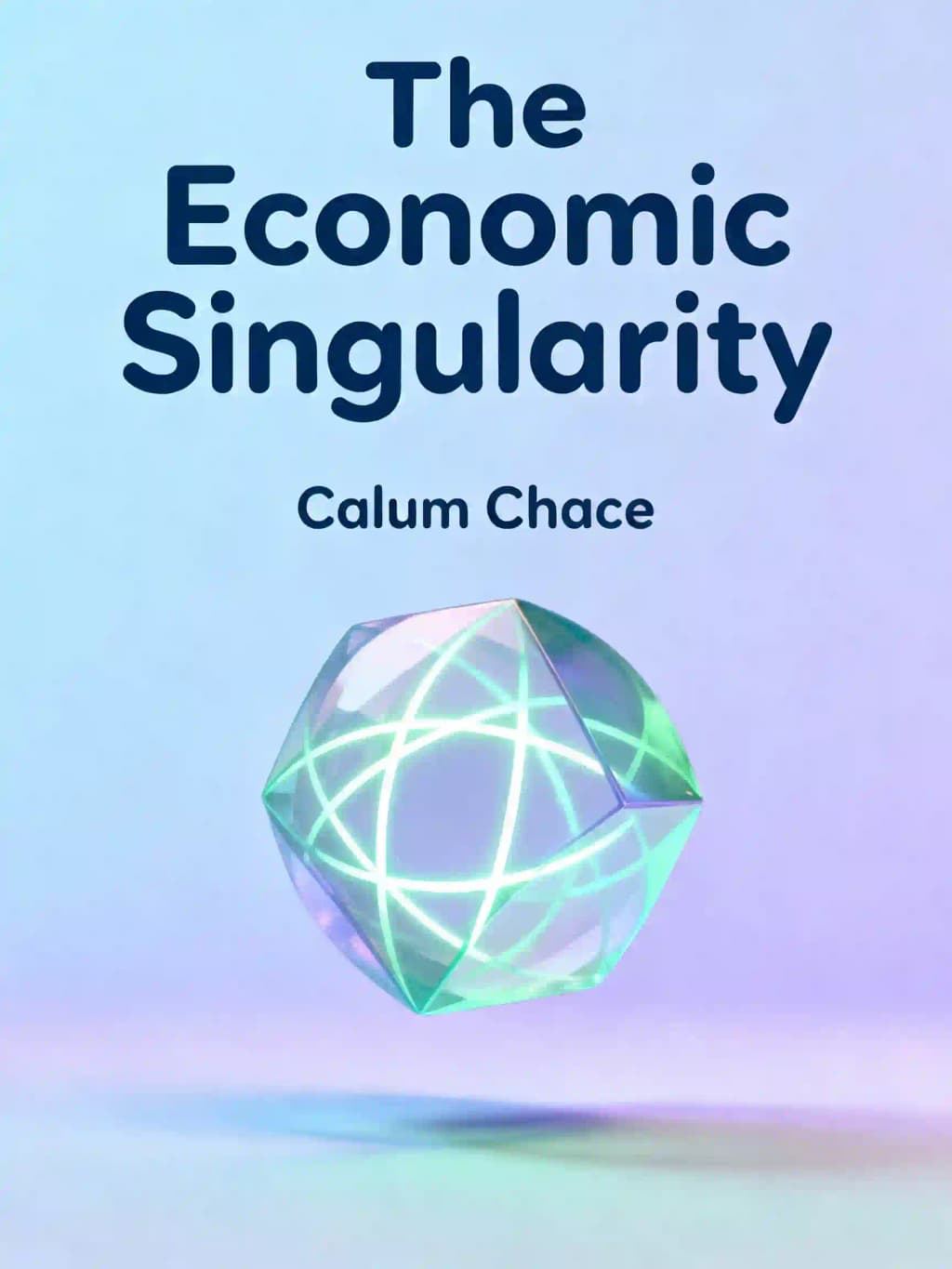
The Economic Singularity
Artificial intelligence and the death of capitalism
Visão geral de The Economic Singularity
"The Economic Singularity" explores how AI will transform capitalism as machines replace human jobs. Endorsed by biogerontologist Aubrey de Grey, this thought-provoking book asks: What happens when technology makes human labor obsolete? Discover why tech leaders are debating universal basic income.

Temas principais em The Economic Singularity
- technological unemployment
- post-capitalist economy
- cognitive automation
- fourth industrial revolution
- artificial general intelligence
Citações de The Economic Singularity
This isn't science fiction.
Humans have been automating work since the industrial revolution.
AI threatens to automate most cognitive tasks.
The power of exponential growth cannot be overstated.
Self-driving vehicles represent a critical bellwether.
Personagens de The Economic Singularity
- Calum ChaceAuthor and researcher of AI's economic impact
- Klaus SchwabWorld Economic Forum founder on the 4th revolution
- John von NeumannMathematician who first applied 'singularity'
Baixar resumo de The Economic Singularity: Artificial intelligence and the death of capitalism
Obtenha o resumo de The Economic Singularity: Artificial intelligence and the death of capitalism como PDF ou EPUB gratuito. Imprima ou leia offline a qualquer momento.
Perguntas Frequentes Sobre Este Livro
The Economic Singularity explores how artificial intelligence (AI) and automation could render most human jobs obsolete, leading to a potential collapse of capitalism. Calum Chace examines scenarios like universal basic income (UBI) and post-scarcity economies while analyzing the societal and ethical challenges of widespread technological unemployment. The book blends economic theory with futurism to map AI’s transformative impact.
This book is ideal for policymakers, tech professionals, and readers interested in AI’s socioeconomic consequences. Entrepreneurs and economists will value its analysis of capitalism’s future, while general audiences gain insights into preparing for radical workforce changes. Chace’s clear explanations make complex concepts accessible to non-experts.
Yes—it’s a timely, thought-provoking analysis of AI’s disruptive potential. Reviews praise its balanced approach to optimistic and pessimistic scenarios, though some critique its speculative solutions. The book synthesizes key debates about automation, making it a primer for understanding 21st-century economic risks.
Coined by Chace, the term describes a hypothetical future where AI and automation displace most human labor, destabilizing capitalist systems. Unlike the “technological singularity” (AI surpassing human intelligence), this focuses on economic collapse triggered by mass joblessness.
Chace argues AI’s ability to outperform humans in cognitive tasks—from legal analysis to creative work—will devalue human labor. Unlike historical automation (replacing manual jobs), AI threatens skilled professions, creating systemic unemployment unless new economic models emerge.
Key ideas include universal basic income (UBI), retraining programs, and wealth redistribution through mechanisms like sovereign wealth funds. Chace also explores “post-capitalist” models where AI-driven abundance reduces reliance on traditional employment.
UBI is a recurring cash payment to all citizens, regardless of employment status. Chace presents it as a potential solution to AI-driven job loss, arguing it could maintain consumer demand and social stability while transitioning to new economic systems.
Critics note Chace’s solutions remain theoretical, with limited policy roadmaps. Some argue he underestimates job creation from new industries, while others say his timeline for mass unemployment is overly pessimistic.
While Surviving AI focuses on existential risks from superintelligent AI, The Economic Singularity examines near-term economic disruption. Both books emphasize proactive planning but target different aspects of AI’s impact.
With AI advancing rapidly in healthcare, finance, and creative industries, Chace’s warnings about job displacement feel increasingly urgent. The book provides frameworks for businesses and governments navigating automation’s second wave.
Chace uses “centaurs” to describe hybrid human-AI teams that outperform either alone. This concept appears in early automation phases but becomes obsolete as AI surpasses human capabilities in most domains.
Chace advises focusing on skills AI can’t easily replicate—creativity, empathy, and complex problem-solving. He also recommends advocating for policies like UBI and staying informed about AI’s socioeconomic trends.
Chace writes: “The Economic Singularity is the Third Industrial Revolution’s endgame—a world where human labor has no economic value.” This encapsulates his argument about AI eroding traditional work structures.
The book urges readers to anticipate industries vulnerable to AI (e.g., transportation, law) and pivot to resilient fields like AI ethics, robotics maintenance, or roles requiring human interaction.