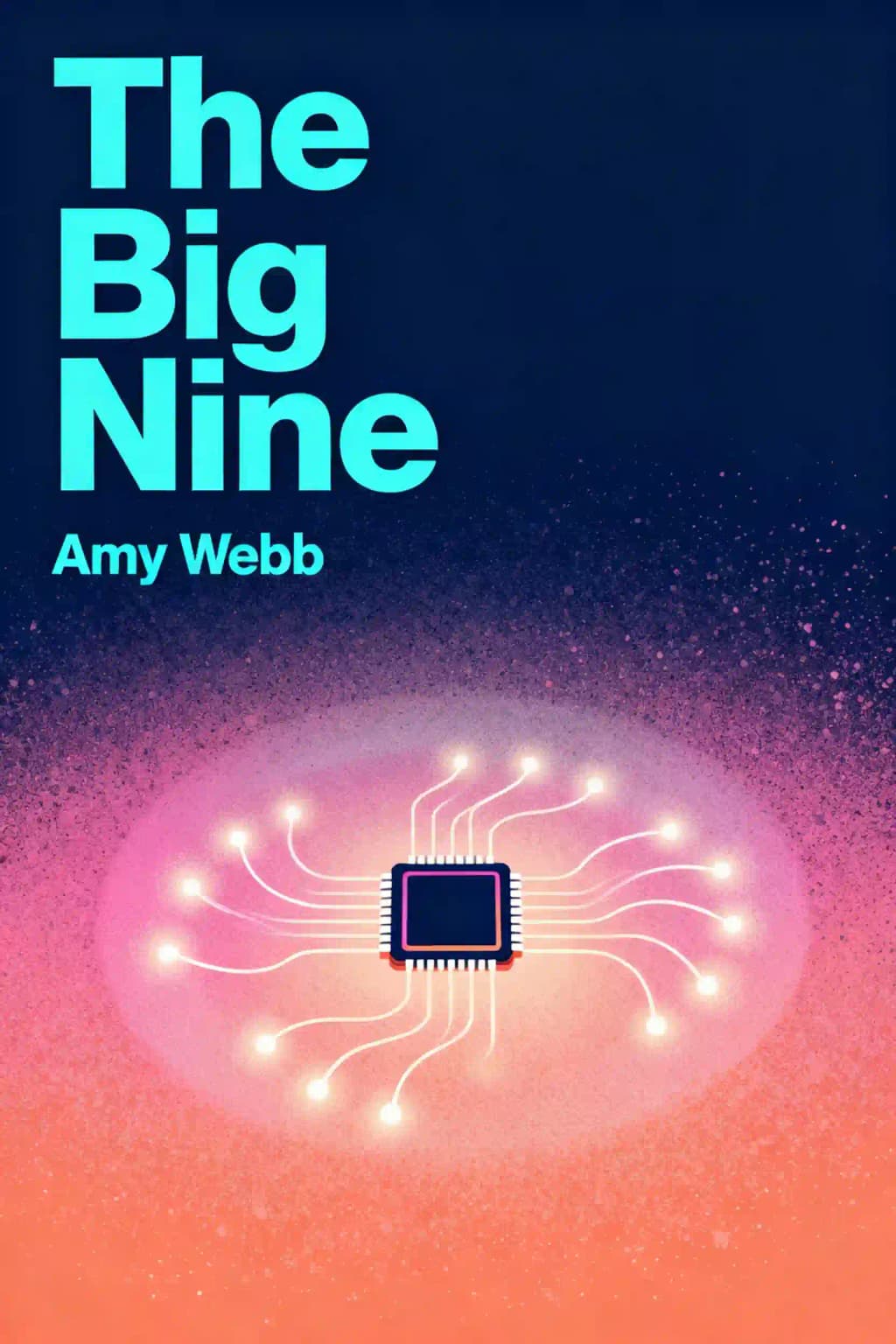
In "The Big Nine," Amy Webb reveals how nine tech titans control AI's future, potentially warping humanity. Harvard's Jonathan Zittrain calls it "intellectually crisp" - a wake-up call about the ethical battlefield where American profit motives clash with China's state control.
Amy Webb, author of The Big Nine: How the Tech Titans and Their Thinking Machines Could Warp Humanity, is a globally recognized quantitative futurist and founder of the Future Today Institute. A professor of strategic foresight at NYU Stern and Thinkers50’s #4 most influential management thinker (2023), Webb combines data-driven analysis with actionable insights on technology’s societal impact.
Her book explores artificial intelligence’s risks and opportunities, informed by her advisory roles with the World Economic Forum, U.S. Government Accountability Office, and Fortune 500 leaders.
Webb’s expertise extends to other works like The Signals Are Talking, which decodes emerging trends, and Data, A Love Story, a memoir blending analytics with personal narrative.
A BBC 100 Women honoree and frequent speaker at events like SXSW, her TED Talk on data optimization has garnered 6.7 million views. The Big Nine won the 2020 Gold Axiom Award for Business Technology and has been translated into 19 languages, solidifying Webb’s status as a leading voice on AI’s ethical future.
The Big Nine examines how six U.S. tech giants (Google, Amazon, Apple, IBM, Microsoft, Facebook) and three Chinese firms (Baidu, Alibaba, Tencent) are shaping AI’s future, often prioritizing profit over ethical safeguards. Amy Webb warns of AI’s unchecked growth eroding human autonomy and proposes strategies to align AI with humanity’s best interests.
This book is essential for policymakers, tech professionals, and anyone concerned about AI’s societal impact. It suits readers interested in tech ethics, geopolitical AI competition, and mitigating risks like algorithmic bias or corporate overreach.
Yes—it combines rigorous research with accessible scenarios to explain AI’s trajectory. Webb’s analysis of corporate incentives and her “three futures” framework make it a critical read for understanding AI’s risks and opportunities.
The “Big Nine” includes six U.S. firms (Google, Amazon, Apple, IBM, Microsoft, Facebook) and three Chinese companies (Baidu, Alibaba, Tencent). Webb argues their unchecked dominance in AI development risks prioritizing shareholder interests over global welfare.
Webb outlines:
Webb argues both nations prioritize short-term gains over safety: U.S. firms focus on shareholder returns, while China’s state-driven AI aims for surveillance and social control. Neither model serves global ethical standards.
Webb compares AI risks to “a gradual series of paper cuts”—small, cumulative harms like biased hiring algorithms or privacy erosion that collectively degrade societal trust.
Some experts argue Webb underestimates grassroots AI innovation’s potential to counter corporate power. Others note her scenarios downplay near-term regulatory progress.
Its warnings about algorithmic bias and autonomous weapons remain urgent, particularly as global AI standards lag behind advancements in quantum computing and neural networks.
While O’Neil’s work focuses on present-day algorithmic harm, Webb offers a forward-looking analysis of AGI risks and systemic corporate failures, making it complementary to foundational AI ethics texts.
Sinta o livro através da voz do autor
Transforme conhecimento em insights envolventes e ricos em exemplos
Capture ideias-chave em um instante para aprendizado rápido
Aproveite o livro de uma forma divertida e envolvente
AI will reflect humanity's values - or lack thereof.
Humans had been holding AI systems back.
AI is being developed by homogeneous tribes.
Change occurs as thousands of gradual paper cuts.
Humanity should be at the center of AI's development.
Divida as ideias-chave de Big Nine em pontos fáceis de entender para compreender como equipes inovadoras criam, colaboram e crescem.
Destile Big Nine em dicas de memória rápidas que destacam os princípios-chave de franqueza, trabalho em equipe e resiliência criativa.

Experimente Big Nine através de narrativas vívidas que transformam lições de inovação em momentos que você lembrará e aplicará.
Pergunte qualquer coisa, escolha a voz e co-crie insights que realmente ressoem com você.

Criado por ex-alunos da Universidade de Columbia em San Francisco
"Instead of endless scrolling, I just hit play on BeFreed. It saves me so much time."
"I never knew where to start with nonfiction—BeFreed’s book lists turned into podcasts gave me a clear path."
"Perfect balance between learning and entertainment. Finished ‘Thinking, Fast and Slow’ on my commute this week."
"Crazy how much I learned while walking the dog. BeFreed = small habits → big gains."
"Reading used to feel like a chore. Now it’s just part of my lifestyle."
"Feels effortless compared to reading. I’ve finished 6 books this month already."
"BeFreed turned my guilty doomscrolling into something that feels productive and inspiring."
"BeFreed turned my commute into learning time. 20-min podcasts are perfect for finishing books I never had time for."
"BeFreed replaced my podcast queue. Imagine Spotify for books — that’s it. 🙌"
"It is great for me to learn something from the book without reading it."
"The themed book list podcasts help me connect ideas across authors—like a guided audio journey."
"Makes me feel smarter every time before going to work"
Criado por ex-alunos da Universidade de Columbia em San Francisco

Obtenha o resumo de Big Nine como PDF ou EPUB gratuito. Imprima ou leia offline a qualquer momento.
What if the future of human civilization rests not with governments or global institutions, but with nine technology companies? While we scroll through social media, ask voice assistants for weather updates, and let algorithms recommend what to watch next, a handful of corporations are quietly building the infrastructure of artificial superintelligence. Google, Microsoft, Amazon, Facebook, IBM, and Apple dominate the West. Baidu, Alibaba, and Tencent operate as extensions of Chinese state power. Together, these "Big Nine" aren't just creating products-they're encoding values into thinking machines that will shape every aspect of human existence. The question isn't whether AI will transform our world. It's whether that transformation will reflect humanity's highest aspirations or its most troubling blind spots.