Capítulo 1
Transforming Education Through Digital Design
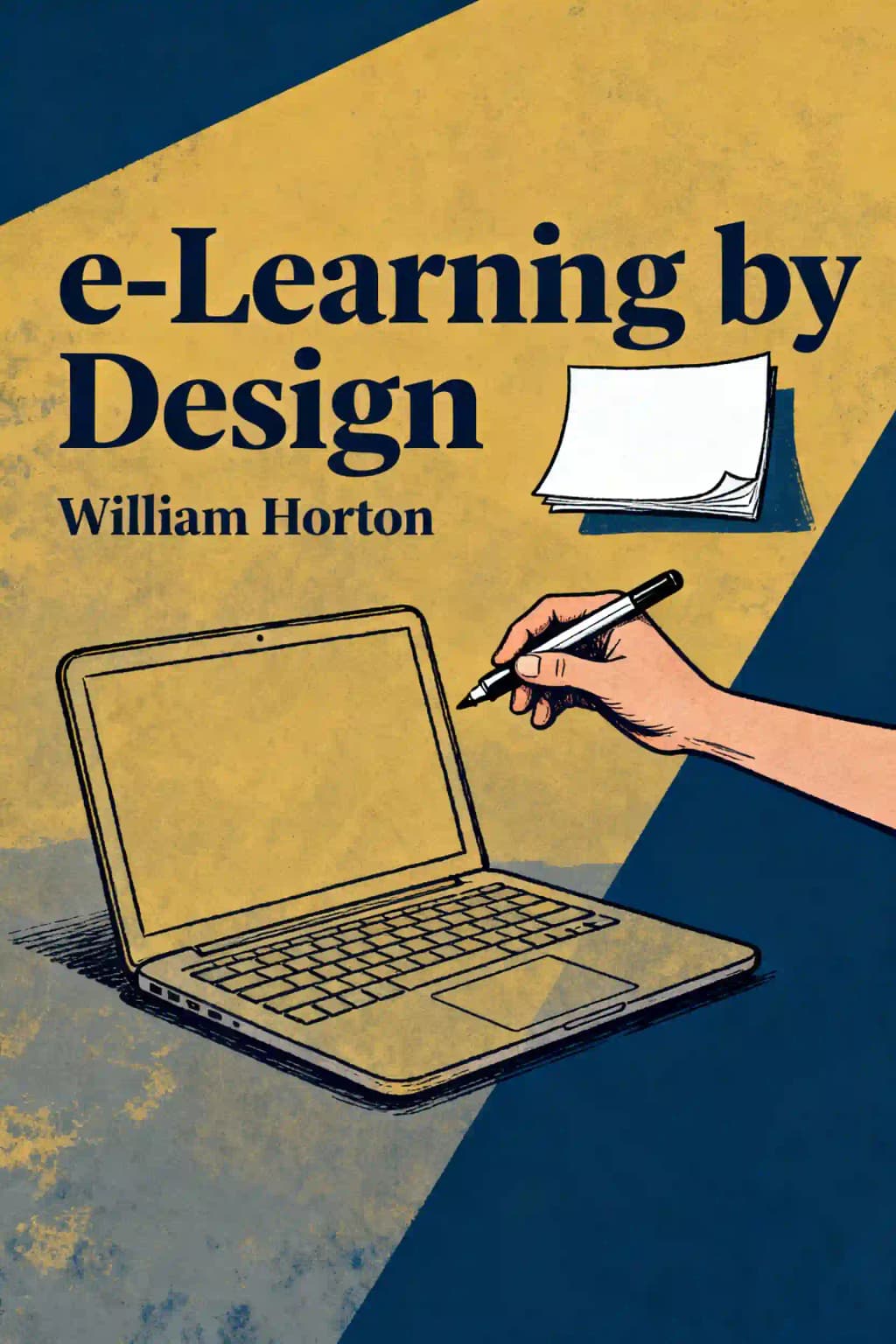
E-learning by Design, William Horton's seminal work, revolutionized how we approach digital education. Since its publication, this guide has become the secret weapon for countless instructional designers, including those at Google, Harvard, and the World Health Organization. What makes this book particularly fascinating is how it anticipated the explosive growth of online learning nearly a decade before the pandemic forced education online. Beyonce reportedly gifted copies to her team when developing her scholarship programs, recognizing its value in creating meaningful educational experiences. Beyond its practical applications, the book has achieved cult status in educational technology circles, with its dog-eared copies passed between professionals like treasured artifacts. Let's explore how Horton's principles continue to shape the digital learning landscape we navigate today.
Capítulo 2
The Foundation: Designing Purposeful Learning Experiences
E-learning encompasses all forms of electronically delivered education, from simple presentations to complex simulations. What began as experimental procedures teaching technical subjects within computer companies has evolved into a mainstream educational approach teaching everything from medical procedures to spiritual vision. But creating effective e-learning requires more than just putting content online-it demands thoughtful instructional design.
Good e-learning design starts with solid instructional design principles but extends beyond them to consider the unique capabilities and constraints of digital environments. This foundation determines everything else in the development process. Effective design requires considering multiple perspectives-those of learners, instructors, subject matter experts, and organizational stakeholders-to create comprehensive learning experiences.
The design process begins by identifying what truly matters to the organization and learners. Before diving into content creation, designers must ask: "What matters most to your organization?" and "How will this project help accomplish that goal?" About half of designers refuse to consider organizational goals when designing instruction, leading to courses that accomplish little or die from lack of support. Goals aren't limited to profit-they may include intellectual capital, customer relationships, operational efficiency, and reputation.
Clear learning objectives specify what learners should be able to do after completing the e-learning. These objectives guide everything from content selection to assessment design. Well-crafted objectives include the behavior learners should demonstrate, the conditions under which they'll perform, and the criteria for successful performance. For instance, rather than vaguely stating "understand project management," an effective objective might specify "Create a project timeline using Gantt charts that accurately represents task dependencies within 15 minutes."
Understanding your learners' existing knowledge, skills, motivations, and constraints ensures e-learning is appropriately targeted. Different types of objectives require different prerequisites. Procedural objectives need component skills and confidence. Decision-making objectives require knowledge of rules, available choices, and consequences. Creative objectives need procedures and openness to new ideas. Knowledge objectives require understanding of supporting terms and concepts.
The sequence in which objectives are taught significantly impacts learning effectiveness. Bottom-up sequencing builds from fundamental concepts to complex applications. Top-down sequencing begins with the big picture before exploring component details. Sideways sequencing connects related concepts at similar levels of complexity. Each approach serves different learning purposes and should be selected based on the specific learning context.
Capítulo 3
Absorb Activities: The Foundation of Knowledge Acquisition
Absorb activities enable learners to take in information through various forms of presentation, storytelling, reading, and virtual field trips. These activities form the foundation of knowledge acquisition in e-learning, providing the raw materials that learners will later apply and connect to existing knowledge.
Presentations deliver information in structured, engaging formats that combine visual and auditory elements. They're particularly effective for introducing concepts, demonstrating processes, and sharing expert insights. Effective presentations give learners control over pacing, provide abundant examples, offer immediate practice opportunities, and integrate with other learning activities.
Consider how differently a concept like "critical path analysis in project management" could be presented. A basic slide show might define the term and show examples. A more engaging approach might include an animated demonstration showing how changing task durations affects project timelines, followed by interactive examples where learners identify critical paths in sample projects.
Stories engage emotions and create memorable learning experiences by connecting abstract concepts to human experiences. They help learners understand complex ideas through narrative structures that mirror how we naturally process information. Different story types serve different learning purposes: hero stories show how ordinary people overcome obstacles by applying knowledge correctly; disaster stories vividly demonstrate negative consequences of failing to apply knowledge; discovery stories relate how insights were gained through unexpected experiences.
Imagine learning about customer service principles through a story about an employee who transformed an angry customer into a loyal advocate by applying specific communication techniques. The narrative makes the principles memorable and demonstrates their real-world application in a way abstract explanations cannot.
Reading activities provide learners with detailed information from various sources, allowing them to explore topics at their own pace and depth. E-learning can incorporate diverse document types including textbooks, popular books, manuals, handbooks, reports, regulations, brochures, data sheets, specifications, diaries, scholarly papers, trade journals, magazines, newspapers, and blogs.
Virtual field trips transport learners to places and experiences otherwise inaccessible in traditional learning environments. Through guided tours and virtual museums, learners explore real-world contexts that make abstract concepts concrete and meaningful. For instance, a virtual tour of a manufacturing facility could help learners understand supply chain management concepts in ways textbook descriptions never could.
Well-designed absorb activities engage learners in considering, selecting, combining, and judging information. They're not passive experiences but rather the first step in a process that leads to deeper understanding and application.
Capítulo 4
Do Activities: Transforming Knowledge into Skills
Do activities engage learners in applying knowledge through active participation, transforming abstract concepts into practical skills and deeper understanding. These activities bridge the gap between knowing and doing, helping learners develop proficiency through hands-on engagement with content.
Practice activities allow learners to apply what they've learned in controlled, feedback-rich environments where they can develop proficiency without real-world consequences. They come in various forms, from simple drill-and-practice exercises to complex guided analyses and teamwork activities.
Despite criticism from educational theorists, drill-and-practice activities remain valuable for memorizing facts that must be recalled without hesitation (foreign language vocabulary, symbols, programming syntax) and automating procedures that must be performed fluidly. Effective drill-and-practice can auto-generate problems, increase challenge progressively, or draw from problem databases, but should always be combined with other learning activities to teach practical application.
Hands-on activities guide learners through real-life tasks outside the lesson, such as using calculators, filling forms, or operating machinery. They use gatekeeper tasks (requiring successful completion before advancement), provide printable instructions, and request evidence of completion. For dangerous tasks, simulations or application sharing can be used instead.
Discovery activities lead learners to uncover ideas on their own rather than being presented with information. They transform trial-and-error into "trail-and-aha" learning, making them ideal for exploratory learning, revealing principles, and stimulating curiosity. Virtual laboratories provide on-screen simulators or calculators where learners test ideas and observe results without risk. Case studies engage learners in analyzing complex real-world situations to understand underlying causes and draw conclusions. Role-playing scenarios let learners learn by playing someone else's role in a simulated situation.
Imagine a discovery activity teaching financial principles: rather than explaining compound interest directly, learners experiment with different savings scenarios in a simulator, observing how changing interest rates and time periods affects outcomes. Through this exploration, they discover the power of compound interest more meaningfully than through direct explanation.
Games and simulations allow learners to learn through play while practicing tasks, applying knowledge, and inferring principles. The core structure involves a learner with a goal operating in a simulated environment, making choices that produce consequences, creating a continuous cycle of decision-making and feedback that drives learning.
Learning games are justified when: failure costs are high (as with brain surgeons or nuclear operators); real-system learning is impractical; learners need individual attention; many people must be educated; tasks are complex with limited learning time; skills taught are subtle; and sufficient development resources exist.
Effective learning games emphasize thinking over mere action, requiring authentic decision-making rather than just mouse skills. They challenge learners through scaffolding and fading-providing high support initially, then gradually reducing guidance as skills develop.
Capítulo 5
Connect Activities: Bridging Learning and Application
Connect activities help learners integrate new knowledge with existing understanding, bridging the gap between learning and application. They transform abstract concepts into practical tools and personal insights by helping learners relate new knowledge to what they already know, apply learning to their personal situations, and integrate separate learning experiences into a cohesive whole.
Ponder activities prompt learners to think deeply and broadly about what they're learning, examining ideas from fresh perspectives. These simple experiences encourage learners to stop, reflect, and see subjects differently. They're particularly valuable when learners need conceptual breakthroughs, broader thinking, or to connect ideas to their lives.
Rhetorical questions provoke thought without requiring visible responses from learners. These "stop-and-think" questions direct attention to aspects of a subject, making learners consider real-world examples or applications. Effective rhetorical questions are personal ("How will you...?"), contextual (placed in the learner's world), thought-provoking ("Why do you think this is so?"), and sometimes action-oriented ("Find an example...").
Summary activities ask learners to recap what they've learned by reviewing, selecting important points, organizing them logically, and expressing them clearly in their own words. These activities prepare learners to apply knowledge, teach others, and systematically review learning.
Job aids help learners apply knowledge to real-world tasks right when and where they need assistance. They range from simple recipes to elaborate electronic performance support systems. Job aids are ideal when subjects are too complex to recall all details, tasks are critical with negative consequences if performed incorrectly, or when they can replace unnecessary training at a fraction of the cost.
Glossaries define key terms, abbreviations, and symbols in a field, helping learners acquire new vocabulary. Calculators are job-specific numerical tools that eliminate the need to recall formulas, perform calculations, or look up answers in complex tables. E-consultants are interactive forms that provide advice based on user input-essentially conducting a virtual interview to help with complex decisions.
Research activities teach learners to gather, analyze, and report information-connecting them to the broader world of knowledge by teaching self-directed learning. In today's information-rich environment, knowing how to access and use information has become as important as memorizing facts. Scavenger hunts send learners searching for answers and reliable information sources online. Guided research coaches learners through investigating complex topics or series of questions.
Original-work activities represent the ultimate assessment-requiring learners to apply their knowledge to solve real-world problems. These activities verify that learners can integrate and synthesize what they've learned by creating authentic work products for critique by instructors or peers. Types include decision activities (submitting critical project decisions), work-document activities (creating authentic professional documents), journal activities (maintaining ongoing records of work and decisions), comparison activities (evaluating work against peers'), and group critique activities (submitting work for peer review).
Capítulo 6
Testing: Measuring and Reinforcing Learning
Tests serve multiple purposes in e-learning: measuring achievement, motivating study, providing practice, and identifying areas needing improvement. Their design significantly impacts both learning outcomes and learner experience. The purpose of testing should drive its design, from question types and difficulty to timing and feedback.
When choosing question types, consider whether you need subjective questions (requiring human judgment) or objective questions (with clear standards for correctness), and whether questions will be scored by computer or humans. Common test question types include true/false, pick-one, pick-multiple, fill-in-the-blanks, matching-list, sequence, composition, and performance questions.
Application-related questions simulate real-world scenarios that learners will encounter when applying their knowledge. Effective tests set authentic scenes using questions that might come from customers, bosses, or colleagues. Questions should be based on performance objectives rather than enabling objectives, putting learners into realistic situations by asking "What would you do?" The mode of questioning should match how knowledge will be applied-verbal tasks use text questions, visual tasks use click-in-picture questions, and software tasks use simulations.
After answering questions, learners crave immediate, meaningful feedback. Effective feedback does more than indicate correctness-it explains why answers are right or wrong and addresses misconceptions. For incorrect answers, provide gentle correction without embarrassment, explaining the error and suggesting remediation. For correct answers, brief acknowledgment is usually sufficient, though you might occasionally add related information to extend learning.
When reporting test results, clarity and simplicity are essential. Immediately tell learners three critical pieces of information: their score, the passing threshold, and what to do next. This direct approach relieves anxiety and provides clear direction, whether that's celebrating success or pursuing remediation.
Few tests are perfect initially, but thoughtful refinement can eliminate common problems. Consider providing hints before revealing answers, encouraging learners to think more deeply about questions. Leverage advanced testing capabilities like question pooling (selecting from a larger set of available questions), randomizing question order, and shuffling answer choices.
Capítulo 7
Building Learning Objects: Topics, Lessons, and Courses
Topics are the building blocks of instruction that accomplish single learning objectives. They may be simple or complex, but each fulfills one objective completely through a combination of absorb, do, and connect activities with assessment. Topics serve as the lowest-level learning objects in courses or knowledge products.
A topic's components flow from the learning objective, which guides the creation of titles, introductions, activities, assessments, and metadata. The objective is the standard against which all components are judged. Titles are crucial for a topic's success as they're often the first element learners see in menus, search results, and lesson lists. Effective titles must be distinct (unique and distinguishable), context-free (meaningful without surrounding information), understandable (using standard grammar and familiar terms), scannable (with important words at the beginning), thematic (predictive of content), and motivational (showing value to the learner).
Creating reusable topics requires more than just structuring content as learning objects-they must be designed with reuse in mind from the start. Effective reusable topics function like recipe cards: coherent (focused on one purpose), self-contained (usable in any order), complete (containing everything needed to accomplish their goal), and consistent (following standardized formats).
Lessons accomplish complex learning goals that may be too broad for a single topic, cannot be divided into simpler objectives, or represent clusters of related objectives. Positioned between individual topics and whole courses, lessons function as miniature courses with their own objectives, introductions, summaries, activities, and assessments.
Lessons can be structured in various ways, from linear sequences to branching hierarchies to purpose-specific organizations that reflect subject matter and learner needs. Common organizational patterns include classic tutorials (sequential presentation of increasingly difficult concepts), book-like structures (hierarchical organization with table of contents), scenario-centered lessons (learning organized around a central problem), essential-learning tutorials (learners take tests until reaching knowledge limits), exploratory tutorials (learners navigate resources to accomplish goals), and subject-specific structures (free-form organization based on the subject's inherent logic).
Capítulo 8
Strategic Decisions: Shaping the Learning Experience
Strategic decisions shape the fundamental nature of e-learning across an entire course or curriculum. These high-level choices include defining what constitutes a course in an era of learning objects and blended learning, determining the appropriate e-learning format (instructor-led vs. learner-led, synchronous vs. asynchronous), selecting delivery devices and environments, considering alternative approaches like blended or embedded learning, planning for content reuse, and establishing standards for quality, accessibility, and technical implementation.
The choice between instructor-led and learner-led approaches ranges along a spectrum from pure instructor-led (like broadcast presentations where learners are passive) to pure learner-led (where learners control everything). Instructor-led approaches offer advantages like immediate question answering, authority for motivation, course adjustments for specific needs, and human connection. Learner-led approaches offer schedule flexibility, learner empowerment, consistent quality, and lower deployment costs.
Synchronous activities require participants to perform simultaneously in real-time (like online meetings), while asynchronous activities can be experienced whenever convenient (like web pages and automated tests). Most courses include a mix of both types. The appropriate level of synchronicity depends on factors like geographical distribution of learners, work schedules, and learning needs.
The location where learners take e-learning significantly impacts course success. Designers must consider actual usage environments, not idealized scenarios. Location determines available computers, network connections, noise levels, and distractions. These factors affect the course's ability to display information, play media, conduct live events, and handle confidential information.
For many learning needs, the best solution may not be pure e-learning but an intelligent hybrid combined with other learning types. Blending combines different forms of education for a single purpose-not just mixing e-learning with classroom learning, but potentially any learning form: classroom, virtual-classroom, or standalone e-learning. Strategic blending starts by decomposing skills into components-what learners must know, believe, and do. For each component, determine the best learning experience, whether it requires personal interaction, and the optimal delivery method.
E-learning can also be embedded within other knowledge products rather than standing alone. It can be integrated into applications, online help systems, diagnostic procedures, or linked to other knowledge resources. Embedded e-learning works best for guiding complex decisions, troubleshooting systems, or helping users choose between alternatives requiring conceptual knowledge.
Capítulo 9
The Virtual Classroom: Bridging Distance Through Technology
Virtual classrooms bridge traditional classrooms and the web, using collaboration tools to recreate classroom experiences without requiring physical presence. They preserve structured learning and rich interaction while offering flexibility. In these environments, instructors can adapt learning to students' needs, provide community and discipline, and offer familiar learning formats that combine various activities.
Collaboration tools enable distant learners to communicate and work together. These range from simple email to comprehensive meeting environments. Tools can connect instructors with individual learners or groups, including email, discussion forums, chat, polling, whiteboards, screen-sharing, and audio/video conferencing.
Email remains the most effective collaboration tool for many e-learning tasks-simple, reliable, inexpensive, and universally accessible. Use private email for immediate, intimate communication requiring personal attention, while broadcast emails should be reserved for urgent class announcements.
Discussion forums enable asynchronous threaded conversations that can continue indefinitely. They're particularly valuable for subjects involving collaboration and negotiation. Forums allow participation across time zones, accommodate shy or language-limited learners, enable focused conversations on specialized topics, and foster self-reliance by encouraging peer support.
Online meetings require meticulous planning, management, and follow-up to be effective. Define clear roles for all participants during each phase of the meeting. Schedule meetings strategically-Tuesday mornings are ideal, avoiding weekends and Friday afternoons. Keep sessions between 60-90 minutes, and consider time zone differences.
Virtual classroom instructors need different skills than physical classroom teachers. They must "read" learners through voice or text rather than body language, communicate effectively through various media, and encourage productive learner-to-learner interaction. Key attitudes include egolessness (focusing on helping rather than showcasing themselves), belief in e-learning's value, and confidence.
Capítulo 10
The Catalyst Model: A New Educational Paradigm
Our traditional educational approach resembled publishing-static content delivered in one direction from teacher to student. This model required physical presence, scheduled meetings, and centralized knowledge distribution, limiting learning opportunities to specific times and places. Students were passive recipients of information, confined by rigid schedules and standardized curricula that often failed to address individual learning needs and preferences.
The catalyst model transforms education into a dynamic, learner-driven experience where technology facilitates rather than dictates learning. Like chemical catalysts that enable reactions without being consumed, e-learning technologies create environments where learning happens naturally through exploration and interaction. This approach empowers learners to take control of their educational journey, setting their own pace and choosing learning pathways that align with their interests and goals. For example, adaptive learning platforms can automatically adjust difficulty levels based on student performance, while virtual reality simulations allow for immersive experiential learning in safe, controlled environments.
Future learning will be increasingly self-directed, personalized, and integrated into daily life. Learners will access knowledge on demand, collaborate across distances, and engage with content through multiple modalities-all enabled by technologies that adapt to individual needs and learning contexts. Mobile learning apps, microlearning modules, and artificial intelligence tutors are already demonstrating how education can seamlessly blend with daily activities. Social learning platforms facilitate peer-to-peer knowledge exchange, while gamification elements maintain engagement and motivation.
The e-learning journey is only starting, with emerging technologies continuously expanding possibilities. Virtual reality classrooms enable students to interact with 3D models and conduct virtual experiments. Artificial intelligence can analyze learning patterns to provide personalized recommendations and support. Blockchain technology may revolutionize credential verification and skill certification. As these technologies evolve and our understanding of effective online learning deepens, we'll continue developing more immersive, responsive, and effective learning experiences that transcend traditional educational boundaries.
Horton's comprehensive framework provides the foundation for creating e-learning that truly accomplishes its educational purpose. By thoughtfully designing absorb, do, and connect activities, developing meaningful assessments, organizing content into reusable objects, making strategic decisions about delivery and format, and leveraging the power of virtual collaboration, we can create learning experiences that transform information into knowledge, skills, and meaningful change. The future of education isn't just about technology-it's about using technology to catalyze human potential in ways previously unimaginable. This includes adaptive assessment systems that provide immediate feedback, collaborative projects that span continents, and personalized learning paths that adapt to each student's progress and preferences. The catalyst model represents a fundamental shift from instruction to empowerment, where technology serves as the enabler of human learning and development rather than its driver.