Capítulo 1
The Learning Journey: Transforming Knowledge into Action
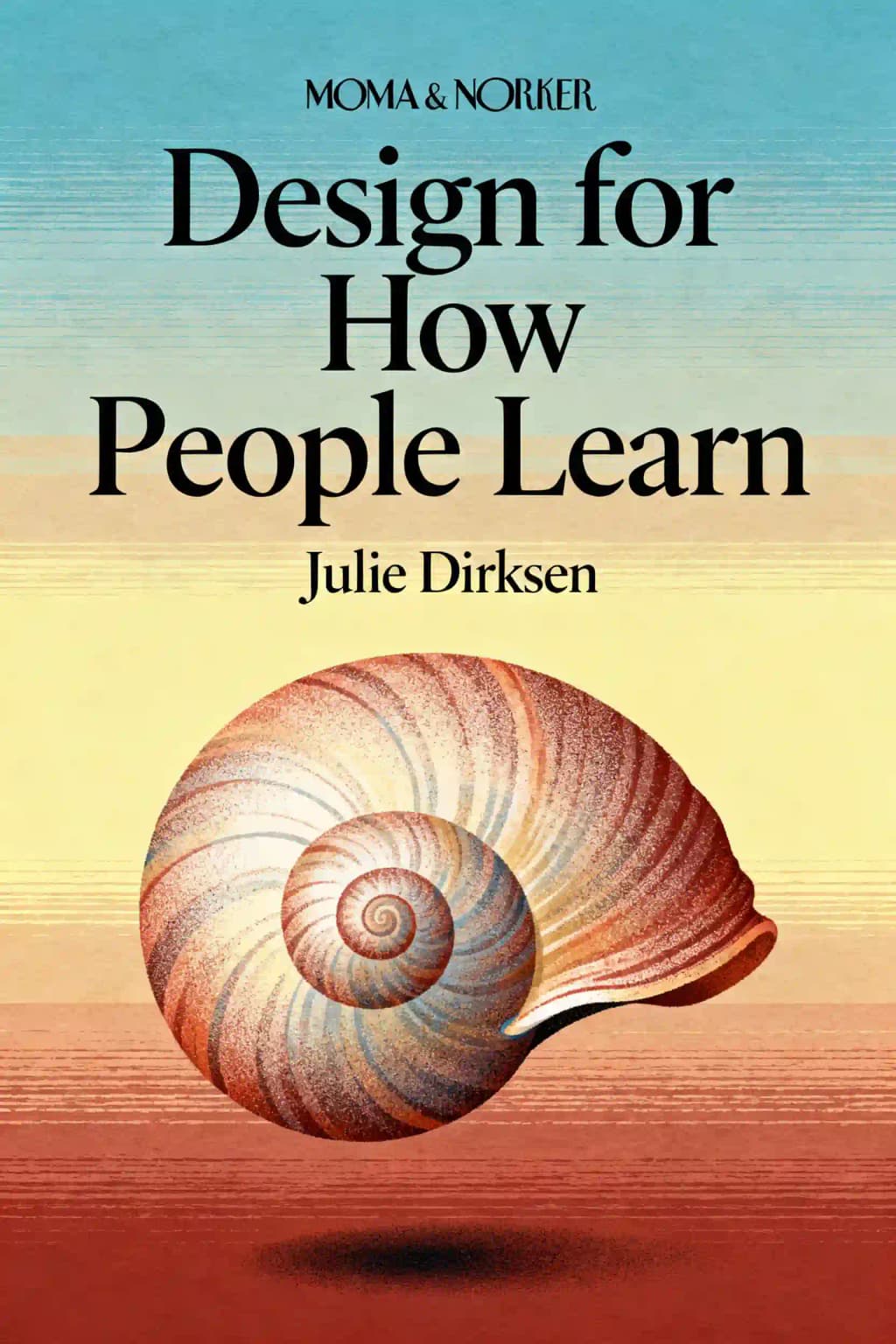
What if I told you that the most impactful learning experiences of your life probably didn't involve textbooks or PowerPoint presentations? Julie Dirksen's "Design for How People Learn" has become a cornerstone text in the learning design community since its publication, with luminaries like Brene Brown citing it as essential reading for anyone who teaches. The book's enduring popularity stems from its practical approach to a universal challenge: how do we create learning experiences that actually stick rather than evaporate the moment learners walk out the door?
Dirksen, drawing on her decades of experience in instructional design, tackles this question by merging cognitive psychology, behavioral science, and practical design principles. The result is a framework that has transformed how organizations approach learning-from Fortune 500 companies revamping their training programs to educational institutions rethinking their teaching methodologies. In a world where the half-life of professional skills continues to shrink, Dirksen's insights have never been more relevant for anyone who needs to help others learn effectively.
Capítulo 2
Mind the Gap: Understanding What Learners Really Need
The journey to effective learning begins with understanding what stands between learners and success. Learning isn't just about acquiring information-it's about transformation. When we design learning experiences, we're creating a bridge between where learners are now and where they need to be to succeed.
Different scenarios require addressing different types of gaps. A college student learning project management faces different challenges than a professional adapting to a company merger. Dirksen identifies six distinct types of gaps that might need bridging:
Knowledge gaps occur when learners lack necessary information. In today's information-rich world, delivering content is relatively easy. The real challenge is determining what information is critical for learners to carry with them versus what can be "cached" for retrieval when needed. We often mistakenly assume that providing information alone will enable performance when more is required.
Skills gaps exist when practice is necessary to develop proficiency. Just as memorizing a hiking guidebook won't prepare someone for the Appalachian Trail without physical conditioning, learners need opportunities to practice and develop skills. The key question to ask is: "Is it reasonable to think someone can be proficient without practice?" If not, you're dealing with a skill gap.
Motivation gaps appear when someone knows what to do but chooses not to do it. These gaps arise for various reasons: learners may not buy into the outcome, feel anxiety about change, become distracted, or miss the big picture. While we can't force motivation, design decisions significantly influence learner behavior-even subtle choices like font readability can affect how difficult learners perceive tasks to be.
Habit gaps emerge when knowledge, skills, and motivation aren't enough-automated behaviors are needed. Most of our daily activities run on autopilot, like morning routines. Habit gaps are particularly challenging because they require different learning approaches than other gaps. Statements like "I should exercise more" fall into the "easier said than done" category.
Environment gaps occur when the surrounding context prevents success despite a learner's preparation and motivation. These external factors include processes that don't support desired behavior, missing job aids, lack of necessary resources, absence of incentives, or insufficient reinforcement over time.
Communication gaps happen when performance failures stem from poor directions rather than learning issues. These masquerade as learning problems but actually stem from miscommunication about goals or expectations.
Consider Marianna, a new IT supervisor struggling with management responsibilities. Her issues stem primarily from skills, attitude, and environment gaps rather than knowledge. Or Marcus, who wasted time teaching database design skills his audience already had while neglecting their knowledge needs about new technology. By identifying the correct gap, we can design much more effective learning solutions that truly bridge the distance between current state and success.
Capítulo 3
Know Your Audience: The Foundation of Effective Learning Design
Understanding your learners is essential for designing effective learning experiences. Beyond basic demographics like age and role, you need to understand what motivates them, their current skill level, and how they differ from you.
Different types of learners approach learning situations with varying attitudes-from the pragmatic "just tell me what I need to know" learner to the enthusiastic "hey, this is cool!" learner, the problem-solving focused learner, the reluctant "required course" learner, the easily distracted "shiny" learner, the change-resistant learner, and the know-it-all learner.
Motivation exists on a spectrum from purely extrinsic (seeking rewards or avoiding punishment) through social motivations (pleasing others, group belonging) to purely intrinsic (doing something for its inherent satisfaction). Intrinsic motivation is significantly more powerful than extrinsic motivation, which tends to disappear when rewards or punishments cease.
For intrinsically motivated learners, allow time for personal projects and leverage them as peer teachers. For extrinsically motivated learners, search for any intrinsic motivators they might have, have them articulate why the topic matters, identify their pain points that learning could address, and focus on practical applications rather than theory.
Despite the popularity of "For Dummies" books, learners don't want to feel incompetent. As one game designer noted, "My job is to make the player feel smart." Learning designers should similarly make learners feel capable, not ashamed of what they don't know. Ways to engage wary learners include leveraging what they already know, giving early success, providing control over the learning process, and creating safe places to fail.
The difficulty of a learning experience depends not just on content complexity but also on the learner's prior knowledge. Different skill levels require entirely different approaches-novices need structure and guidance while experts need autonomy and resources they can access as needed.
One of the most important principles in learning design is recognizing that "You are not your learner." Designers often subconsciously assume their own learning preferences and motivations are universal. Not everyone enjoys learning new things-some find it scary or view it as a necessary evil.
Experts have orderly mental models with sophisticated categorization systems, while novices have unstructured "piles" of information. When experts receive new information, they know exactly where to store it within their organized framework. Novices, lacking this structure, struggle to organize and later retrieve information without clear organizing principles.
To help learners organize information, provide high-level organizers as "shelves" for storing knowledge. Use visuals for additional memory cues, tell stories that evoke emotions, work through problems to show application, and employ metaphors that connect to familiar concepts. For expert learners, create efficient "fast-forward lanes" that let them access just what they need without wading through basics.
Capítulo 4
Charting the Course: Setting Clear Learning Destinations
Setting clear learning goals requires identifying the problem you're solving and establishing a destination. Without knowing both where learners are starting and where they need to go, you can't plot an effective learning path.
Begin by identifying the gaps in knowledge or skills before determining learning objectives. Starting with the problem rather than the goal prevents solving problems you don't have while missing the real issues. Learning designers often must dig deeper when clients provide vague objectives like "understanding the basics." By asking what learners will do with the information or what could happen if they don't know it, you can uncover the real purpose.
When learning objectives are too broad ("students need to learn to be better managers"), break them down into specific, actionable goals like "schedule restaurant employees so all shifts are adequately covered" or "provide appropriate feedback to chronically late employees." These specific destinations make planning the learning journey much more effective.
After defining the problem, you need clear, specific goals to design an effective learning path. Vague objectives like "Students will understand how to program in Java" are problematic because "understanding" isn't observable. Instead, focus on what learners should be able to DO with their knowledge: "The student will be able to create a simple, fully functional user interface that collects customer data and transmits that data to the database."
When setting goals, consider the desired level of cognitive complexity using Bloom's Taxonomy (Remember, Understand, Apply, Analyze, Evaluate, Create). While these levels increase in cognitive demand, they aren't necessarily a rigid progression for learning design. For example, analyzing advertisements might help understand design principles, or creating a design might teach application.
Another way to define learning goals is by proficiency level: Familiarization, Comprehension, Conscious Effort, Conscious Action, Proficiency, and Unconscious Competence. Higher proficiency levels require more time and practice-you can't reach Unconscious Competence without significant distributed practice.
While instructional design tradition dictates sharing objectives with learners, the standard bullet-point slide of objectives often fails to engage. Rather than boring slides, communicate objectives through challenges, scenarios, or mission statements that engage learners while directing their focus.
Be realistic about how far learners can progress in the available time. Some skills develop quickly while others take much longer. For example, in GMAT prep courses, quantitative skills (math shortcuts, geometry formulas) can improve in a weekend, but verbal skills (vocabulary, reading comprehension) take years to develop.
When determining if a skill is fast or slow to develop, consider whether it has explicit rules (fast) or tacit understanding (slow). For new restaurant manager Todd, skills like approving timesheets are fast, while ensuring a respectful environment is slow. With slow skills, you can't expect complete transformation in short timeframes.
Capítulo 5
Memory Matters: How We Learn and Remember
Memory forms the foundation of learning. Our brains aren't passive storage containers but dynamic, self-organizing systems where new information interacts with existing knowledge, creating multiple pathways and connections.
Learning requires both encoding (getting information in) and retrieval (getting it out again). Our brains filter the millions of data points we encounter through three memory systems: sensory memory (our first filter), short-term memory (temporary holding for immediate action), and long-term memory (our storage system).
Sensory memory briefly holds everything we perceive, but most sensations pass through unnoticed unless something unusual catches our attention. Habituation is when we stop noticing consistent sensory stimuli, like refrigerator buzzes or banner ads on websites. Unpredictable stimuli (flickering lights, stop-and-go traffic) resist habituation because their changing patterns repeatedly grab our attention.
Once something attracts your attention, it moves into working memory-typically things that are significant to you, that you're actively seeking, need to act on, or that surprise you. Working memory has limited capacity and duration, but we use it constantly throughout the day. Most information is discarded once used, unless you deliberately maintain it through repetition.
While the classic limit of working memory is often cited as 72 items, the actual capacity depends on chunking-grouping related information together. Four random digits are easy to remember, nine become difficult, but nine digits presented as three groups of three are much easier. Similarly, sequential information like counting from 1-9 becomes just one chunk.
The ultimate goal of learning is to move information into long-term memory, where it can be retrieved when needed. Nothing is learned in isolation-everything becomes part of a network of associations. Information stored with multiple associations is much easier to retrieve than information with limited connections. This is why pure memorization through flashcards is ineffective; it creates only one "shelf" for information, making it harder to retrieve later.
The environment where you study becomes part of your association with the material. Surprisingly, studying in the same environment where you'll be tested is more effective than studying in pleasant but unrelated settings. This is because context becomes part of the memory. When learning happens far from the context of use, fewer mental shelves are utilized.
Emotional context is particularly challenging to recreate in learning environments. Learning about giving difficult feedback in a calm classroom doesn't prepare you for the anxiety and potential hostility of real-world application. When emotionally stressed, we often abandon intellectual knowledge for automatic responses.
We often overestimate what we know because recognition creates a false sense of mastery. When studying, material might look familiar as you read it, making you feel confident. But this recognition knowledge fails when faced with a blank test requiring recall. To truly learn information you'll need to retrieve later, you must practice retrieving it during study.
Memory isn't a single system but consists of several distinct types that are encoded and retrieved differently:
Declarative memory consists of facts, principles, and ideas you can explicitly state-like multiplication tables or historical dates.
Episodic memory relates to specific events or experiences. Stories stick in memory remarkably well compared to abstract information because we have mental frameworks for stories with expected elements, providing ready-made "shelves" for storing information.
Conditioned responses are automatic reactions to specific stimuli-like slowing down when seeing a police car in your rearview mirror. These implicit memories trigger immediate reactions without conscious deliberation.
Procedural memory is how we remember to perform step-by-step processes. Much of it becomes implicit through practice-like driving home without consciously thinking about the route, or being unable to verbalize a phone number you can easily dial.
Flashbulb memories are vivid recollections of emotionally charged events, like remembering exactly where you were during major news events. These powerful memories likely evolved as a survival mechanism.
Capítulo 6
Capturing Attention: The Gateway to Learning
In our constantly distracted world, capturing learner attention is critical-if learners aren't paying attention, even the best learning experience fails. The key is understanding how to engage both parts of the learner's brain.
Jonathan Haidt's metaphor of the brain as rider and elephant helps us understand attention. The rider represents conscious, controlled thought while the elephant encompasses gut feelings, visceral reactions, emotions and intuitions of the automatic system.
The rider is our rational, control-your-impulses, plan-for-the-future brain-the part that tells us what will provide long-term benefit. The elephant is our attracted-to-shiny-objects, what-the-hell, go-with-what-feels-right brain that's drawn to novelty, pleasure, comfort and familiarity.
We tend to overestimate the rider's control because it's our conscious, verbal brain that "talks" to us. Sometimes the elephant cooperates easily, but when elephant and rider conflict, the elephant usually wins. When learners' elephants aren't engaged, paying attention becomes extremely difficult. While the rider can force attention, this cognitive effort is exhausting and depletes willpower quickly.
Our brains tend to prefer immediate rewards over delayed ones, even when the delayed reward is larger-a concept called hyperbolic discounting. This directly impacts learning: attention is a resource learners "pay," and they're more willing to pay it when they can use the information immediately. You can leverage this by either moving learning closer to the point of use (just-in-time resources) or bringing the point of use closer to learning through scenarios and problem-solving.
To capture the elephant's attention, you can tell it stories, surprise it, show it shiny things, tell it all the other elephants are doing it, and leverage its habits.
Stories are naturally engaging and easier to process than abstract information. They make effective learning tools because they utilize existing mental frameworks, follow logical sequences that aid memory, create engaging suspense through implied puzzles, and promise to be interesting rather than boring.
Surprising the elephant is a guaranteed way to capture attention. Our brains are wired to notice the unexpected and allocate mental resources to it. Unexpected rewards create stronger brain activation than anticipated ones. Cognitive dissonance occurs when something contradicts our existing mental models-like seeing a purple dog. When faced with opposing viewpoints, we must reconcile them, creating a "teachable moment" with productive friction that engages learners.
Curiosity arises when we notice gaps in our knowledge, creating a feeling of deprivation we're motivated to eliminate. To make learners curious: ask interesting questions that require interpretation rather than recall; create mysteries to solve; deliberately leave information out; and present messy, ill-structured problems that require learners to fill in gaps themselves.
The elephant is social and pays more attention when other people are involved. MIT research showed people learned more when they believed they were interacting with real people rather than computers, even when the interaction was identical.
Visual and tactile elements can effectively attract the elephant's attention. Visuals engage the elephant effectively but must be used purposefully. Tactile engagement helps manage the "monkey mind" that jumps between different neural activities. Humor can effectively engage learners, though it's highly subjective.
Capítulo 7
Designing for Knowledge: Making Learning Stick
This section addresses fundamental challenges in designing knowledge-based learning: ensuring learners remember content, helping them understand material, determining appropriate guidance levels, and following an effective design process.
Rather than presenting information directly, instructors should first draw out learners' existing knowledge. For example, when teaching how to write job descriptions, ask learners what they think should be included. This approach activates existing mental frameworks ("shelves") and engages learners in actively evaluating and adapting their mental models rather than passively receiving information.
Our memory naturally filters out mundane information while retaining what stands out as significant, important or unusual. Working memory has a very short duration-information that doesn't stand out simply passes through "like water through a pipe." This is particularly problematic when learners believe they already understand the material, as they won't pay attention to something they think they know.
Learning benefits from messiness-engaging with challenging material helps embed information into long-term memory. Passive experiences like lectures or page-turner eLearning courses allow information to flow right past disengaged learners. "Desirable difficulty" creates cognitive friction that forces learners to actively process content.
When learners must draw their own conclusions rather than being explicitly told what's correct, they engage more deeply with the material. As elearning designer Cathy Moore explains, showing (allowing learners to see consequences and interpret results) creates more friction than telling (explicitly stating what's correct).
Interpersonal interaction adds productive friction to learning experiences as each learner brings unique perspectives and experiences. Rather than vague discussion topics, give groups concrete purposes: creating something together, teaching content to others, debating different perspectives, or investigating and reporting findings.
Understanding goes beyond mere memorization. The foundation of learner comprehension starts with providing the right content: less than you think necessary, with sufficient but not excessive detail, relevant to learners' needs, and compatible with their existing knowledge structures.
Working memory's limited capacity means designers should include less content than they initially believe necessary. When teaching beginners, focus on one clear approach rather than multiple variations or technical digressions. For example, when teaching someone to make an apple pie for the first time, stick to basic instructions rather than explaining alternative techniques, scientific principles, or advanced considerations.
To prevent misconceptions, establish good feedback loops where learners answer questions, give examples, and explain concepts back to you. A particularly effective technique is pairing examples with counter-examples-showing both what to do and what not to do. Counter-examples often clarify concepts more effectively than multiple good examples alone.
Creating learning experiences requires giving learners appropriate directions without leaving them lost. The challenge is finding the right balance between step-by-step instructions and conceptual understanding. Step-by-step instructions help learners complete tasks quickly, but leave them vulnerable when circumstances change. Like following GPS directions without learning the neighborhood, learners won't develop troubleshooting skills or deeper understanding.
Teaching all underlying concepts and principles creates self-sufficient learners who can troubleshoot any situation. However, this approach is often impractical and time-consuming. The ideal approach balances detailed instructions with conceptual understanding.
Michael Allen's CCAF model provides an excellent framework for learning design: Context (framework and conditions), Challenge (stimulus to action), Activity (physical response), and Feedback (reflection on effectiveness). This structured approach ensures learning activities are grounded in realistic scenarios with appropriate challenges and meaningful feedback.
Capítulo 8
Skill Development: Practice Makes Proficient
Teaching skills requires time, effort, and practice from both instructor and learner. Unlike knowledge-based learning, skill development demands practice and feedback-simply introducing a skill isn't enough for proficiency.
To determine if something is a skill, ask: "Is it reasonable to think someone can be proficient without practice?" If the answer is no, you're dealing with a skill. Many learning experiences only introduce skills rather than developing proficiency, which requires two key components: practice and feedback.
Learners need practice to develop proficiency-simply memorizing information isn't enough. Without structured practice opportunities, learners will practice on their own, often painfully and not as intended. Learning new material is cognitively demanding, like biking uphill, while using established knowledge is efficient, like coasting downhill. Brain scans show practiced skills require significantly less glucose.
Effective practice should balance challenge with ability to avoid exhaustion and frustration. Rather than forcing learners to "bike straight uphill" with constant new information, learning experiences should alternate between new challenges and opportunities to apply established knowledge.
Most learning experiences overwhelm learners with constant new information, which is exhausting. Instead, learning should alternate between new challenges and practice of established skills, allowing learners to acclimate before advancing to the next level-similar to how games are structured.
Optimal practice creates "flow"-Mihaly Csikszentmihalyi's concept of total engagement where time seems to fly by. Flow occurs when challenge and ability are balanced. When challenges greatly exceed ability, learners become frustrated; when tasks are too easy, they become bored. Effective learning keeps learners at the edge between challenge and ability.
Research shows distributed practice over time is generally more effective than massed practice for long-term retention. The best approach is to match practice frequency to how often the skill will be used. Sleep between learning sessions helps consolidate knowledge, so spreading practice across multiple days is beneficial even when time is limited.
The amount of practice needed depends on four key variables: (1) outcome variability-skills with many correct approaches require more practice than those with limited correct methods; (2) required error rate-safety-critical skills need more practice to achieve lower error rates; (3) level of automaticity needed-reaching unconscious competence demands extensive practice; and (4) response time requirements-situations requiring quick reactions to infrequent events need more practice than those where job aids can be consulted.
Effective feedback is crucial for skill development since practicing incorrectly can be worse than not practicing at all. Incorrect habits become ingrained and require difficult unlearning later. Video games excel at skill development partly because they provide feedback every few seconds or minutes. By contrast, traditional learning environments like college lectures might offer feedback only twice a semester.
Frequent feedback is most effective when delivered through varied mechanisms. A game that interrupts flow with identical text popups after every action would be tedious. Effective learning experiences use diverse feedback methods-sounds, points, visual cues, character reactions, and natural consequences-without constantly halting the action to explain outcomes explicitly.
Once learners master skills, they should be able to accomplish real-world tasks requiring those skills. Traditional module-based courses often fail because learners don't retain information or can't apply it on the job. Restructuring learning around accomplishments rather than topics provides more opportunities for practice and skill development.
Games build expertise through repeated cycles where learners practice skills until nearly automatic, then face challenges that force them to adapt and learn anew. As James Paul Gee describes, good games create "cycles of expertise" with extended practice, mastery tests, new challenges, and more practice. Games structure these cycles using immediate, short-term, medium-term, and long-term accomplishments.
Capítulo 9
Beyond Knowledge: Designing for Real-World Application
This final section explores how learning extends beyond knowledge acquisition to address motivation, habits, social learning, and environmental design-elements that determine whether learning actually transfers to real-world application.
People often engage in behaviors they know are dangerous, like texting while driving, despite understanding the risks. This disconnect between knowledge and action stems from how we learn from experience. When someone texts while driving nine times without incident and crashes only on the tenth attempt, they've learned from experience that texting while driving is usually fine-until it isn't.
The elephant (our emotional brain) responds primarily to immediate consequences rather than abstract future risks, making it difficult to motivate behavior change for activities where the action happens now but negative consequences occur later, like smoking, overeating, or skipping exercise.
Changing established behavior patterns requires significant effort because the elephant is a creature of habit. When accustomed to going left, considerable conscious effort is needed to redirect right instead. The goal isn't to control or trick learners into compliance, but to design environments that make success easier.
Modeling and practice are essential for developing self-efficacy and changing behavior. When people struggle with new responsibilities, having them observe successful practitioners and practice in low-stakes situations builds confidence. These approaches benefit learners in multiple ways: they help develop self-efficacy, work with the elephant's preference for learning through direct experience, and overcome the inertia of habit formation.
Social proof is powerful for encouraging behavior adoption. People tend to base their actions on what others around them are doing, especially those they respect. While executive endorsement gives authority to initiatives, peer influence often proves more effective.
The most critical principle for behavior change: "Change is a process, not an event." Even when learners begin with strong intentions, their commitment will likely fade without ongoing reinforcement. Learning designers must plan for long-term reinforcement of desired behaviors rather than treating training as a one-time intervention.
Habits are defined as "acquired behavior patterns regularly followed until almost involuntary." They consist of several key components: the learned behavior itself, triggers that activate the habit, motivation to perform it, feedback that reinforces the behavior, practice/repetition to establish it, and environmental supports. Without visible feedback (like the tingly feeling from toothpaste), habits are much harder to form.
To make overwhelming habits more manageable, focus on the smallest productive behavior first. For example, rather than attempting a full yoga routine to avoid sitting too long, simply start by standing up once at your desk. Once this tiny action becomes habitual, you can gradually build upon it.
In real organizations, learning happens constantly through social interactions and informal channels. In workplaces, learning occurs when colleagues advise each other on projects, demonstrate tasks, share articles, check professional networks, or search for solutions online. These activities represent what Jay Cross calls "the unofficial, unscheduled, impromptu way people learn to do their jobs."
Environmental design can reduce learning burdens by embedding knowledge in the world rather than requiring it to be carried in learners' heads. Donald Norman's concept of putting "knowledge in the world" rather than requiring "knowledge in the head" can dramatically reduce cognitive load. A poorly designed stove forces users to memorize which dial controls which burner, while a well-designed stove makes relationships obvious through spatial arrangement.
People and technology have different strengths. People excel at pattern recognition, empathy, and creative problem-solving, while technology is better at calculations, consistent rule application, and perfect memory. Good environmental design lets each focus on what they do best.
Effective evaluation requires clarity about what you're trying to assess: whether your learning design functions properly, if learners are acquiring the right knowledge, if they can perform required tasks, and if they apply what they've learned in real-world situations.
Learning is natural for children who absorb information through curiosity and play, but somewhere along the way, many people come to see learning as difficult and tedious. Learning designers have the opportunity to challenge this notion by creating engaging, relevant environments that support learners in becoming the heroes of their own learning journeys. While we can't force anyone to learn, we can create optimal conditions for learning to happen naturally.




![[designing-your-life-by-bill-burnett:c0000] Designing Your Life p1-1](/_next/image?url=https%3A%2F%2Fd1y2du6z1jfm9e.cloudfront.net%2Fassets%2Fpodcast%2Fpurple.png&w=1024&q=50)
![[designing-your-life-by-bill-burnett:c0001] Designing Your Life p1-1](/_next/image?url=https%3A%2F%2Fd1y2du6z1jfm9e.cloudfront.net%2Fassets%2Fpodcast%2Fblue.png&w=1024&q=50)
![[designing-your-life-by-bill-burnett:c0002] Designing Your Life p1-1](/_next/image?url=https%3A%2F%2Fd1y2du6z1jfm9e.cloudfront.net%2Fassets%2Fpodcast%2Fyellow.png&w=1024&q=50)


