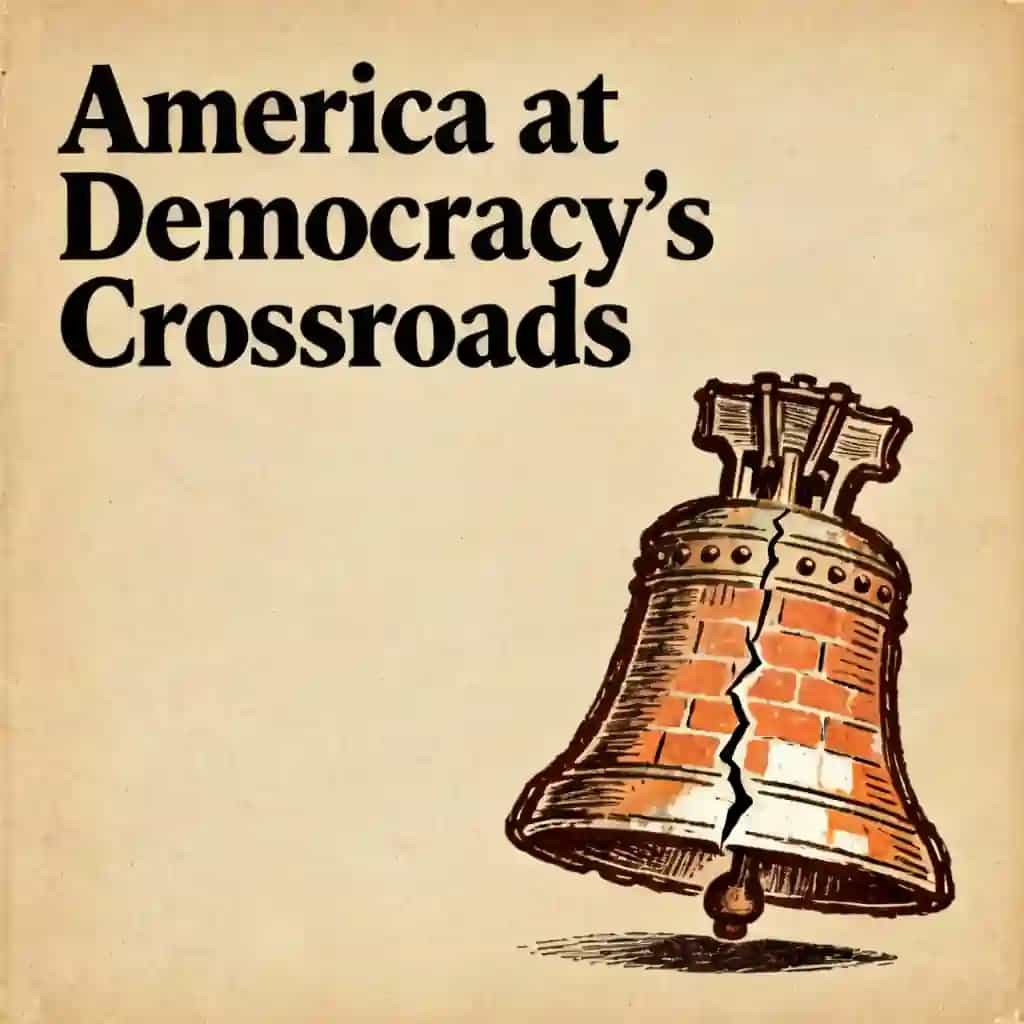
Capítulo 1
The Enduring Paradox of Democracy
In the summer of 1831, a young French aristocrat named Alexis de Tocqueville embarked on a journey that would forever change our understanding of democratic societies. Officially tasked with studying America's prison system, Tocqueville's true mission was far more ambitious: to comprehend the nature of democracy itself by examining the first nation where it had fully blossomed. The resulting work, "Democracy in America," would become one of the most influential political texts ever written.
What makes this book particularly remarkable is its continued relevance nearly two centuries later. Barack Obama reportedly kept it on his nightstand during his presidency, while Supreme Court justices from across the ideological spectrum regularly cite it in their opinions. Even tech moguls like Jeff Bezos and Mark Zuckerberg have praised its insights. This enduring appeal stems from Tocqueville's unique ability to see both democracy's promise and its perils with extraordinary clarity. Unlike many European observers who viewed America with either blind admiration or contemptuous dismissal, Tocqueville approached his subject with genuine curiosity and nuance, recognizing that democracy represented humanity's future-for better or worse.
Capítulo 2
The Democratic Revolution: An Unstoppable Force
Tocqueville begins with a profound observation: "A great democratic revolution is taking place among us." This revolution wasn't merely political but social-a fundamental transformation in human relations. For Tocqueville, democracy meant more than just voting rights; it signified the gradual leveling of social conditions, the dismantling of hereditary privileges, and the rise of equality as society's organizing principle.
This democratic revolution wasn't limited to America. Tocqueville saw it as an irresistible, providential force sweeping across the Western world. The revolution had been brewing for centuries, as various social developments gradually undermined aristocratic power: the clergy opening positions to all classes, lawyers challenging barons' authority, merchants introducing wealth as a rival to military influence, and the Enlightenment making intelligence a social force.
What made America unique was that democracy had developed there organically, without the violent upheavals that characterized Europe's democratic transitions. Americans were "born equal instead of becoming so." They had no aristocratic past to overthrow, no ancient regime to dismantle. This gave American democracy a stability and coherence lacking in European counterparts.
Tocqueville's genius lay in recognizing that this democratic revolution was inevitable. Unlike philosophers who debated whether democracy was desirable, Tocqueville accepted its inevitability and focused instead on how to make it function well. "The gradual development of the principle of equality is a providential fact," he wrote. "It has all the chief characteristics of such a fact: it is universal, it is durable, it constantly eludes human power, and all events as well as all men contribute to its progress."
The question, then, wasn't whether to embrace democracy but how to shape it. Would it lead to freedom and prosperity or to new forms of tyranny? America provided a laboratory to observe democracy's natural tendencies-both its virtues and its vices.
Capítulo 3
Township Democracy: Freedom's Primary School
What immediately struck Tocqueville about American democracy was its decentralized nature. Unlike in France, where power radiated from Paris, American democracy began at the local level-specifically in the New England township. These small, self-governing communities served as "primary schools of freedom" where citizens learned the art of self-government through direct participation.
The township wasn't just an administrative unit but a vibrant political community. Tocqueville observed how township residents gathered in town meetings to debate local issues, elect officials, and make decisions affecting their community. These meetings weren't merely symbolic-they exercised real power over taxation, education, roads, and public welfare.
This local democracy created what Tocqueville called "the spirit of the township"-a deep attachment to self-government that permeated American society. Citizens developed a sense of ownership over public affairs because they participated in them directly. They understood their rights and responsibilities not as abstract concepts but as practical realities they exercised regularly.
The township system distributed power widely, involving numerous citizens in governance through various elected offices. In a typical New England township, Tocqueville counted nineteen principal offices filled annually by election, from selectmen who executed laws to assessors who established taxes, from school commissioners to highway inspectors. This proliferation of offices meant that a significant portion of citizens held public responsibilities at some point, creating a society where political participation was the norm rather than the exception.
This decentralized system produced what Tocqueville called "administrative decentralization"-the distribution of administrative power among many locally elected officials rather than centrally appointed bureaucrats. While the state established general laws, it rarely supervised their execution directly. Instead, it relied on courts to ensure that townships fulfilled their obligations, using judicial processes rather than administrative hierarchies.
Tocqueville contrasted this approach with France's centralized administration, where officials appointed in Paris controlled local affairs throughout the country. The American system sacrificed some administrative efficiency but gained something more valuable: civic engagement. Americans might execute each public function "less perfectly than a centralized government," but they did "infinitely more things" because citizens themselves took initiative rather than waiting for the state to act.
Capítulo 4
The Tyranny of the Majority: Democracy's Greatest Danger
Despite his admiration for American democracy, Tocqueville identified a profound danger at its core: the potential tyranny of the majority. In democracies, the majority holds immense power, and without proper restraints, this power can become as oppressive as any monarch's.
"I know of no country where there is generally less independence of mind and true freedom of discussion than in America," Tocqueville wrote, challenging the conventional wisdom that democracies naturally protect individual liberty. The problem wasn't legal restrictions on speech but social pressure. When the majority formed a definite opinion on any question, dissenting voices found themselves not just outvoted but ostracized.
This tyranny operated through public opinion, which in democracies exerts "an immense pressure on the minds of all." When the majority pronounces judgment on any question, Americans fall silent-even those who disagree. No monarch, Tocqueville observed, could silence opposition as effectively as democratic public opinion.
The consequences were profound. Politicians feared defying majority sentiment, leading to what Tocqueville called "the servility of legislators"-representatives who followed rather than led public opinion. Intellectual innovation suffered as thinkers avoided challenging conventional wisdom. Even the press, despite its legal freedom, often reinforced majority views rather than challenging them.
This tyranny extended beyond ideas to political power. The majority's control of all branches of government-legislative, executive, and in many states even judicial-left minorities with no institutional protection. When the majority wanted something, no countervailing force could resist it.
Tocqueville's analysis of majority tyranny remains one of his most prescient insights. He understood that democracy's danger comes not from too little power but from too much-the concentration of all authority in a single social force. "Omnipotence in itself is a bad and dangerous thing," he wrote. "I think that liberty is endangered when this power finds no obstacle which can retard its course and give it time to moderate itself."
Capítulo 5
Counterweights to Majority Tyranny: America's Saving Graces
If majority tyranny represented democracy's greatest danger, what prevented American democracy from succumbing to it? Tocqueville identified several counterbalancing forces that moderated majority power and protected individual liberty.
First was America's federal structure, which divided sovereignty between national and state governments. This division prevented power from concentrating in a single institution and created multiple centers of authority that could check each other.
Second was the independent judiciary, particularly the Supreme Court's power to declare laws unconstitutional. This judicial review provided a crucial check on majority will, allowing courts to protect individual rights against legislative encroachment. Though judges couldn't directly oppose public opinion, they could "parry its blows" by declaring unconstitutional those laws that violated fundamental rights.
Third was the legal profession, which Tocqueville called America's "aristocratic element." Lawyers formed a distinct class with conservative tendencies, respect for precedent, and skepticism toward innovation. Their influence in legislatures, courts, and public opinion served as a "hidden brake" on democratic passions.
Fourth was the jury system, which Tocqueville viewed not just as a judicial institution but as a political one. By involving ordinary citizens in the administration of justice, juries spread legal knowledge throughout society and taught citizens to take responsibility for public affairs. They served as "the most energetic means of making the people rule" while simultaneously teaching them how to rule wisely.
Perhaps most importantly, Tocqueville identified religion as democracy's essential counterbalance. Religion provided moral boundaries that pure democracy lacked. While democratic principles encouraged individuals to question authority and follow their own judgment, religion reminded them of moral truths beyond human choice. "Liberty regards religion as its companion in all its battles and triumphs," Tocqueville wrote, "as the cradle of its infancy and the divine source of its rights."
American religion succeeded precisely because it remained separate from government. Unlike in Europe, where churches allied with political authorities, American churches maintained independence from the state. This separation allowed religion to exercise moral authority without becoming entangled in partisan politics. When religious leaders spoke, they did so not as government officials but as independent moral voices.
These counterbalancing forces created what Tocqueville called "the art of being free"-the practical knowledge of how to maintain liberty within a democratic framework. Americans had developed this art through experience, learning to combine majority rule with institutional constraints that prevented that rule from becoming tyrannical.
Capítulo 6
Associations: Democracy's Vital Strength
One of Tocqueville's most original insights concerned the role of voluntary associations in democratic society. Americans, he observed, had a remarkable tendency to form associations for countless purposes-commercial, moral, religious, and political. This habit of association wasn't merely a cultural quirk but a vital democratic strength.
In aristocracies, powerful individuals could accomplish great things alone. A nobleman with wealth, status, and followers could undertake major projects without needing broader cooperation. In democracies, however, individuals are relatively weak and equal. No single person possesses the resources to accomplish significant undertakings without cooperation.
This creates a fundamental democratic dilemma: as individuals become more equal, they grow weaker in isolation, requiring association to maintain their strength and independence. Yet the very equality that necessitates association makes it harder to achieve, as citizens lack the natural hierarchies that facilitate organization.
Americans had solved this dilemma by developing what Tocqueville called "the art of association"-the ability to unite voluntarily for common purposes. They formed associations for building hospitals, establishing schools, sending missionaries, constructing churches, distributing books, and countless other endeavors. These associations accomplished what government might otherwise do, allowing citizens to address social needs without expanding state power.
Political associations played a particularly crucial role. By participating in political groups, Americans learned organizational skills they could apply to civil purposes. They developed habits of cooperation, compromise, and collective action essential for democratic citizenship.
Newspapers facilitated this associational life by connecting like-minded citizens who might otherwise remain isolated. "A newspaper," Tocqueville wrote, "is an adviser that does not require to be sought, but that comes of its own accord and talks to you briefly every day of the common weal, without distracting you from your private affairs." By informing citizens about shared concerns and coordinating collective action, newspapers enabled the associations that sustained democratic society.
This associational vigor distinguished America from France, where citizens often looked to government rather than voluntary cooperation to solve social problems. The French habit of relying on the state created a dangerous cycle: as government grew stronger, citizens became weaker, further increasing their dependence on government. Americans had broken this cycle through robust civil society, maintaining their independence by working together rather than surrendering responsibility to the state.
Capítulo 7
Self-Interest Well Understood: Democracy's Moral Principle
How could a society founded on equality and individual rights maintain social cohesion? Tocqueville found the answer in what he called "self-interest well understood"-the American doctrine that serving the common good ultimately serves one's own interests.
Unlike European moralists who emphasized noble self-sacrifice, American moralists frankly acknowledged self-interest as a primary human motivation. Rather than fighting this tendency, they channeled it toward social ends by demonstrating how individual and collective interests align. "They show with such skill the agreement of personal interest with the public interest," Tocqueville wrote, "that it becomes difficult to distinguish between them."
This doctrine lacked the grandeur of aristocratic virtue, which celebrated selfless devotion to honor and glory. It produced no heroes willing to sacrifice everything for abstract principles. But it created something perhaps more valuable for democratic society: consistent, moderate virtue accessible to ordinary citizens.
Self-interest well understood worked because it matched democratic conditions. In societies where individuals focus primarily on their own welfare, moral systems requiring constant self-sacrifice face an uphill battle. The American approach accepted human nature as it was while redirecting it toward social harmony.
Religion reinforced this practical morality. American religious leaders rarely dwelled on otherworldly rewards, instead emphasizing how faith produced benefits in this life. They showed how religious practice led to stable families, honest commerce, and orderly communities-all contributing to individual well-being alongside spiritual salvation.
This pragmatic approach to morality reflected democracy's broader tendency to favor practical results over abstract principles. Americans might not achieve the heroic virtue of aristocratic societies, but they maintained a consistent level of decent behavior that sustained social order. "What one might call enlightened love of themselves constantly leads them to help one another," Tocqueville observed, creating a society where virtue emerged from mutual advantage rather than self-denial.
Capítulo 8
The Pursuit of Well-Being: Democracy's Double-Edged Sword
Material prosperity formed a central element of American democracy. Tocqueville observed an unprecedented "taste for physical well-being" among Americans-a universal pursuit of comfort and material improvement that pervaded all classes.
This materialism had positive aspects. It drove remarkable economic development, as Americans applied their energy and intelligence to improving their conditions. It created a society where extreme poverty was rare and modest comfort widely available. It even supported democratic institutions, as citizens recognized that their prosperity depended on stable government and the rule of law.
Yet this pursuit of well-being also posed dangers. As citizens focused increasingly on private concerns, they risked neglecting public affairs. The "love of physical gratification" could gradually erode civic virtue, creating what Tocqueville called "soft despotism"-a condition where citizens surrender their political rights in exchange for comfort and security.
Tocqueville observed a peculiar restlessness among Americans despite their prosperity. "In America I saw the freest and most enlightened men placed in the happiest circumstances that the world affords," he wrote, "yet it seemed to me that a cloud habitually hung upon their brow, and they seemed serious and almost sad even in their pleasures." This paradoxical discontent stemmed from democracy itself, which simultaneously raised expectations and created anxiety about maintaining one's position.
The democratic citizen, constantly comparing himself to others and seeing endless possibilities for advancement, never finds satisfaction in what he has. He pursues material goods with "feverish ardor" yet feels perpetually unsatisfied. This creates a strange melancholy amid abundance-a society materially rich but spiritually restless.
Religion provided an essential counterbalance to this materialism. By periodically directing attention toward spiritual concerns, religious practice prevented citizens from becoming entirely absorbed in physical pleasures. Even imperfect religious beliefs proved valuable in democratic society, as they reminded citizens that "man has not been placed upon the earth merely to enjoy ephemeral pleasures" but to pursue higher purposes.
Capítulo 9
Family and Gender: Democracy's Transformation of Intimate Relations
Democracy transformed not just public institutions but private relationships, particularly within families. Tocqueville observed a remarkable difference between aristocratic and democratic family structures, with profound implications for society.
In aristocratic families, authority flowed from rigid hierarchies. The father ruled as "not only the political head of the family, but the organ of tradition, the interpreter of custom, the arbiter of manners." Children showed formal deference rather than intimate affection, and relationships followed strict protocols reflecting broader social hierarchies.
Democratic families operated differently. As social equality spread, it penetrated family life, replacing formal authority with natural bonds. "As social conditions become more equal," Tocqueville wrote, "relations between father and son become more intimate and tender; rule and authority are less talked of; confidence and tenderness are often increased, and it would seem that the natural bond is drawn tighter in proportion as the social bond is loosened."
This transformation extended to gender relations. Tocqueville praised American women's education, which prepared them for independence rather than sheltering them in ignorance. Unlike European girls raised in "naive ignorance" and "happy innocence," American girls learned early about life's realities, developing judgment and self-control through knowledge rather than isolation.
American marriage reflected this democratic approach to gender. While maintaining distinct roles for men and women, Americans based these distinctions on mutual respect rather than male superiority. "They have carefully divided the functions of man and woman," Tocqueville observed, "in order that the great work of society might be better performed." Yet they considered these different functions as having "equal value though different character."
This democratic family structure produced what Tocqueville considered America's greatest strength: strong, independent women who willingly chose domestic responsibilities. American women entered marriage with "exercised and mature" minds, making a deliberate choice rather than following blind obedience. Their education prepared them to face life's challenges with "tranquil and indomitable energy," whether in prosperous New England homes or frontier settlements.
The democratic family thus balanced freedom with stability, creating intimate bonds stronger than aristocratic formality while maintaining the structure necessary for social order. It represented democracy's ability to transform even the most fundamental human relationships without dissolving them entirely.
Capítulo 10
The Future of Democracy: Between Freedom and Despotism
As Tocqueville concluded his analysis, he turned to democracy's future-not just in America but worldwide. He recognized that the democratic revolution would continue spreading, transforming societies across the globe. The question wasn't whether this revolution would proceed but what form it would take.
Democracy faced a fundamental choice between two paths: freedom or despotism. It could produce societies where citizens actively participated in self-government, maintaining their independence through civic engagement. Or it could degenerate into a new kind of despotism-not the harsh tyranny of old but a milder, more insidious form of control.
This "soft despotism" represented democracy's unique danger. Unlike traditional despotism that ruled through fear and force, democratic despotism would operate through bureaucracy and benevolence. It would provide for citizens' needs while gradually stripping away their independence. It would "degrade men without tormenting them," reducing citizens to "a flock of timid and industrious animals, of which the government is the shepherd."
The path to this despotism lay through individualism-the tendency of democratic citizens to withdraw from public affairs into private concerns. As citizens focused increasingly on personal well-being, they would gradually surrender political responsibilities to central authorities. The state would grow ever more powerful while individuals became ever more isolated, creating a society of weak citizens ruled by an omnipotent government.
To avoid this fate, democratic societies needed to maintain what Tocqueville called "secondary powers"-institutions between the individual and the state that preserved liberty by distributing authority. Local self-government, voluntary associations, religious institutions, and an independent judiciary all served this function, preventing power from concentrating in a single center.
Most fundamentally, democracies needed to preserve the "taste for freedom" alongside the "taste for equality." While equality came naturally to democratic peoples, freedom required constant effort and vigilance. It depended on citizens' willingness to participate in public affairs despite the temptations of private life.
Tocqueville's final message was both warning and hope. Democracy contained within itself both the seeds of freedom and the seeds of despotism. Which would flourish depended not on fate but on human choice-on citizens' willingness to embrace the responsibilities of self-government rather than surrendering them for comfort and security.
"The nations of our day cannot prevent conditions of equality from spreading in their midst," he concluded. "But it depends upon themselves whether equality is to lead to servitude or freedom, to knowledge or barbarism, to prosperity or wretchedness."
Capítulo 11
Democracy's Enduring Challenges
Tocqueville's analysis remains remarkably relevant because the tensions he identified continue to shape democratic societies. The balance between majority rule and minority rights, between central authority and local control, between individual freedom and collective welfare-these fundamental democratic dilemmas persist across time and place.
Perhaps most presciently, Tocqueville recognized that democracy's greatest threats come not from external enemies but from within-from citizens' willingness to trade freedom for security, from the gradual concentration of power in administrative bureaucracies, from the erosion of civic engagement in favor of private pursuits.
His insights remind us that democracy is not self-sustaining. It requires constant renewal through active citizenship, robust civil society, and institutional checks on power. It depends not just on formal structures but on civic habits and mores that support self-government.
As we navigate democracy's challenges in our own time, Tocqueville offers not easy answers but essential questions: How can we preserve liberty within equality? How can we maintain civic engagement in an individualistic age? How can we prevent the centralization of power while addressing complex social problems?
These questions have no permanent solutions, only ongoing responses that each generation must discover anew. This is perhaps Tocqueville's most enduring lesson-that democracy is not a fixed achievement but a continuous project, requiring perpetual vigilance and renewal. Its success depends not on institutions alone but on citizens willing to embrace both the freedom and the responsibility of governing themselves.