Capítulo 1
Unleashing the Power of Collaborative Leadership
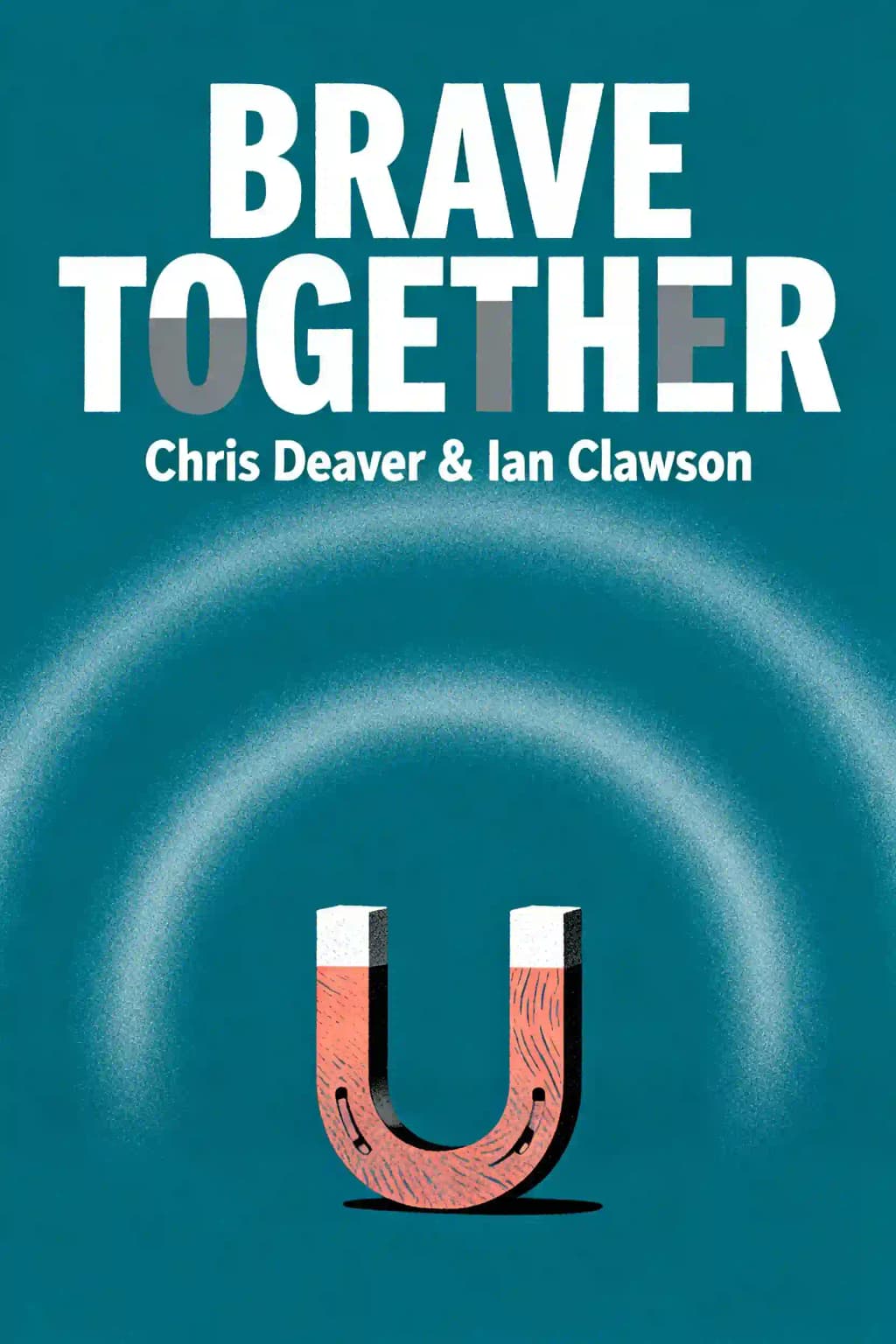
In an age of relentless hustle culture and solo achievement, "Brave Together" arrives as a revolutionary manifesto for a different way of working. The book has been making waves in Silicon Valley boardrooms and beyond, with Tim Cook reportedly gifting copies to Apple executives and leadership coaches incorporating its principles into Fortune 500 training programs. Co-authors Chris Deaver (former Apple culture strategist) and Ian Clawson challenge our deeply ingrained notions of success, arguing that the future isn't self-made-it's shared. Their work emerges at a critical moment when workplace disengagement has reached epidemic proportions and traditional leadership models are failing. What if the path to innovation, fulfillment, and sustainable success isn't through individual genius but through the messy, beautiful process of co-creation?
Capítulo 2
From Self-Made to Shared: Reimagining Success
For generations, we've celebrated the mythology of the self-made success story-the lone genius who powers through obstacles through sheer force of will. Chris Deaver's personal journey exemplifies the limitations of this mindset. Despite achieving his dream of working at Disney, he found himself feeling empty inside. The accolades, promotions, and external validation couldn't fill the void created by pursuing achievement in isolation.
"I was addicted to achievement," Deaver confesses, describing how his relentless pursuit of solo success left him exhausted and unfulfilled. When offered a book deal to write alone, something didn't feel right. The breakthrough came when he joined Apple and witnessed firsthand how the company was evolving from Steve Jobs' "Think Different" mantra to Tim Cook's "Different Together" approach-a subtle but profound shift that prioritized collaborative innovation.
This evolution wasn't just happening at Apple. Across industries, the most innovative companies were discovering that sustainable success comes not from individual brilliance but from creating environments where diverse minds can build together. When Deaver met co-author Ian Clawson in 2017, they experienced the transformative power of co-creation firsthand, developing a story world together that validated their shared belief: collaborative creation generates exponentially better results than solo efforts.
The authors introduce six meta principles for co-creation that form the backbone of their philosophy: lead with questions to access collective wisdom, turn pain into power by creating gains from sacrifices, make others the mission by setting aside ego, define situations through value-driven actions, create context through meaningful work, and follow true north by building alignment. Unlike tactical formulas that quickly become outdated, these principles represent timeless truths that can guide leaders through any challenge.
What makes this approach revolutionary is its rejection of the binary thinking that dominates most leadership advice. Instead of choosing between being an employee or entrepreneur, creative or analytical, compassionate or driven, the co-creative mindset embraces the power of "and"-finding strength in apparent contradictions and harnessing diverse perspectives to build something greater than any individual could achieve alone.
Capítulo 3
Breaking Free from Status Quo Thinking
Most of us are trapped in status quo thinking without realizing it. The traditional work system operates like a chip implanted in our brains, killing creativity through constant monitoring, productivity tracking, and compliance enforcement. This control-based approach has led to 70% worker disengagement pre-pandemic, followed by the Great Resignation and Quiet Quitting-clear signals that the system is fundamentally broken.
Fear plays a central role in maintaining this broken system. The authors identify three types of fear that keep us stuck: fear we feel from others (rejection, judgment, micromanagement), self-inflicted fear (failure, inadequacy, catastrophizing), and fear tied to our growth (uncertainty, change). Understanding these fears is essential to breaking free and embracing our creative potential.
"Being brave alone puts a target on your back," the authors warn. While personal bravery unlocks inner power, it eventually reaches its limits. The addiction to boldness and optimization leads to burnout, loneliness, and emptiness. Social media becomes a poor substitute for real connection, and we present curated versions of ourselves rather than authentic ones.
To break free from status quo thinking, we must take the Mirror Test-a co-creative pattern centered on responsibility that helps us reimagine our experiences by distinguishing between reality and ideals. This involves synthesizing our past (identifying working principles and rewriting negative stories), future (envisioning ourselves in 10 years and the sacrifices needed), and present (recognizing energy sources and drains).
The authors share the story of Mohammad Anwar, whose company Softway was on the verge of collapse after 13 years of success. Following massive layoffs, only two employees out of 100 still trusted him. His transformation began when he attended a University of Houston football game and witnessed the coach attribute their comeback victory to the love players had for each other. This revelation changed Mohammad's leadership approach-he took responsibility, sought forgiveness, rebuilt relationships, and eventually co-authored "Love as a Business Strategy."
Capítulo 4
The Evolution of Work: From Industrial to Contextual Age
To understand our current workplace challenges, we must recognize the three successive waves of work evolution. The Industrial Age (18th century-early 1900s) introduced the manual worker, emphasizing "working hard" and efficiency. It gave us production lines creating most modern products, but also exploited people and the environment for profit. Progress included efficiency, capitalism, and new technologies, but the by-products were the 40-hour workweek, performance-driven culture, and concentrated wealth.
The Information Age (mid-20th century-early 2000s) introduced the knowledge worker focused on effectiveness-"working smarter." It brought computer processing, internet connectivity, smartphones, and advanced education. However, it also created workplace silos and competitiveness, expert models, and market monopolies.
We're now entering the Contextual Age, which thrives when people connect deeply, engage in creative work, and operate from principles. Work and life blend in a decentralized system designed for compassion, where wisdom serves deep empathy. This era demands creative work beyond AI's limitations, shifting from hierarchies to intentional culture-building, horizontal collaboration, principle-based leadership, and better alignment between passion and purpose.
"Most meetings are terrible data dumps with no real listening-just loaded agendas leaving 70% of workers disengaged," the authors observe. Instead, meetings should be reimagined as co-creative conversations that inspire and connect. Leaders can transform meetings by emailing conversation-starting questions beforehand, leading with questions that challenge assumptions, taking egos off the table, letting the best ideas win, and designing with intention.
Capítulo 5
Leading with Questions: The Power of Shared Wisdom
For decades, companies have obsessed over expertise, flaunting intellect as the ultimate superpower. This approach has evolved from centralized authority (Industrial Age) to knowledge workers (Information Age) to co-creators with shared wisdom (Contextual Age). The expert model closes off connection, treating others as threats rather than collaborators.
Steve Jobs believed most people don't get experiences because they never ask. At 12, Jobs called Bill Hewlett for spare parts and got a summer job. "If you're afraid of failing, you won't get very far," Jobs said. Similarly, Pixar founder Ed Catmull revealed his leadership philosophy: "I lead with a question." After struggling with answering every question at Pixar, a seven-day meditation retreat taught him to ask questions and listen. This transformed his leadership, particularly in his "braintrust" meetings where thought-provoking questions sent beforehand led to rich, collaborative problem-solving.
Most of us were never trained to listen-we were taught to talk more and share answers. Stephen Covey taught "seek first to understand, then to be understood," but true listening goes beyond understanding. It requires openness to changing your mind. Steve Jobs exemplified this at Apple, shocking colleagues by pivoting 180 degrees in real time during meetings if presented with compelling ideas, regardless of their source.
The authors introduce three "golden questions" that can unlock wisdom and deepen conversations: "At the back of your head and heart, what is something still unfulfilled in your life?" This reveals truths about past or present pain. "What are you most excited about right now?" This reveals whether you're living in fear or striving to be brave. "What inspires you to be your best?" This question centers on values and sources of inspiration.
Capítulo 6
The Hero's Sacrifice: From Ego to Empathy
The Hero's Sacrifice pattern is rooted in humility-not weakness but a powerful path forward. While the world tells us success means beating others or becoming a celebrity, the Hero's Sacrifice turns selflessness into our greatest superpower.
We live on multiple stages-front stage (performing for others), backstage (more relaxed but still performing), and off stage (our private selves). Social psychologist Erving Goffman observed that we're thrown onto life's stage at birth, learning to play roles assigned by others. This "impression management" creates a disconnect between our outward reputation and inward experience.
True sacrifice isn't primitive but sophisticated-giving away something valuable to achieve a higher state of living. People approach sacrifice at different levels: Tier 1 (sacrificing for results-"I sacrificed my marriage for this promotion"), Tier 2 (sacrificing for self-delaying gratification for future gain), and Tier 3 (sacrificing for others-becoming a healthy, whole person to make a difference in others' lives).
The Golden State Warriors demonstrate how to live ego-free through simple yet powerful practices. They take crazy shots during practice to build confidence in doing bold things together. They remain humble, spotlighting teammates rather than themselves. They religiously high-five each other after every play-made shots, missed shots, bad passes-creating constant connection and acknowledgment. They stick with fundamentals despite their elite status, running basic drills that surprise visiting coaches.
Giannis Antetokounmpo exemplifies the ego-free approach to success and failure. When his top-seeded Milwaukee Bucks were eliminated in the first round of the playoffs and a reporter asked if he viewed the season as a failure, Giannis offered a masterclass in perspective: "It's not a failure; it's steps to success. Michael Jordan played 15 years, won six championships. The other nine years was a failure?" He reminded us that sports-and life-contain good days and bad days, success and setbacks.
Capítulo 7
Turning Pain into Power: The Passion Principle
When Clint Schaff took over LA Times Studios, the newspaper business was bleeding money. Undeterred, he led his team in brainstorming world-changing ideas, with #47 being "start a podcast." That simple concept evolved into a $10-15 million business producing hits like "Dirty John" that attracted 50+ million listeners and partnerships with Netflix. They succeeded by turning their pain into co-creative power, focusing less on external solutions and more on unlocking their team's shared passion for storytelling.
Studies show we interpret 80 percent of daily experiences as negative or as losses, stemming from our brain's evolution to prioritize threats. We feel losses much more intensely than equivalent gains-losing a $100 bill hurts far more than finding one feels good. While fear of loss motivates us in truly existential situations, it's unhelpful in everyday life.
Turning Pain into Power isn't just a mindset-it's a way to navigate difficult emotions. Loss creates a vicious cycle that hijacks our subconscious, leaving us addicted to anger. The solution? Choose to see gains instead. When we recognize gains, our lives fill with gratitude, leading to happiness and peace. Make the choice to never play the victim in your life-flip the script by redirecting your thoughts toward small achievable gains.
Pain caused by others can linger, burning inside us like wildfire. Many don't seek immediate revenge but let venomous thoughts erode their relationships and character. "Don't get mad, get even" isn't strength but weakness-uncontrolled passion leading to destructive consequences. The Count of Monte Cristo illustrates this perfectly: Edmond Dantes, betrayed and imprisoned for 13 years, meticulously plots revenge against his enemies. But is revenge truly satisfying? Edmond ultimately found himself feeling empty despite achieving his vengeance, realizing his life "had been a lie" and that his resources were "designed for nobler, holier purposes" than revenge.
Capítulo 8
Apple's Transformation: From Think Different to Different Together
How does Apple innovate so brilliantly? Few know the struggles behind their success. When Chris Deaver joined Apple in 2015 as an HR partner, he witnessed genius-level engineers who could solve anything. But the culture of secrecy, while protecting "surprise and delight" for customers, created problems: information hoarding, personal agendas, and infighting. New employees constantly worried about sharing information, fearing termination or legal consequences.
The authors were inspired by Stephen Covey's principles in "The 7 Habits," especially his focus on synergy and interdependence. But they realized co-creation shouldn't come at the end of the journey-it must be central. They were also inspired by Ed Catmull's concept of the "braintrust" at Pixar that encouraged creative voices. These questions led Deaver to form a mini braintrust at Apple to explore which leaders and teams collaborated best, and why.
Their research revealed something surprising: while Apple emphasized secrecy, the most successful leaders highlighted sharing as their key to success. The "Camera Braintrust" (CBT) exemplified this through weekly cross-staff transparency sessions where leaders openly shared challenges and needs. They applied this approach to the AirPods team, partnering with Randy Nelson from Apple University (who founded Pixar University). As teams became more open and connected, higher-quality collaboration emerged, resulting in the noise-canceling AirPods Pro.
By studying the most innovative teams, they co-created principles for Apple's future culture: Follow the North Star and Have a Vision, Don't Wait for Perfection and Share Early, Take Ownership and Be Authentic, Build Trust (and Braintrust), Share Freely Within the Circle, Take Smart Risks Together, and Be Biased Toward Others' Ideas.
These principles resulted in a culture shift called "Different Together"-combining the historic "Think Different" ethos with collaborative power. Working with Greg "Joz" Jozwiak and Apple Marketing, they captured this spirit in a video called "Join Us. Be You." This cultural evolution positioned Apple to better handle challenges while accelerating innovation.
Capítulo 9
Making Others the Mission: The Power of Compassion
Malala Yousafzai's story exemplifies making others the mission. This young Pakistani girl stood against the Taliban's suppression of girls' education, was shot in the head for her activism, but recovered to continue her mission. Her courage focuses not on personal glory but on fighting for education worldwide. Stanford psychologist Jennifer Aaker's research confirms that the most meaningful lives focus on connecting to larger purposes and making positive contributions.
Too many people make themselves the mission, focusing on personal branding and lifestyle while abandoning relationships with family, friends, and colleagues in their self-centered pursuit. John Gottman's research shows successful relationships depend on "turning toward" partners instead of away or against them. Making others the mission helps escape the void of self-obsession, filling life with purpose and instant joy.
Making others the mission creates endless energy, takes life to the next level, and develops compassion. By focusing on helping others like Malala did with education, we tap into an endless source of strength. Goals focused on others are more powerful than self-centered ones. Compassion makes us present in conversations, creating safe spaces where others feel seen and heard.
Satya Nadella transformed Microsoft's toxic culture by embodying compassion learned through personal experience. When his son Zain was born with cerebral palsy, Satya witnessed how his wife Anu focused on their son's needs rather than asking "why us?" This profound experience shaped Satya's leadership philosophy, infusing empathy into his actions as both father and CEO. He credits Zain, who passed away at 26, with inspiring Microsoft's commitment to accessibility features and teaching him to listen better and amplify others' strengths.
Capítulo 10
Creating Context: The Power of Meaningful Work
Purpose isn't something we find through endless searching but through our choices, capabilities, and impact. Most people are either addicted to consuming content or obsessed with creating it, but co-creators focus on quality over quantity, infusing their original worldview into everything they do. Creating context means building stories that matter-not just plot-driven explosions but narratives with deep meaning that stir the subconscious.
To create context in our digital age, we must carefully select what influences us. This begins with having an AIM-Aspiration (who you want to be), Inspiration (when you burn brightest), and Motivation (what drives you). After Kenny Funk's father died following 9/11, this framework transformed his leadership at Disney. Being selective about content consumption and seeking diverse experiences are equally important.
Organizations thrive when they shift from mechanical approaches (strategies, tactics, programs) to organic systems where people aren't treated like cogs in a machine. An organic approach offers autonomy to choose, explore, and experiment in a work environment that feels like a lab. At Apple, when Deaver grew impatient wanting to roll out the "Different Together" culture quickly, his colleague Caroline pointed to Apple Park's ecosystem-trees, water, people in harmony-showing how cultural transformation should grow naturally, pulling people in rather than being forced upon them.
Creating Context means communicating intentions clearly and connecting people with different situations into a shared story. As Guy Kawasaki advised, "paint big dots in life"-preparing for luck by doing what you love and being ready to pivot or double down. Future leaders need crossover agility to see existing dots, create new ones, and connect them with others. Tim Cook exemplified this when Elon Musk publicly attacked Apple-instead of firing back, Tim invited Elon to Apple Park, shifting from potential conflict to mentorship.
Capítulo 11
Following True North: Aligning with Purpose
The world has changed, with toxic and transactional cultures giving way to expectations of greater humanity, creativity, and authenticity from leaders. True alignment means living principles, not just talking about them. Sivan Ya'ari's story with Innovation: Africa demonstrates this perfectly-initially installing solar panels for lighting in African villages, she discovered kids still weren't attending school. By observing more deeply, she realized they spent their time searching for water. Redirecting solar power to drill for clean water transformed entire communities, proving that following true north requires adjusting course when original solutions miss the mark.
To follow true north, we must zoom out from micro-problems and tactical approaches to see the bigger picture. Instead of getting caught in optimization and micro-management, we need to shift from a to-do list to a to-be list, asking whom we need to become for our future. The Macro View connects us to co-creative patterns that ground us in meaningful themes rather than just habits.
While goals focus on achievement and measurement, themes provide direction and purpose that outlast specific targets. Angela Ahrendts captures this spirit: "Belief is ignited by hope and supported by facts-it builds alignment and creates confidence." Themes help us understand why we're succeeding, not just what it takes to win. They transform our approach from what we need to do to who we need to be, shifting us from transactions to transformation.
Charlie Munger, Warren Buffett's partner at Berkshire Hathaway, lives by everlasting themes: love what you do and who you do it with, become wise through reading, master principles, and do the right thing. Similarly, filmmaker Bryce Dallas Howard focuses on learning from others, creating deeper meaning, and sharing inspiring women's stories. Both ignore the "Outer Scoreboard" (what others think) and focus on their "Inner Scoreboard" (their principles).
Capítulo 12
Building Co-Creative Cultures: The Future of Work
When Marvel Studios created Iron Man, everything was on the line. Director Jon Favreau, Jeff Bridges, and Robert Downey Jr. faced a startling reality: no finished script despite a $200 million budget. Instead of panicking, they embraced co-creation-improvising dialogue while Marvel executives nervously watched. The result? A blockbuster that launched the entire Marvel Cinematic Universe.
Co-creative cultures share fundamental building blocks similar to nature's geometric codes found in DNA, tree rings, and the universe itself. The first building block is Shared Wisdom-combining "Lead with a Question" and "Define the Situation" through action. The best cultures inspire through collective knowledge, focusing more on teamwork and innovation than balance sheets.
The second building block is Deep Empathy, which combines passion (Turn Pain into Power) with compassion (Make Others the Mission). These cultures encourage people to join forces, bringing work and life together seamlessly with respect and even love. They're guided by how people feel, putting empowerment at the center rather than as a feature.
The third building block is being Powered by Principles, which combines purpose (Create Context) with alignment (Follow True North). When we embody values like compassion, integrity, and respect, we transcend politics and blame games. Principles become our guiding stars through unknowns.
The future belongs to creativity-the last frontier that automation cannot replace. Co-creative leadership shapes this future through three geometric principles: The Square represents grounding leadership in first principles, creating stability through shared values rather than intelligence alone. The Circle creates brave spaces where people can share authentically without fear, generating ideas, encouraging horizontal sharing, and empowering people through extended trust. The Triangle represents the synthesis of mind and heart, making better connections through balanced thinking.
When facing overwhelming personal struggles, Chris tried to power through alone until his friend Ian called, suggesting he connect with nature by literally touching a tree. At the summit, he found a tree with half its branches cut away, lying on the ground. Placing his hand on its bark, he felt a profound connection to its suffering that mirrored his own. Moving to the other side, he sensed a shift, as if the tree were saying, "Look up. Look what I get to see." The magnificent valley view revealed that the tree's pruning wasn't harm but healing-the moldy branches had been removed to save it. This epiphany showed that suffering can be part of healing, and we're all connected in a larger ecosystem. True bravery means helping each other heal and co-creating our best moments together.