Capítulo 1
The Cold War's Longest Unresolved Conflict
In April 1959, a striking contrast unfolded at Washington's Statler Hilton Hotel. Fidel Castro, clad in olive green fatigues, met with Acting Secretary of State Christian Herter in his formal three-piece suit. Just four months after leading guerrillas in the Sierra Maestra, Castro was now Cuba's prime minister. When introduced to the State Department official "in charge of Cuban affairs," Castro quipped, "And I thought I was in charge of Cuban affairs" - a clever joke signaling his intention to end a half-century of U.S. control over Cuban matters. This meeting marked the beginning of what would become the Western Hemisphere's most enduring diplomatic standoff.
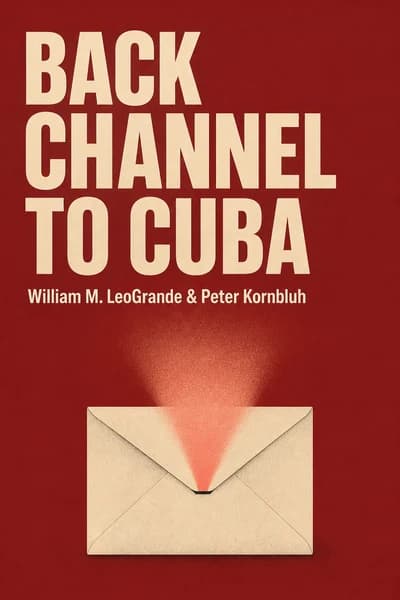
"Back Channel to Cuba" has been hailed as the definitive account of U.S.-Cuba relations, with The Washington Post calling it "the most complete account yet of U.S.-Cuban relations in the fifty years since the thaw in diplomatic relations." The book reveals how, despite public hostility, every administration from Eisenhower to Obama engaged in secret talks with Cuba. As former President Jimmy Carter noted, the book "shows that despite the public rhetoric and the frozen state of relations, there has been a surprising level of dialogue between the two countries."
Capítulo 2
A Revolution's Troubled Birth: Eisenhower and Castro
The historical tensions between Cuba and the United States set the stage for their complex relationship. Throughout the 19th century, Washington coveted Cuba while U.S. economic and cultural influence permeated the island. After U.S. intervention in 1898, the imposed Platt Amendment gave America extraordinary powers over Cuba, allowing multiple military interventions. By the 1930s, U.S. interests controlled most of Cuba's economy, from sugar to banking. Batista's subsequent dictatorship, despite its corruption and brutality, enjoyed U.S. support until its collapse.
When Fidel Castro's revolutionary movement triumphed on January 1, 1959, the Eisenhower administration initially adopted a cautious approach. Ambassador Philip Bonsal, a professional diplomat with Latin American expertise, believed Cuba and the United States shared a "mutuality of interest" that would moderate the revolution's radical tendencies. In his first meeting with Castro in March 1959, Bonsal listened as Fidel enthusiastically outlined plans for agrarian reform and industrialization, while gently suggesting mutual respect would be necessary for good relations.
Castro's April 1959 visit to the United States represented perhaps the best opportunity for the two governments to avoid a break in relations. Despite ignoring advice to shave their beards and exchange olive-green uniforms for business suits, Castro and his entourage made a strong impression. Everywhere he went, Castro was greeted by cheering crowds. At the Bronx Zoo, he even jumped over a guardrail to playfully taunt tigers-quintessential Fidel, boldly courting danger.
Yet the official aspects of the visit proved disappointing. President Eisenhower deliberately snubbed Castro, going golfing in Georgia rather than meeting him. More significantly, a strange dance around economic aid produced no results. Castro had instructed his economic team not to request assistance, telling them, "When we go back to Cuba, they will offer us aid without our asking for it." Meanwhile, U.S. officials, who had prepared to offer a $25 million loan, waited for the Cubans to broach the subject. In the end, "the Cubans wouldn't ask, and the Americans didn't offer."
The Revolutionary Government's agrarian reform law of May 17, 1959, marked a critical turning point in U.S.-Cuban relations. The law nationalized most estates exceeding one thousand acres with compensation based on tax assessments paid through 20-year bonds. The agrarian reform alarmed Washington not for its content-which was less radical than reforms Kennedy would later support through the Alliance for Progress-but because it revealed the revolution's direction and confirmed suspicions that Castro was committed to radical social reform.
By late June 1959, key Eisenhower administration officials concluded that Castro's government fundamentally conflicted with U.S. interests. On July 8, Assistant Secretary Rubottom argued at an Operations Coordinating Board meeting that policy should shift "from the testing phase in which Castro had failed practically every test we had given him to the pressure phase." By July, the administration had decided "it was not possible to achieve our objectives with Castro in power" and tasked the CIA to develop plans to support Castro's opponents.
Diplomatic efforts collapsed completely in October 1959 amid a series of crises. When a State Department official accidentally revealed that the U.S. had blocked Britain from delivering jets purchased by the Batista regime, Castro saw this as confirmation of American duplicity. Days later, when former revolutionary commander Huber Matos resigned over growing communist influence and was arrested, and exile leader Pedro Diaz Lanz "bombed" Havana with anti-Castro leaflets, Castro interpreted these events as a coordinated pattern of aggression.
On November 5, Eisenhower approved a SECRET policy document declaring that the U.S. objective was to ensure that "not later than the end of 1960," Cuba would have a government that met "basic United States policy objectives." As Rubottom explained, this meant overthrowing Castro, whose policies were "inconsistent with the minimal requirements of good Cuban-U.S. relations."
Capítulo 3
Kennedy's Paradox: Aggression and Accommodation
On November 22, 1963, French journalist Jean Daniel was in Cuba carrying a message of potential reconciliation from President Kennedy to Fidel Castro. While discussing Kennedy's secret "feeler" over lunch at Varadero Beach, Castro received the shocking news that Kennedy had been shot in Dallas. "This is an end to your mission of peace," Castro told Daniel. "Everything has changed."
Kennedy's presidency had begun quite differently. As a candidate, he attacked the Eisenhower administration for abandoning Cuban "fighters for freedom." As president, he ignored Latin American governments' attempts to broker U.S.-Cuban dialogue before authorizing the CIA-led Bay of Pigs invasion on April 17, 1961. Within 72 hours, the brigade's beachhead collapsed with over 1,200 prisoners taken. "Victory has a thousand fathers, and defeat is an orphan," Kennedy said, acknowledging responsibility for "one of the great debacles in the history of U.S. foreign policy."
The humiliation at the Bay of Pigs drove both Kennedy brothers to focus on "redressing" this "insult." The president tasked Robert Kennedy with overseeing "Operation Mongoose," a massive campaign combining diplomatic and economic pressure with covert operations to overthrow Castro's regime. Kennedy imposed a full economic embargo in February 1962-a hostile policy pillar that has endured for over five decades.
Yet amid this aggression, Kennedy secretly explored accommodation with Cuba. As McGeorge Bundy explained, "We wanted to make a reality check on what could or could not be done with Fidel Castro." The president "clearly thought this was an exploration worth making."
The first high-level contact occurred unexpectedly at the Alliance for Progress meeting in Uruguay in August 1961. Che Guevara initiated the encounter by sending Cuban cigars to Richard Goodwin, a young White House aide, with a note reading: "To write to the enemy is difficult. I limit myself to extending my hand." After Guevara's formal speech criticizing the United States, he tracked down Goodwin at a late-night party and arranged a private conversation that lasted until dawn. Guevara presented a carefully organized proposal for a "modus vivendi" with five key concessions, while making clear Cuba would not give up "the type of society to which they were dedicated."
The Bay of Pigs debacle created the first opportunity for substantive U.S.-Cuban negotiations since diplomatic relations were severed. Kennedy felt personally responsible for the captured brigade members, while Castro saw an opportunity to extract concessions. The negotiations ultimately secured the release of 1,113 Bay of Pigs prisoners and 39 U.S. citizens through the efforts of attorney James Donovan, who became the first U.S. emissary to win Castro's trust.
During an April 1963 visit, Donovan skillfully used a Nation magazine article to suggest normalization possibilities. When Castro asked how relations might be restored, Donovan memorably explained: "Do you know how porcupines make love? Very carefully - and that's how you and the U.S. would have to get into this."
The most serious attempt at rapprochement came through ABC News correspondent Lisa Howard, who secured an exclusive interview with Castro in April 1963. Howard then privately committed herself to facilitating negotiations between the two countries, even writing directly to Castro offering her help despite disagreeing with his communist direction. She arranged the first face-to-face meeting between U.S. and Cuban officials by connecting William Attwood, a former journalist serving as special advisor to UN Ambassador Adlai Stevenson, with Cuba's UN ambassador Carlos Lechuga at a party in her Central Park apartment.
By November 1963, Castro had invited Attwood to Cuba for direct talks, though Kennedy insisted on a preliminary agenda before any such visit could occur. In his final days, President Kennedy sent two messages to Castro indicating openness to reconciliation. First, in a November 18 speech to the Inter-American Press Association, Kennedy suggested that improved relations were "possible" if Cuba stopped acting as "a weapon in an effort dictated by external powers to subvert the other American republics." He reinforced this message through French journalist Jean Daniel, acknowledging America's "sins" in prerevolutionary Cuba. Castro responded positively, telling Daniel that Kennedy could become "the greatest president" who understood "coexistence between capitalists and socialists" was possible. As they spoke, news arrived of Kennedy's assassination. The potential breakthrough died with Kennedy.
Capítulo 4
Johnson's Missed Opportunities
Following Kennedy's assassination, the prospects for U.S.-Cuban rapprochement dimmed significantly. White House aide Gordon Chase noted that unlike Kennedy, who had proven his toughness during the missile crisis, Johnson would risk accusations of "going soft" on communism if he pursued accommodation with Castro. The situation was further complicated by Lee Harvey Oswald being identified as "a pro-Castro type," making any outreach to Cuba politically toxic.
Despite this tough stance, back-channel communications with Castro continued throughout Johnson's presidency. Journalist Lisa Howard remained a key back channel to Castro. In February 1964, she visited Cuba, securing interviews with Che Guevara and Castro himself. During private discussions, Castro crafted a four-point message for President Johnson: First, he would understand if Johnson took hostile actions for domestic political purposes during the 1964 election. Second, he reiterated Cuba's interest in resuming the secret talks initiated under Kennedy. Third, his conciliatory attitude should not be interpreted as weakness. Finally, he pledged absolute secrecy.
In spring 1964, U.S.-Cuba tensions escalated on multiple fronts. The Guantanamo crisis began when the U.S. seized Cuban fishing boats, prompting Castro to cut off water to the base. More dangerous was Castro's threat to shoot down U-2 surveillance planes. To warn Castro without triggering conflict, the CIA devised a "black channel" through an asset who would pass information to an attorney representing Cuban interests, who would then relay it to Cuba's UN ambassador Lechuga.
Despite the CIA's clandestine "black channel," it was Lisa Howard who established the most effective back channel between Castro and Johnson. After being rebuffed by the White House, Howard turned to UN ambassador Adlai Stevenson, convincing him to deliver Castro's message to Johnson. In June, Stevenson passed along Castro's crucial pledge regarding U-2 flights: "Nothing will happen to our planes" and "there will be no crisis until after the November elections."
In summer 1964, Castro made multiple attempts to improve relations with the Johnson administration. Fearing the Warren Commission might implicate Cuba in Kennedy's assassination, he secretly met with commission lawyer William Coleman on his yacht to deny any Cuban involvement. Castro then made his "strongest bid to date" for rapprochement in a July interview with the New York Times, offering to halt support for Latin American revolutionaries if the U.S. stopped exile operations, released political prisoners, and eventually compensated U.S. companies for expropriated properties.
The Cuban migration crisis of 1965 led to the first formal diplomatic accord between Washington and Havana since the revolution. After tense negotiations through Swiss diplomatic channels, both sides reached an agreement on refugee airlifts. The airlift operated until April 1973, transporting 260,737 Cubans to America. The Cuban Adjustment Act, passed in November 1966, granted these refugees permanent residency and a path to citizenship.
In late 1967, following Che Guevara's capture and execution in Bolivia, the Johnson administration undertook the first substantive Cuba policy review since the Kennedy era. The 14-month review produced a remarkable document challenging conventional wisdom. It concluded that Castro's overthrow was "not indispensable" to U.S. interests and that attempts to remove him by force risked superpower confrontation and would only rally Cubans around their nationalist revolution.
The analysts proposed replacing "passive containment" with "positive containment" - maintaining the trade embargo as leverage while introducing "controlled relaxation of U.S. pressures" to foster "a more constructive modus vivendi." However, this promising planning paper was "never formally processed for approval." Instead, as a State Department memorandum noted just days before the November 1968 presidential election, "it was decided that it should be considered by the new administration."
Capítulo 5
Nixon, Kissinger, and Caribbean Detente
When Henry Kissinger initiated secret contact with Cuba in April 1974 during the waning weeks of the Nixon administration, he did so without informing President Nixon, who "disliked Castro intensely." Kissinger's handwritten note to Castro, delivered by Democratic operative Frank Mankiewicz, set in motion the most serious effort to normalize relations since 1961.
Despite Nixon's antipathy toward Castro-dating back to their April 1959 meeting when Nixon was vice president-Castro initiated a discreet approach to the new administration through the Swiss embassy just ten days after Nixon's inauguration. Castro conveyed interest in discussing issues like illegal Cuban emigration through Guantanamo, exile plots to introduce hoof-and-mouth disease into Cuban cattle, and hinted at Cuba's willingness to curb support for revolutionary movements. However, Nixon scrawled "a very, very cautious probe" on the memo and later told CIA Director Richard Helms: "I'm not changing the policy towards Castro as long as I'm alive. That's absolute. Final. No appeal whatever. I never want you to raise it with me again."
Despite Nixon's hard-line stance, the epidemic of airplane hijackings forced communication with Cuba. Between 1961 and 1972, 173 of 325 worldwide hijackings were diverted to Cuba. After violent skyjackings in late 1972, Castro announced Cuba was ready to adopt a broad hijacking agreement. Within nine days, Cuba presented a draft treaty through the Swiss ambassador. After eight weeks of negotiations, they reached an agreement - hijackers would be prosecuted or extradited, with one U.S.-insisted exception for non-violent political refugees.
Kissinger's assessment of Cuba policy evolved dramatically from his early days as national security advisor to his tenure as secretary of state in 1973. Initially supporting Nixon's hard line, he gradually concluded that maintaining an outdated approach created more problems than advantages. In July 1974, Frank Mankiewicz delivered Kissinger's initial message to Castro, returning with a handwritten note accepting the U.S. offer to begin dialogue.
The first secret meeting occurred on January 11, 1975, at a bustling La Guardia airport cafeteria. Eagleburger, Mankiewicz, Sanchez-Parodi and Cuban diplomat Nestor Garcia held "exploratory talks" on engaging in substantive dialogue. When interrupted by a blind man selling pens, the Cubans worried the pens might contain CIA microphones.
On July 9, 1975, the United States and Cuba held their first formal negotiating session on normalizing relations in suite 727 at the Pierre Hotel. Eagleburger opened by mentioning Kissinger's willingness to meet with Cuba's foreign minister at the upcoming UN General Assembly. Rogers then presented "a series of ideas for a reciprocal, across-the-board improvement of relations" - what the Cubans called a "package deal." The U.S. would support lifting multilateral sanctions at the OAS and begin dismantling the trade embargo piece by piece in exchange for Cuban gestures including releasing U.S. nationals from Cuban jails, granting exit permits for Cubans with dual U.S. citizenship, permitting family visits between countries, curtailing military relations with the USSR, showing restraint on Puerto Rican independence, pledging non-intervention in the hemisphere, and settling compensation claims for expropriated properties.
Despite promising developments in U.S.-Cuban relations during summer 1975, the warming trend soon gave way to autumn tensions. Cuba's military intervention in Angola became the major impediment to normalization. Beginning in April 1975, Cuba sent military advisors to help the MPLA against rival movements supported by the U.S. and South Africa. After South African troops invaded Angola in October, Cuba deployed 36,000 troops with Soviet logistical support, successfully halting the South African advance.
Kissinger was apoplectic, repeatedly calling Castro a "pipsqueak" who dared challenge U.S. interests globally. By December 20, President Ford declared that Cuba's Angola intervention "destroys any opportunity for improvement of relations." Relations deteriorated further in 1976 as exile terrorism undermined any chance for improved ties. The violence culminated on October 6, 1976, with the bombing of Cubana airlines flight 455, killing all seventy-three people aboard, including Cuba's Olympic fencing team.
Capítulo 6
Carter's Bold Initiative
President Jimmy Carter launched an unprecedented effort to normalize relations with Cuba, issuing Presidential Directive NSC-6 shortly after his inauguration. His initiative was driven by personal conviction, Cuba's reduced revolutionary activities in Latin America, and the climate of superpower detente.
The National Security Council approved a gradual, reciprocal approach, beginning with fisheries negotiations. Assistant Secretary Terence Todman led successful talks in New York and Havana, resulting in both countries establishing Interests Sections in their respective capitals by September 1977.
However, two events in early 1977 complicated matters. The Katangan invasion of Zaire's Shaba Province from Angola, though not involving Cuba directly, heightened regional tensions. Additionally, Cuban troops helped suppress a pro-Soviet coup attempt in Angola, leading to continued Cuban military presence there.
The situation deteriorated further when Cuba became involved in the Horn of Africa conflict. Despite Castro's attempted mediation, Cuba's military support for Ethiopia against Somalia crossed a critical line for Carter, who viewed it as neo-colonial intervention. This involvement proved to be the turning point for normalization efforts.
In December 1977, Congressmen Nolan and Richmond met with Castro in an eight-hour session to explore possibilities for improved relations. Castro agreed to cultural exchanges and allowing dual nationals to emigrate, but remained firm on maintaining troops in Angola, stating that Cuban-American relations couldn't advance if tied to African issues.
The relationship reached a crisis point in 1980 with the Mariel boatlift. After six Cubans crashed into the Peruvian Embassy, Castro removed police barriers, leading to over ten thousand Cubans seeking refuge. The situation escalated into a mass exodus, with eventually 120,000 Cubans reaching Florida despite the Carter administration's conflicting policies.
In retrospect, Carter acknowledged that his administration's emphasis on Cuba's withdrawal from Ethiopia may have been excessive, missing an opportunity for establishing full diplomatic relations.
Capítulo 7
Reagan's Pragmatic Turn
Ronald Reagan entered office in 1981 with a hardline stance toward Cuba, with Secretary of State Alexander Haig even suggesting military action: "You just give me the word and I'll turn that fucking island into a parking lot." While Reagan was initially tempted by aggressive options, his administration ultimately negotiated major agreements with Cuba on migration and southern Africa.
Reagan entered office determined to restore America's global stature by taking the offensive in the Cold War, with Central America as the frontline against Soviet influence. He blamed the Soviets and their "proxy" Cuba for revolutionary turmoil in Nicaragua, El Salvador, and Guatemala. Though initially considering military options against Cuba, Reagan was dissuaded by advisors warning that Cuba's well-trained army could create "another Vietnam."
The Cubans, genuinely worried about U.S. attack, pursued military deterrence while simultaneously seeking diplomatic solutions. They reduced arms shipments to Salvadoran rebels, supported regional peace initiatives, advised the Sandinistas to be flexible in negotiations, and repeatedly sought direct talks with Washington. These overtures came through multiple channels: Wayne Smith at the U.S. Interests Section, columnist Jack Anderson arranging meetings with NSC staff, and Mexican President Lopez Portillo offering to mediate.
In October 1983, following an internal coup within Grenada's socialist government that killed Prime Minister Maurice Bishop, the United States invaded the small Caribbean island. As U.S. warships approached, Castro sent Washington a message proposing contact to avert violence and instructed Cubans in Grenada not to initiate combat but to defend themselves if attacked. The crisis demonstrated the value of the U.S. Interests Section as a communication channel that helped prevent escalation.
Migration issues remained contentious throughout Reagan's first term. The Mariel boatlift had created two problems: processing visas for former political prisoners and returning "excludables" - Mariel refugees with serious criminal records. In May 1983, Assistant Secretary Enders proposed migration talks to Cuba, making clear no other issues would be discussed. After Jesse Jackson's June 1984 trip to Cuba - which secured the release of American prisoners and Cuban political prisoners - formal migration talks began in July. The U.S. delegation was led by Michael Kozak and Cuba by Ricardo Alarcon. Despite initial tough positions, the talks progressed through three rounds, culminating in a December agreement that met "virtually every major U.S. objective."
After Reagan proposed Radio Marti in 1981, it faced significant congressional opposition due to fears of Cuban retaliation through radio interference. While State Department officials tried to downplay Radio Marti as just another Voice of America service, Cubans understood its subversive intent and considered naming it after Cuban independence hero Jose Marti particularly insulting. Reagan authorized its launch on May 17, 1985, and broadcasting began three days later on Cuba's Independence Day. Cuba's reaction was swift but unexpected. Rather than retaliating with radio interference, Castro canceled the migration agreement and halted Cuban American visits to the island.
In July 1988, Carlos Aldana Escalante joined the Cuban delegation negotiating the resolution of conflicts in southern Africa. As a moderate reformer within the Cuban leadership who found Gorbachev's reforms attractive, Aldana proved more conciliatory than the confrontational Risquet. He believed Cuba's interests would be best served by repairing relations with the United States, especially as the Soviets disengaged from Third World conflicts.
The breakthrough came in November 1988, just after George H.W. Bush's presidential election victory. With a new administration approaching, the parties had incentive to finish before inauguration day. On December 22, 1988, representatives signed the accord at UN headquarters. While Secretary Shultz praised it as a "momentous turning point," the ceremony quickly deteriorated into mutual recriminations.
Capítulo 8
Clinton's People-to-People Approach
In late August 1994, Nobel Prize-winning novelist Gabriel Garcia Marquez traveled to Martha's Vineyard for a private dinner with President Bill Clinton. Unknown to most guests at the Styrons' home, Garcia Marquez was serving as a secret emissary between Havana and Washington, presenting Clinton with a private proposal from Castro to end the "balsero crisis"-the flood of Cubans taking to sea in makeshift rafts and boats to cross the Florida Strait.
Clinton personally understood the folly of the Cuba embargo, later confiding that "Anybody with half a brain could see the embargo was counterproductive." But politically, he recognized that the path to the White House ran through Florida. In April 1992, Clinton attended a fundraiser at Victor's Cafe in Little Havana, telling Miami's wealthy Cuban Americans, "I think [the Bush] administration has missed a big opportunity to put the hammer down on Fidel Castro."
Clinton endorsed the Cuban Democracy Act (CDA)-the Torricelli-Graham bill-designed "to wreak havoc on that island." The bill's sponsor, Congressman Robert Torricelli, had formed a political alliance with Jorge Mas Canosa, founder of the anti-Castro Cuban American National Foundation (CANF). The CDA tightened sanctions by reinstating the ban on trade with Cuban subsidiaries of U.S. corporations abroad, banning vessels traveling to Cuba from entering U.S. ports for 180 days, and specifying that the embargo should only be lifted after democratic elections in Cuba.
In Clinton's first year, the administration implemented several "enlightened" initiatives. Deputy Secretary of State Clifford Wharton declared, "The United States poses no military threat" to Cuba. Officials alerted Cuban authorities about naval maneuvers near the island, opened discussions on counter-narcotics cooperation, and reduced anti-Castro rhetoric. The administration expanded people-to-people contacts by licensing travel for humanitarian, religious, and educational purposes; granting more visas to Cuban artists and scholars; approving additional Miami-Havana flights; and allowing U.S. telecommunications companies to upgrade phone service between the countries.
In August 1994, the "nightmare scenario" U.S. officials had feared became reality. Desperate Cubans began fleeing the island by the thousands on homemade rafts (balsas). The exodus had been building - from 467 refugees intercepted by the Coast Guard in 1990 to 3,656 in 1993. On August 18, NSC Senior Director Morton Halperin proposed detaining Cubans at Guantanamo naval base - effectively reversing 28 years of automatic admission for Cuban refugees.
On August 23, 1994, both Clinton and Castro independently initiated secret back-channel communications. Castro moved first, having filmmaker Alfredo Guevara call Max Lesnick, a moderate Cuban exile in Miami who had once fought alongside Castro. The message: Castro wanted former President Jimmy Carter to mediate the crisis, seeing him as "a serious, capable, and prestigious person" who "could be constructive and useful."
The "alternative communication channel" that replaced Jimmy Carter was Mexican President Carlos Salinas de Gotari, who was "tight with Castro" and gave Clinton a direct line "over the silent wall of non-recognition between the United States and Cuba." Unknown to Carter, the White House had been secretly using Salinas as a parallel intermediary with Castro the entire time Carter was involved.
A fortuitous dinner party on Martha's Vineyard created the perfect cover for Garcia Marquez to deliver Castro's message directly to Clinton. On August 27, 1994, at writer William Styron's home, Garcia Marquez was seated next to President Clinton at dinner. During the meal, Garcia Marquez attempted to engage Clinton about a new approach to Cuba, explaining how Washington had continually "moved the goalposts" on its demands-from breaking ties with the Soviet Union to withdrawing from Angola and Nicaragua, and now democratization.
The agreement stipulated the U.S. would no longer automatically accept Cubans arriving "in irregular ways," would provide at least 20,000 annual visas plus 6,000 additional visas to clear waiting lists, while Cuba would prevent unsafe departures and allow Guantanamo detainees to return home. "It has been demonstrated that Cuba and the United States can reach agreement," Alarcon declared on September 9. The flow of balseros quickly diminished from over 1,000 on September 10 to none by September 18.
Capítulo 9
Bush's Regime Change Policy
President George W. Bush's Cuba policy was defined by its unwavering objective of "regime change" and rejection of dialogue. Bush's team believed that increased economic pressure and aid to Cuban dissidents would collapse the regime despite fifty years of evidence to the contrary. This hardline approach stemmed both from Bush's messianic foreign policy worldview and his close ties to Miami's most conservative Cuban Americans, who had punished Democrats for the Elian Gonzalez affair by voting 82% Republican in 2000.
On September 11, 2001, Cuba was among the first countries to express condolences and offer assistance to the United States, including making Cuban runways available to any U.S. flights needing to land. Despite these concerns, Cuba sought to demonstrate its good faith by signing all twelve international protocols against terrorism. Havana didn't even object when the United States used the Guantanamo naval base as a detention center for Al Qaeda and Taliban prisoners.
Jimmy Carter first met Fidel Castro in 1989 at a Venezuelan presidential inauguration, and they reconnected at Pierre Trudeau's funeral in 2000, where they discussed their respective global health programs. In January 2002, Castro formally invited Carter to visit Cuba, which he accepted despite protests from Cuban-American representatives.
When Carter arrived on May 12, 2002, Castro greeted him in a gray pinstripe suit rather than his usual fatigues, presenting Rosalynn with white flowers and arranging for both national anthems to be played. Carter had negotiated "tough" conditions for his visit, including unlimited access to Cuban leaders and dissidents, freedom to speak his mind, and a live television broadcast to the Cuban people.
In his televised speech at the University of Havana, Carter called for ending the 42-year "destructive state of belligerence" between the countries, urged Congress to lift the travel ban and embargo, and directly criticized Cuba's lack of democracy. After the speech, Castro simply said, "Good speech. Let's go to a baseball game," where Carter threw out the first pitch.
President Bush systematically dismantled people-to-people exchanges with Cuba, implementing strict enforcement of travel restrictions to reduce hard currency flowing to the Cuban government. By 2003, his administration had eliminated the people-to-people exchange program initiated by Clinton, which had been the largest category of non-Cuban American legal travel.
On July 31, 2006, Fidel Castro shocked Cuba by announcing that illness required him to temporarily transfer power to his brother Raul and a leadership team of six others - the first time in 47 years he had surrendered leadership. While Miami's Cuban Americans celebrated in the streets, hoping Castro's death would bring regime collapse, Cubans reacted with quiet concern about the future. There were no riots, celebrations, or mass exodus.
On August 18, Raul Castro published his first statement as acting president in Granma, offering "normal relations on an equal plane" with the United States while rejecting "impositions and threats." The State Department dismissed this, insulting Raul as "Fidel's baby brother" and "Fidel Lite." Raul repeated his dialogue offer on December 2, even sending a private message through the Swiss ambassador to ensure Washington understood it was genuine. Assistant Secretary Thomas Shannon dismissed this as "nothing new," insisting regime change must precede dialogue.
Capítulo 10
Obama's New Beginning
In August 2007, Barack Obama broke from traditional hardline positions by promising to end restrictions on Cuban American remittances and travel, resume people-to-people exchanges, and engage Cuba in diplomatic talks. After his election, Obama quickly lifted travel and remittance restrictions for Cuban Americans and authorized U.S. telecommunications companies to operate in Cuba.
At the 2009 Americas Summit, Latin American leaders, particularly Brazilian President Lula da Silva, pressed Obama on Cuba policy. Obama promised "a new beginning," though details were sparse. At the OAS General Assembly, the U.S. agreed to support repealing Cuba's 1962 suspension if Cuba accepted OAS democratic principles.
However, Obama's approach showed limitations. He didn't restore Clinton-era educational exchanges, maintained Cuba on the terrorism sponsors list, and continued Bush's $20 million USAID "democracy promotion" programs. These programs included controversial efforts to create clandestine wireless networks bypassing Cuban surveillance. This led to the arrest of USAID contractor Alan Gross in 2009 for installing secret satellite communications equipment, resulting in a fifteen-year sentence.
The administration attempted to work through Spanish diplomatic channels, with Obama sending messages to Raul Castro requesting reciprocal steps for improved relations. In March 2011, Jimmy Carter visited Cuba, meeting with various leaders and calling for both sides to take decisive action - urging the U.S. to normalize relations and end the embargo, while asking Cuba to release Gross and expand civil liberties.
Though Obama's approach differed from Bush's aggressive stance seeking regime collapse, he relied on "soft power" through cultural exchange and diplomatic engagement to foster gradual change. Yet halfway through his second term, Obama remained constrained by long-standing assumptions about U.S.-Cuba relations, leaving uncertain whether he would dramatically alter this decades-old impasse.
Capítulo 11
The Path Forward: Lessons from History
At Nelson Mandela's memorial service in December 2013, Barack Obama and Raul Castro shared a historic handshake-the first public meeting between U.S. and Cuban presidents since 1959. This symbolic gesture occurred as both leaders expressed frustration with the policy stalemate. Obama had recently acknowledged that policies from 1961 made little sense "in the age of the internet," while Raul reiterated his desire for "civilized relations" through "respectful dialogue."
Despite Fidel Castro's professed belief that the "imperialist United States" could never accept Cuban socialism, he consistently extended olive branches to new U.S. administrations regardless of their political leanings. While Castro benefited politically from portraying himself as David battling Goliath-once telling an audience that "combat is what makes revolutions strong"-the historical record shows numerous Cuban attempts at reconciliation.
The history of U.S.-Cuba dialogue offers ten key lessons, including that domestic politics always constrains both sides, bureaucratic misunderstandings abound because neither side comprehends the other's system, and Cuba insists on being treated as an equal sovereign nation. From 1959 onward, Cuba has consistently demanded "mutual respect and reciprocal benefits" in any dialogue. This requirement for equality challenges America's historical "hegemonic presumption" toward its "backyard."
Despite their antagonism, the geographic proximity of Cuba and the United States provides both the source of conflict and the impetus for reconciliation, as the nations become increasingly interconnected through trade, travel, and family ties. As the book went to press in 2014, the question remained whether these two intimate adversaries could finally find a path to become friends.