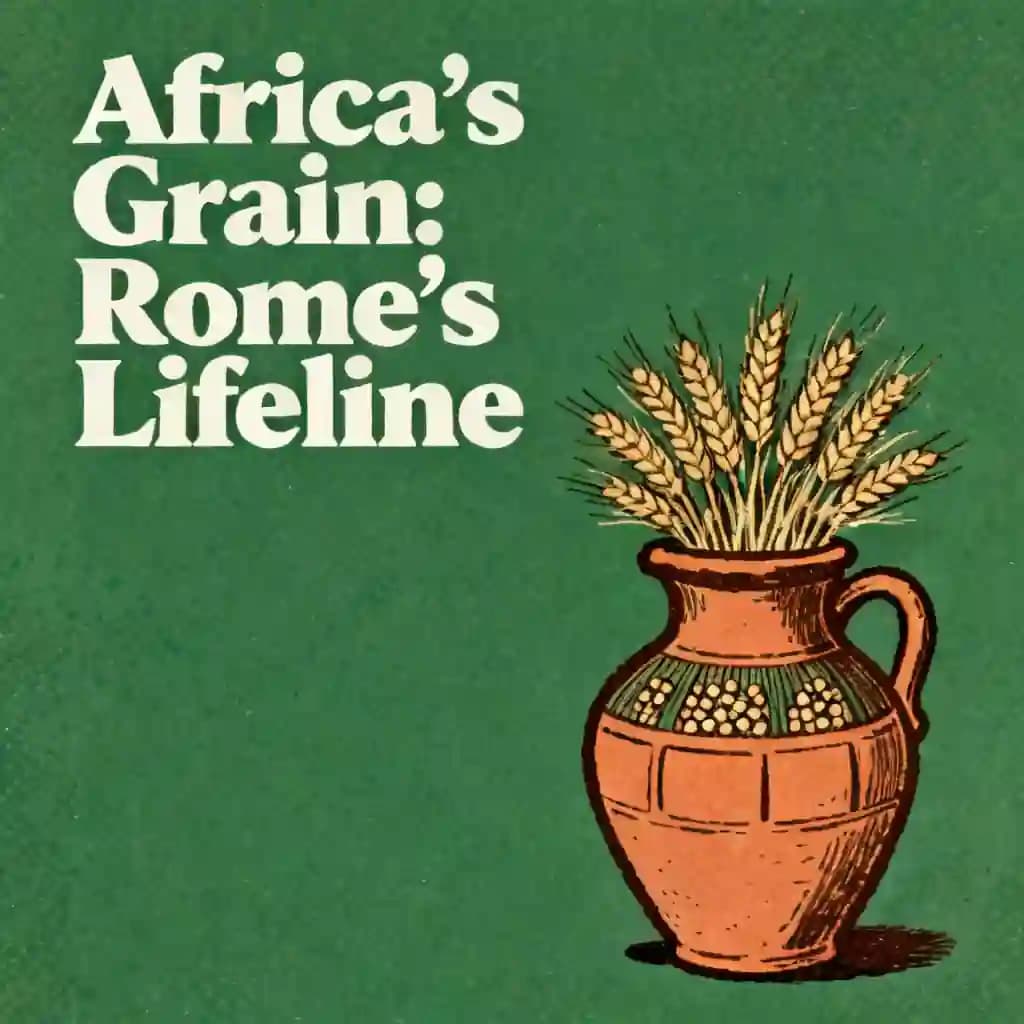
Rome couldn't survive without its African provinces. Discover how this 'granary' used engineering and trade to become the empire's economic backbone.
Best quote from Roman North Africa and the Secret to Feeding an Empire
“
North Africa was so productive it was called the 'granary of the empire,' providing enough grain to feed the people of Rome for eight months out of every single year. Without that soil, the heart of the empire would have literally gone hungry.
”
C
Generated by Cameron Smith
Input question
The Romans in north Africa
Host voices
Lena
Miles
Knowledge sources
Frequently Asked Questions
North Africa earned this title because of its immense agricultural productivity, specifically in cereal production. It is estimated that the region provided enough grain to feed the population of Rome for eight months out of every year, exporting approximately one million tons of cereal annually. In addition to wheat, the province was a massive producer of olive oil and served as a primary source of wealth and resources that sustained the heart of the Roman Empire.
The Romans transformed the landscape through visionary hydraulic engineering and sophisticated land management. They built massive infrastructure projects like the 132-kilometer Zaghouan aqueduct and large-scale cisterns to supply cities. In rural and semi-arid zones, they utilized dams, reservoirs, and underground tunnels called qanats to capture and transport winter rainwater. They also implemented terrace cultivation in mountainous regions to prevent erosion and maximize every drop of water, turning bone-dry areas into productive olive groves and wheat fields.
Social mobility was possible through the agricultural boom, as evidenced by personal stories like the "small peasant" of Mactaris. This individual started with nothing but through lifelong hard work in his fields, he eventually became a wealthy landowner and was summoned to the local Senate as a censor. This "Roman Dream" was supported by a unique class of "farming townspeople" who lived in urban centers for status and protection but worked the arable land just outside the city walls.
The Romans practiced a policy called interpretatio romana, where they blended local deities with Roman ones rather than erasing indigenous beliefs. For example, the Punic god Baal Hammon was identified with the Roman god Saturn, and the goddess Tanit became Juno Caelestis. This created a distinct "Roman African" identity where Latin was the language of law and administration, but Punic and Berber influences remained in language, art, and religion. This cultural melting pot eventually produced high-ranking Roman leaders, including the emperor Septimius Severus.
Despite the "Third-Century Crisis" and internal revolts, North Africa remained an economic "fiscal anchor" for the empire longer than many other provinces. In the fifth century, the Vandals invaded and seized Carthage, severing direct Roman administrative control. However, the Vandals largely maintained the existing Roman systems, including land taxes and grain levies, and continued to export goods like African Red Slip pottery. The agricultural and urban infrastructure was so deeply embedded that it persisted through Vandal and Byzantine rule, and even influenced the region long after the Arab conquests.
From Columbia University alumni | built in San Francisco
BeFreed Brings Together A Global Community Of Curious Minds
4.7
avg rating
7.84k+ App Rating
BeFreed Community
Seriously I haven’t even explored this app fully yet but from using it the last few days I am so impressed... BeFreed is on a different level from any other learning app I have used. This makes it ultra engaging and can actually improve your concentration which is great for all the doom scrollers!
@ladyInfinity
I bought BeFreed exactly 23 days ago, and I have used it every single day since. It has completely embedded itself into my daily workflow and learning habit.
@jayallen
The truth is, the app has exceeded all my expectations. I can ask it to generate audio on any topic, whatever it may be, and the result is impressive. My professional field is a specialization in psychotherapy and it is multidisciplinary; however, the answers are very accurate.
@Raguipa
What I appreciate most is how much it's reduced my scrolling – I'm spending less time searching and more time absorbing information. The combination of full audiobooks, podcasts, the learning plans are brilliant.
@colonyofcreatorsNGO
I have been a PhotoReading Accelerated Learning Instructor for the past 24 years... books and reading and learning are my thing, and BeFreed has done a great job in providing an innovative approach to disseminating and delivering information in an easy to consume way.
@BeFreed user
It is not just a book summary app, I have used the 'fun reading' option and it's a much better summary and way to grasp ideas the traditional way, that alone is worth this deal.
@austinakon
I love this app. Used it for several days and I cannot stop listening. Such a great way to start.
@jcrules328
I really like the program; I have already tested it for around one month, and I feel that it's an amazing gem. It works so well because I can use BeFreed to create my own topics, and the voice is so good with unlimited choice of narrations.
@DanielCZ
Seriously I haven’t even explored this app fully yet but from using it the last few days I am so impressed... BeFreed is on a different level from any other learning app I have used. This makes it ultra engaging and can actually improve your concentration which is great for all the doom scrollers!
@ladyInfinity
I bought BeFreed exactly 23 days ago, and I have used it every single day since. It has completely embedded itself into my daily workflow and learning habit.
@jayallen
The truth is, the app has exceeded all my expectations. I can ask it to generate audio on any topic, whatever it may be, and the result is impressive. My professional field is a specialization in psychotherapy and it is multidisciplinary; however, the answers are very accurate.
@Raguipa
What I appreciate most is how much it's reduced my scrolling – I'm spending less time searching and more time absorbing information. The combination of full audiobooks, podcasts, the learning plans are brilliant.
@colonyofcreatorsNGO
I have been a PhotoReading Accelerated Learning Instructor for the past 24 years... books and reading and learning are my thing, and BeFreed has done a great job in providing an innovative approach to disseminating and delivering information in an easy to consume way.
@BeFreed user
It is not just a book summary app, I have used the 'fun reading' option and it's a much better summary and way to grasp ideas the traditional way, that alone is worth this deal.
@austinakon
I love this app. Used it for several days and I cannot stop listening. Such a great way to start.
@jcrules328
I really like the program; I have already tested it for around one month, and I feel that it's an amazing gem. It works so well because I can use BeFreed to create my own topics, and the voice is so good with unlimited choice of narrations.
@DanielCZ
I love the fact that I can get useful, condensed, information and ideas in a 8 - 15 minute podcast style audio. I'm not a general fan of podcasts because of all the fluff, but this cuts through all that.
@BeFreed user
I am finishing up my doctorate, and have to read a lot of unfamiliar material... With BeFreed, you simply enter a prompt, and the app finds source material for you and generates an audio podcast. I find the process in BeFreed to be more streamlined than NotebookLM.
@Brad
I often search YouTube for something to listen to whilst making breakfast, when I'm out walking, commuting, etc, and BeFreed has provided an even more targeted approach, without the adverts and the fluff!
@BeFreed user
The absolute best part about this platform is its versatility. There is literally no subject that is off-topic. It handles whatever you throw at it... It is rare to find an learning tool with zero limitations that actually delivers on its promises.
@jayallen
BeFreed is fantastic. The user-friendly design means I spend less time navigating and more time learning. The mix of audiobooks, podcasts, and learning plans is a genius combo that has completely changed my daily routine.
@BeFreed user
At the start I needed a while to understand how to create podcasts in italian language and boom! It is so great! I can ask to explain every argument and it does so well and so smartly!
@matteo77
BeFreed has become my daily app for audio books tools... What I like the most is the way you put your text and come with an audio that you can listen on the go.
@kotanzu1
I love the fact that I can get useful, condensed, information and ideas in a 8 - 15 minute podcast style audio. I'm not a general fan of podcasts because of all the fluff, but this cuts through all that.
@BeFreed user
I am finishing up my doctorate, and have to read a lot of unfamiliar material... With BeFreed, you simply enter a prompt, and the app finds source material for you and generates an audio podcast. I find the process in BeFreed to be more streamlined than NotebookLM.
@Brad
I often search YouTube for something to listen to whilst making breakfast, when I'm out walking, commuting, etc, and BeFreed has provided an even more targeted approach, without the adverts and the fluff!
@BeFreed user
The absolute best part about this platform is its versatility. There is literally no subject that is off-topic. It handles whatever you throw at it... It is rare to find an learning tool with zero limitations that actually delivers on its promises.
@jayallen
BeFreed is fantastic. The user-friendly design means I spend less time navigating and more time learning. The mix of audiobooks, podcasts, and learning plans is a genius combo that has completely changed my daily routine.
@BeFreed user
At the start I needed a while to understand how to create podcasts in italian language and boom! It is so great! I can ask to explain every argument and it does so well and so smartly!
@matteo77
BeFreed has become my daily app for audio books tools... What I like the most is the way you put your text and come with an audio that you can listen on the go.
Explore how a tiny settlement grew into history's most influential empire, spanning three continents and 1,200 years. Discover why Roman innovations in military, politics, and society still shape our world today.
A comprehensive journey through Rome's evolution from humble beginnings to world domination, exploring the myths, revolutionary governance, military conquests, and lasting global influence of history's most enduring empire.
Explore Rome's thousand-year evolution from a small city-state to history's most influential empire, ruling 20% of the world's population across three continents without modern technology.
Discover how Roman innovations in law, government, architecture, and language still define Western civilization. From courthouses to credit cards, explore the empire's living legacy in your daily life.
Explore how a small Italian city-state became history's greatest empire, from Augustus's political genius to environmental collapse. Discover timeless lessons about power, leadership, and civilization's fragility.