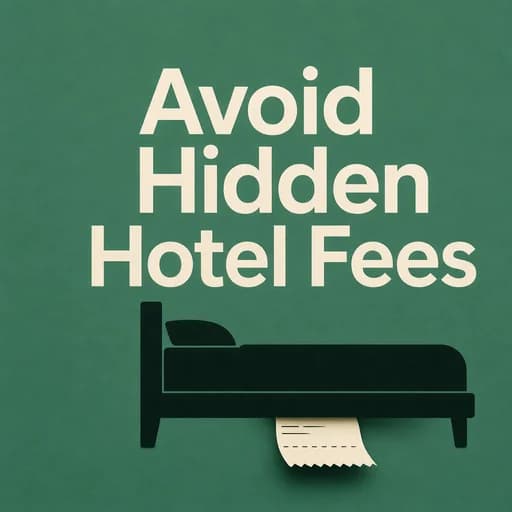
Tired of seeing room rates double at checkout? Learn how drip pricing works and get a practical playbook to opt out of sneaky surcharges.
Best quote from Hidden hotel fees and how to avoid them
“
The advertised price is really just the 'opening bid' in a much longer negotiation. It’s not just about what you pay; it’s about what you refuse to pay for.
”
J
Generated by Jacob
Input question
Hidden secrets that hotels used to make money and things to watch out for
Host voices
Eli
Nia
Knowledge sources
Frequently Asked Questions
Drip pricing is a psychological tactic where hotels reveal the true cost of a room incrementally rather than upfront. By stripping away mandatory fees in initial search results, hotels make their rates appear cheaper to prevent travelers from jumping to a competitor. These hidden costs, such as resort or destination fees, can sometimes inflate the advertised price by up to twenty-five percent, leading to significant "checkout shock" for the consumer.
The "Junk Fees Rule" is a regulatory shift finalized by the FTC that requires industries like hotels to disclose all mandatory fees upfront in the advertised price. While it does not cap the amount a hotel can charge for things like "facility fees" or "urban fees," it ensures transparency by showing the total cost at the start of the booking process. This rule is estimated to save consumers millions of hours previously spent trying to calculate the actual price of a room.
Hotels typically place a hold on a guest's card at check-in to cover potential costs like room service or damages, which can range from $50 to $200 per night. If a traveler uses a debit card, the bank treats this hold as a real transaction, effectively locking those funds and making them unavailable for 5 to 14 days after checkout. Using a credit card is the recommended "playbook move" because it only affects the credit limit without impacting the traveler's actual cash flow or daily spending money.
While these fees are often labeled as mandatory, guests can use a "Challenge Move" if the amenities covered by the fee—such as the pool, gym, or WiFi—are unavailable or if the guest already receives those perks through a loyalty program. Being a member of a hotel's free loyalty program or booking directly through their website is one of the most effective ways to get fees for WiFi or bottled water waived. Additionally, if a major amenity is under renovation, guests can politely argue that the hotel is not delivering the promised value and request a partial credit or waiver.
Modern minibars often use "sensor-activated" technology that registers a charge the moment an item is lifted for more than a few seconds, even if it is not consumed. To avoid these automated fees, guests can treat the minibar as a "museum exhibit" and avoid touching the items. If a guest needs a refrigerator for medical supplies or baby food, they should request a separate "medical fridge" or ask the staff to empty the minibar before arrival to prevent accidental sensor triggers.
From Columbia University alumni | built in San Francisco
BeFreed Brings Together A Global Community Of Curious Minds
4.7
avg rating
7.84k+ App Rating
BeFreed Community
Seriously I haven’t even explored this app fully yet but from using it the last few days I am so impressed... BeFreed is on a different level from any other learning app I have used. This makes it ultra engaging and can actually improve your concentration which is great for all the doom scrollers!
@ladyInfinity
I bought BeFreed exactly 23 days ago, and I have used it every single day since. It has completely embedded itself into my daily workflow and learning habit.
@jayallen
The truth is, the app has exceeded all my expectations. I can ask it to generate audio on any topic, whatever it may be, and the result is impressive. My professional field is a specialization in psychotherapy and it is multidisciplinary; however, the answers are very accurate.
@Raguipa
What I appreciate most is how much it's reduced my scrolling – I'm spending less time searching and more time absorbing information. The combination of full audiobooks, podcasts, the learning plans are brilliant.
@colonyofcreatorsNGO
I have been a PhotoReading Accelerated Learning Instructor for the past 24 years... books and reading and learning are my thing, and BeFreed has done a great job in providing an innovative approach to disseminating and delivering information in an easy to consume way.
@BeFreed user
It is not just a book summary app, I have used the 'fun reading' option and it's a much better summary and way to grasp ideas the traditional way, that alone is worth this deal.
@austinakon
I love this app. Used it for several days and I cannot stop listening. Such a great way to start.
@jcrules328
I really like the program; I have already tested it for around one month, and I feel that it's an amazing gem. It works so well because I can use BeFreed to create my own topics, and the voice is so good with unlimited choice of narrations.
@DanielCZ
Seriously I haven’t even explored this app fully yet but from using it the last few days I am so impressed... BeFreed is on a different level from any other learning app I have used. This makes it ultra engaging and can actually improve your concentration which is great for all the doom scrollers!
@ladyInfinity
I bought BeFreed exactly 23 days ago, and I have used it every single day since. It has completely embedded itself into my daily workflow and learning habit.
@jayallen
The truth is, the app has exceeded all my expectations. I can ask it to generate audio on any topic, whatever it may be, and the result is impressive. My professional field is a specialization in psychotherapy and it is multidisciplinary; however, the answers are very accurate.
@Raguipa
What I appreciate most is how much it's reduced my scrolling – I'm spending less time searching and more time absorbing information. The combination of full audiobooks, podcasts, the learning plans are brilliant.
@colonyofcreatorsNGO
I have been a PhotoReading Accelerated Learning Instructor for the past 24 years... books and reading and learning are my thing, and BeFreed has done a great job in providing an innovative approach to disseminating and delivering information in an easy to consume way.
@BeFreed user
It is not just a book summary app, I have used the 'fun reading' option and it's a much better summary and way to grasp ideas the traditional way, that alone is worth this deal.
@austinakon
I love this app. Used it for several days and I cannot stop listening. Such a great way to start.
@jcrules328
I really like the program; I have already tested it for around one month, and I feel that it's an amazing gem. It works so well because I can use BeFreed to create my own topics, and the voice is so good with unlimited choice of narrations.
@DanielCZ
I love the fact that I can get useful, condensed, information and ideas in a 8 - 15 minute podcast style audio. I'm not a general fan of podcasts because of all the fluff, but this cuts through all that.
@BeFreed user
I am finishing up my doctorate, and have to read a lot of unfamiliar material... With BeFreed, you simply enter a prompt, and the app finds source material for you and generates an audio podcast. I find the process in BeFreed to be more streamlined than NotebookLM.
@Brad
I often search YouTube for something to listen to whilst making breakfast, when I'm out walking, commuting, etc, and BeFreed has provided an even more targeted approach, without the adverts and the fluff!
@BeFreed user
The absolute best part about this platform is its versatility. There is literally no subject that is off-topic. It handles whatever you throw at it... It is rare to find an learning tool with zero limitations that actually delivers on its promises.
@jayallen
BeFreed is fantastic. The user-friendly design means I spend less time navigating and more time learning. The mix of audiobooks, podcasts, and learning plans is a genius combo that has completely changed my daily routine.
@BeFreed user
At the start I needed a while to understand how to create podcasts in italian language and boom! It is so great! I can ask to explain every argument and it does so well and so smartly!
@matteo77
BeFreed has become my daily app for audio books tools... What I like the most is the way you put your text and come with an audio that you can listen on the go.
@kotanzu1
I love the fact that I can get useful, condensed, information and ideas in a 8 - 15 minute podcast style audio. I'm not a general fan of podcasts because of all the fluff, but this cuts through all that.
@BeFreed user
I am finishing up my doctorate, and have to read a lot of unfamiliar material... With BeFreed, you simply enter a prompt, and the app finds source material for you and generates an audio podcast. I find the process in BeFreed to be more streamlined than NotebookLM.
@Brad
I often search YouTube for something to listen to whilst making breakfast, when I'm out walking, commuting, etc, and BeFreed has provided an even more targeted approach, without the adverts and the fluff!
@BeFreed user
The absolute best part about this platform is its versatility. There is literally no subject that is off-topic. It handles whatever you throw at it... It is rare to find an learning tool with zero limitations that actually delivers on its promises.
@jayallen
BeFreed is fantastic. The user-friendly design means I spend less time navigating and more time learning. The mix of audiobooks, podcasts, and learning plans is a genius combo that has completely changed my daily routine.
@BeFreed user
At the start I needed a while to understand how to create podcasts in italian language and boom! It is so great! I can ask to explain every argument and it does so well and so smartly!
@matteo77
BeFreed has become my daily app for audio books tools... What I like the most is the way you put your text and come with an audio that you can listen on the go.
Lena and Eli reveal game-changing strategies for STR success, from dynamic pricing algorithms to smart cost-cutting tactics that boost your bottom line without sacrificing guest experience.