Greene vs. Carnegie: The Power of Influence and Success Strategies
Explore the clash between Robert Greene and Dale Carnegie. Learn how to navigate professional relationships using power strategies and influence to achieve success.
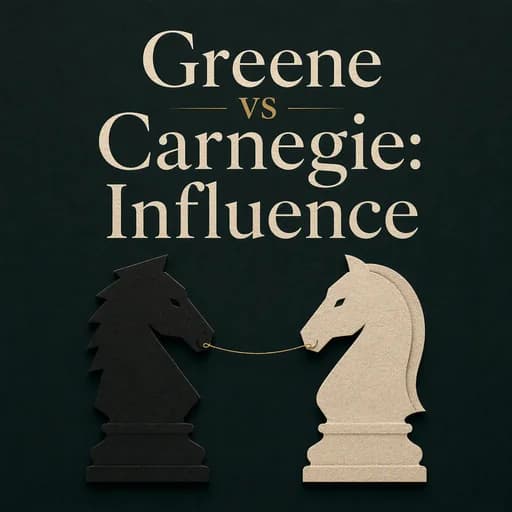
Best quote from Greene vs. Carnegie: The Power of Influence and Success Strategies
Success in the modern world doesn't go to the most moral person, and it doesn't necessarily go to the most ruthless person; it goes to the person who understands human psychology well enough to know when to use warmth and when to use power.
Generated by Kadafa🐾
A comparison of 'The 48 Laws of Power' by Robert Greene and 'How to Win Friends and Influence People' by Dale Carnegie, specifically focusing on the direct contradictions between Greene's power dynamics and Carnegie's relationship-building approach.






Frequently Asked Questions
The primary difference lies in their approach to professional relationships and influence. Dale Carnegie emphasizes bridge-building, making others feel important, and avoiding disagreement to preserve connections. In contrast, Robert Greene focuses on calculated realism and self-interest, warning that actions like outshining a superior can create enemies. This creates a fundamental friction between the desire to be liked and the necessity of maintaining power in a corporate environment.
This strategy warns against demonstrating superior intelligence or skills in a way that makes a superior feel insecure. According to Greene, correcting a boss's error in front of peers can lead to long-term career undermining due to the master's bruised ego. It is a law of self-interest that suggests protecting your position by managing how your competence is perceived by those in power to avoid making unnecessary enemies.
Dale Carnegie’s strategies focus on the power of influence through warmth and relationship preservation. His philosophy suggests that by making others feel important and avoiding direct conflict, you can build a supportive network. This approach is often seen as the 'Golden Rule' of professional life, prioritizing long-term rapport and likability over the immediate gratification of being right or appearing as the smartest person in the room.
Understanding the tension between these two philosophies is essential for anyone navigating a corporate ladder or building a business. Choosing between Carnegie’s bridge-building and Greene’s upper-hand strategy allows professionals to better navigate the gap between being liked and being powerful. By recognizing when to apply warmth and when to use calculated realism, individuals can more effectively manage the complex friction of professional success and self-interest.
From Columbia University alumni built in San Francisco
"Instead of endless scrolling, I just hit play on BeFreed. It saves me so much time."


"I never knew where to start with nonfiction—BeFreed’s book lists turned into podcasts gave me a clear path."


"Perfect balance between learning and entertainment. Finished ‘Thinking, Fast and Slow’ on my commute this week."
"Crazy how much I learned while walking the dog. BeFreed = small habits → big gains."
"Reading used to feel like a chore. Now it’s just part of my lifestyle."

"Feels effortless compared to reading. I’ve finished 6 books this month already."
"BeFreed turned my guilty doomscrolling into something that feels productive and inspiring."

"BeFreed turned my commute into learning time. 20-min podcasts are perfect for finishing books I never had time for."
"BeFreed replaced my podcast queue. Imagine Spotify for books — that’s it. 🙌"

"It is great for me to learn something from the book without reading it."
"The themed book list podcasts help me connect ideas across authors—like a guided audio journey."
"Makes me feel smarter every time before going to work"
 Ask ChatGPT
 Ask Claude
From Columbia University alumni built in San Francisco
"Instead of endless scrolling, I just hit play on BeFreed. It saves me so much time."
"I never knew where to start with nonfiction—BeFreed’s book lists turned into podcasts gave me a clear path."
"Perfect balance between learning and entertainment. Finished ‘Thinking, Fast and Slow’ on my commute this week."
"Crazy how much I learned while walking the dog. BeFreed = small habits → big gains."
"Reading used to feel like a chore. Now it’s just part of my lifestyle."
"Feels effortless compared to reading. I’ve finished 6 books this month already."
"BeFreed turned my guilty doomscrolling into something that feels productive and inspiring."
"BeFreed turned my commute into learning time. 20-min podcasts are perfect for finishing books I never had time for."
"BeFreed replaced my podcast queue. Imagine Spotify for books — that’s it. 🙌"
"It is great for me to learn something from the book without reading it."
"The themed book list podcasts help me connect ideas across authors—like a guided audio journey."
"Makes me feel smarter every time before going to work"
"Instead of endless scrolling, I just hit play on BeFreed. It saves me so much time."
"I never knew where to start with nonfiction—BeFreed’s book lists turned into podcasts gave me a clear path."
"Perfect balance between learning and entertainment. Finished ‘Thinking, Fast and Slow’ on my commute this week."
"Crazy how much I learned while walking the dog. BeFreed = small habits → big gains."
"Reading used to feel like a chore. Now it’s just part of my lifestyle."
"Feels effortless compared to reading. I’ve finished 6 books this month already."
"BeFreed turned my guilty doomscrolling into something that feels productive and inspiring."
"BeFreed turned my commute into learning time. 20-min podcasts are perfect for finishing books I never had time for."
"BeFreed replaced my podcast queue. Imagine Spotify for books — that’s it. 🙌"
"It is great for me to learn something from the book without reading it."
"The themed book list podcasts help me connect ideas across authors—like a guided audio journey."
"Makes me feel smarter every time before going to work"
"Instead of endless scrolling, I just hit play on BeFreed. It saves me so much time."
"I never knew where to start with nonfiction—BeFreed’s book lists turned into podcasts gave me a clear path."
"Perfect balance between learning and entertainment. Finished ‘Thinking, Fast and Slow’ on my commute this week."
"Crazy how much I learned while walking the dog. BeFreed = small habits → big gains."
"Reading used to feel like a chore. Now it’s just part of my lifestyle."
"Feels effortless compared to reading. I’ve finished 6 books this month already."
"BeFreed turned my guilty doomscrolling into something that feels productive and inspiring."
"BeFreed turned my commute into learning time. 20-min podcasts are perfect for finishing books I never had time for."
"BeFreed replaced my podcast queue. Imagine Spotify for books — that’s it. 🙌"
"It is great for me to learn something from the book without reading it."
"The themed book list podcasts help me connect ideas across authors—like a guided audio journey."
"Makes me feel smarter every time before going to work"