1장
The Essence of Hinduism in a Modern World
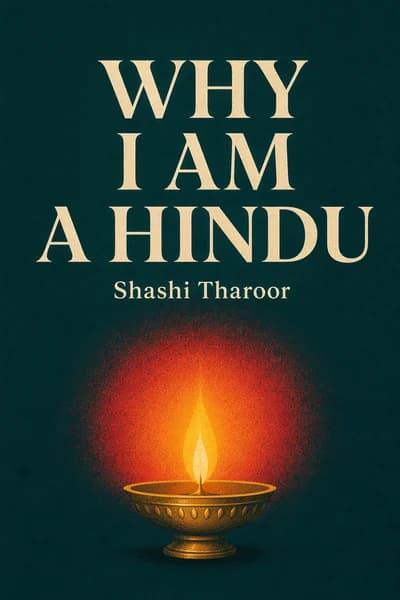
In an era where religious identity increasingly shapes political discourse, Shashi Tharoor's "Why I Am a Hindu" arrives as both personal testimony and scholarly defense. This remarkable exploration has resonated with readers worldwide, becoming a bestseller in India and garnering praise from religious scholars and cultural commentators alike. Tharoor, who has served as both UN Under-Secretary-General and Indian Minister of State for External Affairs, brings unique credentials to this work-a Harvard-educated intellectual with deep roots in Hindu tradition who can articulate the faith's complexities to global audiences. What makes this book particularly timely is how it reclaims Hinduism's pluralistic essence at a moment when religious nationalism threatens to narrow its interpretation. As the Dalai Lama noted after reading it, "This book reminds us how crucial it is to preserve the ancient wisdom traditions that teach tolerance, compassion and understanding."
2장
A Faith Without Fundamentals
I am Hindu because I was born one-the simplest and most common reason worldwide. Yet when media began discussing "Hindu fundamentalism" in the 1980s, the term struck me as contradictory. Hinduism lacks fundamentals-no founder, no church, no compulsory beliefs, no single sacred book. This is perhaps its most distinctive feature among major world religions.
The term "Hindu" itself originated as a foreign label for people living beyond the River Sindhu (Indus), not as a self-designation in any Indian language. It embraces an eclectic range of doctrines and practices without any binding requirements-not even belief in God. A Hindu can be astika (pious) or nastika (impious), following any philosophical school including materialistic ones like the Charvaka. This uniquely flexible faith allows each adherent to find their own truth through personal spiritual exploration.
Hinduism's remarkable intellectual freedom is captured in the beautiful Nasadiya Sukta from the Rig Veda, which questions whether even the Creator Himself knows the origins of creation: "Whence this creation has arisen-perhaps it formed itself, or perhaps it did not-the one who looks down on it, in the highest heaven, only He knows-or perhaps He does not know."
This civilization, rather than dogma, recognizes that different paths lead to the same divine truth. As Swami Vivekananda emphasized, Hinduism teaches not just tolerance but acceptance. The sage Yajnavalkya, when asked to count the gods, began with 3,300 and ultimately reduced them to one-Brahman, the cosmic spirit underlying all creation. This reflects the Rig Veda's wisdom: "That which exists is One; the sages call It by various names."
This philosophical openness makes Hinduism uniquely suited for our pluralistic world. Unlike faiths that anthropomorphize God, the Hindu concept is both simpler and more complex-God is everywhere, within and outside us, transcending time and space, without beginning or end, form or shape. The highest form is Brahman, the Absolute universal soul suffusing all creation.
3장
The Divine in Multiple Forms
To make the abstract concept of Brahman accessible, Hinduism offers saguna Brahman-the Absolute given form and attributes as Ishvara or Bhagavan. This manifests as the trinity of Brahma (Creator), Vishnu (Preserver), and Shiva (Destroyer), plus their avatars and companions.
Hindus often identify an ishta-devta (personal deity) representing their preferred connection with the divine. For me, that deity is Ganesh (or Ganapathi in South India). I begin each day with "Om maha Ganapathe namaha," invoking the elephant-headed god to bless my endeavors. His statues adorn my home and office in various forms and materials.
Ganesh is perhaps Hinduism's most popular divine figure, sought before any auspicious occasion as the remover of obstacles. The stories of how he acquired his elephant head vary-my grandmother told me Shiva beheaded him for guarding Parvati's door too zealously, while my mother claimed Shani's gaze reduced his original head to ashes.
What impresses me most about Ganesh is his devotion to duty-he even sacrificed his tusk when Parasurama threw Shiva's axe at him, refusing to dishonor his father's weapon by avoiding it. His symbolism is rich-his fat body represents the cosmos, the elephant-human combination signifies unity of microcosm and macrocosm, and his trunk forms the sacred "Om." His unusual mount-a rat-shows how the greatest and smallest creatures are equally important to the divine.
In Hindu life, gods are intimate presences. As a child in Bombay, I was captivated by the Ganesh Chaturthi festival, where millions parade elaborately decorated statues through the streets before immersing them in the sea. Though sad to see them disappear beneath the waves, I knew Ganesh remained with me-in calendars, on mantlepieces, in my books, and in my morning prayers.
4장
Seeing Life Whole
Hinduism embraces a comprehensive vision of human existence through structured yet flexible frameworks. Every Hindu life traditionally follows four stages (ashramas): brahmacharya (the student phase focused on learning and character development), grihastha (family life and societal responsibilities), vanaprastha (gradual withdrawal and contemplative retirement), and sannyas (complete renunciation and spiritual pursuit). These stages correspond to four fundamental aims of life (Purusharthas): dharma (moral code and righteous living), artha (material prosperity and economic welfare), kama (legitimate pleasures and emotional fulfillment), and moksha (ultimate salvation through self-realization).
This holistic approach acknowledges our multifaceted needs throughout life's journey. The pursuit of knowledge in youth prepares one for worldly success, while family life provides the context for emotional growth and social contribution. The later stages facilitate spiritual development without denying earlier experiences. These aspects intertwine throughout our lives, recognized in the ancient expression "mata, pita, guru, daivam" - our journey begins with total dependence on mother (representing unconditional love), exposure to the world through father (representing protection and guidance), wisdom from teachers (representing knowledge and discipline), and ultimately finding God (representing spiritual fulfillment).
Hinduism resembles a vast banyan tree, its spreading branches sinking back into earth to form new roots, creating an expansive canopy under which diverse thoughts and practices flourish. This openness manifests in the multiplicity of worship experiences - from elaborate temple pilgrimages across India's sacred geography to vibrant regional festivals. The Kumbh Mela draws millions to holy rivers, while local celebrations like Durga Puja in Bengal, Ganesh Chaturthi in Maharashtra, and Holi across North India reflect distinct cultural expressions. Some spiritual journeys demand extreme dedication, like the challenging trek to Amarnath's ice lingam in Kashmir or the circumambulation of Mount Kailash in Tibet, while others involve regular visits to neighborhood temples that become integral to daily life.
The remarkable variety extends beyond locations to practices themselves, reflecting Hinduism's adaptability to different communities and circumstances. On matters like vegetarianism and alcohol consumption, Hindus hold seemingly contradictory positions - some strictly abstain from meat while others participate in animal sacrifices at Kali temples; ancient texts reference deities consuming soma (an intoxicating ritual drink) while later traditions strictly prohibit Brahmins from drinking alcohol. Unlike more centralized faiths such as Christianity or Islam, Hinduism operates without standard universal practices, ecclesiastical hierarchies, or a single authoritative text, though the Bhagavad Gita has gained prominence as a widely respected philosophical guide in modern times. This decentralized structure allows for remarkable diversity while maintaining core philosophical principles.
5장
A Polycentric Faith
Hinduism's polycentric nature means it has no single structure of theological authority or liturgical power. With no center, there is no periphery-Sanatana Dharma is inherently inclusive. Unlike the Semitic (Abrahamic) faiths which believe in divine revelation and absolute truth, Sanatana Dharma engages believers in a permanent quest for truth through prayer, meditation, good conduct and experience. This fundamental difference manifests in the acceptance of multiple paths to spiritual enlightenment, from bhakti (devotional worship) to karma (action) to jnana (knowledge).
For Hindus, religious experience is deeply personal and experiential; self-realization varies between individuals as the Divine reveals itself within one's intimate perceptions. A Hindu may practice at several levels: the quotidian (temple rituals, social customs, festivals like Diwali and Holi), the spiritual (prayer, meditation, devotion, yoga practices), and the intellectual (philosophical study, scriptural analysis, theological discourse). Most practitioners never progress beyond the first stage of ritualistic observance, but even those who delve deeper into spiritual practices or philosophical inquiry understand that their quest won't end with a blinding revelation from a sacred text. Instead, it's viewed as a continuous journey of discovery and understanding.
Hinduism embraces multiple sacred texts rather than a single authoritative book, creating a rich tapestry of spiritual wisdom. These scriptures divide into Srutis (heard/revealed texts, including the four Vedas), Smritis (remembered texts like the Laws of Manu), Itihasas (historical epics like Ramayana and Mahabharata), Puranas (ancient stories), Agamas (temple-related texts), and Darshanas (philosophical treatises). The Darshanas represent six principal schools of Hindu philosophy: Nyaya, Vaisheshika, Samkhya, Yoga, Mimamsa, and Vedanta. The central philosophical debate in Hinduism exists between the dualistic Sankhya School (distinguishing spirit from matter) and the non-dualistic Vedanta School (seeing spirit and matter as one unified reality), though many other philosophical positions exist between these poles.
Unlike Abrahamic faiths, Hindus don't view their texts as embodying ultimate truth but as means for self-realization and spiritual growth. As Swami Vivekananda eloquently explained, Western religious books were "inspired" while Hindu texts were "expired"-breathed out from the hearts of realized sages who had direct experience of spiritual truths. This approach extends to other faiths' scriptures: Hindus evaluate religious texts by their practical utility in helping understand one's true self rather than their literal meaning or historical accuracy. This inclusive approach allows Hinduism to readily incorporate new interpretations and spiritual insights while maintaining its essential character, making it both ancient and eternally contemporary.
6장
Confronting Caste and Superstition
While many Hindu temples stand as architectural marvels and spiritual sanctuaries, not all traditional Hindu practices merit preservation in modern society. The caste system represents one of Hinduism's most problematic and persistent aspects, though many scholars and practitioners argue it has nothing to do with the religion's core teachings but rather emerged as a social construct that became intertwined with religious practice over centuries.
The author's personal journey with caste begins with a pivotal moment in his childhood when a schoolmate's seemingly innocent question about his caste identity disrupted his social innocence. Raised by nationalist parents who deliberately maintained silence on the subject as part of their progressive outlook, he had to seek answers about his Nair background from them. This enforced awareness marked the beginning of his complex relationship with caste identity - one that would evolve from childhood confusion to adult criticism. Despite this awakening, the author developed a pragmatic approach, viewing caste as an artificial construct that could be acknowledged or ignored based on circumstance.
While caste discrimination continues to plague Hindu society, particularly in rural areas and traditional settings, numerous religious leaders and reformers have consistently opposed it. Swami Vivekananda explicitly labeled it a social practice rather than a religious mandate. Hindu reformers across centuries, from Adi Shankara in the 8th century to Mahatma Gandhi in the 20th, actively worked to dismantle caste barriers. The ancient tale of Utanga serves as a powerful parable against caste prejudice - a sage who forfeited the gift of immortality by refusing water from Krishna himself, who had appeared disguised as an outcaste, demonstrating how spiritual truth transcends social hierarchies.
Another contentious aspect of contemporary Hinduism involves the widespread prevalence of superstitious practices and the burgeoning industry of self-proclaimed gurus. The Hindu tradition's deep-rooted respect for spiritual teachers stems from the Vedantic understanding that spiritual knowledge requires personal guidance. In Advaita Vedanta tradition, gurus hold an exalted position as "dispellers of darkness" (gu-darkness, ru-remover), serving as essential bridges between theoretical understanding and practical realization. A genuine guru's role extends beyond mere philosophical instruction (jnana) to facilitate direct spiritual experience (anubhava) through personal example and guidance.
However, this venerable tradition has increasingly faced corruption in modern times. The emergence of what critics call "the God Market" has seen the rise of numerous self-styled spiritual leaders who exploit devotees' faith for material gain. These modern godmen often combine simplified spiritual messages with promises of miraculous solutions to life's problems, building vast commercial empires through their followers' donations. This phenomenon has transcended traditional religious boundaries, attracting followers from various faiths and backgrounds, while some non-Hindu spiritual leaders have also gained significant Hindu followings, creating a complex landscape of contemporary spirituality that often prioritizes commercial success over genuine spiritual guidance.
7장
Great Souls Who Shaped Hinduism
Hinduism's development has been guided by remarkable individuals who reinvigorated the faith during challenging periods. The religion traces its roots to the Indus Valley civilization (3300-1500 BCE), with basic doctrines established around 3000 BCE (though many scholars suggest 1500 BCE), codified in the four Vedas composed between 1700-500 BCE.
As Vedic religion became increasingly ritualistic and hierarchical, new ideas emerged. Around 150 BCE, Patanjali compiled the Yoga Sutras, establishing classical yoga's eight-fold path for achieving self-realization. The Upanishads introduced sophisticated philosophical inquiry, while the Puranas integrated folk religions into the Vedic tradition.
Eventually, Hinduism became paralyzed by orthodoxy and sectarian conflicts, leading to reformist movements by Mahavira Jaina and Gautama Buddha. As mainstream Hinduism descended into esoteric disputes, Adi Shankara emerged to rejuvenate the divided religion. He taught that self-knowledge requires living an ethical life guided by principles like ahimsa (non-violence), satya (truthfulness), asteya (non-stealing), and aparigraha (non-possession)-ideas that would profoundly influence Mahatma Gandhi centuries later.
Though eventually eclipsed by Hinduism, both Buddhism and Jainism permanently transformed the religion they challenged. Buddhism introduced the concept of sannyasis (celibate monks) to Hinduism, previously unknown as Hindu priests were typically married householders. From Jainism, Hinduism adopted ahimsa as a fundamental principle and vegetarianism as a superior lifestyle.
Around 1000 CE, Hinduism faced a new challenge from Islamic invasions. Unlike Buddhism or Jainism, Islam directly challenged Hinduism's philosophical foundations and social structure. Hinduism responded through renewal: simplifying doctrines, adopting practices from Buddhism and Jainism, accommodating local deities, emphasizing accessible human-form gods, using arts to spread religious stories, promoting daily home worship, and developing bhakti devotion.
The Bhakti movement produced remarkable poet-saints whose works made Hindu philosophy accessible to common people across India. Mirabai's ecstatic devotion to Krishna was so complete that legend claims when her disapproving husband tried to poison her, it turned to honey. Her hymns express complete abandonment to divine love: "Tying anklets upon her feet, Mira dances in ecstasy...People say Mira has gone mad."
By offering accessible spirituality regardless of social position, Bhakti revitalized ancient Vedic traditions. It moved Hinduism away from formal rituals and abstract philosophy toward communal religious expression through shared services, collective bhajan-singing, emotional devotion, and festivals. Most of what we consider popular Hinduism today traces back to the Bhakti movement.
8장
The Rise of Hindutva
In recent decades, a political interpretation of Hinduism called Hindutva has gained prominence. The Bharatiya Janata Party adopted Hindutva as its defining credo in 1989, a doctrine promoted by the Rashtriya Swayamsevak Sangh (RSS) and affiliated organizations. Vinayak Damodar Savarkar (1883-1966) is credited with inventing this concept in his seminal work "Essentials Of Hindutva" (1923).
Savarkar defined Hindutva as the "quality of being a Hindu" in ethnic, cultural and political terms. A Hindu, according to him, considers India his motherland (matrbhumi), ancestral land (pitrbhumi), and holy land (punya bhumi). While Sikhism, Buddhism and Jainism qualified as variants of Hinduism under these criteria, Islam and Christianity did not. Savarkar distinguished Hindutva from Hinduism, arguing that the religion was merely "a derivative, a fraction" of the broader political concept of Hindutva.
M.S. Golwalkar, who succeeded RSS founder K.B. Hedgewar, articulated a vision for minorities in India that was uncompromising. He declared that non-Hindus had only two options: either "merge themselves in the national race and adopt its culture" or "live at its mercy" and "quit the country at the sweet will of the national race." He demanded minorities adopt Hindu culture and language, respect Hindu religion, and lose their separate existence-or remain "wholly subordinated to the Hindu Nation, claiming nothing, deserving no privileges, far less any preferential treatment-not even citizen's rights."
The Hindutva vision for constitutional reform reveals a fundamental transformation of India's governing principles. It would reject Western concepts like human rights and secularism, arguing rights must be balanced with duties, and secularism should be eliminated as "completely irrelevant in the Indian context" since it implies "opposition of Hindus and appeasement of Muslims."
This Hindutva approach fundamentally differs from traditional Hinduism. Where Hinduism is inward-directed toward Self-Realization, Hindutva is outward-directed toward political identity. It reduces Hinduism to "a badge of allegiance rather than a way of relating to the cosmos."
9장
The Politics of Division
The Hindutva project attempts to conflate religion, culture, nation and state, insisting that India's national culture must be Hindu religious culture. This approach rejects the inclusive Hinduism of thinkers like Vivekananda and Gandhi in favor of a cultural project that seeks to "nationalise and spiritualise" by glorifying a "golden Hindu past" while purging external influences.
Even scientific discourse has been corrupted, with government ministers making absurd claims about "Vedic aviation" or rejecting Darwin's theory of evolution. This approach diverts attention from India's real challenges of poverty, development and justice, replacing the country's rich tapestry of beliefs with a dogmatic uniformity that leaves no room for difference or heterodoxy.
The Hindutva view of history deliberately omits tolerant rulers like Ashoka, Akbar, and Jai Singh from its pantheon of heroes, while Muslim freedom fighters against the British are conspicuously absent. Meanwhile, textbooks in Maharashtra and Rajasthan have been revised to glorify Hindu rulers while eliminating mentions of Muslim rulers.
The Hindutva project seeks not only to rewrite history but to purge Hinduism of its "accretions"-particularly its celebrated acceptance of difference and diversity. Unlike the Nehruvian version of Indian nationalism that embraced diversity, Hindutva actively rejects different interpretations of Hinduism. This manifests in campaigns against heterodox interpretations of Hinduism, ironically in the name of a faith with no concept of heresy.
The cow protection movement exemplifies how religious sentiment can be weaponized for political purposes. While acknowledging the widespread veneration of cows in India, it's worth noting that the Constitution's Article 48 addresses cow protection as an economic matter related to agriculture, not religion. Mahatma Gandhi, despite being personally opposed to cow slaughter, refused to impose Hindu views on those of different faiths.
10장
Taking Back Hinduism
As a believing Hindu, I feel shame at what Hindutva followers do in the name of my faith. Hinduism has historically been characterized by "astonishing breadth" and acceptance of all ways of worshipping God as equally valid-the only major religion that doesn't claim exclusive truth. How dare a bunch of thugs reduce the "soaring majesty of the Vedas and Upanishads" to petty bigotry and identity politics?
Authentic Hinduism contrasts sharply with the violent Hindutva that destroyed the Babri Masjid. Swami Vivekananda's vision that Hinduism stands for "both tolerance and universal acceptance" represents the Hinduism practiced by most Hindus, whose acceptance of other faiths has been a vital cultural hallmark.
Hindutva is fundamentally rooted in insecurity rather than self-confidence, imprisoned in narratives of victimhood, humiliation, and defeat. American Hindutva advocate David Frawley admits that Hindus suffer from "lack of self-esteem and an inferiority complex" after centuries of foreign rule. But India's essence lies in rejecting the idea that religion should determine nationhood-"We are not going to reduce ourselves to a Hindu Pakistan."
Hinduism functions as a shared cultural framework beyond religious boundaries. Hindu festivals like Holi, Diwali and Onam have transcended religious origins to become secular celebrations embraced by Indians of all faiths. Similarly, epics like the Ramayana and Mahabharata provide a "common idiom" for all Indians-exemplified by Muslim writer Dr. Rahi Masoom Raza scripting the televised Mahabharata series.
India must return to the pluralism of its national movement rather than privileging a doctrinaire version of Hinduism. The true common enemy lies in "forces of sectarian division" that would transform the country into something "most self-respecting Hindus would refuse to recognize."
11장
A Religion for the 21st Century
Hinduism possesses the qualities of a universal religion for the 21st century: it's personal, grants individual freedom to find meaning, offers wide choice in practice, values intellectual inquiry, and avoids dogma. In a world resisting authority, Hinduism imposes none; in an era of networked individuals, it proposes no hierarchies; amid open-source information, it accepts all paths as valid; in times of rapid change, it remains adaptable.
Professor Clement Webb observed in 1926 that Hinduism could easily develop into a universal religion. Dr. Karan Singh identified five principles giving Hinduism contemporary relevance: recognition of mankind's unity, harmony of religions, inherent divinity in each person, synthesis of action and contemplation, and a cosmic philosophical vision.
Vivekananda envisioned a universal religion without boundaries of place or time, embracing all faiths without persecution or intolerance. Hinduism offers an example others may follow, needing revival in its liberal, open form in India. As the Upanishads pray: "Lead me from Untruth to Truth, from darkness to light, from death to immortality."
In our fractured world, where religious identities increasingly fuel conflict rather than compassion, Hinduism's inherent pluralism offers a powerful alternative-not as a competing dogma, but as a framework for embracing difference. The faith that gave the world the concept that "Truth is One, though the wise call it by many names" may yet have its greatest contribution to make in our polarized century, not through political dominance but through philosophical generosity. The challenge for modern Hindus is to reclaim this heritage from those who would narrow it, and to share its wisdom with a world desperately in need of its tolerance.