1장
When Two Worlds Collide: The Story History Forgot to Tell
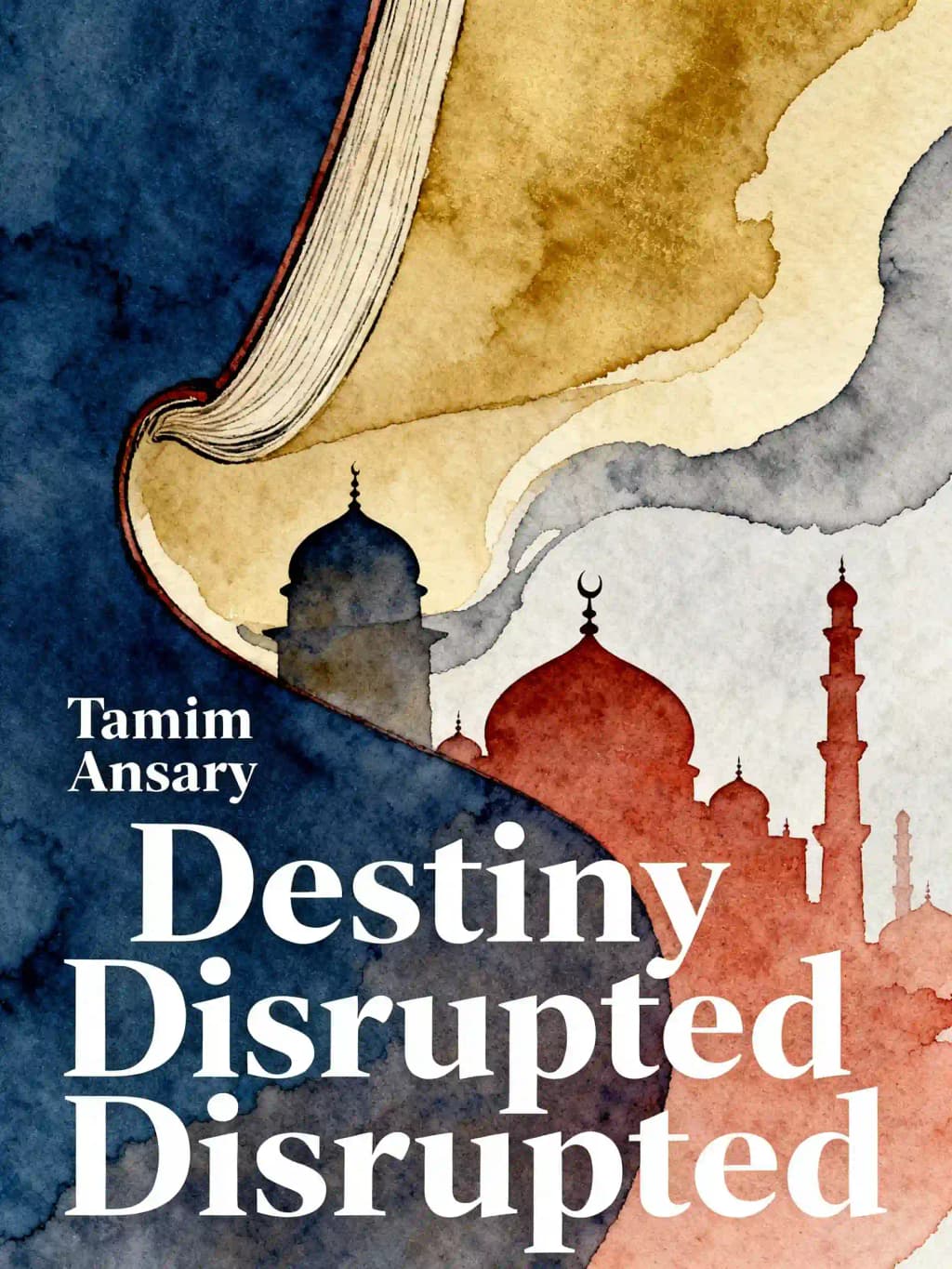
Have you ever wondered why the Middle East seems to be in perpetual conflict with the West? Why, despite decades of intervention, the region remains volatile? The answer lies not in policy failures or cultural incompatibilities, but in something far more fundamental: we've been reading different history books. In his groundbreaking work "Destiny Disrupted," Tamim Ansary reveals a stunning revelation-there exists an entirely separate historical narrative that has shaped the worldview of nearly two billion Muslims. This isn't just another perspective on the same events; it's an entirely different story with its own beginning, middle, and end. Ansary's book has become required reading in diplomatic circles and intelligence agencies precisely because it illuminates what Western education has missed-that to understand today's geopolitical landscape, we must first acknowledge there are two distinct narratives of world history running in parallel. As historian Bernard Lewis noted, Ansary accomplishes what few Western authors have managed: presenting Islamic history through the eyes of those who lived it, rather than through a Western interpretive lens.
2장
The Middle World: Cradle of Islamic Civilization
Long before Islam emerged, two distinct civilizational spheres had formed between the Atlantic Ocean and the Bay of Bengal. The Mediterranean world, connected by sea routes, would become the center of Western civilization. The Middle World-stretching across India, Central Asia, Iran, Mesopotamia, and Egypt-was defined by land routes and would eventually become the Islamic world. These two worlds occasionally overlapped in what is now Israel, Lebanon, Syria, and Jordan, creating a contested zone that remains a flashpoint today.
The Middle World's history predates Islam by millennia. The Parthians, who ruled from the third century BCE to the third century CE, protected trade within their borders and maintained cities where merchants from across Asia and Europe converged. Their bazaars buzzed with news from all quarters-Greco-Buddhist kingdoms, Hindus, Chinese, Greeks, and Armenians. Despite frequent conflicts with Rome, cultural exchange between the Mediterranean and Middle worlds remained limited, preserving their distinct identities.
The Parthians were eventually overthrown by the Sassanids, who made Zoroastrianism the state religion while maintaining Persian cultural identity. Meanwhile, the Roman Empire fragmented, with its eastern portion continuing as the Byzantine Empire from Constantinople. By the mid-sixth century, the Byzantine and Sassanid empires had become the region's superpowers, with disputed territories between them along the Mediterranean shore. To the south lay the Arabian Peninsula with its autonomous tribes-the setting where Islam would soon emerge.
This geographical and cultural division helps explain why the Islamic world developed its own historical consciousness separate from the West. The Middle World wasn't just another region-it was an entire civilizational sphere with its own networks of commerce, communication, and cultural exchange. When Islam emerged in the seventh century, it didn't create this world; rather, it unified and transformed an existing civilizational sphere that had already been distinct from the Mediterranean world for centuries.
3장
The Birth of a New Narrative: Mohammed and the Hijra
In the early seventh century, a merchant named Mohammed began receiving revelations in Mecca that would transform the Middle World forever. His message wasn't simply promoting monotheism over polytheism; he preached about an all-encompassing, universal God beyond any particular image or attributes. This radical message threatened Mecca's business leaders who profited from religious tourism centered around the Kaaba, a shrine housing hundreds of tribal deities.
Despite gaining influential followers like Abu Bakr, Othman, and eventually Omar, Mohammed faced growing opposition. When his protective uncle Abu Talib and his wife Khadija died in the same year, seven Quraysh elders plotted to kill him. Mohammed escaped to Yathrib (later renamed Medina), where he had been invited to serve as an arbiter among quarreling tribes.
In Medina, Mohammed established the Pact of Medina, a covenant guaranteeing each tribe religious freedom while creating a unified defense agreement. This migration, known as the Hijra, became year zero in the Islamic calendar-marking not the birth or enlightenment of Islam's founder, but the birth of the Muslim community (Umma) as a social and political entity. This distinction is crucial for understanding Islamic history: unlike other religions that commemorate their founder's spiritual achievements, Islam marks this political-social transformation as its pivotal moment.
In Medina, Islam evolved from individual spiritual practice to a comprehensive social project. The Quranic revelations shifted from primarily spiritual themes to include detailed legislation on everything from personal hygiene to criminal justice. Mohammed provided guidance on all aspects of community life, establishing a model that would shape Islamic civilization for centuries to come.
Tensions with Mecca continued, leading to several battles. At Badr, 300 Muslims defeated 1,000 Meccans-a victory Mohammed attributed to divine favor. However, at Uhud, Muslims disobeyed Mohammed's orders and suffered defeat. Mohammed explained this loss as Allah's lesson that divine support must be earned through righteous behavior and submission to God's will-an explanation Muslims would invoke repeatedly throughout history to understand later defeats.
What's remarkable about early Islamic history is how thoroughly it was documented. Unlike older religions, Muslims began collecting and preserving their history immediately, embedding each anecdote in a nest of sources with chains of transmission. These weren't parables but accounts of real people wrestling with practical issues in actual history-a foundation for an entire civilization's self-understanding.
4장
The Rightly Guided Ones: Shaping Islamic Governance
The story of Islam continues beyond Mohammed's death through the era of his first four successors, known as the Rashidun ("the rightly guided ones"): Abu Bakr, Omar, Othman, and Ali. This forty-year period forms Islam's core religious allegory, comparable to Christianity's crucifixion and resurrection narratives.
When Mohammed died, the community faced not just a leadership vacuum but an existential question: what form should that leadership take? The leader needed to be more than a king but couldn't be another prophet. Abu Bakr emerged as the solution when he crashed a meeting of Medinans who were planning to elect their own leader. After Omar dramatically pledged allegiance to Abu Bakr, he was unanimously chosen as khalifa ("deputy")-a title that hadn't existed before.
This succession wasn't without controversy. Ali, Mohammed's cousin who had grown up in his household, was washing the Prophet's body during the meeting and wasn't consulted. His supporters (who would become the Shi'i sect) believed him the rightful successor, and some accounts claim it took six months for Ali to concede the election.
As khalifa, Abu Bakr quickly faced the Apostate Wars when tribes across Arabia seceded from the alliance. He established the principle that while accepting Islam was voluntary, leaving it constituted treason-defining Islam as a single, indissoluble community.
Omar, the second khalifa, transformed from a feared, temperamental warrior to a legendary leader who shaped Islamic theology, political ideology, and civilization. During his ten-year rule, he built an empire larger than Rome while embodying humility-patching his own clothes and personally delivering food to the needy. He formalized Islam's world-changing mission by establishing a new calendar beginning with the Hijra, confirming that Islam wasn't just about individual salvation but about transforming society.
Othman, the third khalifa, oversaw the transition from spiritual movement to government administration. His major achievement was creating a definitive edition of the Qur'an, destroying all competing versions to ensure uniformity. However, his policies disproportionately benefited his own Umayyad clan, and discontent grew throughout the empire. When Egyptian petitioners discovered what appeared to be Othman's order to execute them, they returned to Medina in fury and killed the elderly khalifa as he read his Qur'an.
Ali, the fourth khalifa, inherited an unraveling community. He decided to attack the corruption rotting the empire, but the nouveau riche who had emerged from Muslim conquests saw him as a revolutionary threat. Civil war erupted, and Ali was eventually assassinated by a Kharijite extremist, ending the era of the Rightly Guided Khalifas.
This period established precedents for Islamic governance that would be debated for centuries. Was leadership to be determined by election, consensus, or bloodline? Should rulers prioritize religious purity or practical governance? These questions would drive the first major schism in Islam between Sunni and Shi'i interpretations of legitimate authority.
5장
Empire and Schism: The Umayyad Transformation
Mu'awiya, who had opposed Ali, presented himself as continuing the religious mission of his predecessors, but his actions revealed the shift to dynastic rule. Near the end of his life, he forced the succession of his son Yazid, making it brutally clear that the principle of consultative leadership would never again be truly discussed.
When Yazid took power, Hussein-Ali's son and Mohammed's grandson-finally took action against what he saw as the corruption of his grandfather's legacy. With just seventy-two followers, including women, children, and elderly relatives, Hussein left Medina to challenge the emperor. This wasn't military strategy but ritual sacrifice; Hussein saw himself embarking on a pilgrimage of noble suicide to stand against tyranny.
At Karbala in the Iraqi desert, Yazid's army trapped Hussein's band, cutting them off from water. One by one his warriors fell in battle while women, children, and elders died of thirst. After everyone perished, the general cut off Hussein's head and sent it to Yazid. Rather than crushing Ali's cause, Hussein's martyrdom at Karbala ignited Shi'ism as a powerful movement. His sacrifice became a redemptive act; believing in Hussein offered salvation regardless of one's sins.
The Umayyads may have ended Islam's religious evolution, but they launched its civilization and empire. Under their rule, garrison cities evolved into bustling commercial centers as the empire hummed with handicrafts and intricate trade networks. Despite being worldly rulers, the Umayyads nurtured Islamic religious institutions. They supported scholars, built mosques, and enforced laws allowing Islamic life to flourish.
The Umayyads declared Arabic the official government language, replacing Persian, Greek, and local languages. This period saw both Arabization and Islamification across the empire. Conversion to Islam was simple-just recite "There is no god but God and Mohammed is his messenger"-yet this simple declaration carried profound commitments to Islamic practices and beliefs.
While mainstream Western histories praise the stability the Umayyads brought, it came at a cost: the rich got richer, the poor increased in numbers, and magnificent cities arose alongside vast slums. Justice became a commodity only the wealthy could afford, and social stratification contradicted Islam's promise of equality, especially for non-Arab converts like Persians. This contradiction, along with memories of the founders' simple lifestyle, fueled growing discontent that would eventually threaten Umayyad rule.
6장
The Golden Age: Abbasids and the Flourishing of Islamic Civilization
The Abbasid revolution that overthrew the Umayyads began in the distant eastern provinces, led by a mysterious revolutionary calling himself Abu Muslim. Working for a secretive group claiming descent from the Prophet's uncle, he promoted an apocalyptic narrative promising to restore the Prophet's family to power. By 750 CE, his black-clad warriors defeated the white-uniformed Umayyad forces, and Abbas took power.
Despite Abbasid propaganda claiming revolutionary change, the new dynasty largely intensified existing Umayyad patterns. They embraced even greater luxury and pomp, presided over an explosive economic expansion, and used spies and military force to maintain control. Though they had risen to power on Shi'ite discontent, the Abbasids quickly embraced orthodox Islam, finding it politically expedient to ally with the powerful religious establishment.
Yet the Abbasids also maximized everything positive about Umayyad governance. Their first centuries marked what Western history remembers as Islam's Golden Age. Al-Mansur built Baghdad as his new capital, completed in 765 CE. The perfectly circular "Round City" soon became the world's first city with over a million inhabitants. Baghdad's strategic location between the Tigris and Euphrates rivers made it a commercial powerhouse, with ships and caravans bringing goods from China, India, Africa, and Spain.
Commerce was meticulously regulated, with every nationality and business type assigned its own neighborhood. The Street of Stationers featured over a hundred shops selling paper, a Chinese invention acquired after defeating China in 751 CE. According to Ya'qubi, an Arab geographer, Baghdad boasted six thousand streets, thirty thousand mosques, and ten thousand bathhouses.
This was the glittering city of turrets and tiles immortalized in the Arabian Nights, with stories like Aladdin set during the reign of the fourth and most famous Abbasid khalifa, Haroun al-Rashid. While legends portray him as a benevolent ruler disguising himself to learn of his subjects' troubles firsthand, in reality it was likely his spies who moved among the people seeking malcontents to neutralize.
The Abbasid khalifas became near-mythic figures, insulated from reality by elaborate court rituals borrowed from Byzantine and Sassanid traditions. Though Islam had conquered the territories of these earlier empires, their ghosts ultimately infiltrated and altered Islam itself, transforming the simple, egalitarian community of the Prophet's time into an imperial civilization with distinct social hierarchies.
7장
The Battle for Islam's Soul: Scholars, Philosophers, and Sufis
After Mohammed's death, Muslims faced the challenge of codifying Islamic doctrine without the Prophet's direct guidance. Since the Qur'an often required interpretation, Muslims established authoritative understandings through hadith - collections of Mohammed's sayings and actions. Six hadith collections achieved canonical status, forming a second level of authority alongside the Qur'an.
When these sources proved insufficient, scholars versed in Qur'an and hadith made rulings that formed the shari'a - the complete Muslim way of life. This crystallized into four Sunni schools and a Shi'i version. The ulama (scholars) who mastered this knowledge gained significant social power, controlling education, courts, and institutions.
Alongside the ulama, Muslim philosophers emerged who integrated philosophical traditions with Islamic revelations. Their pursuit of understanding reality's nature led to advances in sciences like botany, optics, and medicine. The Mu'tazilite school, emphasizing Allah's absolute unity (tawhid), argued that good and evil were discoverable through reason independently of revelation.
Though the Mu'tazilites initially gained court favor, traditionalists like Ahmed Ibn Hanbal successfully opposed them, insisting only revelation could determine right and wrong. This shift ultimately constrained Muslim intellectual inquiry by placing reason below revelation.
As Islamic law became more codified, Sufi mystics sought direct, transformative experiences of Allah through spiritual practices. The tension between orthodox scholars and mystics peaked with al-Hallaj's execution for his ecstatic declarations about unity with God.
By the mid-eleventh century, three intellectual movements competed: scholar-theologians developing doctrine, philosopher-scientists studying natural patterns, and Sufi mystics pursuing divine union. Al-Ghazali eventually reconciled orthodoxy with mysticism while marginalizing philosophical inquiry. His work also codified restrictive gender roles, contrasting with women's earlier public roles in Islamic society.
8장
Catastrophe and Rebirth: The Mongol Holocaust and Islamic Revival
What gave rise to the anxiety of Ghazali's time was the political fragmentation unfolding alongside intellectual movements. The khalifate began cracking before reaching its height, with competing centers of power emerging in Spain under the Umayyads and in Egypt under the Fatimids. By the 10th century, Islam had fragmented into three competing khalifates, each claiming to be the one true authority.
The Abbasids had the most territory initially, but their very size became their weakness. Like Rome, they grew too large to administer effectively, developing a vast bureaucracy that distanced the khalifa from his subjects. The empire was further weakened by the rise of Turkish mamluks-elite slave soldiers who eventually became powerful enough to control the khalifas themselves.
As the empire decayed, barbarian Turks penetrated the northern borders in growing numbers, bringing ruin to cities and making highways unsafe. The Seljuk Turks eventually defeated the Ghaznavids in 1040, marking the beginning of a new era. Under leaders like Alp Arslan and his brilliant Persian secretary Nizam al-Mulk, the Seljuks pushed westward, crushing the Byzantine army at Manzikert in 1071-a seminal battle that would have far-reaching consequences.
Nizam al-Mulk's grand vision was to create a stable Islamic society woven from three ethnic strands: Turks providing military strength, Arabs contributing religious doctrine, and Persians supplying administration, arts, and sciences. He established a network of madrassas with standardized Sunni curriculum to educate future officials.
This tripartite ruling class-Turkish sultan and army, Arab khalifa and ulama, Persian bureaucracy and intellectuals-would maintain order so farmers and merchants could generate wealth, providing taxes to fund armies in a virtuous cycle. However, this vision was threatened by Hassan Sabbah's Assassins cult, whose agents carried out public killings with no attempt to escape, functioning as suicide knifers to create terror through spectacle.
By 1095 CE, the Muslim world faced catastrophes from both east and west. The Crusaders arrived from Europe, exploiting Muslim disunity to establish four Crusader states. What finally turned the tide was a series of Muslim leaders culminating in Saladin, who recaptured Jerusalem in 1187 and became renowned for his compassion and justice.
Far more devastating was the Mongol invasion beginning in 1218 CE. Cities like Bokhara, Balkh, Herat, and Naishapur were completely destroyed. The Mongols employed sophisticated siege machinery, destroyed irrigation systems, burned fields, and deliberately spread terror. Hulagu Khan sacked Baghdad in 1258, killing hundreds of thousands and obliterating centuries of Islamic civilization. Only Egypt's Mamluk forces managed to defeat the Mongols at Ayn Jalut in 1260.
The Mongol conquests created a theological crisis for Muslims who had long seen military success as proof of Islam's truth. The Syrian jurist Ibn Taymiyah developed influential responses: Muslims had grown weak because they had abandoned "true" Islam; jihad was a core obligation requiring active struggle; and jihad was valid against not just non-Muslims but heretics within Islam. His ideas eventually resurfaced as Salafism, advocating return to the ways of the "pious originals" (al-salaf al-salihin).
From the ashes of these catastrophes emerged three great Muslim empires that would dominate the world stage for centuries: the Ottoman Empire in Turkey and the Middle East, the Safavid Empire in Persia, and the Moghul Empire in India. Each developed distinctive cultural expressions while maintaining core Islamic principles, creating a coherent civilization stretching from Indonesia to Morocco.
9장
When Worlds Collide: Europe's Rise and Islamic Response
After the last Crusaders fled the Islamic world in 1291, residual effects persisted throughout Europe. The crusading spirit evolved into exploration as Europeans developed a growing appetite for eastern trade goods but found themselves blocked by Muslim-controlled territories. European seafarers began seeking sea routes to circumvent these barriers, eventually leading to Columbus's voyage in 1492 and the Portuguese discovery of a sea route to India in 1498.
While Europeans sought new sea routes, Muslims had already established trade networks in Malaysia and Indonesia for centuries. Southern Europeans, particularly Italians, were asserting their maritime power, with Venetian and Genoese fleets dominating Mediterranean trade. This Mediterranean trade generated tremendous wealth for Italian city-states, creating the conditions for the Renaissance.
As wealth accumulated in Europe, books returned to prominence. The intellectual revival began when Christian scholars discovered Arabic translations of Greek texts in Muslim Andalusia. Though they stripped away Muslim commentaries by philosophers like Ibn Sina and Ibn Rushd, these works sparked the scholastic philosophies that would transform European thought.
The rediscovery of Greek thought introduced humanistic ideas that challenged the Church's otherworldly focus. The Protestant Reformation empowered individuals within Christianity, inadvertently sanctioning independent thinking on all subjects. This intellectual liberation cross-fertilized with rediscovered ancient Greek thought and Arab influences, allowing thinkers to separate scientific inquiry from religious frameworks.
This separation enabled a scientific revolution: Copernicus proposed heliocentrism; Bacon and Descartes established the scientific method; Galileo and others developed atomic theory; Vesalius mapped human anatomy; Harvey discovered blood circulation; Leeuwenhoek found microorganisms; Boyle formulated thermodynamic laws; and Newton revolutionized physics and mathematics.
Ironically, Muslim scientists had approached these same discoveries centuries earlier-al-Razi refuted Galen's four humors; Ibn Sina analyzed motion mathematically; Ibn al-Nafis described blood circulation; and Ibn al-Haytham discovered the spectrum and established the scientific method. The crucial difference was timing: Muslim discoveries occurred as their social order crumbled, while Western discoveries coincided with social recovery and religious reformation.
The Protestant Reformation intertwined with another momentous development: the emergence of nation-states. When reformers defied the Church, they sought protection from European monarchs. The Peace of Augsburg (1555) established the principle that each monarch could determine his state's religion, dismantling Europe's unified religious ideology in favor of a system where church and state reinforced nationalism.
Nation-states created coherent governments where everyone spoke roughly the same language and followed a single administrative system. This new political form would prove formidable when Europeans later encountered the looser imperial structures of the East-"nation-states, hard and sharp as knives, cutting into empires, loose and soft as bread."
By 1600, these developments peaked simultaneously: Europeans had become master mariners, were organizing as compact nation-states, were rethinking the world scientifically, possessed American gold, and were energized by protocapitalist entrepreneurs armed with a new individualist ethos.
Remarkably, this European transformation went virtually unnoticed in the Muslim world, where Moghul civilization in India, Safavid culture in Persia, and the Ottoman empire were at or near their peaks of cultural efflorescence.
10장
The Great Unraveling: Colonial Penetration and Islamic Reform
Between 1500 and 1800 CE, western Europeans colonized much of the world. But in places with well-organized, wealthy societies-particularly the Islamic heartland-European penetration took a subtler course. Europeans initially arrived in the eastern Islamic world as traders seeking privileges rather than conquerors.
Though Ottoman Turks had been fighting Christian Europeans for centuries, even during conflicts trade continued elsewhere. By the seventeenth century, European traders armed with guns were slowly transforming the Ottoman Empire into what would eventually be called "the Sick Man of Europe."
Two seminal military events marked the beginning of Ottoman decline: the 1571 naval defeat at Lepanto and Suleiman the Magnificent's failure to take Vienna in 1529. These events weren't recognized as turning points at the time, but they marked the end of Ottoman expansion-a critical problem for an empire built on the premise of permanent conquest.
European traders disrupted the delicate Ottoman economic system. While guilds controlled manufacturing with state-imposed price limits, Europeans came seeking raw materials. With American gold at their disposal, Europeans could outbid local guilds for these materials, causing domestic production to fall. Newly rich Ottomans spent their wealth on European luxury goods, creating inflation that hurt the fixed-income bureaucratic class, who then demanded bribes to process paperwork.
Similar patterns of decline affected Safavid Persia between 1600-1800. Dynastic decay produced dissolute rulers, while the state religion of Shi'ism created internal tensions. Shi'i religious scholars claimed authority over kings, forcing Safavid rulers to choose between acknowledging clerical authority or ruling without popular legitimacy.
Europeans never formally invaded Persia or waged direct war against it-they simply came to trade and "help." But they exploited every crack in the fragmenting society, growing more powerful as the nation weakened. Most significantly, Europeans didn't see themselves as taking over Persia-there was no unified "they." British, French, Russians, Dutch and others moved into power vacuums not primarily to conquer Persia but to block other Europeans from doing so.
In the Moghul empire, the fundamental tension had always been between Hindus and Muslims. After Aurangzeb's death, the empire fragmented into smaller states, each dissolving into religious conflicts. Throughout this fragmentation, European powers-Portuguese, Dutch, French, and English-hovered along the coastal trading posts.
These Europeans represented something unprecedented: they weren't generals, soldiers, or government envoys, but employees of joint stock-holding companies-corporations. The English, Dutch, and French East India Companies were limited liability corporations with private shareholders, chartered by their governments with national monopolies on eastern trade.
Over two centuries, these European corporations transformed India's economy. In Bengal, where the British dominated, the East India Company destroyed local crafts industries by purchasing raw materials at high prices. As the native economy collapsed, Bengalis became increasingly dependent on and subservient to the British.
Through direct control or installed proxies, Britain gradually emerged as the dominant power in the subcontinent-the true successor to the Moghuls. India became "the jewel in the British crown," financing further colonial expansion worldwide.
11장
Modern Dilemmas: Nationalism, Secularism, and the Islamic Revival
Nationalism took root across the Islamic world, particularly in the Ottoman Empire. Unlike nation-states that evolved organically from historical circumstances, nationalism as an ideology flourished where nation-states hadn't yet formed. German intellectuals glorified the nation as the highest expression of human life, justifying colonial expansion as the noble destiny of "great" nations-ideas that would eventually spread throughout Europe and beyond.
Two other nationalist movements emerged with profound consequences for the Muslim world. In North America, the United States developed a distinct form of nationalism based not on shared ethnicity or religion but on shared principles. Meanwhile, Zionism emerged as a European nationalist movement claiming that Jews constituted a nation deserving their own state, seeking territory they hadn't inhabited for millennia.
The Ottoman sultan found himself caught between modernists and traditionalists, tilting between competing forces. Briefly in 1876, modernists gained the upper hand, forcing adoption of a constitution celebrated as the "French Revolution of the East." But the old guard soon outmaneuvered them, abolishing the constitution and restoring absolute monarchy.
By 1900, a new generation of "Young Turks" emerged, forcing the reinstatement of the constitution in 1908, but quickly fracturing into competing factions. The Committee for Union and Progress (CUP) embraced Turkish nationalism, eventually seizing power in 1913 through a coup that established a one-party state. When World War I erupted, the CUP aligned with Germany, and in 1915 ordered the infamous Deportation Act against Armenians, unleashing systematic ethnic cleansing.
By 1919, Asia Minor was occupied by foreign troops until resistance movements coalesced around General Mustafa Kemal (later Ataturk), who drove out all foreigners and declared the birth of Turkey in 1923. Ataturk's Turkey claimed only Asia Minor, creating a nation-state with clear borders where ethnic Turks would be the majority. Most radically, he declared Turkey secular, demoting Islam to the private sphere and replacing it with "Kemalism"-an ideology built on nationalism, secularism, reformism, statism, populism, and republicanism.
After World War I, secular modernism surged throughout the Muslim world. In Iran, Colonel Reza Pahlavi overthrew the last Qajar king and declared himself Shah in 1925. In Afghanistan, the young King Amanullah implemented similar reforms. What unified these leaders was their commitment to "development"-building roads, dams, power plants, factories, hospitals, and establishing airlines, newspapers, and radio stations.
Despite secular modernism's apparent triumph, alternative Islamic reform movements persisted. The Wahhabis seized power in Arabia, founding Saudi Arabia, while in India they established the Deoband seminary. Most significantly, in 1928, Hassan al-Banna founded the Muslim Brotherhood in Egypt, which rapidly evolved from a youth club into a political force opposing secular Islam and Egypt's "Westernized" elite.
By the late 1930s, secular leaders throughout the Muslim world found themselves squeezed between European imperialists pressing from above and Islamist insurgents pushing from below. Unable to appeal to religion, these leaders instead waved two banners: "development" promising material prosperity, and nationalism.
The European conflict that began in 1914 appeared to the Middle World as merely a European civil war. Though Muslims had no natural stake in this fight, the Ottoman leadership joined Germany's side, believing it would be a brief conflict. The war dragged on, with Britain attacking through Asia Minor and making contradictory promises to both Arab leaders and Zionists.
12장
The Tide Turns: From Secular Modernism to Islamic Revival
The Six Day War of 1967 marked a turning point in the struggle between secular modernists and Islamists. Israel's decisive victory humiliated Egypt's Gamal Abdul Nasser, ending his career as the champion of Arab nationalism. Rather than forcing Arabs to make peace, Israel's victory damaged only the secular modernist current, creating a power vacuum filled by more dangerous forces.
The war had three major consequences. First, Palestinian refugees abandoned hope in Arab states and formed their own resistance under Yasser Arafat's leadership. Second, Nasser's fall empowered the Ba'ath Party, which seized control in both Syria and Iraq. Third and most ominously, the war marked a turning point in the struggle between secular modernists and Islamists. Saudi Arabia's Wahhabis used their oil wealth to fund missionary activity throughout the Muslim world, while Egypt's Muslim Brotherhood expanded beyond borders and spawned increasingly radical offshoots.
After World War II, Muslims initially viewed America favorably for its efficiency, products, military strength, and proclaimed values of freedom and democracy. In Iran, secular modernists hoped to build democracy after the Allies removed Reza Shah Pahlavi. Iranians elected Mohammad Mosaddeq as prime minister, who nationalized the oil industry. But in August 1953, the CIA orchestrated a coup that restored the Shah's son to power. This betrayal deeply wounded Iranians and convinced Muslims worldwide that American imperialism had simply replaced British colonialism.
The Cold War resembled the Great Game revisited, with the Soviet Union replacing czarist Russia and America replacing Britain. The competition extended globally, with both superpowers funneling money and weapons to potential allies. Oil-exporting Muslim nations had gradually negotiated better terms with foreign corporations, bringing considerable wealth to the region. However, without democratic institutions in place, this sudden wealth concentrated power rather than sparking widespread cultural renaissance.
Ruling elites used oil money to rapidly build modern infrastructure, creating a new technocratic class dependent on the state, while traditional economies remained marginalized. The result was a sharp cultural and economic division: a "governing club" of Western-oriented elites and a "left-behind" traditional majority.
Beginning in the 1970s, secular modernists across the Muslim world began to fall. Pakistan's Prime Minister Zulfikar Ali Bhutto was overthrown by Islamist General Zia al-Haq. In Iran, the Shah was driven out, and Khomeini established an "Islamic Republic" ruled by conservative clerics. In Afghanistan, a communist coup followed by Soviet invasion triggered a massive tribal and religious insurgency that attracted Islamist zealots from around the Muslim world.
Iraq's secular ruler Saddam Hussein invaded Iran in 1980, possibly threatened by Khomeini's intention to export his revolution. The catastrophic eight-year war cost both countries nearly an entire generation. After this pointless bloodshed, Saddam invaded Kuwait in 1990, prompting the U.S.-led Desert Storm coalition. Meanwhile, the Soviets withdrew from Afghanistan in 1989, and the Afghan communists fell three years later. Foreign jihadists returned to make the rubble their base for operations against the West, with Saudi-funded Wahhabis helping develop the Taliban. Eventually, militants in Afghanistan planned the September 11, 2001 attacks.
13장
Two Narratives, One Planet: Finding Common Ground
The post-9/11 period represents the intersection of two distinct historical narratives. President Bush framed the terrorist attacks within Western historical themes-as an assault on freedom and democracy requiring military defense. Yet jihadist discourse rarely mentions freedom or democracy; it centers instead on moral purity versus corruption, discipline versus decadence, and the erosion of Islamic social values under Western dominance.
This disconnect has real consequences. Western strategists reflexively sought nation-state adversaries after 9/11 rather than addressing the specific terrorists. Meanwhile, Western-imposed democratic processes often fail to mesh with local social realities.
What appears from the Western perspective as bringing democracy and free markets to "backward" societies looks, from the Muslim perspective, like the familiar pattern of weakening Muslim communities. Western customs and legal systems seem designed to atomize society into individual economic units competing against each other, undermining communal structures.
The starkest incompatibility between Islamic and Western worlds concerns the role of women in society. Both sides agree that no human beings should be oppressed, but Muslim societies have historically divided life into separate men's and women's realms, with sexuality confined to the private arena. This fundamentally conflicts with Western integration of genders in all social spaces.
Some of the most daring Islamic doctrinal reinterpretations emerged in Iran after expelling Western influence, including anonymous writers proposing each generation's right to reinterpret Shari'ah without reference to accumulated scholarly code. However, external pressure from the West after 9/11 made such "Western-scented" ideas lose credibility.
The author argues that Islam should not be viewed merely as a religion comparable to Christianity or Judaism, but also as a social project like communism or democracy, a civilization like Chinese or Indian civilization, and a historical narrative moving through time. Each perspective represents a valid "real history of the world," with the challenge being to compile these perspectives into a shared universal history.
Understanding this alternative historical narrative doesn't mean accepting or endorsing it, but it does mean acknowledging its existence and power in shaping how nearly two billion people view the world. Only by recognizing that we've been reading different history books can we begin to write a new chapter together-one that might finally bring these parallel narratives into meaningful dialogue rather than destructive collision.





![[PDF] The battle of Ayn Jalut - Cambridge University Press & Assessment](/_next/image?url=https%3A%2F%2Fd1y2du6z1jfm9e.cloudfront.net%2Fassets%2Fpodcast%2Fyellow.png&w=1024&q=50)


