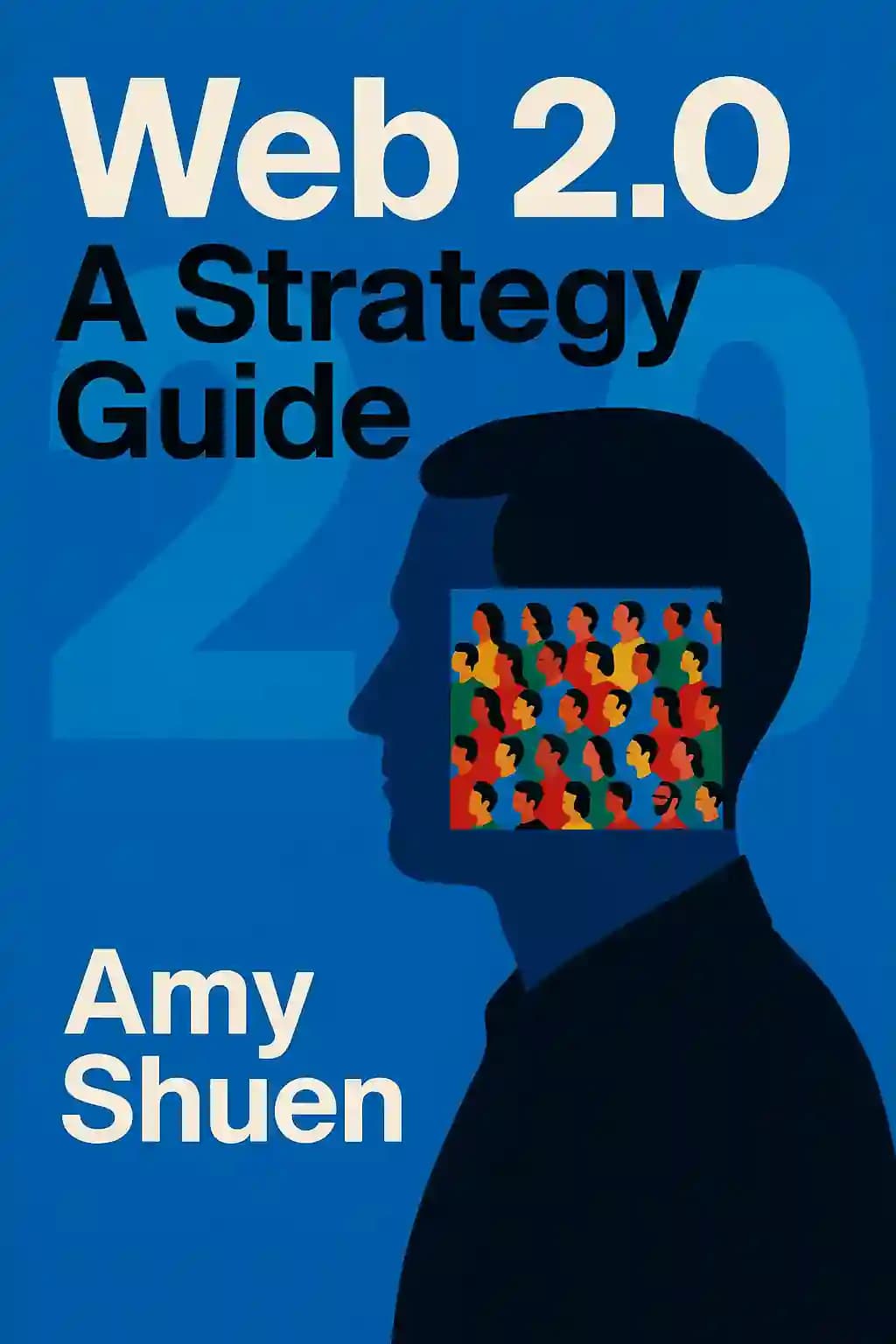
Web 2.0
A Strategy Guide - Business Thinking and Strategies Behind Successful Web 2. 0 Implementations
Web 2.0 개요
Unlock the business secrets of Web 2.0 with Amy Shuen's strategic guide, endorsed by Mark Zuckerberg himself. Learn how companies like Flickr and Facebook transformed user participation into profit - a must-read that revolutionized business models across industries without requiring an MBA.

Web 2.0의 핵심 주제
- network effects
- collective intelligence
- freemium business models
- user-generated metadata
- demand-side economies
Web 2.0의 명언
Traffic is a powerfully good thing.
Networks are characterized by demand-side scale economies.
The battle zone is between 40-60% market share.
Web 2.0의 등장인물
- Amy ShuenAuthor and business strategist
- Tim O'ReillyTech publisher who coined the term Web 2.0
- Fred WilsonVenture capitalist who coined the term freemium
- Alvin TofflerWriter who predicted the rise of pro-sumers
저자 소개
Web 2.0의 저자 소개
Amy Shuen, author of Web 2.0: A Strategy Guide, is a renowned technology strategist and innovation economics expert whose work bridges academic theory with real-world business applications. A professor at institutions like Wharton School and UC Berkeley, Shuen’s research focuses on high-tech entrepreneurship, platform-driven growth, and the strategic use of network effects—themes central to her book’s exploration of Web 2.0 business models.
Her Silicon Valley consulting experience with major tech firms and contributions to dynamic capabilities theory, including frameworks for orchestrating digital ecosystems, underscore her authority in analyzing disruptive technologies.
Published by O’Reilly Media, Web 2.0: A Strategy Guide leverages case studies from Google, Flickr, and LinkedIn to decode counterintuitive strategies like freemium pricing and recombinant innovation. Shuen’s insights, shaped by decades of teaching and advising startups, have made her a sought-after speaker on digital transformation.
Her work is widely cited in academia and used in MBA programs to teach modern platform economics. The book remains a seminal resource for executives and entrepreneurs, praised for translating complex Web 2.0 concepts into actionable roadmaps for sustainable growth.
Web 2.0 요약 다운로드
Web 2.0 요약을 무료 PDF 또는 EPUB으로 받으세요. 인쇄하거나 오프라인에서 언제든 읽을 수 있습니다.
이 책에 대한 FAQ
Web 2.0: A Strategy Guide explores how businesses leverage network effects, user-generated value, and freemium models to drive innovation. Amy Shuen analyzes companies like Google, Flickr, and LinkedIn, showing how they disrupted industries by embracing collaborative platforms, social networks, and recombinant innovation. The book provides actionable frameworks for integrating Web 2.0 strategies into traditional business models.
Business leaders, digital strategists, and entrepreneurs seeking to adapt Web 2.0 principles like collective user value and competence syndication. It’s ideal for those exploring social media integration, network effects, or innovative monetization strategies. Shuen’s clear examples make it accessible for non-technical readers aiming to harness digital collaboration.
Yes. Core concepts like network effects, user-generated content, and platform-driven growth remain foundational to modern digital strategies. Shuen’s analysis of scalable, low-cost business models (e.g., Flickr’s freemium approach) prefigured today’s SaaS and crowdsourcing trends, making it a timeless resource for understanding digital transformation.
- Network effects: How user growth amplifies value (e.g., Flickr’s tagging system).
- Freemium models: Offering free services to build paid user bases (e.g., LinkedIn Premium).
- Recombinant innovation: Combining existing tools/APIs to create new value streams.
- Competence syndication: Partnering across platforms to enhance offerings.
Shuen dissects successes like Google’s ad-supported search engine, Flickr’s community-driven photo tagging, and Goldcorp’s crowdsourced mining exploration. These examples demonstrate how Web 2.0 strategies reduce costs, accelerate innovation, and engage users as co-creators.
- How will we attract and retain users?
- Can user interactions generate actionable insights?
- What partnerships or APIs could enhance our platform?
- How might relinquishing control drive innovation?
These questions help align Web 2.0 tactics with broader business goals.
Shuen highlights hybrid approaches: Facebook’s targeted ads, Flickr’s premium subscriptions, and Procter & Gamble’s open innovation (35% of new ideas from external collaborators). She emphasizes indirect monetization through data, network scalability, and ecosystem growth.
Some note its lighter technical depth and focus on mid-2000s platforms. However, the strategic principles remain applicable, and Shuen’s business-first perspective makes it accessible for decision-makers rather than technologists.
Startups learn to bootstrap via network effects (e.g., viral growth loops), while enterprises gain methods to crowdsource innovation (e.g., P&G’s Connect+Develop). Both benefit from Shuen’s emphasis on agility and user-centric design.
- “Creating value often means letting some of that value flow elsewhere” (mashup ecosystems).
- “Web 2.0 isn’t about control—it’s about influence through participation”.
While Cluetrain focuses on market conversations and Lean Startup on iterative testing, Shuen’s guide bridges strategy and execution for Web-native business models. It complements both by detailing how network effects and user collaboration drive scalable growth.
The book includes a Web 2.0 business plan template, emphasizing iterative testing, metrics for network effects, and competency mapping. Shuen also provides frameworks like the Bass Diffusion Curve to predict adoption rates.