1장
A Boy Soldier in the Crucible of War
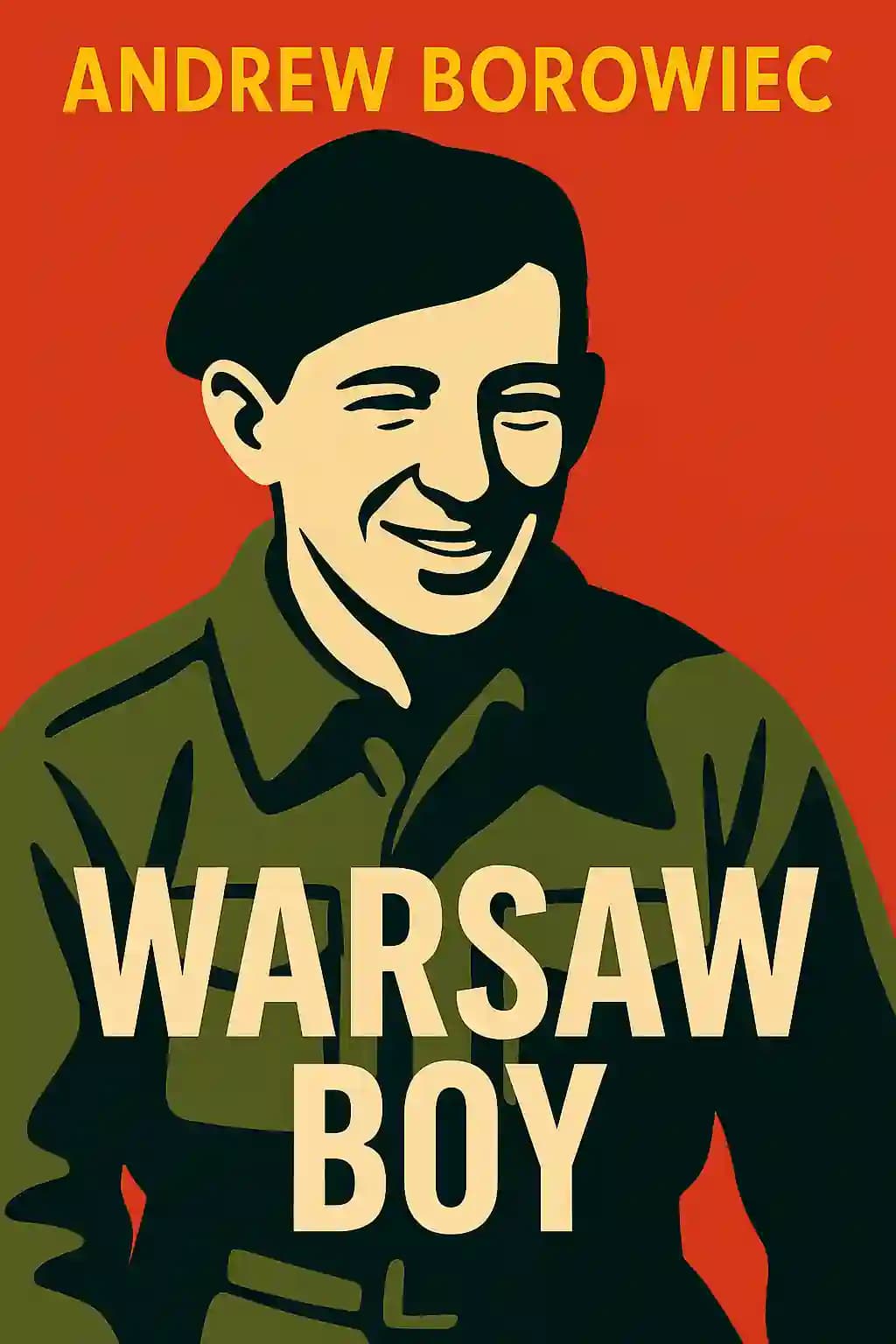
Andrew Borowiec's "Warsaw Boy" offers a remarkable window into one of history's most harrowing chapters through the eyes of a teenage combatant. This memoir, which began as notes scribbled on Red Cross toilet paper in a German POW camp, has become required reading in military academies worldwide for its unflinching portrayal of urban warfare. Borowiec's account resonates with readers from all backgrounds-from history buffs to those interested in coming-of-age stories set against impossible circumstances. The book has been praised by historians like Norman Davies as "essential reading for understanding the Polish experience of World War II" and has influenced modern military thinking about urban combat operations. What makes this memoir extraordinary is not just its historical significance but its emotional honesty-a teenage boy's perspective on war, resistance, and the loss of innocence.
2장
From Peacetime to Occupation: Poland's Descent into Darkness
Andrew Borowiec's childhood ended abruptly when Germany invaded Poland on September 1, 1939. Born into a military family-his father a prematurely retired colonel with an ambivalent relationship to his career-young Andrew had enjoyed a relatively privileged upbringing in pre-war Poland. His early years in the mountain town of Makow Podhalanski were marked by the distinctive culture of the Gorale highlanders, swimming in the cold Skawa River, and exploring with his red setter puppy, Mik. These idyllic memories stand in stark contrast to what followed.
The Munich Agreement of 1938 had already signaled trouble, with Poland participating in the dismemberment of Czechoslovakia. By early 1939, war seemed inevitable. Andrew's father was recalled to military service, and the family prepared for conflict. When Germany attacked, Andrew was evacuated eastward to Lwow, considered safer due to its distance from the German border. The journey through a mobilizing country provided his first glimpse of war-troop trains, field kitchens, and soldiers gathering at stations.
The reality of occupation quickly shattered any illusions about a swift Polish victory. After the fall of Lwow, Andrew's father made a daring escape from Soviet-controlled territory to German-occupied Poland, recognizing that while the Germans might send officers to POW camps, the Soviets would likely send them to Siberia "or worse." The family was eventually reunited in German-occupied Makow, where life under Nazi rule meant closed schools, confiscated radios, and the constant fear of arbitrary execution.
The Germans transformed daily life completely. They allowed only primary education for Poles, stripping schools of patriotic content and removing portraits of Polish heroes. As Andrew's father explained: "Keep Poles ignorant but not illiterate. They need us as skilled workers, but don't want us as equals." Food shortages became severe, with peasants charging fortunes for hoarded supplies. Despite these hardships, Andrew's father insisted he learn German: "They will lose the war, but their language will survive."
By 1942, the occupation had grown even more brutal. Andrew witnessed the deportation of Makow's entire Jewish population to Belzec extermination camp. The image of Old Weiss, unable to walk and brought to the station in a wheelbarrow only to be casually shot by an SS officer, would haunt him forever. Shortly afterward, Andrew's father suffered a stroke and died, leaving the teenager to face an uncertain future in Nazi-occupied Poland.
3장
Coming of Age Under Occupation
Following his father's death, Andrew moved to Krakow to live with Ada, his father's former housekeeper. He worked as a messenger at a furniture factory that had been seized from its Jewish owner and now produced items for the Wehrmacht. Though German-owned, most workers were Polish, including a few Jewish "essential workers" allowed out of the ghetto. Andrew witnessed the gradual emptying of the Krakow ghetto as Jews were moved to the nearby Plaszow concentration camp. One Jewish worker gave him a stamp collection before being deported, saying, "I don't think I'll be needing them where I'm going."
Life in Krakow was a daily reminder of occupation-German headquarters for the Generalgouvernement, streets renamed in German, and Wehrmacht vehicles everywhere. Most Poles used trams or horses and observed the strict 6 p.m. curfew. After arguments with Ada, Andrew was sent to Warsaw to live with his mother, whom he hadn't seen in four years.
In Warsaw, Andrew joined a household of women-his mother, grandmother, and Aunt Olga-who had established efficient routines in their small flat on Opoczynska Street. The women all spoke good German from their years in Vienna, which proved useful under occupation. His mother received food parcels from abroad sent by her husband through neutral cities, containing valuable items like coffee and tea that they mostly sold on the black market.
Within a week of his arrival, Andrew's education resumed through clandestine classes. In Warsaw's million-person population, these underground schools operated more safely than in small towns. By defying Nazi plans to deny Poles education beyond age fourteen, these secret classes became a first step toward resistance. Students met in groups of ten, changing venues every couple of weeks for security.
April 1943 brought shocking news that shook Polish hearts. Radio Berlin announced the discovery of a mass grave in Katyn forest containing 3,000 Polish officers, all shot in the back of the head. Documents found on the bodies dated no later than April 1940-a year before Germany invaded Russia-implicating Soviet forces. Despite Moscow's denials, most Poles knew this was one instance where Goebbels wasn't lying.
Before Warsaw could fully process the Katyn revelation, another extraordinary event unfolded-the Warsaw Ghetto Uprising. Jews who had been corralled into a square mile of the city, facing certain death in the gas chambers, decided to fight back. With a few smuggled weapons and homemade explosives, they resisted SS-Polizeifuhrer Jurgen Stroop's forces for weeks. From clandestine classes near the ghetto wall, Andrew watched orange flames and black smoke rise as SS troops used flamethrowers against the last Jewish resistance. Someone in his classroom remarked, "If the Jews could do it, then so could we-and so much better."
4장
The Grey Ranks: Poland's Teenage Resistance
In late summer 1943, shortly before his fifteenth birthday, Andrew joined the Szare Szeregi (Grey Ranks)-the underground resistance group that had staged the Arsenal rescue operation earlier that year. When invited to "meet some interesting people" by Tadeusz Stopczynski, a schoolteacher's son two years his senior, Andrew felt honored: "I could have walked on air."
For these teenagers, the war replaced normal adolescent experiences. They operated on a cell system where members knew as little as possible about each other and used noms de guerre. Andrew chose "Zych," after a character in a Henryk Sienkiewicz novel-an old soldier known for his pointed quips and jokes that appealed to his teenage ideal of the cynical warrior.
His initial assignments were modest but dangerous-distributing copies of the Biuletyn Informacyjny underground news-sheet and painting kotwica (anchor) graffiti, the Home Army's insignia formed by merging P and W letters. Originally meaning "We will avenge Wawer" (commemorating 107 Poles murdered there), it now stood for "Fighting Poland." Andrew could paint one in under a minute, constantly watching for German patrols.
By early 1944, he graduated to "Battle Schools" as the youngest member in a sekcja of six, code-named MG300. During weekly meetings, they studied the pre-war infantry manual, learning the infantryman's five basic tasks: reconnoitering, advancing, attacking, defending, and withdrawing. They memorized column formations, studied sentry duties, and examined infantry rifles through colored drawings. More thrilling was handling actual weapons-a captured MP40 Schmeisser sub-machine gun and Poland's famous Vis 9mm pistol.
As training progressed, they conducted field exercises in the countryside near Zielonka, a small town in forested areas northeast of Warsaw. They practiced formation marching with flankers and rearguards, collected stones for grenade-throwing drills, and learned field medicine from Girl Scout medics. The riskiest part was traveling through Warsaw's central station, heavily monitored by police and Gestapo.
By July 1944, Warsaw enjoyed glorious weather as the war's tide turned decisively against Germany. Hitler had narrowly survived an assassination attempt, while on the Eastern Front, the Wehrmacht's Army Group Centre had nearly collapsed. The Red Army was advancing rapidly into eastern Poland. Moscow Radio broadcast constant appeals for Warsaw to rise up against the Germans, while the Communist-backed "Polish People's Army" claimed to be liberating Poland alongside Soviet forces.
Meanwhile, German Governor Fischer desperately tried recruiting Poles to help build fortifications, cynically appealing to anti-Bolshevik sentiment. The Home Army urged non-compliance while preparing for uprising. Andrew received his red and white armband stamped "WP" for Wojsko Polskie (Polish Army) and was ordered to mobilize his sekcja at Dabrowski Square with emergency gear. The Warsaw Uprising was about to begin.
5장
Sixty-Three Days of Hell: The Warsaw Uprising
On August 1, 1944, at 5 p.m., the Warsaw Uprising erupted across the city. Andrew's first combat experience came when SS troops arrived in trucks at Dabrowski Square. His squad leader and deputy-the only armed members-fired from windows, killing two SS men. Following Lieutenant Bohun upstairs, Andrew was handed a Mills grenade. When SS troops tried crossing the courtyard, he pulled the pin and threw it through the window. Though the explosion was surprisingly loud, the Germans escaped unharmed. Still, he'd finally become a soldier, trying to kill the enemy. "I'll never be able to live back with my mother after this," he thought.
The Uprising's initial results were mixed. Polish forces did well in the city center, Old Town, and Wola suburb where German presence was lighter. By 8 p.m., they held the Prudential Tower and had confined Governor Fischer and General Stahel to the Bruhl Palace. The Zoska Battalion captured a warehouse containing thousands of SS camouflage smocks which would soon outfit much of the army. But they failed to secure major objectives-the Vistula bridges remained in German hands, as did the airports. They'd been driven from Praga district and Zoliborz.
The weapons shortage was critical. One 600-strong battalion went to war with only 300 grenades, thirty pistols, three sub-machine guns, and three rifles. Repeated attempts to capture well-defended positions like Gestapo headquarters proved suicidal. Buildings changed hands but Germans usually recaptured them at horrendous cost to the Poles.
By morning, Warsaw's citizens had fully embraced the uprising. During the night, civilians had approached sentries asking where to build barricades. Deep trenches were dug, pavements torn up, and abandoned tramcars overturned to create tank barriers filled with earth and rubble. For the first time in nearly five years, the Polish national anthem "Jeszcze Polska Nie Zginea" (Poland Is Not Yet Lost) was broadcast publicly.
The Germans responded with unprecedented brutality. Heinrich Himmler appointed Obergruppenfuhrer Erich von dem Bach to crush the uprising, supported by two particularly brutal formations: SS-Sonderregiment Dirlewanger, a penal unit of criminals and poachers, and the Waffen-SS Sturmbrigade RONA led by Bronislaw Kaminski. These forces committed horrific atrocities in Warsaw's western suburbs, massacring at least 10,000 men, women, and children on the first day alone.
As massacres continued across Warsaw, the Home Army achieved some victories. After a twenty-day siege, the PAST telephone exchange finally fell to the Kilinski Battalion. In an operation called Gesiowka, the Zoska Battalion used a captured Panther tank to liberate 348 Jews from a concentration camp in the former Warsaw ghetto. Almost all volunteered to fight with the Home Army.
By late August, the Old Town was under siege. About 7,000 Polish combatants defended 100,000 civilians against fewer than 3,500 Germans. Well-constructed barricades positioned to create killing zones proved effective. When the Germans brought in self-propelled guns and tank destroyers, the Poles countered with PIATs (Projector Infantry Anti-Tank weapons) dropped by the RAF, along with Molotov cocktails and homemade grenades.
6장
Into the Sewers: The Underground War
As the battle for Warsaw intensified, the city's extensive sewer system became a crucial lifeline for the resistance. Andrew volunteered with four other boys for a special mission to carry important dispatches to the besieged Old Town through this underground network. They were selected for being short and skinny-perfect for navigating the cramped tunnels. Their guide, a nineteen-year-old girl in German camouflage and rubber boots, warned them that Germans sometimes dropped grenades through manholes, so absolute silence was essential.
The journey through the sewers was harrowing. The contrast with the surface world was overwhelming-stench, silence, and utter darkness. Their guide showed them how to move through the egg-shaped tunnel, just three feet high, using short sticks for support in a rabbit-like motion. They advanced slowly through the slime, crossing several intersections where sewage moved swiftly. After about three hours, they emerged in the Old Town to find streets lined with gutted buildings, piles of rubble, and makeshift graves marked by wooden crosses.
The Old Town was devastated compared to the city center. They delivered their dispatches and rested in a barracks-like building while return packages were prepared, listening to mortar shrapnel rattling on the corrugated-iron roof. Men played cards and ate chocolate, barely reacting to the distinctive whine of diving Stukas.
By late August, morale in the Old Town was cracking. Civilians crammed into cellars simply wanted the fighting to stop. German propaganda leaflets claimed the uprising served Soviet interests while offering good treatment at the Pruszkow refugee camp. With only rats having full bellies and the wounded dying from thirst and infections, even some fighters questioned how much longer they could continue.
Colonel Wachnowski attempted to evacuate as many wounded as possible through the sewers. Despite initial setbacks, by September 2, he had evacuated about 4,500 people to the city center, including 1,500 armed combatants. Another 800 escaped to Zoliborz. Some 2,500 wounded were left behind with 35,000 civilians. While von dem Bach kept his word regarding civilians, sending most to the countryside, Dirlewanger's men murdered all the wounded in their hospital beds.
After escaping the Old Town, Andrew was recruited to join the depleted Zoska Battalion, which had fewer than 100 members remaining. Despite their unmilitary appearance-most lacking proper uniforms and wearing civilian clothes or mismatched German items-the officers accepted him, valuing his combat experience. The remnants of various battalions were being sent to reinforce Czerniakow on the Vistula's west bank. General Bor hoped the Soviets would eventually support these potential bridgeheads, despite their apparent indifference to the nationalist Polish forces.
7장
The Final Battle: Czerniakow and Betrayal
The leafy Czerniakow suburb presented a stark contrast to the dense urban environment they'd fought in previously. Its well-spaced houses, gardens, and parks required different defensive tactics, including digging communication trenches. What the fighters didn't realize was how desperate their strategic position had become. General Bor had already informed London that his forces were reaching "the bounds of human possibility," running out of ammunition, food, and hope.
On the forty-first day of the Uprising, hope briefly returned when Red Army artillery fire erupted from the east bank, supporting a large-scale attack on German positions in Praga. General Berling's 1st Polish Army Corps led the infantry assault, while Soviet fighters reappeared in Warsaw's skies. The Soviets began sending supplies via slow-flying Polikarpov Po-2 biplanes-"kukuruzniks"-which dropped sacks of bread, canned meat, and various weapons.
Von dem Bach assembled a formidable force for his assault on Czerniakow: seven combat infantry battalions totaling 4,000 men, supported by sixteen tanks and assault guns, engineers with remote-controlled Goliath mines, sixteen self-propelled 155mm guns, rocket launchers, and massive siege mortars. Against this overwhelming firepower stood about 1,600 Polish fighters with only a few Soviet 50mm light mortars and limited ammunition.
Andrew's first action in Czerniakow came at night when he spotted German muzzle flashes about 100 meters away and returned fire with his newly-issued Schmeisser, squeezing off several short bursts just as he'd been trained. Though he doubted he hit anyone, the enemy fire ceased, and Lieutenant Szczerba seemed impressed. The next day brought unexpected good news when Andrew was promoted to lance corporal-a morale-boosting exercise that worked wonderfully on him, still ten days shy of his sixteenth birthday.
The fight for the Czerniakow bridgehead became one of the Uprising's bloodiest battles. House-to-house fighting brought them dangerously close to Germans who would shout "Banditen, Hande hoch!" while shooting through floorboards. None would surrender-they knew "bandits" couldn't expect military courtesies. Men fell constantly, and they became numb to it. Andrew acquired a camouflage smock from a corpse and found a German helmet with a small hole in it.
While on observation duty in a basement window one evening, Andrew spotted a small object the size of a coffee table moving across the vacant lot toward their position-a Goliath, a remote-controlled miniature tank packed with sixty kilograms of high explosive. His warnings were met with hostility and disbelief from celebrating soldiers. When the blast finally came, it was enormous, ripping through the cellar with heat and dust. The Germans followed with an attack, and Andrew rushed upstairs to join the defense.
As Soviet support became increasingly unreliable, Colonel Radosaw announced they were pulling out of Czerniakow through the sewers to Mokotow. The evacuation began with chaos as artillery shells exploded along the riverbank. After four hours underground, they emerged into bright morning sunlight in Mokotow, where insurgents greeted them with warm drinks.
8장
From Soldier to Prisoner: The End of the Uprising
Mokotow was initially quiet until September 24th-Andrew's sixteenth birthday-when the Germans launched their attack with artillery and Stuka dive-bombers. Von dem Bach, reinforced by the Hermann Goring SS Panzer Division, attacked with infantry and armor. The terrain was too open with too many gardens and parks, unlike the defensible narrow lanes of the Old Town.
While defending the evacuation route at a small factory wall, Andrew was wounded in his right hand and leg, blood dripping into his German boot. When mortar bombs exploded nearby, he took a devastating hit below his right knee that caused excruciating pain. A medic named Lidka bandaged his leg with paper dressings.
Andrew dreaded the prospect of another sewer trip with his paper-bandaged wounds exposed to filth and risk of gangrene. When his turn came at the manhole, he suddenly decided to stay rather than descend into that stinking labyrinth. "The Germans will kill you," warned a lieutenant, but he didn't care. Alone in the September drizzle, he cried-sixteen years and three days old, wanting only to die in peace.
After the sector surrendered, Germans in new uniforms called them "Soldaten" rather than "Banditen"-they were taking them as prisoners rather than executing them. A nurse found Andrew civilian clothes-ironically, an evening suit with satin lapels. A German general named Gunther Rohr briefly appeared, praising their combat performance while regretting that "such brave opponents did not fight Communism on Germany's side."
Andrew was processed as a prisoner of war and transported to Stalag XI-A near Altengrabow, Germany. British medical orderlies met him at the ambulance and led him to a clean ward where Captain John Burton of the Royal Army Medical Corps examined his wounds. When Andrew told him his age, he muttered something in English. The hospital was truly a European community, with prisoners from many nations running the facility while Germans remained in the background.
The Warsaw Uprising had lasted sixty-three days. Nearly 200,000 Polish civilians died, while German casualties were estimated at 11,000. About 16,000 Polish fighters ended up in prison camps, including 5,000 wounded, while Warsaw itself was systematically destroyed by Nazi demolition teams, with 42 percent of the city's buildings completely destroyed.
9장
From Prisoner to Exile: The Long Road Home
Life as a prisoner of war was governed by the Geneva Convention. The main problem was hunger-they received only ersatz tea for breakfast, thin soup for lunch, and a dark liquid for dinner, with one Wehrmacht-issue loaf and margarine shared between six men. They eagerly awaited Red Cross parcels with their tins of corned beef, sardines, and cigarettes, which could be traded.
Andrew's treatment as a Warsaw insurgent was unprecedented-no other partisans in Nazi-occupied Europe had ever been recognized as combatants entitled to Geneva Convention protection. The surrender document signed on October 2, 1944, granted prisoner-of-war status to all combatants and amnesty for previous anti-German activities.
Once a week, a monocled German doctor conducted inspections, focused primarily on identifying prisoners fit enough to join labor pools in the main camp. When he ordered Andrew to leave the hospital despite his still-healing wounds, Captain Burton intervened, instructing him to feign melancholia-what we now call clinical depression.
Christmas 1944 brought melancholy and camaraderie. A French padre celebrated midnight Mass with six Warsaw teenagers singing traditional carols. Their Christmas Eve supper was the usual mysterious soup and potatoes, supplemented by shared Red Cross packages. Two wounded Poles-a man without a leg and a seventeen-year-old who'd lost an arm-wept in each other's arms, setting everyone off.
In early January 1945, Andrew made what every adult in the hospital considered the stupidest decision of his young life-volunteering to transfer from his comfortable hospital placement to the main camp with two slightly older friends from the Uprising. Despite warnings about overcrowded conditions, he gave up his envied position as "Dr. Burton's spoilt melancholia patient" because having friends his own age seemed more important than clean sheets and hospital meals.
As the Soviet offensive pushed westward, the prisoners were transferred to various locations. By spring 1945, Andrew was part of a work detail at a German estate called Rittergut. On April 12, 1945, they noticed increased military traffic and spotted eight barrage balloons swaying against the blue sky-a sign the front was near. The next day, they saw American tanks with white stars moving along the highway. Liberation had arrived.
10장
Aftermath: A Nation in Exile
On May 8, 1945, when Germany's unconditional surrender was announced, Andrew was with Ute, an eighteen-year-old German girl he'd been dating. Back at camp, the Poles sang patriotic songs and staged a victory parade for visiting American officers. But the question remained: where would they go now?
While the war had ended, Poland's struggle continued. On January 19, 1945, with Poland occupied by the Red Army, the Home Army had officially stood down. When Stalin invited sixteen army leaders to help organize the new Polish government in March, they were kidnapped by the NKVD, secretly taken to Moscow's Lubyanka Prison, and tortured into confessing "collaboration with Nazi Germany."
The West's reaction to these sentences left no doubt where Poland stood. On July 6, 1945, the Anglo-Americans withdrew recognition of the legitimate government-in-exile in London and recognized Moscow's puppet regime in Warsaw. Meanwhile, parts of Poland verged on open insurrection. The Home Army had transformed into WIN (Freedom and Independence), with many fighters refusing to surrender their weapons.
Andrew briefly joined WIN and underwent intensive training at one of the Polish Parachute Brigade's camps in the British Zone. However, his return to Poland became a fiasco. Crossing from the British to Soviet Zone, he faced immediate hostility. In Berlin, he boarded a freight train carrying Russian laborers being repatriated. At Frankfurt-an-der-Oder, Soviet troops inspected the train. He watched in horror as his three companions were discovered and marched away at gunpoint.
In Krakow, he found his WIN contact's apartment sealed by the Citizens' Militia with an official notice threatening prosecution by military tribunal. He fled immediately back to Warsaw, realizing how narrowly he'd escaped arrest. The capital greeted him with propaganda banners declaring "Heroic Warsaw Greets Fighters for the Freedom of the Masses." Moscow's propaganda blaming the Home Army for Warsaw's destruction was clearly taking hold.
By early 1946, Andrew's stepfather, now deputy chief of intelligence for General Anders in Rome, arranged their escape from Communist Poland. With false French laissez-passer permits and help from a smuggler, they crossed into Czechoslovakia before the Communist putsch sealed that border. For all three of them, a lifetime's exile had begun.
Andrew eventually settled in Britain with the Polish Resettlement Corps, established by the Labour government. He arrived speaking little English but became fluent enough within three years to enter an American college. After studying journalism at Columbia University, he began a career that would take him around the world as a foreign correspondent, witnessing the continued struggles of Eastern Europe under Soviet domination.
His last glimpse of his former commander Radosaw came on All Souls' Day in November 1945 at Warsaw's Powazki Military Cemetery. Radosaw, nearly unrecognizable in civilian clothes with thinning white hair, lit a symbolic fire and intoned "May God protect Poland." When they sang the national anthem, everyone defiantly used the occupation-era version asking God to "return our Fatherland to Freedom" rather than acknowledging Soviet "liberation."
Radosaw died in May 1988 at ninety-five. Had he lived just two more years, he would have witnessed President Waesa receive the presidential symbols from the London government-in-exile, finally ending Poland's Second World War where it began: in Poland.