Hidden in coat seams, Gunter Koschorrek's secret wartime diary resurfaced 40 years later, revealing the brutal realities of a German soldier on WWII's Eastern Front. This visceral account humanizes the enemy while sparking uncomfortable questions about duty amid unspeakable horror.
Gunter K. Koschorrek, born in 1923 in Gelsenkirchen, Germany, is the acclaimed author of Blood Red Snow: The Memoirs of a German Soldier on the Eastern Front and a former machine-gunner in the Wehrmacht during World War II. His memoir provides a visceral, ground-level perspective of the Eastern Front, detailing combat from the frozen retreats near Stalingrad to Germany’s final collapse.
Koschorrek’s harrowing experiences—compiled through an illicit wartime diary hidden for decades—reveal the brutality of front-line warfare and the psychological toll on soldiers.
After the war, Koschorrek transitioned to a civilian career as a managing director of a sales company in Germany. His memoir, praised for its raw authenticity and unvarnished portrayal of infantry life, has resonated globally with translations in Turkish (Kan Kirmizi Karlar) and Estonian (Veripunane lumi). The work has garnered over 7,000 ratings on Goodreads, establishing it as a seminal firsthand account of the Eastern Front’s horrors.
Blood Red Snow is a WWII memoir detailing Günter K. Koschorrek’s experiences as a German machine-gunner on the Eastern Front. Based on his secret diary, it chronicles brutal combat at Stalingrad, Romania, and Italy, emphasizing survival amid extreme cold, hunger, and chaos. The narrative captures his evolution from a patriotic recruit to a disillusioned soldier bonded to comrades.
This book is essential for WWII historians, military enthusiasts, and readers seeking firsthand accounts of frontline combat. Its visceral descriptions of trench warfare, retreats, and psychological toll offer unmatched insight into the Eastern Front’s horrors. Those interested in human resilience amid war’s dehumanizing effects will find it particularly impactful.
Yes, for its raw authenticity and unflinching portrayal of war. Koschorrek’s diary-based account—hidden in his coat lining during the war—provides rare, undiluted perspectives on camaraderie, trauma, and survival. Readers praise its novel-like pacing and historical value, though some note minor translation quirks (e.g., "Kalashnikovs" for Soviet rifles).
Koschorrek served as a machine-gunner in the 24th Panzer Division’s 1st Battalion. Deployed to Stalingrad (1942), he fought in key battles like the Nikopol Bridgehead and endured six wounds. His assignments included anti-partisan operations in Italy before returning to the Eastern Front’s collapsing lines.
Koschorrek describes Stalingrad as chaotic urban warfare marked by constant artillery, snipers, and close-quarters combat. His unit narrowly escaped encirclement by crossing the frozen Don River under fire. The memoir highlights disorientation and despair as German forces faced relentless Soviet assaults amid freezing ruins.
Central themes include:
He hid notes on scraps of paper sewn into his coat lining, smuggling them to his mother during rare leaves. The diary resurfaced decades later when Koschorrek reunited with his daughter in America, enabling the memoir’s publication.
Some note minor historical inaccuracies, like anachronistic references to "Kalashnikovs" (translation errors). Others highlight its singular perspective—while visceral, it avoids broader Nazi context. Despite this, its unvarnished portrayal of infantry suffering is widely praised.
Unlike strategic analyses (e.g., David Glantz), Koschorrek’s ground-level focus mirrors The Forgotten Soldier’s intensity but with sharper diary immediacy. It avoids mythologizing, instead emphasizing sensory brutality—frozen corpses, starvation, and the Russian winter’s omnipresent threat.
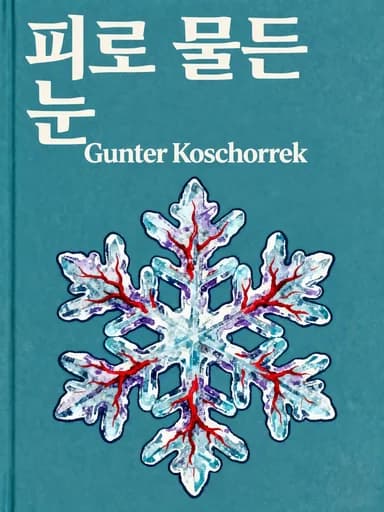
It evokes the Eastern Front’s apocalyptic imagery: snow stained by combat casualties. Metaphorically, it represents war’s corruption of innocence—the "red" of violence seeping into the "snow" of Koschorrek’s initial naiveté.
It humanizes soldiers dehumanized by history, challenging simplistic villain/victim binaries. Koschorrek’s reflections on moral erosion in extremis offer timeless insights into trauma’s universality—resonating with modern discussions of combat psychology and resilience.
Post-war, he avoided Soviet imprisonment by intentionally aggravating a wound to stay hospitalized. He later became a sales company executive in Germany. Blood Red Snow (published 1998) fulfills his vow to honor fallen comrades, cementing his legacy as a witness to history.
저자의 목소리로 책을 느껴보세요
지식을 흥미롭고 예시가 풍부한 인사이트로 전환
핵심 아이디어를 빠르게 캡처하여 신속하게 학습
재미있고 매력적인 방식으로 책을 즐기세요
Far from glorifying conflict, it serves as a powerful anti-war statement.
The journey itself becomes a gradual stripping away of illusions.
Some freeze, others pray, while a few try to return fire.
The fog becomes both salvation and curse
Blood Red Snow의 핵심 아이디어를 이해하기 쉬운 포인트로 분해하여 혁신적인 팀이 어떻게 창조하고, 협력하고, 성장하는지 이해합니다.
Blood Red Snow을 빠른 기억 단서로 압축하여 솔직함, 팀워크, 창의적 회복력의 핵심 원칙을 강조합니다.

생생한 스토리텔링을 통해 Blood Red Snow을 경험하고, 혁신 교훈을 기억에 남고 적용할 수 있는 순간으로 바꿉니다.
무엇이든 물어보고, 목소리를 선택하고, 진정으로 공감되는 인사이트를 함께 만들어보세요.

샌프란시스코에서 컬럼비아 대학교 동문들이 만들었습니다
"Instead of endless scrolling, I just hit play on BeFreed. It saves me so much time."
"I never knew where to start with nonfiction—BeFreed’s book lists turned into podcasts gave me a clear path."
"Perfect balance between learning and entertainment. Finished ‘Thinking, Fast and Slow’ on my commute this week."
"Crazy how much I learned while walking the dog. BeFreed = small habits → big gains."
"Reading used to feel like a chore. Now it’s just part of my lifestyle."
"Feels effortless compared to reading. I’ve finished 6 books this month already."
"BeFreed turned my guilty doomscrolling into something that feels productive and inspiring."
"BeFreed turned my commute into learning time. 20-min podcasts are perfect for finishing books I never had time for."
"BeFreed replaced my podcast queue. Imagine Spotify for books — that’s it. 🙌"
"It is great for me to learn something from the book without reading it."
"The themed book list podcasts help me connect ideas across authors—like a guided audio journey."
"Makes me feel smarter every time before going to work"
샌프란시스코에서 컬럼비아 대학교 동문들이 만들었습니다

Blood Red Snow 요약을 무료 PDF 또는 EPUB으로 받으세요. 인쇄하거나 오프라인에서 언제든 읽을 수 있습니다.
Blood Red Snow pulls you into the brutal reality of the Eastern Front through the eyes of eighteen-year-old Gunter Koschorrek. Unlike polished accounts from generals or politicians, this memoir offers something rare-the unfiltered perspective of an ordinary German machine gunner thrust into history's most devastating conflict. These aren't carefully crafted memories but authentic diary entries, lost for decades until Koschorrek's daughter unexpectedly returned them. What emerges is a haunting journey from naive patriotism to the desperate struggle for survival that defined the German experience on the Russian front. The power lies in its simplicity-no grand strategic analysis, no political justifications-just the day-to-day reality of a young man trying to survive as the world collapses around him. Have you ever wondered what thoughts race through a soldier's mind as they face almost certain death? This memoir answers that question with unflinching honesty.