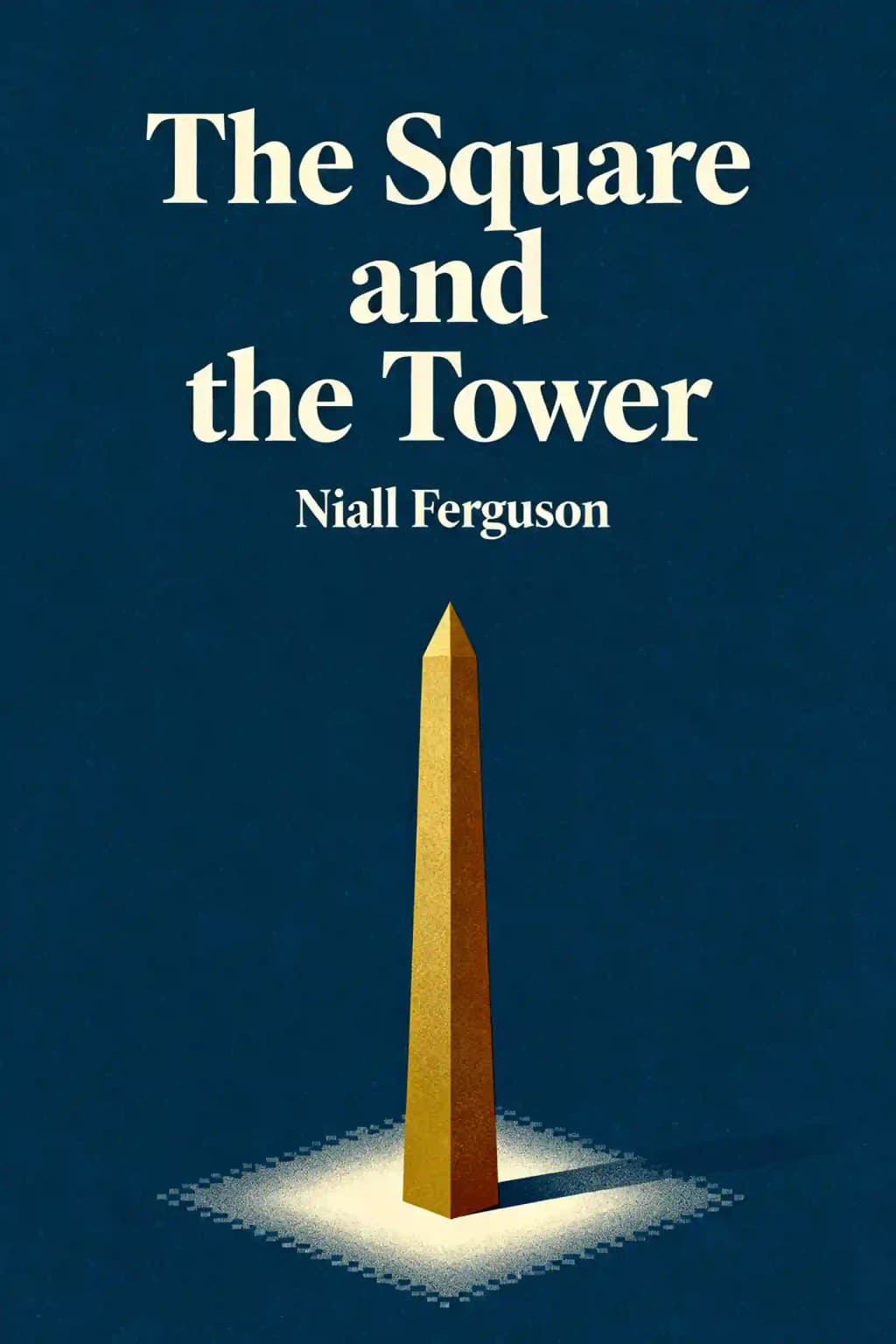
Ferguson's masterwork reveals how networks, not hierarchies, drive history's pivotal moments - from Freemasons to Facebook. This NYT bestseller captivated Wall Street Journal critics: "brilliant... restocks your mind." Discover why understanding networks is essential for navigating today's digital power dynamics.
Niall Ferguson, the acclaimed British-American historian and bestselling author of The Square and the Tower: Networks and Power, from the Freemasons to Facebook, is a leading authority on global history, finance, and institutional dynamics.
A senior fellow at Stanford’s Hoover Institution and Harvard’s Belfer Center, Ferguson merges rigorous academic scholarship with accessible storytelling, exemplified by his Emmy-winning PBS documentary The Ascent of Money.
His works, including The Great Degeneration and Civilization, explore the rise and fall of political and economic systems, a theme central to The Square and the Tower’s analysis of networks versus hierarchies.
A frequent commentator for Bloomberg Opinion and founder of advisory firm Greenmantle LLC, Ferguson has shaped public discourse through his BBC Reith Lectures and New York Times-bestselling biographies like Kissinger, 1923-1968: The Idealist.
The Square and the Tower became a PBS documentary series and has been translated into 15 languages, solidifying Ferguson’s reputation for transforming complex historical patterns into actionable insights for modern governance.
The Square and the Tower explores how hierarchies (symbolized by the tower) and networks (symbolized by the square) have shaped historical events, from the Renaissance to the digital age. Ferguson argues that while hierarchies often dominate, networks like the Freemasons or social media drive revolutionary change by bypassing traditional power structures. The book blends historical analysis with modern insights into technology’s impact on society.
History enthusiasts, policymakers, and anyone interested in how networks like Facebook or historical movements influence power dynamics will find this book compelling. It’s ideal for readers seeking a fresh lens to understand societal shifts, from the printing press to Silicon Valley.
Key ideas include:
Ferguson highlights Boston’s associational networks, like the Freemasons, as catalysts for independence. These groups connected disparate communities, spreading anti-British sentiment and coordinating actions such as the Boston Tea Party. Weak ties between networks amplified revolutionary ideas, showcasing how grassroots movements can topple hierarchical regimes.
Some critics argue Ferguson’s focus on networks is overly broad, making historical analysis vague. For instance, labeling conquistadors as a “network” against the Inca hierarchy oversimplifies complex power struggles. Others note the book’s uneven depth, with fascinating anecdotes but underdeveloped themes.
The book frames platforms like Facebook as modern “squares,” enabling decentralized networks to challenge governments and corporations. Ferguson warns that unchecked digital networks can spread misinformation or extremism, mirroring historical conspiracies like the Pazzi plot against the Medici.
Unlike his financial histories, this book focuses on social structures rather than economics. However, it retains Ferguson’s signature blend of narrative storytelling and sweeping historical analysis. Fans of The Ascent of Money will appreciate similar depth but may find the network-hierarchy dichotomy less cohesive.
The “tower” symbolizes rigid hierarchies like governments or corporations, while the “square” represents fluid networks such as activist groups or online communities. This contrast underscores Ferguson’s thesis: power oscillates between centralized control and decentralized collaboration.
Yes, for its provocative insights into how networks shape history. While critics note uneven execution, the book offers valuable perspectives on modern issues like social media’s societal impact. Ferguson’s engaging style makes complex concepts accessible to general readers.
He predicts ongoing tension: hierarchies will attempt to regulate disruptive networks (e.g., governments regulating tech giants), while networks will continue evolving to bypass control. This dynamic mirrors past cycles, such as the Catholic Church’s response to the printing press.
저자의 목소리로 책을 느껴보세요
지식을 흥미롭고 예시가 풍부한 인사이트로 전환
핵심 아이디어를 빠르게 캡처하여 신속하게 학습
재미있고 매력적인 방식으로 책을 즐기세요
Humans were born to network.
Homo dictyous ('network man') because our brains seem built for social connection.
Birds of a feather flock together.
The friend of my friend is my friend.
The first 'worldwide web' emerged about 12,000 years ago.
Square and the Tower의 핵심 아이디어를 이해하기 쉬운 포인트로 분해하여 혁신적인 팀이 어떻게 창조하고, 협력하고, 성장하는지 이해합니다.
Square and the Tower을 빠른 기억 단서로 압축하여 솔직함, 팀워크, 창의적 회복력의 핵심 원칙을 강조합니다.

생생한 스토리텔링을 통해 Square and the Tower을 경험하고, 혁신 교훈을 기억에 남고 적용할 수 있는 순간으로 바꿉니다.
무엇이든 물어보고, 목소리를 선택하고, 진정으로 공감되는 인사이트를 함께 만들어보세요.

샌프란시스코에서 컬럼비아 대학교 동문들이 만들었습니다
"Instead of endless scrolling, I just hit play on BeFreed. It saves me so much time."
"I never knew where to start with nonfiction—BeFreed’s book lists turned into podcasts gave me a clear path."
"Perfect balance between learning and entertainment. Finished ‘Thinking, Fast and Slow’ on my commute this week."
"Crazy how much I learned while walking the dog. BeFreed = small habits → big gains."
"Reading used to feel like a chore. Now it’s just part of my lifestyle."
"Feels effortless compared to reading. I’ve finished 6 books this month already."
"BeFreed turned my guilty doomscrolling into something that feels productive and inspiring."
"BeFreed turned my commute into learning time. 20-min podcasts are perfect for finishing books I never had time for."
"BeFreed replaced my podcast queue. Imagine Spotify for books — that’s it. 🙌"
"It is great for me to learn something from the book without reading it."
"The themed book list podcasts help me connect ideas across authors—like a guided audio journey."
"Makes me feel smarter every time before going to work"
샌프란시스코에서 컬럼비아 대학교 동문들이 만들었습니다

Square and the Tower 요약을 무료 PDF 또는 EPUB으로 받으세요. 인쇄하거나 오프라인에서 언제든 읽을 수 있습니다.
History is shaped by an eternal tension between two fundamental forms of human organization: hierarchical towers and horizontal networks. While we've always been natural networkers - our brains evolved specifically for social connection in groups of around 150 people - most of recorded history has been dominated by rigid hierarchies. This paradox sits at the heart of Niall Ferguson's exploration. From the neural connections in our brains to the first human settlements, networking is our natural state. Yet for millennia, power concentrated in towers of authority - churches, castles, corporations, and government buildings. Why? Because hierarchies solved practical problems of coordination as societies grew more complex. They reduced time-consuming negotiations that might escalate into conflicts, provided clear lines of authority, and enabled efficient resource allocation. The physical embodiment of this tension could be seen in medieval towns, where towers of secular power literally overshadowed but never eliminated the market squares where networks flourished.