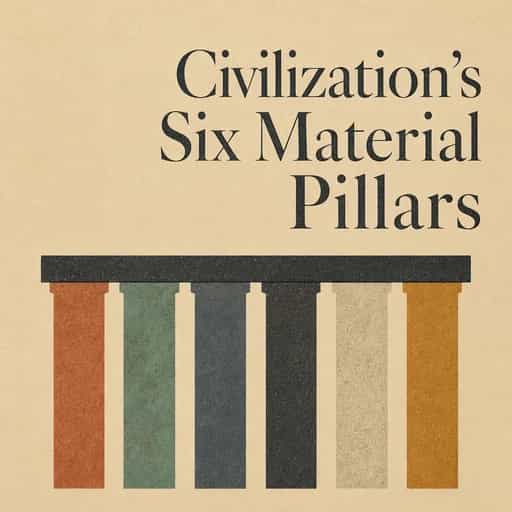
Ferguson's "Civilization" reveals how six "killer apps" - competition, science, property rights, medicine, consumerism, and work ethic - propelled Western dominance. Now as China adopts these same principles, are we witnessing the end of Western supremacy?
Niall Ferguson, author of Civilization: The West and the Rest, is a British-American historian and bestselling author renowned for his incisive analyses of global economic systems and geopolitical history.
A senior fellow at Stanford University’s Hoover Institution and former Harvard professor, Ferguson blends academic rigor with accessible storytelling to explore themes of institutional power, cultural evolution, and technological innovation.
His acclaimed works, including The Ascent of Money and The Square and the Tower, dissect the forces shaping civilizations, earning him accolades like the International Emmy for his PBS documentary series. A frequent commentator for Bloomberg and PBS, Ferguson also advises through Greenmantle LLC, a macroeconomic consultancy he founded.
Civilization has been translated into over 20 languages and underscores his reputation as a provocative thinker bridging past and present.
Civilization: The West and the Rest by Niall Ferguson analyzes how Western nations dominated global politics and economics from the 15th century through six "killer applications": competition, science, property rights, medicine, consumerism, and the Protestant work ethic. Ferguson argues that the West’s decline stems from losing its monopoly on these institutions while other nations adopted them, reshaping global power dynamics.
This book is ideal for history enthusiasts, students of geopolitics, and readers interested in macrohistorical trends. Ferguson’s accessible writing and provocative thesis appeal to those exploring institutional drivers of success, colonial legacies, or shifts in global influence. It also suits critics seeking a counter-narrative to Eurocentric historical analyses.
Yes, for its bold thesis and engaging storytelling. Ferguson combines historical anecdotes with economic theory, making complex ideas digestible. While criticized for oversimplification, the book sparks debate about Western exceptionalism and offers insights into contemporary power shifts. It’s a compelling primer on institutional advantages.
Niall Ferguson is a British historian and author of 15 books, including The Ascent of Money and Kissinger, 1923–1968: The Idealist. A Harvard professor and senior fellow at Stanford, he’s known for countercultural takes on empires, economics, and globalization. His work often bridges academia and public discourse.
Ferguson identifies six institutional advantages:
The West’s dominance emerged from institutional innovations absent elsewhere. Unlike monolithic Eastern empires, Europe’s decentralized states competed militarily and economically. Scientific breakthroughs, property rights, and consumer markets compounded advantages, while colonial medicine and Protestant ethics reinforced control. These "apps" created a self-reinforcing cycle of growth.
Ferguson claims the West is losing faith in its institutions (e.g., weakened property rights, declining work ethic), while nations like China adopt "downloaded" versions of its apps. Western stagnation and ideological self-doubt contrast with the Rest’s pragmatic modernization, accelerating a power rebalance.
Competition among European states spurred military, technological, and economic innovation. Fragmented governance prevented monopolies of power, unlike centralized empires in China or the Islamic world. This "killer app" drove exploration, industrialization, and democratic experimentation.
Scientific advances, like navigation tools and firearms, enabled colonial expansion. Medicine—particularly quinine—allowed Europeans to survive tropical diseases, securing control over Africa and Asia. Ferguson emphasizes science as both a tool of domination and a legacy of Enlightenment values.
Ferguson echoes Max Weber, tying capitalism’s rise to Protestantism’s emphasis on thrift, hard work, and delayed gratification. He notes China’s growing Christian population as a factor in its economic ascent, suggesting this ethic remains a modern "app" for success.
Critics accuse Ferguson of oversimplifying complex histories, neglecting non-Western innovations (e.g., Chinese maritime tech), and Eurocentrism. Some argue his "killer apps" ignore exploitation, slavery, and environmental costs embedded in Western dominance.
Unlike Jared Diamond’s Guns, Germs, and Steel (geographic determinism) or Yuval Noah Harari’s Sapiens (broad cultural shifts), Ferguson focuses on institutional factors. His framework parallels David Landes’ The Wealth and Poverty of Nations but with a tech-metaphor twist.
저자의 목소리로 책을 느껴보세요
지식을 흥미롭고 예시가 풍부한 인사이트로 전환
핵심 아이디어를 빠르게 캡처하여 신속하게 학습
재미있고 매력적인 방식으로 책을 즐기세요
The triumph of the West is not a story of unbroken success.
The Ming dynasty's inward turn proved fatal.
Europe's constant warfare yielded three unexpected benefits.
The West's predominance can no longer be taken for granted.
China's high-level equilibrium became fragile.
Civilization의 핵심 아이디어를 이해하기 쉬운 포인트로 분해하여 혁신적인 팀이 어떻게 창조하고, 협력하고, 성장하는지 이해합니다.
생생한 스토리텔링을 통해 Civilization을 경험하고, 혁신 교훈을 기억에 남고 적용할 수 있는 순간으로 바꿉니다.
무엇이든 묻고, 학습 스타일을 선택하고, 나에게 맞는 인사이트를 함께 만들어보세요.

샌프란시스코에서 컬럼비아 대학교 동문들이 만들었습니다
"Instead of endless scrolling, I just hit play on BeFreed. It saves me so much time."
"I never knew where to start with nonfiction—BeFreed’s book lists turned into podcasts gave me a clear path."
"Perfect balance between learning and entertainment. Finished ‘Thinking, Fast and Slow’ on my commute this week."
"Crazy how much I learned while walking the dog. BeFreed = small habits → big gains."
"Reading used to feel like a chore. Now it’s just part of my lifestyle."
"Feels effortless compared to reading. I’ve finished 6 books this month already."
"BeFreed turned my guilty doomscrolling into something that feels productive and inspiring."
"BeFreed turned my commute into learning time. 20-min podcasts are perfect for finishing books I never had time for."
"BeFreed replaced my podcast queue. Imagine Spotify for books — that’s it. 🙌"
"It is great for me to learn something from the book without reading it."
"The themed book list podcasts help me connect ideas across authors—like a guided audio journey."
"Makes me feel smarter every time before going to work"
샌프란시스코에서 컬럼비아 대학교 동문들이 만들었습니다

Civilization 요약을 무료 PDF 또는 EPUB으로 받으세요. 인쇄하거나 오프라인에서 언제든 읽을 수 있습니다.
When historian Niall Ferguson walked Shanghai's Bund in 2005, the realization struck him with clarity: the West's five-century dominance was ending. In a world where China builds the tallest skyscrapers and India launches Mars missions, it's easy to forget that Western civilization once seemed unstoppable. This provocative thesis forms the backbone of "Civilization," which challenges us to understand not just how the West rose to global dominance, but whether its unprecedented run might be concluding. The stark reversal of fortunes between East and West represents one of history's greatest paradoxes - how did the impoverished, disease-ridden backwaters of Europe overtake advanced Asian civilizations and dominate the globe for five centuries?
Imagine two worlds in 1420: China's Forbidden City, built by over a million workers, represented an advanced civilization at its peak. The Yongle Emperor commissioned an 11,000-volume encyclopedia requiring 2,000 scholars - the largest until Wikipedia in 2007. Meanwhile, London was a primitive backwater with just 40,000 inhabitants, crude walls, and only 37-year life expectancy. Chinese civilization had pioneered mechanical clocks, movable type printing, paper money, iron suspension bridges, rockets, and golf. Yet within a century, everything changed. While China turned inward after Zheng He's expeditions, Portugal's Vasco da Gama set sail with just four vessels "to make discoveries and go in search of spices." This expansion stemmed from Europe's competing polities versus China's unified empire. The Islamic world once led scientific advancement with the Bayt al-Hikma in ninth-century Baghdad, the first true hospitals, and algebra. Yet by 1683, as Ottoman armies retreated from Vienna, Western science surged ahead. Europe's Scientific Revolution benefited from the Christian separation of church and state, unlike Islam's insistence on combining religious and political authority. By the mid-1600s, scientific knowledge spread through printing presses and postal services, creating robust scholarly networks. Ottoman progress stalled when clerics convinced the Sultan that astronomical observation was blasphemous, leading to the destruction of Takiyuddin al-Rasid's Istanbul observatory in 1580.
Why did North America prosper while South America struggled? The answer lies in governing ideas, not geography or resources. The Anglo-American model was built on individual freedom and private property rights secured by representative constitutional government. This tale began with two ships: Spanish conquistadors seeking Inca wealth, and indentured servants seeking better lives through land ownership in South Carolina. The Spanish granted a tiny elite rights to exploit indigenous labor, creating a permanent underclass. In contrast, British colonies distributed land widely through the "headright system" - even indentured servants like Millicent How and Abraham Smith received land after completing their terms. This property-owners' democracy began humbly in Charleston but launched a governmental revolution. The key was social mobility: someone like Abraham Smith could arrive with nothing yet become both a property owner and voter within years. While the American Revolution created a federal republic that would become the world's wealthiest nation, South American revolutions led to instability and underdevelopment.
Western imperialism relied on medical science but perpetuated terrible abuses. West Africa became known as "the white man's graveyard" - with 16 percent of French colonial appointees dying between 1887 and 1912. Sir Rubert William Boyce declared that imperial success depended on conquering disease, with "the future of imperialism" lying "with the microscope." Western research prioritized European diseases over African ones. Scientific racism justified atrocities like Germany's Herero genocide, which reduced the population from 80,000 to 15,000 through starvation and concentration camps. German doctors conducted lethal experiments, performing 778 autopsies for "racial-biological research" in 1906 alone. World War I exposed colonialism's hypocrisy and the expendability of African troops. Clemenceau admitted in February 1918: "I would much prefer to have ten blacks killed than a single Frenchman." This fusion of scientific advancement with racial hierarchy would ultimately culminate in the Holocaust.
By 1910, the world achieved unprecedented economic integration through Western-invented networks of railways, steamships, and telegraphs. American railways alone could circle the earth thirteen times, while ocean freight costs plummeted. Western clothing styles spread globally, as seen when Japanese Crown Prince Hirohito ordered numerous Savile Row suits during his 1921 London visit. Blue jeans transformed from practical workwear into the world's most popular garment and a symbol of Soviet economic failure. The communist bloc couldn't produce this simple item. Behind the Iron Curtain, Western jeans represented liberation from drab uniforms, with authorities even establishing "jeans crimes" for denim-related violations. The communist regime's fundamental problem was its inability to respond to consumer preferences. The Party dictated needs (brown polyester suits) while the West produced what people wanted (jeans). By 1986, French philosopher Regis Debray observed: "There is more power in rock music, videos, blue jeans, fast food, news networks and TV satellites than in the entire Red Army."
Max Weber identified Protestantism as a key advantage in Western civilization's rise. During his 1904 visit to America's World Fair, Weber connected America's material success with its religious vitality. His seminal essay argued that Protestant sects viewed industry and thrift as expressions of godliness, with "tireless labor" signaling divine election. Evidence shows Protestant countries grew faster than Catholic ones. Protestantism's emphasis on Bible reading promoted literacy and human capital development through missionary schools. Today, while Europeans work less than Americans and Asians, Christianity flourishes in China. Wenzhou, known as "Chinese Jerusalem," exemplifies this phenomenon. This entrepreneurial city has grown from 480 churches before the Cultural Revolution to over 1,300 today. "Boss Christians" like Hanping Zhang, who employs 5,000 workers producing 500 million pens annually, embody Weber's Protestant work ethic in a Chinese context - suggesting Western civilization's key advantages can be transplanted.
China's economic transformation has been remarkable, with its per-capita GDP rising from 4% to 19% of America's in thirty years. IMF projections suggest China could surpass America's economy by 2020 in dollar terms, while America's federal debt has doubled as a share of GDP, with China holding over a fifth of foreign-owned US debt. Yet the East's rise doesn't signal Western civilization's decline - Western modes are actually flourishing globally. The West's distinction comes from its institutional package: political pluralism, capitalism, freedom of thought, scientific method, rule of law, property rights, and consumer society. The West still maintains more of these advantages than competitors like China (lacking political competition), Iran (lacking freedom of conscience), or Russia (lacking rule of law). The real threat comes from internal decay - our loss of faith in our inherited civilization. As Churchill noted, Western civilization's central principle is "the subordination of the ruling class to the settled customs of the people and to their will as expressed in the Constitution." Today, the greatest danger stems from our historical ignorance and failure to understand the institutional foundations of our prosperity. The question isn't whether others can download our "killer apps" - it's whether we've deleted them from our own cultural memory.