Inside the secretive Bank for International Settlements, where unelected bankers shape global finance. Adam LeBor's explosive expose - translated into 12 languages - reveals Nazi gold transactions and shadowy power structures that sparked comparisons to the populist thinking behind Brexit and Trump.
Adam LeBor is the acclaimed author of Tower of Basel: The Shadowy History of the Secret Bank that Runs the World and an investigative journalist specializing in international finance, European history, and covert institutions. This groundbreaking work of investigative non-fiction exposes the secretive Bank for International Settlements—a complex financial enterprise founded in 1930 that serves as the central bank for central banks—drawing on LeBor's decades of experience as a foreign correspondent covering central and eastern Europe for The Times, The Independent, and The Economist.
LeBor has authored nine non-fiction books, including the Orwell Prize-shortlisted Hitler's Secret Bankers, which exposed Swiss complicity with the Nazis, and City of Oranges, a New York Times Editor's Choice. He also writes thriller novels and currently contributes to the Financial Times, where he reviews financial and political books. LeBor works as an editorial trainer for Economist Education and the Financial Times, and serves as a journalism tutor at Budapest's Mathias Corvinus Collegium.
His books have been published in fourteen languages, including Chinese, Hebrew, and Japanese, establishing him as a leading voice on financial secrecy and institutional accountability.
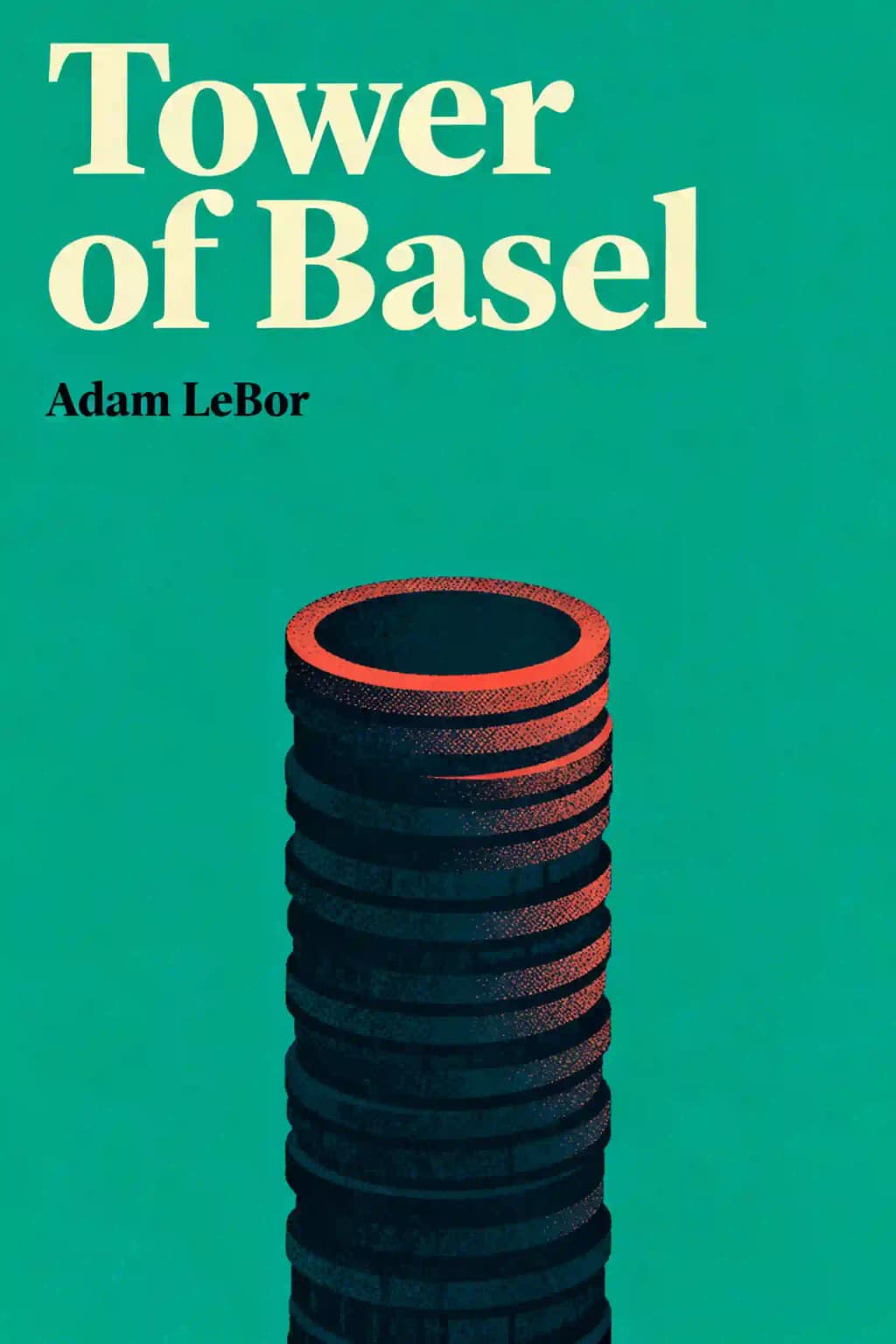
Tower of Basel by Adam LeBor is an investigative history of the Bank for International Settlements (BIS), the world's most secretive global financial institution. The book exposes the BIS's controversial role during World War II, when it accepted looted Nazi gold and facilitated transactions for the Reichsbank, while examining its continued influence over global monetary policy through closed-door meetings of central bank governors.
Adam LeBor is a British investigative journalist and author who worked as a foreign correspondent covering Hungary, central Europe, and the Balkans for The Times, The Independent, and The Economist. He has written nine non-fiction books, including Hitler's Secret Bankers, which was shortlisted for the Orwell Prize. LeBor specializes in exposing financial secrecy and European political affairs, with his work published in fourteen languages.
Tower of Basel is ideal for readers interested in global finance, central banking, economic history, and institutional power. Bankers, policymakers, economists, and investigative journalism enthusiasts will find value in LeBor's examination of financial secrecy. It's particularly relevant for those seeking to understand the hidden mechanisms behind international monetary policy and the accountability gaps in global financial institutions that shape economic outcomes.
Tower of Basel is worth reading for its groundbreaking research into an opaque institution, featuring exclusive interviews with Paul Volcker and Sir Mervyn King. However, critics note the book leans toward exposé rather than balanced history, with an emotional tone that some find borders on conspiratorial. It offers valuable insights into central banking secrecy but should be read alongside more neutral sources for complete perspective.
The Bank for International Settlements (BIS) is the central bankers' own bank, created in 1930 by the governors of the Bank of England and Reichsbank. Protected by international treaty, the BIS operates beyond any government's legal reach, with Swiss authorities having no jurisdiction over its premises or assets. With just 140 customers, it generated tax-free profits of $1.17 billion in 2011-2012 while coordinating global monetary policy.
Adam LeBor argues in Tower of Basel that the BIS is an opaque, elitist, and anti-democratic institution inappropriate for the 21st century. He criticizes its exemption from Swiss banking laws, lack of media access to confidential discussions, excessive profitability for a tax-exempt entity, and historical complicity with Nazi Germany. LeBor calls for reforms to increase transparency and accountability, though some reviewers find his conclusions harsh and unjustified.
Tower of Basel reveals that under American president Thomas McKittrick (1940-1946), the BIS remained open throughout World War II, accepting looted Nazi gold and conducting foreign exchange deals for the Reichsbank. LeBor argues the institution became a de facto German-controlled bank despite having non-German leadership, serving as a secret contact point between Allied and Axis powers to keep international finance channels open during wartime.
Tower of Basel differs significantly from Liaquat Ahamed's Lords of Finance, which offers a balanced history of modern central banking. While Ahamed provides scholarly analysis, LeBor writes from a more skeptical, investigative journalism perspective similar to his earlier work Hitler's Secret Bankers. Critics describe Tower of Basel as more exposé than historical review, with emotional undertones and focus on victimization that sets it apart from academic financial histories.
Tower of Basel profiles Thomas McKittrick (BIS president during WWII), Hjalmar Schacht (Reichsbank president), Montagu Norman (Bank of England governor), Allen Dulles (OSS director), Henry Morgenthau (Treasury Secretary), and Harry Dexter White. LeBor accuses McKittrick and Norman of actions bordering on treason for maintaining BIS operations that benefited Nazi Germany. The book uses these biographical narratives to illustrate broader institutional controversies.
Tower of Basel exposes how the BIS functions as a meeting ground where Federal Reserve, European Central Bank, and Bank of England officials coordinate policies largely shielded from public oversight. LeBor argues this arrangement reflects dominance by a transnational financial elite whose decisions profoundly affect global economies without democratic scrutiny. The book highlights the institution's role in developing Basel Committee banking standards and facilitating central bank cooperation.
Critics note Tower of Basel offers little new information about BIS wartime activities, as an independent academic review was published in 2005 by Cambridge University Press. The book's sensationalist title and emotional tone risk undermining scholarly credibility, with reviewers describing it as having "obvious bias." Some argue LeBor doesn't adequately explain the BIS's successful post-war evolution and valuable contributions to modern financial stability through data collection and research.
Tower of Basel identifies the Euro as a significant global contradiction—a transnational currency lacking transnational fiscal policy. Adam LeBor explains this represented a political compromise that overruled concerns from the Committee of Central Bankers at the BIS. His interviews with key bankers and use of primary sources provide insightful perspectives on European Community integration, though critics note there's limited new analysis compared to existing scholarship.
저자의 목소리로 책을 느껴보세요
지식을 흥미롭고 예시가 풍부한 인사이트로 전환
핵심 아이디어를 빠르게 캡처하여 신속하게 학습
재미있고 매력적인 방식으로 책을 즐기세요
The BIS was actually created to promote central bank cooperation free from political interference.
The BIS found itself "at the heart of the first experiment ever of a multilateral attempt at managing an international financial crisis."
Central banks and warfare had long been intertwined.
Schacht turned against the bank he helped create.
This chemical conglomerate was essentially a parallel state that would become an unprecedented synthesis of finance capital and mass murder.
Tower of Basel의 핵심 아이디어를 이해하기 쉬운 포인트로 분해하여 혁신적인 팀이 어떻게 창조하고, 협력하고, 성장하는지 이해합니다.
Tower of Basel을 빠른 기억 단서로 압축하여 솔직함, 팀워크, 창의적 회복력의 핵심 원칙을 강조합니다.

생생한 스토리텔링을 통해 Tower of Basel을 경험하고, 혁신 교훈을 기억에 남고 적용할 수 있는 순간으로 바꿉니다.
무엇이든 물어보고, 목소리를 선택하고, 진정으로 공감되는 인사이트를 함께 만들어보세요.

샌프란시스코에서 컬럼비아 대학교 동문들이 만들었습니다
"Instead of endless scrolling, I just hit play on BeFreed. It saves me so much time."
"I never knew where to start with nonfiction—BeFreed’s book lists turned into podcasts gave me a clear path."
"Perfect balance between learning and entertainment. Finished ‘Thinking, Fast and Slow’ on my commute this week."
"Crazy how much I learned while walking the dog. BeFreed = small habits → big gains."
"Reading used to feel like a chore. Now it’s just part of my lifestyle."
"Feels effortless compared to reading. I’ve finished 6 books this month already."
"BeFreed turned my guilty doomscrolling into something that feels productive and inspiring."
"BeFreed turned my commute into learning time. 20-min podcasts are perfect for finishing books I never had time for."
"BeFreed replaced my podcast queue. Imagine Spotify for books — that’s it. 🙌"
"It is great for me to learn something from the book without reading it."
"The themed book list podcasts help me connect ideas across authors—like a guided audio journey."
"Makes me feel smarter every time before going to work"
샌프란시스코에서 컬럼비아 대학교 동문들이 만들었습니다

Tower of Basel 요약을 무료 PDF 또는 EPUB으로 받으세요. 인쇄하거나 오프라인에서 언제든 읽을 수 있습니다.
Imagine a circular tower in Basel, Switzerland, where eighteen unelected individuals meet every other month to make decisions that affect your daily life - from mortgage rates to job security. These central bankers control the global money supply and set interest rates that ripple through economies worldwide. Their meetings occur behind closed doors, their communications protected by diplomatic immunity, and their staff enjoy generous tax-free salaries. Welcome to the Bank for International Settlements (BIS) - arguably the world's most powerful and secretive financial institution. Founded in 1930 ostensibly to manage German war reparations, the BIS actually emerged as a sanctuary where central bankers could coordinate global finance away from political interference. Today, when these governors meet, they represent countries comprising four-fifths of global GDP - wielding more practical power than most elected officials on earth. Yet how many people even know this institution exists? What makes this story fascinating isn't just the concentration of power, but how this secretive club has survived - and thrived - through economic collapse, world war, and financial crises. The BIS has reinvented itself repeatedly, from managing Nazi gold to architecting the euro to designing the regulations that govern your bank account today.