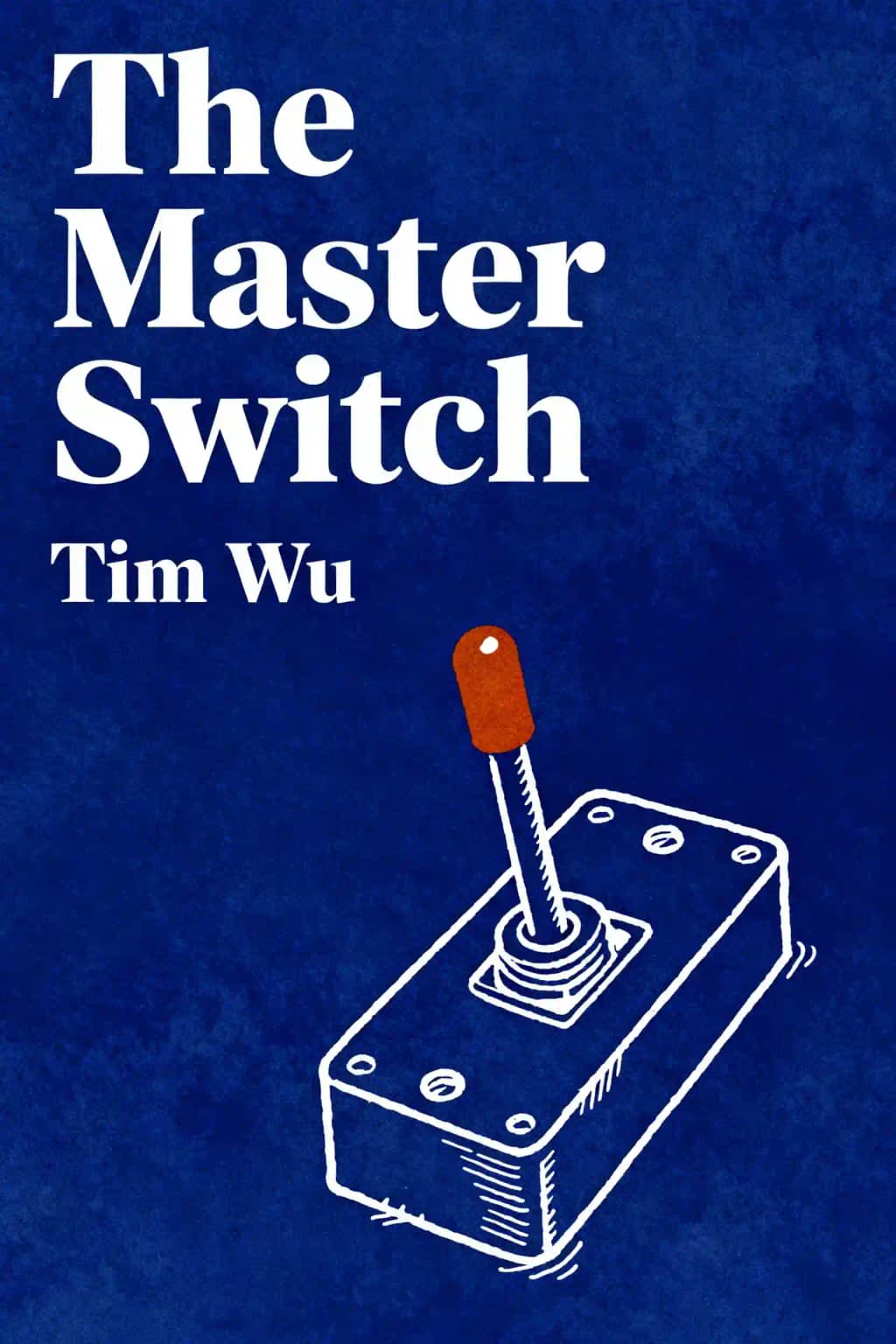
In "The Master Switch," Tim Wu reveals how information empires rise and fall in predictable cycles. Endorsed by Lawrence Lessig and featured in The New Yorker's best books, Wu's concept of "The Cycle" has transformed tech policy debates. What freedoms are we surrendering to digital monopolies?
Tim Wu, born in 1972, is a renowned legal scholar and a professor at Columbia Law School. He is also the bestselling author of The Master Switch: The Rise and Fall of Information Empires.
Wu is a leading authority on technology policy and antitrust. His work explores the cyclical consolidation of corporate power in media and telecommunications.
Wu's insights stem from his roles as Senior Advisor to the Federal Trade Commission, as a member of the White House National Economic Council, and as a clerk for Supreme Court Justice Stephen Breyer.
Wu’s expertise extends to notable works like Who Controls the Internet? and The Attention Merchants, and his commentary regularly appears in The New Yorker and The New York Times. Recognized by the National Law Journal as one of America’s 100 most influential lawyers, Wu’s advocacy for net neutrality has shaped global internet policy.
The Master Switch was hailed as a Best Book of the Year by The New Yorker, Bloomberg, and The Economist, cementing Wu’s reputation as a critical voice in understanding technology’s societal impact.
The Master Switch examines the recurring Cycle in information industries, where technologies like telephony, radio, and film transition from open innovation to monopolistic control. Tim Wu argues this pattern threatens the internet’s openness, drawing parallels to corporate giants like AT&T and Hollywood studios. The book combines historical analysis with warnings about modern tech monopolies.
Tech professionals, policymakers, and media historians will benefit from Wu’s insights into corporate power and regulatory challenges. It’s also valuable for readers interested in internet governance, antitrust issues, or the historical evolution of communication technologies.
Yes. The book offers a compelling blend of historical case studies and forward-looking analysis, making it essential for understanding tech monopolies. Praised for its depth, it remains relevant in debates about net neutrality and corporate control of digital infrastructure.
The Cycle refers to the pattern where new technologies (e.g., telephones, radio) start as open systems but become dominated by monopolies. Wu warns the internet could follow, leading to centralized control. Historical examples include AT&T’s telephone monopoly and Hollywood’s studio system.
Wu’s analysis foreshadows struggles between open platforms and corporate control, citing Apple, Google, and AT&T. The book warns that unchecked power in tech could replicate historical monopolies, stifling innovation and public discourse.
“Every so often, a disruptive invention replaces existing technologies utterly.” This underscores The Cycle’s inevitability without proactive regulation. Another pivotal line: “The master switch is a quest for control over information.”
Some critics argue Wu oversimplifies complex industries into The Cycle framework. Others note the book prioritizes corporate power narratives over technical nuances, potentially underestimating grassroots innovation’s role.
While both address tech monopolies, Wu focuses on historical cycles of control, whereas The Googlization of Everything critiques data exploitation. The former emphasizes regulatory solutions; the latter highlights privacy concerns.
A Columbia Law professor and advocate for net neutrality, Wu’s expertise spans antitrust law and communication history. His work influenced U.S. policy debates on internet freedom and corporate power.
With ongoing battles over AI governance and tech consolidation, Wu’s warnings about monopolistic control remain urgent. The book provides a framework for understanding current regulatory challenges and preserving digital openness.
저자의 목소리로 책을 느껴보세요
지식을 흥미롭고 예시가 풍부한 인사이트로 전환
핵심 아이디어를 빠르게 캡처하여 신속하게 학습
재미있고 매력적인 방식으로 책을 즐기세요
It was 'purchase or perish'—the same model...
Radio inspired extraordinary faith in its potential to transform society.
Vail believed redundant phone lines were as wasteful as duplicate railroad tracks.
Reith insisted radio must not become 'mere entertainment'.
The evening's highlight...left the audience 'staggered'.
The Master Switch의 핵심 아이디어를 이해하기 쉬운 포인트로 분해하여 혁신적인 팀이 어떻게 창조하고, 협력하고, 성장하는지 이해합니다.
The Master Switch을 빠른 기억 단서로 압축하여 솔직함, 팀워크, 창의적 회복력의 핵심 원칙을 강조합니다.

생생한 스토리텔링을 통해 The Master Switch을 경험하고, 혁신 교훈을 기억에 남고 적용할 수 있는 순간으로 바꿉니다.
무엇이든 물어보고, 목소리를 선택하고, 진정으로 공감되는 인사이트를 함께 만들어보세요.

샌프란시스코에서 컬럼비아 대학교 동문들이 만들었습니다
"Instead of endless scrolling, I just hit play on BeFreed. It saves me so much time."
"I never knew where to start with nonfiction—BeFreed’s book lists turned into podcasts gave me a clear path."
"Perfect balance between learning and entertainment. Finished ‘Thinking, Fast and Slow’ on my commute this week."
"Crazy how much I learned while walking the dog. BeFreed = small habits → big gains."
"Reading used to feel like a chore. Now it’s just part of my lifestyle."
"Feels effortless compared to reading. I’ve finished 6 books this month already."
"BeFreed turned my guilty doomscrolling into something that feels productive and inspiring."
"BeFreed turned my commute into learning time. 20-min podcasts are perfect for finishing books I never had time for."
"BeFreed replaced my podcast queue. Imagine Spotify for books — that’s it. 🙌"
"It is great for me to learn something from the book without reading it."
"The themed book list podcasts help me connect ideas across authors—like a guided audio journey."
"Makes me feel smarter every time before going to work"
샌프란시스코에서 컬럼비아 대학교 동문들이 만들었습니다

The Master Switch 요약을 무료 PDF 또는 EPUB으로 받으세요. 인쇄하거나 오프라인에서 언제든 읽을 수 있습니다.
In 1916, a white-haired executive stood before Washington's elite at the New Willard Hotel, demonstrating something extraordinary: voice calls connecting guests to General Pershing at the Mexican border, and a revolutionary wireless telephone that left the audience "staggered." Theodore Vail, president of AT&T, had transformed a scrappy startup into America's most powerful monopoly. But here's the twist-forty years earlier, that same company was just three people working in a Boston attic, challenging the telegraph giant Western Union. How did Bell go from underdog to empire? And more importantly, why does this pattern keep repeating with every new technology we create? From radio to film, television to the internet, information industries follow an eerily predictable cycle: they begin open and chaotic, then consolidate into empires, only to be disrupted again. Understanding this rhythm isn't just academic-it's essential for recognizing the forces shaping our digital lives today. Alexander Bell's telephone didn't just improve communication-it threatened to destroy the telegraph entirely. This is what economist Joseph Schumpeter called "creative destruction," where innovation strikes "not at the margins of profits but at foundations and very lives" of existing firms. Western Union initially dismissed the telephone, then tried crushing Bell's tiny company, yet Bell's patent became an impenetrable shield.