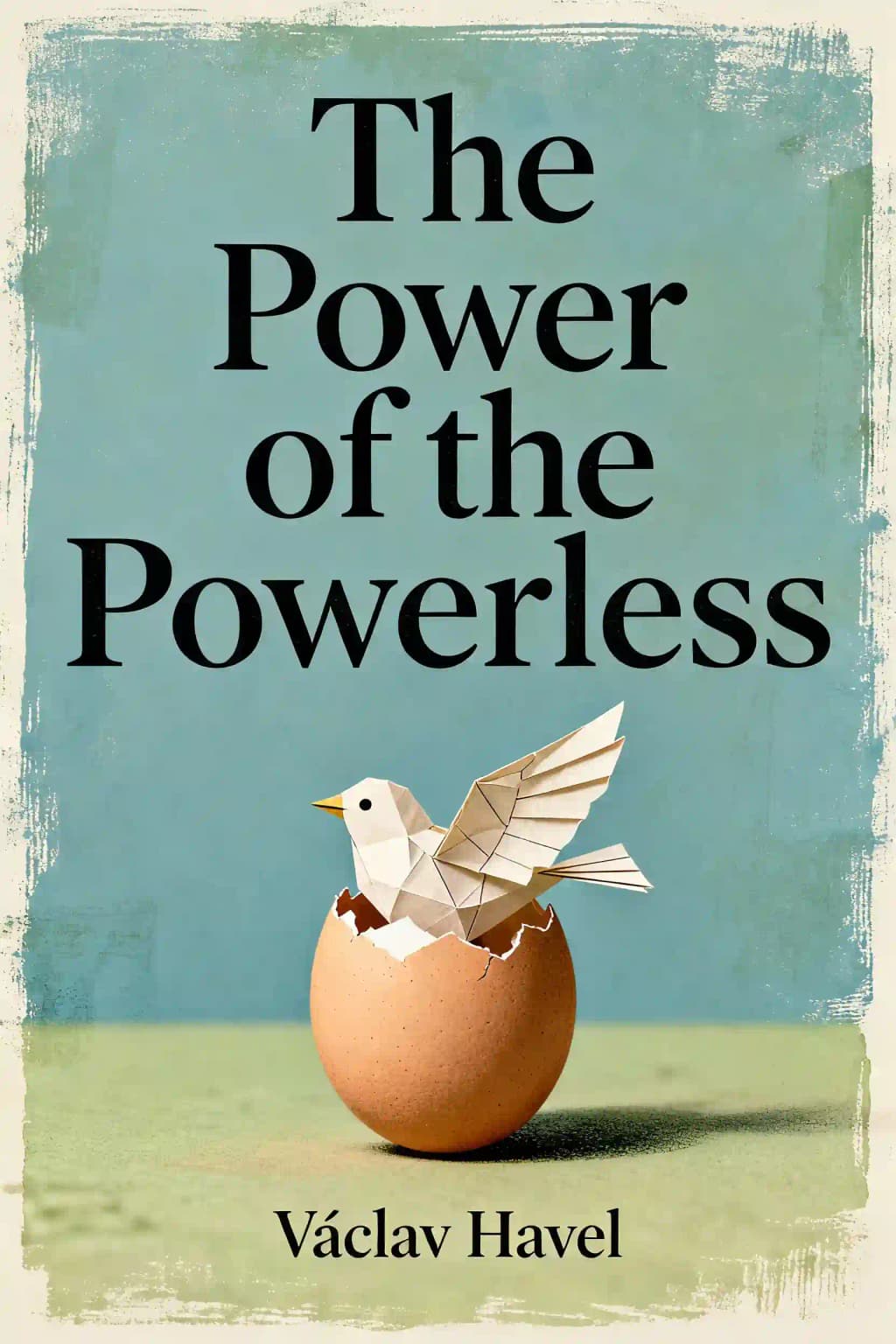
Havel's revolutionary essay challenged communist oppression through "living in truth" - inspiring the Velvet Revolution and global movements. This dissident manifesto, celebrated by intellectuals worldwide, reveals how small acts of defiance can topple entire regimes. What's your first step toward authentic resistance?
Václav Havel (1936–2011), author of The Power of the Powerless, was a Czech playwright, political dissident, and former president whose works dissect authoritarianism and moral responsibility.
This seminal essay collection, rooted in dissident literature and political philosophy, draws from Havel’s firsthand experience challenging Czechoslovakia’s communist regime through his involvement with Charter 77 and his absurdist plays like The Memorandum and The Garden Party.
A Nobel Peace Prize nominee, Havel’s other notable works include the prison correspondence Letters to Olga and the presidential memoir To the Castle and Back. After surviving censorship and imprisonment, he led Czechoslovakia’s Velvet Revolution and became its first democratic president in 1989.
Translated into over 20 languages, The Power of the Powerless remains a cornerstone of resistance literature, taught in political science curricula and cited by global human rights movements.
The Power of the Powerless critiques authoritarian regimes by arguing that ordinary individuals hold latent power to dismantle oppressive systems by rejecting ideological lies and "living in truth." Havel uses the metaphor of a greengrocer who stops displaying propaganda slogans, disrupting the system’s façade of control. The essay emphasizes how small acts of authenticity expose the fragility of regimes built on collective compliance.
This book is essential for activists, political theorists, and anyone interested in nonviolent resistance or 20th-century dissident thought. It resonates with readers navigating modern issues like systemic oppression, censorship, or ethical compromise in bureaucratic systems. Havel’s insights into individual agency make it valuable for leaders and changemakers seeking strategies for moral courage.
"Living in truth" involves rejecting participation in ideological rituals that sustain oppressive systems. Havel argues that even mundane acts of honesty—like refusing to parrot state propaganda—undermine authoritarian control by exposing its reliance on collective dishonesty. This concept became a rallying cry for Eastern European dissenters, illustrating how personal integrity fuels political transformation.
Havel contends that oppressive systems depend on public compliance: when individuals withdraw consent through acts of truth, they erode the regime’s legitimacy. The "powerless" gain influence by refusing to prop up the system’s lies, creating cracks in its ideological foundation. This idea inspired movements like Poland’s Solidarity and Czechoslovakia’s Velvet Revolution.
Havel likens ideology to a "secularized religion" that offers false certainty while demanding obedience. He argues that regimes use rituals—like mandatory slogan displays—to enforce compliance, but these become hollow performances divorced from reality. The essay warns that unchecked ideology dehumanizes both rulers and citizens.
The greengrocer symbolizes ordinary citizens who unconsciously uphold oppression by following trivial rules, like hanging propaganda signs. When he stops complying, he exposes the system’s dependence on collective lies, demonstrating how individual defiance can inspire broader resistance. This parable illustrates Havel’s belief in the subversive power of minor acts.
Havel’s analysis remains relevant to modern autocracies and illiberal democracies, where censorship and performative loyalty tests persist. The essay’s focus on media manipulation, bureaucratic complicity, and grassroots resistance offers a framework for understanding digital-age repression and activism. Its lessons apply to movements like Hong Kong’s pro-democracy protests.
These lines underscore Havel’s thesis that regimes crumble when citizens collectively recognize their falsity.
Havel argues both systems face dehumanizing bureaucracy, but Eastern regimes mask oppression through rigid ideology, while the West uses consumerism and superficial freedoms. Both risk reducing individuals to passive subjects, though the mechanisms differ.
Some scholars argue Havel overestimates individual agency’s impact without addressing structural violence. Others note his focus on moral clarity risks oversimplifying systemic change. Nonetheless, the essay remains a cornerstone of dissident literature.
While both critique totalitarianism, Havel emphasizes incremental resistance through daily integrity, whereas Solzhenitsyn focuses on exposing systemic brutality. Havel’s approach is more pragmatic for activists in less overtly repressive regimes.
The essay’s insights into misinformation, ethical complicity, and grassroots mobilization apply to modern challenges like AI-driven censorship, corporate surveillance, and climate activism. Havel’s call for “living in truth” offers a timeless blueprint for resisting authoritarianism in any form.
저자의 목소리로 책을 느껴보세요
지식을 흥미롭고 예시가 풍부한 인사이트로 전환
핵심 아이디어를 빠르게 캡처하여 신속하게 학습
재미있고 매력적인 방식으로 책을 즐기세요
The manager of a fruit and vegetable shop places in his window, among the onions and carrots, the slogan: 'Workers of the world, unite!' Why does he do it? What is he trying to communicate to the world?
Individuals need not believe all these mystifications, but they must behave as though they did, or they must at least tolerate them in silence, or get out of the way.
Ideology is a specious way of relating to the world. It offers human beings the illusion of an identity, of dignity, and of morality while making it easier for them to part with them.
The primary excusatory function of ideology, therefore, is to provide people, both as victims and pillars of the post-totalitarian system, with the illusion that the system is in harmony with the human order and the order of the universe.
If the main pillar of the system is living a lie, then it is not surprising that the fundamental threat to it is living in truth.
Power of the Powerless의 핵심 아이디어를 이해하기 쉬운 포인트로 분해하여 혁신적인 팀이 어떻게 창조하고, 협력하고, 성장하는지 이해합니다.
Power of the Powerless을 빠른 기억 단서로 압축하여 솔직함, 팀워크, 창의적 회복력의 핵심 원칙을 강조합니다.

생생한 스토리텔링을 통해 Power of the Powerless을 경험하고, 혁신 교훈을 기억에 남고 적용할 수 있는 순간으로 바꿉니다.
무엇이든 물어보고, 목소리를 선택하고, 진정으로 공감되는 인사이트를 함께 만들어보세요.

샌프란시스코에서 컬럼비아 대학교 동문들이 만들었습니다
"Instead of endless scrolling, I just hit play on BeFreed. It saves me so much time."
"I never knew where to start with nonfiction—BeFreed’s book lists turned into podcasts gave me a clear path."
"Perfect balance between learning and entertainment. Finished ‘Thinking, Fast and Slow’ on my commute this week."
"Crazy how much I learned while walking the dog. BeFreed = small habits → big gains."
"Reading used to feel like a chore. Now it’s just part of my lifestyle."
"Feels effortless compared to reading. I’ve finished 6 books this month already."
"BeFreed turned my guilty doomscrolling into something that feels productive and inspiring."
"BeFreed turned my commute into learning time. 20-min podcasts are perfect for finishing books I never had time for."
"BeFreed replaced my podcast queue. Imagine Spotify for books — that’s it. 🙌"
"It is great for me to learn something from the book without reading it."
"The themed book list podcasts help me connect ideas across authors—like a guided audio journey."
"Makes me feel smarter every time before going to work"
샌프란시스코에서 컬럼비아 대학교 동문들이 만들었습니다

Power of the Powerless 요약을 무료 PDF 또는 EPUB으로 받으세요. 인쇄하거나 오프라인에서 언제든 읽을 수 있습니다.
Picture a simple greengrocer arranging his vegetables, then dutifully placing a sign that reads "Workers of the World, Unite!" Why? Not from revolutionary fervor, but because it's expected. This mundane act forms the cornerstone of Vaclav Havel's brilliant analysis of what he calls "post-totalitarian" systems-regimes that no longer rely primarily on terror but on something more insidious: our complicity in our own oppression. The sign communicates: "I behave as expected. I am obedient." The greengrocer would never display a sign reading "I am afraid," because he'd be ashamed. Instead, ideology provides a veneer of nobility that conceals the true nature of his surrender. This daily ritual of small compliance becomes woven into society's fabric, where each citizen becomes both victim and supporter of the system. This is the genius of modern totalitarianism-it offers citizens the illusion of dignity while making it easier to surrender their authentic selves. The system creates a web where everyone monitors everyone else, making resistance not just dangerous but socially awkward. Ideology serves as a bridge between regime and people, presenting the system as natural and opposition as not just illegal but unnatural. The system requires not fanaticism but passive acceptance-the willingness to "live within a lie."
