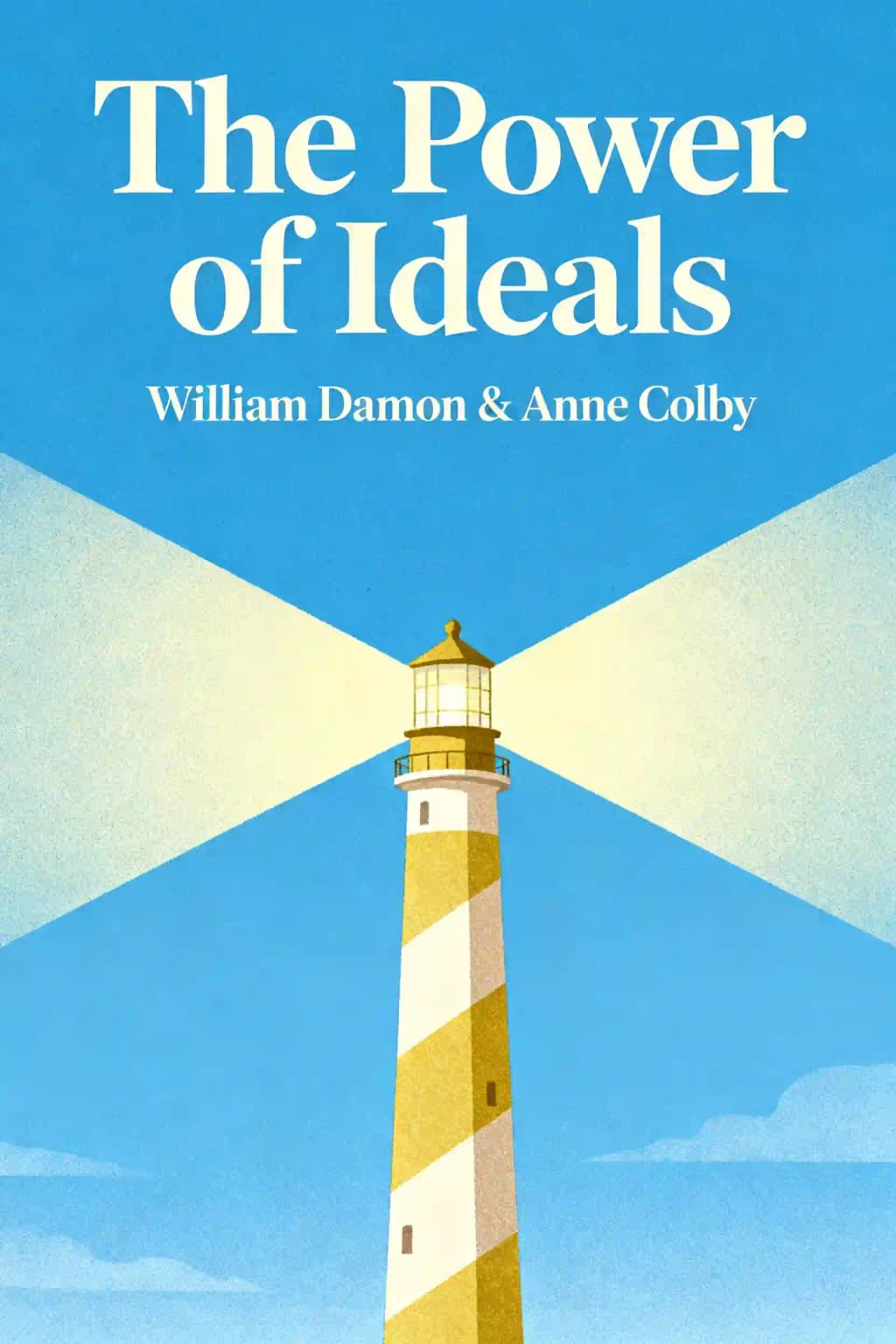
In "The Power of Ideals," Stanford professors Damon and Colby challenge biological determinism, revealing how moral excellence shapes our choices. Through stories of Nelson Mandela and Eleanor Roosevelt, they prove what Pamela King called "accessible to all" - the transformative power of truthfulness, humility, and faith.
William Damon and Anne Colby, leading scholars in moral psychology and human development, co-authored The Power of Ideals: The Real Story of Moral Choice, a groundbreaking exploration of virtue ethics and moral decision-making.
Damon, a Stanford University professor and director of the Stanford Center on Adolescence, partners with Colby, a renowned developmental psychologist, to blend rigorous academic research with real-world case studies of influential 20th-century leaders like Eleanor Roosevelt and Nelson Mandela.
Their work builds on their acclaimed prior collaboration, Some Do Care: Contemporary Lives of Moral Commitment, which established their "exemplar methodology" for studying ethical leadership. As Senior Fellows at Stanford’s Hoover Institution, they bridge psychological science with practical insights on cultivating truthfulness, humility, and purpose.
Published by Oxford University Press in 2015, The Power of Ideals reflects their decades of research into how individuals develop moral courage and commit to ideals beyond self-interest. Damon’s other works, including The Path to Purpose and Good Work (with Howard Gardner), further solidify his reputation as a pioneer in purpose-driven development studies.
The Power of Ideals challenges the notion that morality is biologically predetermined, arguing instead that humans actively cultivate virtues like truthfulness, humility, and faith. Through case studies of 20th-century leaders like Nelson Mandela and Eleanor Roosevelt, the book explores how ideals shape moral choices and inspire societal progress.
Educators, psychologists, and readers interested in moral development will benefit from this book. Its blend of academic research and real-world examples makes it valuable for professionals studying ethics, leadership, or human behavior, as well as general audiences seeking insights into purposeful living.
Yes—it offers a fresh perspective on morality by combining psychological research with profiles of moral exemplars. The book’s critique of deterministic theories and emphasis on personal agency provide actionable insights for cultivating virtues in daily life.
The book disputes claims that morality is purely instinctive, highlighting how individuals like Jane Addams and Abraham Joshua Heschel consciously adhered to ideals despite external pressures. This contrasts with theories emphasizing evolutionary or social determinism.
Profiles include Nelson Mandela (social justice), Eleanor Roosevelt (human rights), and Dietrich Bonhoeffer (resistance to tyranny). Their stories illustrate how ideals can transcend personal gain.
The authors suggest fostering self-reflection, seeking role models, and integrating ideals into daily decisions. Education and mentorship are key to transmitting values across generations.
Yes—Chapter 2 explains how family, schools, and peers shape ideals during youth. Parents and educators play critical roles in nurturing moral frameworks that evolve with experience.
William Damon and Anne Colby are Stanford professors specializing in human development and ethics. Damon pioneered research on purpose in life, while Colby co-authored studies on moral education and professional integrity.
Unlike works focusing on innate traits (e.g., Jonathan Haidt’s The Righteous Mind), this book emphasizes conscious moral choice. It aligns with Carol Dweck’s growth mindset but adds a focus on societal impact.
Some argue the reliance on exceptional individuals may overlook everyday moral struggles. Critics also note limited empirical data on scaling ideals in broader populations.
저자의 목소리로 책을 느껴보세요
지식을 흥미롭고 예시가 풍부한 인사이트로 전환
핵심 아이디어를 빠르게 캡처하여 신속하게 학습
재미있고 매력적인 방식으로 책을 즐기세요
Truthfulness, humility, and faith create lives of extraordinary impact.
Contemporary moral psychology has taken a troubling turn.
The child as moral philosopher actively making sense of social experiences.
People are also moved by concern for others.
Existence is meaningful.
Power of Ideals의 핵심 아이디어를 이해하기 쉬운 포인트로 분해하여 혁신적인 팀이 어떻게 창조하고, 협력하고, 성장하는지 이해합니다.
Power of Ideals을 빠른 기억 단서로 압축하여 솔직함, 팀워크, 창의적 회복력의 핵심 원칙을 강조합니다.

생생한 스토리텔링을 통해 Power of Ideals을 경험하고, 혁신 교훈을 기억에 남고 적용할 수 있는 순간으로 바꿉니다.
무엇이든 물어보고, 목소리를 선택하고, 진정으로 공감되는 인사이트를 함께 만들어보세요.

샌프란시스코에서 컬럼비아 대학교 동문들이 만들었습니다
"Instead of endless scrolling, I just hit play on BeFreed. It saves me so much time."
"I never knew where to start with nonfiction—BeFreed’s book lists turned into podcasts gave me a clear path."
"Perfect balance between learning and entertainment. Finished ‘Thinking, Fast and Slow’ on my commute this week."
"Crazy how much I learned while walking the dog. BeFreed = small habits → big gains."
"Reading used to feel like a chore. Now it’s just part of my lifestyle."
"Feels effortless compared to reading. I’ve finished 6 books this month already."
"BeFreed turned my guilty doomscrolling into something that feels productive and inspiring."
"BeFreed turned my commute into learning time. 20-min podcasts are perfect for finishing books I never had time for."
"BeFreed replaced my podcast queue. Imagine Spotify for books — that’s it. 🙌"
"It is great for me to learn something from the book without reading it."
"The themed book list podcasts help me connect ideas across authors—like a guided audio journey."
"Makes me feel smarter every time before going to work"
샌프란시스코에서 컬럼비아 대학교 동문들이 만들었습니다

Power of Ideals 요약을 무료 PDF 또는 EPUB으로 받으세요. 인쇄하거나 오프라인에서 언제든 읽을 수 있습니다.
What drives a person to risk everything for a principle? To stand alone against tyranny, to sacrifice comfort for justice, to choose truth when lies would be easier? These aren't rhetorical questions-they're the puzzles at the heart of human morality. We live in an age increasingly cynical about goodness itself, where researchers reduce compassion to brain chemistry and philosophers dismiss virtue as evolutionary programming. Yet history keeps producing people who shatter these tidy explanations: individuals who transform suffering into purpose, who see injustice and refuse to look away, who build movements from moral conviction alone. The gap between what science says we are and what we sometimes become reveals something profound about human nature-something that can't be measured in laboratory experiments or explained away by genes and culture.