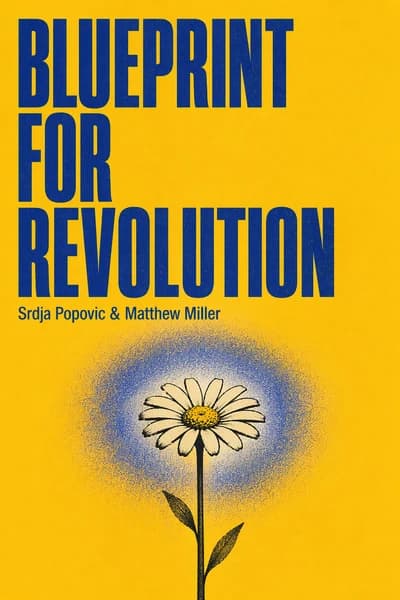
Discover how rice pudding and Lego men toppled dictators. Endorsed by Peter Gabriel, Popovic's revolutionary guidebook reveals nonviolent tactics that mobilized Serbia against Milosevic and inspired global movements. Want to change the world? Start with humor, creativity, and strategic battles.
Srdja Popovic and Matthew Miller, co-authors of Blueprint for Revolution: How to Use Rice Pudding, Lego Men, and Other Nonviolent Techniques to Galvanize Communities, Overthrow Dictators, or Simply Change the World, are leading voices in strategic nonviolent activism.
Popovic, a Serbian political strategist and founder of the Centre for Applied Nonviolent Action and Strategies (CANVAS), draws from his pivotal role in toppling Slobodan Milošević’s regime through the Otpor! movement. His expertise in grassroots mobilization and creative dissent, honed over decades of training global activists, anchors this political science guide to peaceful revolution. Miller’s collaborative writing amplifies Popovic’s insights into tactical frameworks like “laughtivism” and unity-building.
Popovic’s TED Talk and CANVAS workshops—featured in the documentary Bringing Down a Dictator—have influenced movements from Ukraine’s Orange Revolution to Egypt’s Arab Spring. The book, praised by The Guardian as “fantastically readable” and nominated for The Atlantic’s book of the month, blends case studies with actionable advice for activists. Translated into seven languages, including Spanish and Arabic, it remains a cornerstone resource for global democracy campaigns.
Blueprint for Revolution outlines practical strategies for nonviolent activism, teaching how humor, creativity, and unity can dismantle oppressive systems. The book draws from real-world movements like Serbia’s Otpor! and the Arab Spring, emphasizing small victories, neutralizing regime pillars, and fostering mass mobilization. It blends tactical advice with anecdotes (e.g., using Lego men as protest symbols) to show how ordinary people can drive systemic change.
This book is ideal for activists, community organizers, and anyone seeking tools for social change. It’s also valuable for NGOs, educators, and students studying political science or civil resistance. Popovic’s insights cater to both seasoned campaigners and newcomers aiming to understand nonviolent strategy’s power against authoritarianism.
Yes, for its actionable frameworks and engaging case studies, though critics note oversimplification of complex conflicts. It offers a fresh perspective on activism—highlighting humor’s role and the importance of planning—but may lack depth in addressing post-revolution governance challenges. Ideal for readers seeking inspiration and tactical guidance.
Popovic advocates beginning with small, winnable battles to build momentum (e.g., localized protests). Movements should frame clear, inclusive goals (like Serbia’s “Gotov je” slogan) and use creativity (e.g., satirical art) to engage diverse groups. Early victories foster confidence and attract broader participation.
Humor (“laughtivism”) disarms opponents and galvanizes support. Examples include Otpor!’s mockery of Milosevic through street theater and absurdist visuals. By reframing fear into ridicule, activists undermine authoritarian legitimacy while making protests accessible and shareable.
Popovic identifies four pillars: security forces, media, bureaucracy, and economic elites. Successful movements weaken these by persuading police to defect, countering state propaganda, and disrupting fiscal systems. Serbia’s revolution collapsed Milosevic’s regime by eroding police loyalty and media control.
It stresses training activists to resist provocation, isolating violent instigators, and embedding nonviolence as a core ideology. Trust-building via transparency and accountability helps sustain unity. Egypt’s Tahrir Square protests exemplify this approach.
The Egyptian Revolution’s post-Mubarak collapse underscores the need for post-victory planning. Popovic argues movements must prepare to govern, address economic instability, and prevent counterrevolutions. Lasting change requires institutional rebuilding, not just regime removal.
While both emphasize strategic nonviolence, Popovic focuses on grassroots creativity and humor, whereas Sharp’s From Dictatorship to Democracy is more theoretical. The book supplements Sharp’s frameworks with practical tools for modern digital-era activism.
Yes—Popovic notes strategies like unifying narratives and incremental wins work for environmental, labor, or corporate accountability campaigns. The book’s principles adapt to any context where power imbalances exist.
Some argue it oversimplifies conflicts (e.g., ignoring ethnic tensions) and underplays risks activists face. Critics also note its focus on toppling regimes lacks guidance for rebuilding democracies. However, its practical toolkit remains widely praised.
저자의 목소리로 책을 느껴보세요
지식을 흥미롭고 예시가 풍부한 인사이트로 전환
핵심 아이디어를 빠르게 캡처하여 신속하게 학습
재미있고 매력적인 방식으로 책을 즐기세요
Activism could be cool and effective, not boring or futile.
Getting arrested became a badge of honor.
Laughter effectively fights the fear that fuels dictatorships.
Effective activism starts small.
Food makes an ideal rallying point for activism.
Blueprint for Revolution의 핵심 아이디어를 이해하기 쉬운 포인트로 분해하여 혁신적인 팀이 어떻게 창조하고, 협력하고, 성장하는지 이해합니다.
Blueprint for Revolution을 빠른 기억 단서로 압축하여 솔직함, 팀워크, 창의적 회복력의 핵심 원칙을 강조합니다.

생생한 스토리텔링을 통해 Blueprint for Revolution을 경험하고, 혁신 교훈을 기억에 남고 적용할 수 있는 순간으로 바꿉니다.
무엇이든 물어보고, 목소리를 선택하고, 진정으로 공감되는 인사이트를 함께 만들어보세요.

샌프란시스코에서 컬럼비아 대학교 동문들이 만들었습니다
"Instead of endless scrolling, I just hit play on BeFreed. It saves me so much time."
"I never knew where to start with nonfiction—BeFreed’s book lists turned into podcasts gave me a clear path."
"Perfect balance between learning and entertainment. Finished ‘Thinking, Fast and Slow’ on my commute this week."
"Crazy how much I learned while walking the dog. BeFreed = small habits → big gains."
"Reading used to feel like a chore. Now it’s just part of my lifestyle."
"Feels effortless compared to reading. I’ve finished 6 books this month already."
"BeFreed turned my guilty doomscrolling into something that feels productive and inspiring."
"BeFreed turned my commute into learning time. 20-min podcasts are perfect for finishing books I never had time for."
"BeFreed replaced my podcast queue. Imagine Spotify for books — that’s it. 🙌"
"It is great for me to learn something from the book without reading it."
"The themed book list podcasts help me connect ideas across authors—like a guided audio journey."
"Makes me feel smarter every time before going to work"
샌프란시스코에서 컬럼비아 대학교 동문들이 만들었습니다

Blueprint for Revolution 요약을 무료 PDF 또는 EPUB으로 받으세요. 인쇄하거나 오프라인에서 언제든 읽을 수 있습니다.
Picture a flatbed truck circling Belgrade's Republic Square, blasting punk rock anthems with lyrics like "If I shoot, then I won't have time to fuck." This wasn't just teenage rebellion-it was the spark that would ignite a revolution. Srdja Popovic, a bass guitarist in a punk band, witnessed this moment and realized something profound: activism didn't have to be dreary committee meetings and earnest speeches. It could be cool, irreverent, and actually work. Fast forward to 2011, and Egyptian protesters toppling Hosni Mubarak carried signs featuring the same clenched fist symbol that had become iconic in Serbia's revolution a decade earlier. That symbol-and the strategy behind it-came from Otpor!, the student movement Popovic helped create. What started as spray-painted fists across Belgrade became a blueprint copied in over 50 countries. The wisdom isn't theoretical-it's battle-tested by ordinary people who faced down tanks, secret police, and brutal dictators armed with nothing but creativity and courage.