1장
Love's Weight in an Unanchored Universe
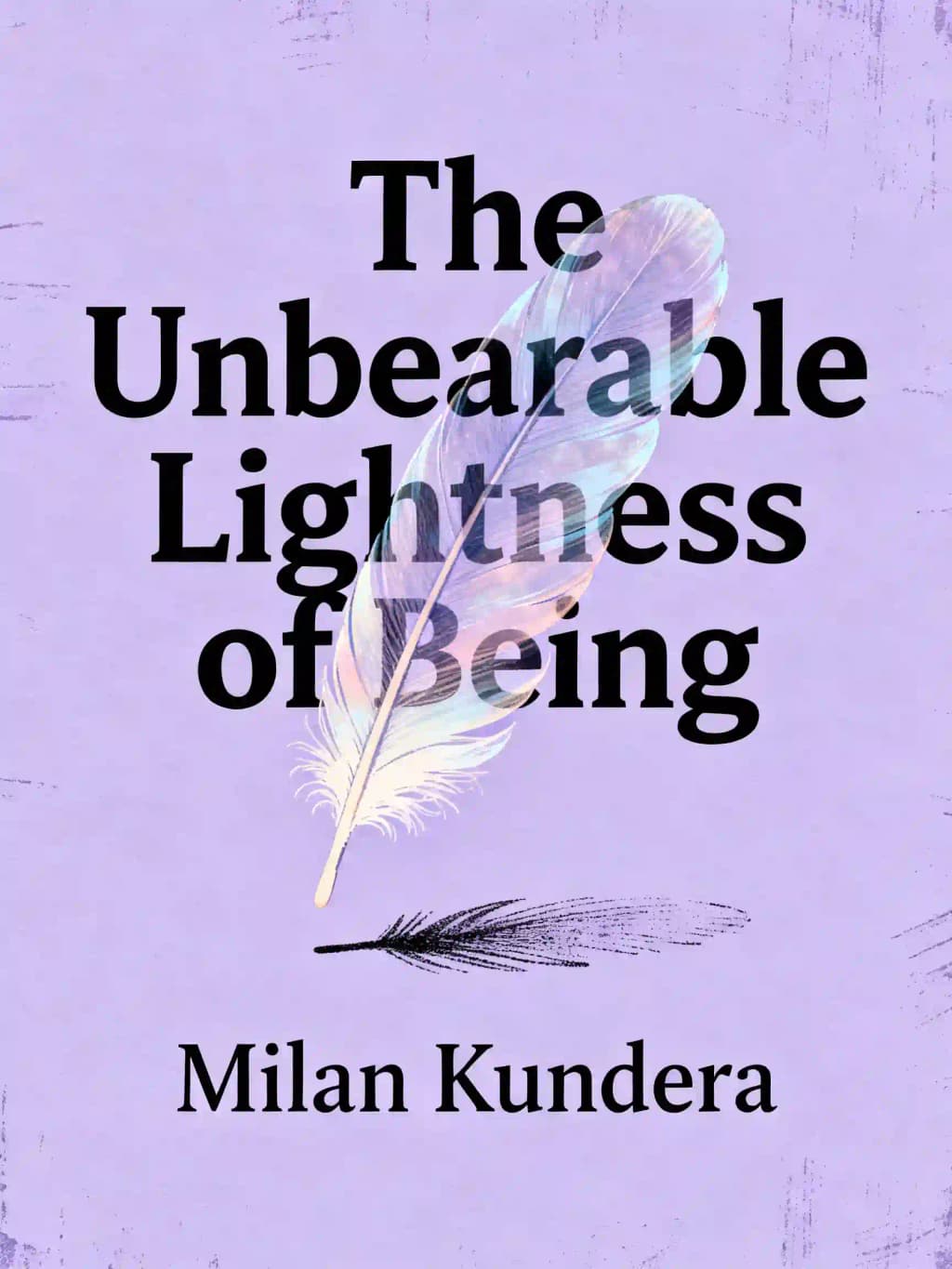
In a world obsessed with meaning, Milan Kundera's masterpiece asks: What if our choices carry no cosmic weight? Banned in Czechoslovakia until 1989, this philosophical novel follows four lovers whose intertwined lives become a canvas for exploring life's most haunting paradox - the simultaneous unbearable lightness and heaviness of existence.
Kundera, who fled Communist Czechoslovakia in 1975, crafted not just a love story but a cultural phenomenon that has sold over 5 million copies worldwide and been translated into nearly 30 languages. His brilliant interweaving of politics, philosophy, and eroticism creates a reading experience that feels both intellectually stimulating and emotionally raw.
Between Tomas's womanizing and Teresa's dreams, Kundera invites you to question everything: Is commitment freedom or burden? Does history repeat or dissolve? The novel's exploration of eternal return - Nietzsche's concept that we're doomed to relive our lives infinitely - will transform how you view your own choices and relationships. You'll close this book with both lightness and weight - exactly as Kundera intended.
2장
The Weight of Choices in a Single Life
The novel opens with a philosophical dilemma: the concept of eternal return. If life occurs only once, with no repetition, does it lose substance and significance? Without recurrence, even monumental events like revolutions diminish in importance, becoming as inconsequential as forgotten wars. In a world without return, moral accountability fades-nothing is truly condemned or forbidden because everything vanishes into the lightness of non-being.
This creates the central tension that haunts the characters throughout the narrative. When life has no return, actions acquire a paradoxical quality-they are simultaneously insignificant (because they happen just once) and unbearably significant (because we have only one chance). Parmenides' ancient philosophical question emerges: Is it better to embrace heaviness or lightness? Is meaning found in commitment and attachment, or in freedom and detachment?
Think about your own life decisions. Do they feel heavy with consequence or light with impermanence? The beauty of Kundera's approach is that he doesn't provide easy answers but invites us to examine the tension between these opposing forces.
The story introduces us to Tomas, a surgeon whose life embodies this philosophical struggle. Standing by his window, he contemplates his feelings for Tereza, a woman he barely knows yet who has made a profound impact on him. Their brief connection forces him into deep introspection about love's entanglement and the potential permanence of inviting her into his life. When she unexpectedly arrives at his door with a suitcase-symbolically offering her entire existence to him-Tomas makes an uncharacteristic decision to welcome her, despite his principles against emotional attachments.
This moment represents the first of many choices where characters must decide between lightness (freedom, detachment) and weight (commitment, meaning).
3장
The Paradox of Love and Freedom
Tomas embodies the conflict between erotic freedom and emotional commitment. Having abandoned traditional roles like fatherhood, he creates "erotic friendships" devoid of sentimentality. His relationship with the painter Sabina represents this perfect arrangement-physical pleasure without emotional entanglement. Yet Tereza's arrival challenges his carefully constructed doctrine of detachment.
Despite welcoming Tereza into his life, Tomas maintains his affairs, creating a fundamental tension. He secures Tereza's presence near him while keeping emotional distance. Her suitcase becomes a powerful symbol of potential love, highlighting his internal conflict between desire for companionship and fear of losing autonomy.
What's fascinating is how sleep becomes their most intimate connection. When they share a bed, Tomas finds himself drawn closer to Tereza in ways his philosophical stance can't explain. This physical proximity creates an emotional intimacy he hadn't anticipated, forcing him to reconsider the nature of love itself.
But Tereza's dreams reveal the cost of this arrangement. Her subconscious struggles manifest in nightmares laden with jealousy and symbolic suffering. These dreams mirror her waking fears of Tomas's infidelities, leaving physical marks like self-inflicted pain on her psyche. Despite this emotional turbulence, they remain entwined, their relationship marked by love fraught with betrayal and doubt.
Haven't we all experienced this tension between freedom and connection? The desire to maintain independence while yearning for the depth that comes with commitment? Kundera brilliantly captures this universal human struggle through characters who feel startlingly real.
4장
The Soul and Body Dichotomy
The novel explores another fundamental tension: the division between soul and body. Tereza's journey to Tomas begins with physical hunger-a rumbling stomach-yet represents a deeper spiritual yearning. This stark division between soul and body forms an essential human experience that drives much of the narrative.
For Tereza, this division is particularly painful. Standing before the mirror, she sees not just her reflection but the glimmer of her soul. This confrontation becomes a defiant act against her mother, an attempt to forge her own identity. Each time she purges her mother's features from her own image represents a rare intoxication, a spiritual ascent toward autonomy.
Her origin story reveals how her life continues her mother's trajectory-a path set by her mother's superficial values. Born to a woman obsessed with physical beauty yet bitter about lost opportunities, Tereza grows up bearing the blame for her mother's failures. This early experience shapes her complex relationship with her own body and her desperate need to be seen as more than flesh.
This soul-body dichotomy extends to sexuality as well. For Tomas, physical encounters are separate from emotional attachment-a philosophy that causes Tereza immense suffering. When she attempts to adopt his approach by having an affair with an engineer, she discovers she cannot separate her body from her soul. During the encounter, "her body moved mechanically, her soul retreating, proudly neutral in an ambiguous moral stance."
Isn't this struggle familiar? The attempt to reconcile our physical existence with our sense of spiritual or emotional identity? The desire to be seen as more than our bodies while simultaneously living through them?
5장
The Unbearable Weight of Compassion
Compassion emerges as a central force in the novel, particularly in Tomas's journey. The word's etymology reveals its deeper meaning-not merely sympathy but a shared emotional experience, a "co-feeling" with another's suffering. When Tereza confesses to reading his letters, Tomas's reaction shifts from anger to empathy, deepening their bond despite his resistance.
This compassion becomes both blessing and burden. When Tereza flees to Prague during the Soviet occupation, Tomas experiences a temporary lightness in Zurich. Yet his imagination soon fills with images of her suffering, and compassion overwhelms him. Despite knowing it means sacrificing his medical career, he returns to occupied Czechoslovakia to be with her.
His decision reveals how compassion can be both a weight and a source of meaning. As he crosses the border, he reflects on Beethoven's phrase "Es muss sein" ("It must be")-suggesting both necessity and choice in his return. The journey becomes a profound statement about what gives life weight and significance.
The novel asks us: Is compassion a sickness from which we should free ourselves, or is it something heavy yet inextricably valuable? Tomas's journey suggests the latter-that meaning comes precisely from the weight of our connections to others, even when those connections limit our freedom.
This compassionate weight extends beyond human relationships. Tereza's love for their dog, Karenin, represents perhaps the purest form of love in the novel. She observes that "mankind's true moral test consists of its attitude toward those who are at its mercy: animals." Her bond with Karenin, free from expectation or betrayal, becomes a sanctuary from her complicated human attachments.
6장
Political Oppression and Personal Freedom
Against the backdrop of the 1968 Soviet invasion of Czechoslovakia, the characters navigate not only personal relationships but political oppression. The novel brilliantly connects philosophical questions about freedom with the concrete reality of living under totalitarianism.
When Tomas publishes an article comparing the Communist regime to Oedipus (who blinded himself after realizing his crimes), he faces severe consequences. The regime demands he retract his statements, presenting him with an impossible choice between integrity and career. This scenario highlights how political systems can force individuals into moral compromises that erode their sense of self.
Tomas's refusal to retract his article costs him his position as a surgeon. He becomes first a window washer, then a rural driver-his professional identity stripped away by political forces. Yet in this loss, he finds an unexpected liberation. No longer bound by his prestigious career, he discovers new forms of freedom despite the oppressive system.
The political context also shapes intimate relationships. When Tereza works as a photographer documenting the Soviet invasion, she faces surveillance and intimidation. Her fear that the engineer she slept with might be working for the secret police reveals how totalitarianism corrupts even the most private human connections.
The novel asks: Can personal freedom exist under political oppression? The characters find complex, imperfect answers-creating private spaces of meaning and connection even as external forces limit their choices.
7장
Kitsch and Authentic Existence
One of the novel's most powerful concepts is "kitsch"-the denial of everything unacceptable in human existence, a curtain drawn over reality's messier aspects. Kundera presents kitsch as more than mere bad taste or sentimentality; it's a philosophical stance that systematically excludes everything that challenges our desire for absolute meaning. Kitsch represents an agreement with being that rejects complexity in favor of simple, emotionally manipulative narratives, offering a sanitized version of reality that people can easily digest and embrace.
Sabina, the painter who values authenticity above all, emerges as the novel's most astute critic of kitsch, recognizing its presence in both Communist parades and American sentimentality. The Communist May Day parade epitomizes forced consensus with existence, where people feign unity under superficial beauty. She observes how participants must smile, dance, and pretend to be joyful, creating an artificial spectacle of harmony that masks underlying oppression. Similarly, an American senator who equates children's joy with universal happiness employs the same emotional manipulation through different symbols. Sabina sees how both systems, despite their opposing ideologies, use kitsch to create an artificial sense of meaning and belonging.
Kitsch thrives on shared emotions and eternal motifs-children playing, families united, patriotic sacrifice-but its power lies in how it transforms these universal experiences into weapons of emotional coercion. It operates by activating what Kundera calls the "second tear": not the tear we shed for the touching scene itself, but the tear we shed for our collective ability to be moved by such scenes. This mechanism silences dissenting voices by creating a theatrical consensus that feels unquestionable. In totalitarian regimes, kitsch becomes particularly dangerous, subjugating individuality to conformism's blissful facade. The novel shows how political systems weaponize kitsch to maintain control, making any resistance appear not just politically but morally wrong.
The novel suggests that authentic existence requires rejecting kitsch-facing life's complexity, ambiguity, and even ugliness. This rejection isn't simple; it demands constant vigilance against our own tendency to seek comfort in simplified narratives. Sabina's art attempts this authenticity, revealing truths beneath socially acceptable lies. Through her paintings, she literally creates layers, with conventional images cracking to reveal unexpected truths underneath. Her struggle to elude kitsch becomes central to her identity and her art, representing the broader human challenge of maintaining authenticity in a world that constantly pushes us toward comfortable falsehoods.
Haven't we all felt the pressure to embrace simplistic narratives about our lives? To post only the perfect moments on social media, to embrace cultural cliches about love, success, or happiness? Kundera challenges us to recognize and resist these comfortable illusions. In our contemporary world, kitsch has evolved beyond political propaganda into the carefully curated lives we present online, the oversimplified narratives of self-help culture, and the reduction of complex human experiences into marketable lifestyle choices. The novel's critique of kitsch remains startlingly relevant, asking us to consider how we might live more authentically in a world increasingly dominated by artificial perfection.
The concept of kitsch also raises profound questions about art and representation. Can any artistic expression completely avoid kitsch? How do we distinguish between genuine emotion and manipulative sentimentality? These questions become particularly pressing in our digital age, where images and narratives are constantly filtered, edited, and perfected before being shared with the world.
8장
The Grand March of History
The novel's sixth section, "The Grand March," presents a masterful examination of how political movements throughout history conform to a universal pattern-a collective procession toward idealized goals that often sacrifices individual nuance for the sake of unified narrative. Franz, a Geneva-based academic driven by intellectual idealism, yearns to be part of what he sees as humanity's noble progression toward justice, embodying the eternal human desire to be part of something transcendent.
The march to Cambodia's border serves as a microcosm of political activism's inherent contradictions. Franz joins international protesters opposing Vietnamese occupation, believing in the power of collective action to effect change. His personal journey from academic theorist to active participant mirrors the broader human impulse to transform abstract principles into concrete action.
The theatrical nature of modern political protest reveals itself in layers of increasing complexity. The diverse group of participants-European intellectuals, American journalists, a Hollywood actress seeking to burnish her activist credentials-creates a mirror of global power dynamics within their supposedly egalitarian movement. Linguistic battles emerge as French, English, and German speakers vie for dominance in crafting the protest's message, revealing how even in opposition to power, hierarchies naturally form. The presence of media transforms their protest into a performance, with participants increasingly conscious of their roles as actors in a global drama.
The death of the photographer becomes a pivotal moment that crystallizes the section's themes. Stepping on a land mine, his tragic end transforms their flag into a grotesque trophy, stained with real blood. This moment reveals how political movements often require martyrs to validate their significance, converting individual tragedy into collective symbolism. The protesters' pride in their blood-stained banner exposes the thin line between principled resistance and the fetishization of suffering.
The march's climactic arrival at the Cambodian border provides the ultimate commentary on political theater's limitations. The Vietnamese officials' complete indifference-neither confronting nor acknowledging the protesters-creates an anticlimactic void that forces participants to question their assumptions about resistance and power. Franz's response to this moment is particularly poignant: while recognizing the futility of their gesture, he finds beauty in humanity's persistent need to stand against injustice, even when that stance is ultimately meaningless.
This section serves as a sophisticated critique of political idealism while simultaneously exploring its psychological necessity. Through detailed observation of group dynamics, individual motivations, and the gap between intention and impact, it illuminates how the "grand march" of history often consists of symbolic gestures rather than substantive change. Yet it also compassionately acknowledges that these gestures, however futile, fulfill a fundamental human need to believe in progress and participate in collective action.
The author's treatment suggests that while political theater may not change immediate circumstances, it serves as a ritual through which humans process their relationship to power, justice, and historical meaning. The section thus becomes not just a critique of political activism but a meditation on how humans create meaning through collective action, even when that meaning exists primarily in the realm of symbol and gesture rather than practical effect.
9장
Finding Peace in the Countryside
After years of struggle in Prague, Tomas and Tereza retreat to a rural village, finding refuge among apple trees and rolling hills, far from the city's political tensions and social misunderstandings. The transition from urban professionals to rural workers isn't merely geographical - it represents a profound spiritual and emotional journey. They gradually adapt to country rhythms, learning the unspoken customs of village life while discovering a natural simplicity that had eluded them in Prague. Tereza, especially, finds deep contentment in this rural cocoon, where the smell of hay and the morning mist remind her of her childhood memories of comfort and security.
The couple's integration into village life happens in subtle stages. They learn to navigate local relationships, from the skeptical initial welcome to eventual acceptance by their neighbors. Their small farmhouse, with its creaking floors and garden full of wildflowers, becomes both sanctuary and symbol of their new life. Tereza photographs the landscape and its inhabitants, capturing a world that moves at a different pace from the urban chaos they left behind.
Their simple life represents a delicate compromise between their conflicting needs-Tomas's lifelong desire for personal freedom and Tereza's deep-seated need for security and belonging. Working as a truck driver, Tomas finds a different kind of liberation in the solitary hours on country roads, while his reduced social circle naturally limits his former philandering. Tereza, tending to animals and maintaining their home, discovers a sense of purpose that had eluded her in the city. Though far from their original ambitions - he as a renowned surgeon, she as a photographer - they create a life that offers an unexpected kind of peace.
Yet even this pastoral retreat can't entirely escape the tensions that defined their urban life. When Tereza finds a mysterious letter in Tomas's pocket, old doubts and insecurities resurface, proving that geographic distance doesn't automatically heal emotional wounds. Their dog Karenin's progressive illness and eventual death becomes a powerful catalyst, forcing them to confront not only mortality but also the nature of unconditional love. The experience of caring for their dying pet brings them closer together while highlighting the fragility of all relationships.
The countryside setting allows Kundera to explore another philosophical dimension: the complex relationship between humans and animals, which serves as a mirror for human nature itself. Tereza's observation that true morality begins with how we treat those completely at our mercy becomes a central theme, expanded through her daily interactions with farm animals. Her deep bond with Karenin and her special relationship with a heifer named Marketa reveal a purity of connection that contrasts sharply with the complications of human relationships. These animal connections provide a stark contrast to the cruelty she observes in collective farming practices and, by extension, political oppression - suggesting that humanity's capacity for both compassion and cruelty exists in all settings, rural or urban.
The rural environment also serves as a metaphor for the couple's journey toward authenticity. Away from the performative aspects of city life, they must confront their true selves and their relationship without the distractions and pretenses of urban society. The seasonal rhythms of farm life, the direct connection to nature's cycles, and the immediate consequences of their actions create a framework for understanding life's fundamental truths that had been obscured in their previous existence.
10장
The Final Lightness
The novel's conclusion brings us full circle to its opening philosophical question: Is it better to choose lightness or weight? The characters find their answers not in abstract philosophy but in concrete choices about love, commitment, and meaning.
Tomas, who once prized his freedom above all, finds himself "drawn by Tereza's cleverly disguised demands," leading to a confined yet meaningful life. Questions of purpose and past choices cloud him as he resigns to an altered existence, where dreams of strength are replaced by an acceptance of vulnerability.
Sabina, continuing her path of betrayal and flight, moves through life seeking ultimate lightness. Her will requests cremation and dispersal of her ashes into the winds-a final rejection of weight and permanence.
The novel ends with a dreamlike scene at a rural hotel where Tomas and Tereza dance together, finding momentary happiness before their death in a car accident on mountain roads. This ending-revealed earlier in the narrative-gives their story a poignant finality. Their choices, whether right or wrong, have led them to this moment of connection before oblivion.
What Kundera ultimately suggests is that the lightness of being-the fact that we live just once, without rehearsal or return-is both unbearable and beautiful. It makes our choices simultaneously meaningless (in cosmic terms) and profoundly meaningful (in human terms). The weight we choose to bear-through love, compassion, and commitment-creates whatever meaning is possible in our brief existence.
And isn't that the paradox we all live with? The knowledge that nothing lasts forever alongside the human need to create meaning through connection? Kundera's masterpiece continues to resonate because it articulates this fundamental tension with rare insight and compassion, reminding us that in choosing what to care about-what to give weight to-we define who we are.