1장
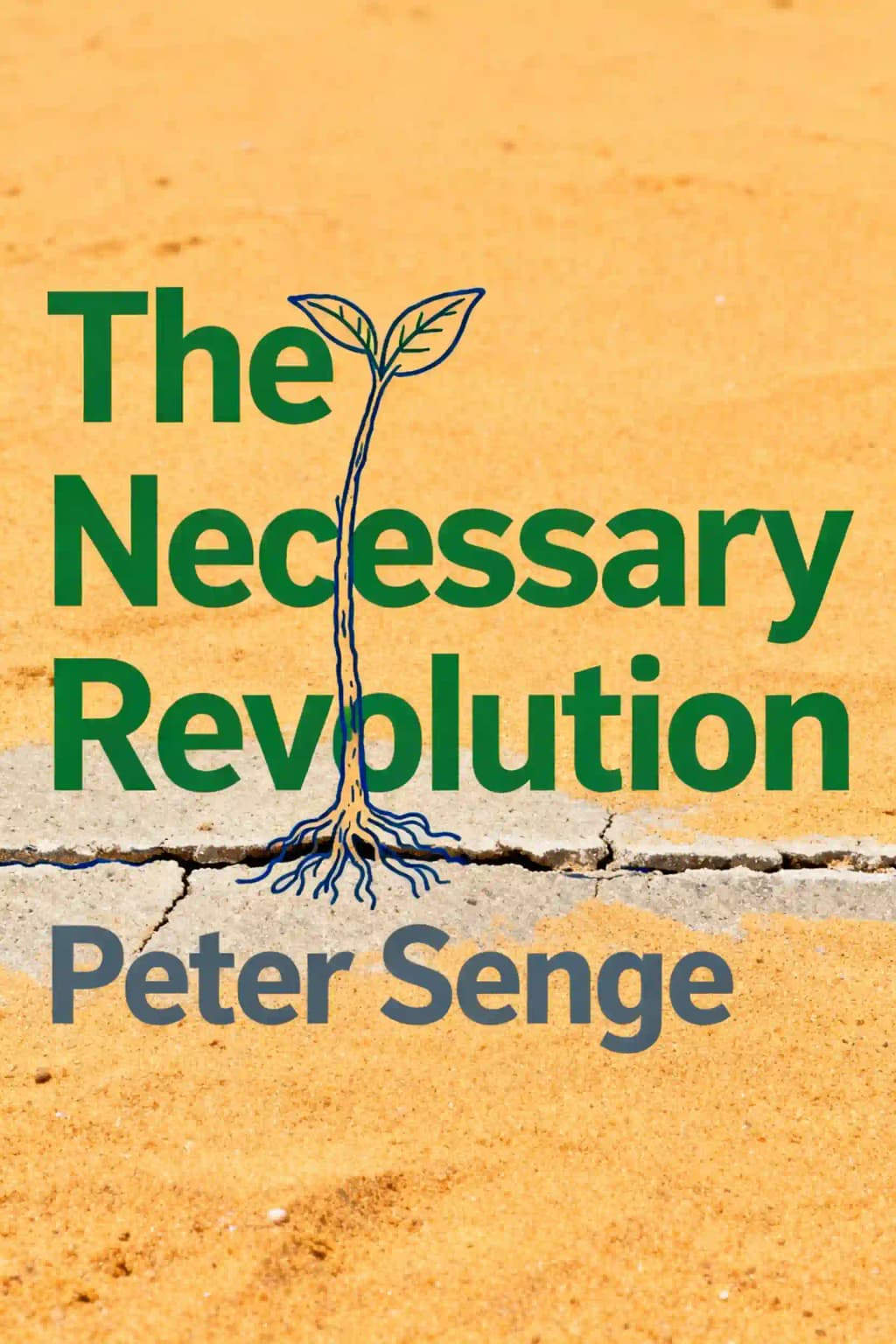
The Necessary Revolution: How We Can Shape a Sustainable Future
In a world increasingly threatened by environmental degradation, resource depletion, and climate change, "The Necessary Revolution" by Peter Senge offers a beacon of hope. This groundbreaking book has become required reading in sustainability programs at universities worldwide and has influenced corporate leaders from Fortune 500 companies to small businesses. When published in 2008, it arrived at a pivotal moment-just as the economic crisis revealed the fragility of our industrial systems and as climate awareness was reaching mainstream consciousness. Senge, a renowned MIT professor and organizational learning expert, collaborated with Bryan Smith, Nina Kruschwitz, Joe Laur, and Sara Schley to create what Unilever's former CEO Paul Polman called "the most important business book of our time." The book's central premise-that we can create a regenerative economy by fundamentally reimagining how we think, collaborate, and create-has inspired a generation of sustainability leaders who are now transforming industries from the inside out.
2장
The End of the Industrial Age Bubble
We stand at a crossroads in human history. Australia faces severe water shortages with reservoirs at just one-quarter capacity. Sweden has established a fifteen-year plan to eliminate fossil fuel use by 2020. Companies like DuPont are shifting from petroleum-based to bio-based feedstocks, while Nike aims for zero waste and toxicity. These aren't isolated incidents but symptoms of a profound transformation-the end of what Senge calls the "Industrial Age Bubble."
This bubble represents a collective delusion that we can continue consuming resources and generating waste indefinitely on a finite planet. Like all bubbles, it cannot expand forever. The signs of its limits are already visible in climate disruption, resource depletion, and ecosystem collapse. The Industrial Revolution that began 200 years ago brought unprecedented prosperity but at a devastating environmental cost.
The scale of industrial waste is staggering-the U.S. economy generates about one ton of waste per person per day, with over 90% of raw materials ending up as extraction and production waste. Globally, fossil fuel burning releases 8 billion tons of carbon dioxide annually-5 billion tons more than the biosphere can absorb. Even renewable resources face severe degradation: one-fifth of humanity lacks reliable clean drinking water, agricultural runoff is the biggest water polluter, and over 70% of world fisheries are chronically overfished.
We've created a pattern of shifting environmental responsibility to specialists and experts, making many people view issues like water, waste, energy, and community health as "someone else's problems." Rather than working proactively with government for innovative solutions, businesses often rely on lobbyists to preserve the status quo. This shifting-the-burden pattern creates a destructive cycle where fundamental solutions are perpetually neglected in favor of quick fixes.
The ultimate challenge we face-what scientists call the "80-20 Challenge"-requires reducing carbon emissions by 80% within the next 20-30 years. This isn't merely about incremental improvements but signals the Industrial Age's end and demands transformations in energy use, transportation, building design, urban planning, and global mobility systems.
3장
Seeing Systems: A New Way of Thinking
Addressing these challenges requires a fundamentally different way of thinking. Systems thinking isn't about fighting complexity with more complexity-it's about stepping back to see intuitive patterns clearly. The industrial system exists within nature's larger systems, which include both regenerative resources (that sustain us indefinitely if not over-harvested) like forests, fisheries, and freshwater aquifers, and non-regenerative resources (which can only be depleted) such as fossil fuels and rare earth minerals. Industrial processes generate multiple forms of waste - chemical, thermal, and material - that damages nature's ability to replenish, creating a vicious cycle that accelerates environmental degradation.
Like the Maya civilization that collapsed due to environmental degradation from unsustainable practices - including deforestation, soil erosion, and water management failures - we face similar risks on a global scale. However, our fate isn't sealed. The Icelanders successfully managed their grasslands 600 years ago by collectively limiting sheep grazing through a sophisticated quota system, demonstrating that humans can create sustainable systems when they understand the larger patterns at work. Similar success stories can be found in modern Japan's forest management and Switzerland's alpine meadow preservation.
A regenerative society follows the core principle that "life creates conditions for life." This is evident in natural systems like forests, where fallen leaves nourish soil microorganisms, which in turn support new growth. Our daily choices - from transportation methods to food consumption patterns - either support this principle or compromise the conditions that sustain life. The Industrial Age Bubble persists through our everyday decisions about what we buy, make, and how we interact. These choices rest on deeply embedded assumptions: that energy is infinite and cheap (despite clear evidence of fossil fuel depletion), there will always be enough room for waste disposal (ignoring ocean plastic accumulation and landfill limitations), humans can't alter the global environment (despite clear climate change evidence), humans are the primary species (overlooking ecosystem interdependencies), resources are unlimited (despite increasing scarcity), and productivity and economic growth are keys to progress (ignoring social and environmental costs).
By contrast, life beyond the Bubble embraces different principles: using renewable energy from solar, wind, and geothermal sources; creating zero waste through circular economy practices; borrowing responsibly from future generations by considering long-term impacts; recognizing our place among nature's species through biodiversity protection; valuing ecosystem services like pollination and water purification; embracing diversity in both natural and human systems; and acknowledging our global interdependence through international cooperation on environmental challenges. A regenerative society isn't about sacrifice but about rediscovering what we truly value-quality living through sustainable practices, community connection through shared resources and knowledge, and harmony with nature through respectful coexistence. This transformation requires redesigning our systems - from agriculture to urban planning - to work with natural processes rather than against them.
4장
The Power of Collaboration Across Boundaries
Individual systems thinkers have limited impact in a world shaped by organizational networks. The systems intelligence needed to address Industrial Age challenges must be collective, built through collaboration at multiple levels within and beyond organizations, spanning industries, communities, and global supply chains.
Sweden's remarkable transformation in reducing fossil fuel dependence-cutting oil reliance from 77% to 30% of its energy-wasn't driven by massive government programs but by small networks of committed individuals. Per Carstedt, a Ford dealership owner in northern Sweden, became a catalyst for change after attending the 1992 Rio Conference. Facing the chicken-and-egg problem of having ethanol cars but no fuel infrastructure, Carstedt and his colleagues took a practical approach, starting with just two filling stations and gradually expanding through persistent persuasion of retailers.
Similarly, the U.S. Green Building Council began in 1993 with just ten people who shared a vision of transforming building practices. Their first breakthrough insight was that they needed representatives from the entire system-real estate owners, financiers, engineers, architects, construction companies, environmental organizations, and government-working together from the start. Despite contentious early meetings, they established a productive approach: "Seek agreement and go," focusing on action rather than getting bogged down in disagreements.
When the LEED (Leadership in Energy and Environmental Design) rating system was released in 2000, it met an untapped hunger in the marketplace. By 2007, over 7,500 buildings worldwide were LEED-registered, up from just 635 in 2002. Though voluntary, LEED certification rapidly became an industry norm, with cities like Washington D.C. and Boston revising building codes to require LEED standards.
Perhaps the most striking example of collaboration comes from the unlikely partnership between Coca-Cola and the World Wildlife Fund (WWF). In July 2007, Coca-Cola CEO E. Neville Isdell announced at the UN Global Compact summit that Coke's guiding principle must be "We should not cause more water to be removed from a watershed than we replenish." This represented a significant shift for Coca-Cola, which had traditionally focused only on internal water efficiency rather than broader watershed impacts.
The breakthrough came when they focused on value chains as a meeting point for ecological, social, and business concerns. While the company had been working to reduce direct water consumption in bottling from about 3 liters per liter of product to 2.5, WWF's Jason Clay revealed that when considering the entire value chain, particularly water-intensive sugarcane cultivation, it could take 200+ liters of water to produce one liter of Coke. This order-of-magnitude shift in perspective became a touchstone for the company's thinking, solidifying its commitment to integrated watershed management.
5장
The Business Case for Sustainability
For businesses to innovate toward sustainability, they must first see the Industrial Age system with fresh eyes. Many executives still view the world from an Industrial Age perspective, seeing the economy as the largest domain, with society and environment as smaller subsets. The necessary shift inverts this perspective: the environment is the largest circle containing human society, with the economy as a much smaller circle within both.
Companies that ignore sustainability issues risk losing market share, talent, reputation, and investment capital. Surveys consistently show stakeholders care deeply about environmental responsibility, with one GlobeScan study finding 69% of respondents hold companies "completely responsible" for environmental protection. As GE's CEO Jeffrey Immelt notes, "When society changes its mind, you better be in front of it and not behind it."
The business case is clear: ignoring sustainability threatens long-term viability (you can't have a fishing industry without fish or a soft-drink company without clean water), while embracing it creates opportunities and competitive advantage. Goldman Sachs found companies implementing strong environmental, social, and governance policies outperformed the general stock market by 25 percent since 2005, with 72 percent outperforming industry peers.
Companies progress through five stages of sustainability integration. Many get stuck in non-compliance or basic compliance (stages 1-2), missing the substantial benefits of proactive approaches. Momentum builds when organizations move beyond compliance to stage 3, where savings begin outweighing investments. The critical leap happens at stage 4, when sustainability becomes fully integrated into corporate strategy, impacting capital allocation, supply chains, R&D, and core operations. At stage 5, contributing to society becomes the company's purpose-exemplified by pioneers like Patagonia and Interface.
DuPont's transformation offers important lessons in creating sustainable value. After Greenpeace labeled them the "world's number one polluter" in 1989, CEO Edgar Woolard declared the company would become "some shade of green." DuPont strategically shifted from petrochemicals to plant-based chemicals and environmentally friendly products, recognizing their existing business would become commoditized.
By 2004, they had cut global air carcinogens by 90%, hazardous waste by 40%, greenhouse gases by 70%, and energy use by 5%. While production increased 40%, energy costs remained flat, saving $3 billion-a powerful proof point that sustainability pays. This became a virtuous cycle, with savings reinvested in innovation. DuPont now focuses on three "mega sustainability trends": renewable energy and materials, safety and security, and increased food production.
6장
From Problem Solving to Creating
Problem solving focuses on making what you don't want go away, while creating involves bringing something you care about into reality-a subtle but profound distinction. Creating draws energy from dreams and visions, while reactive problem solving is driven by fear of consequences.
The creative orientation makes problem solving secondary to realizing what we truly care about. A sustainable future requires collective creating of every sort: new energy systems, buildings, transport, and ways to reduce waste through new products, processes, business models, and leadership approaches. This demands passion, patience, and the courage to act without all the answers.
Xerox engineers created the groundbreaking Lakes concept that transformed into the Document Center family of copiers in the late 1990s. Team leader John Elter, charged with developing a new generation of digital copiers, broke conventional rules by forming a team deeply connected to ecosystems. The transformative moment came when they discovered a Xerox copier in a landfill, leading to their "Zero to Landfill" vision. This nature-inspired constraint unleashed extraordinary creativity, resulting in machines that were 93% remanufacturable and 97% recyclable, manufactured in waste-free plants. Since 1991, Xerox has diverted 1.9 billion pounds of waste from landfills, saving approximately $400 million annually in manufacturing costs.
Jeffrey Hollender founded Seventh Generation to "change the nature of consumption" by creating products that make a positive impact. This creative spirit contrasts with the negative vision strategies common in environmental movements and corporate motivation through fear. While fighting threats can motivate temporarily, once threats diminish, so does motivation. Fear-based approaches limit imagination and commitment.
Martin Luther King Jr. identified the core principle of "creative tension"-the gap between vision and current reality that naturally generates energy for change. This tension can be visualized as a rubber band stretched between vision and reality, seeking resolution either by lowering the vision or by pulling reality toward the vision. Masterful leaders distinguish between creative tension and emotional tension, avoiding the temptation to relieve emotional discomfort by lowering vision or denying reality.
7장
Building a Regenerative Economy
The circular economy presents a revolutionary framework for transcending the limitations of the Industrial Age Bubble by fundamentally reimagining our industrial system. Instead of the traditional linear extract-use-discard model that has dominated manufacturing for centuries, it creates sophisticated circular flows where waste becomes valuable input for new processes. Two distinct categories of by-products emerge in this system: "natural nutrients" (biodegradable materials that safely return to nature's systems like compost and organic matter) and "technical nutrients" (durable materials like metals, plastics, and synthetic fibers that can circulate back into manufacturing processes indefinitely). This model demonstrates how industries can systematically reduce waste toward zero while simultaneously decreasing resource extraction from the Earth's finite supplies.
Companies implementing circular principles are already seeing substantial financial benefits. Xerox saves over $400 million annually through their "Design for Environment" program, where copiers are specifically engineered for easy disassembly and remanufacturing. Their modular design allows 90% of components to be reused or recycled. Similarly, BMW's vehicle recovery program systematically recovers and reuses automobile components from end-of-life vehicles, including precious metals from catalytic converters and high-grade plastics from body panels. Interface, the carpet tile manufacturer, has saved over $450 million through their waste reduction initiatives while creating innovative products from recycled materials.
Managing essential commons like water, topsoil, and climate stability requires first establishing effective management systems and governance structures. While government regulation provides necessary frameworks, it rarely generates the breakthrough innovation needed to fundamentally reinvent products and business models beyond Industrial Age thinking. The most effective approach has proven to be collaborative management systems like LEED certification for buildings, which represents a continuously evolving shared body of knowledge and tools. The Forest Stewardship Council (FSC) certification system for sustainable forestry provides another successful model of stakeholder-driven standards that improve through collective learning and adaptation.
Creating large-scale systemic change requires engaging people with both the power and motivation to take action. Rather than focusing solely on senior executives, who often have too much invested in maintaining the status quo, successful initiatives engage a critical mass of diverse stakeholders willing to lead change from multiple positions within the system. The practice of convening means "getting the system in the room" by thoughtfully bringing together representatives from all parts of the system affected by the issue - from suppliers and customers to regulators and community members.
Nike's sustainability journey illustrates these principles in action. When executive Darcy Winslow began questioning the toxicity in their products, she realized their sustainability efforts needed to evolve beyond mere regulatory compliance toward true innovation. Rather than attempting to reach all 25,000 employees simultaneously, she strategically identified that engaging 20% of Nike's 300 designers would create the critical mass needed for transformation. Instead of focusing on restricting designers with a "bad list" of chemicals to avoid, she emphasized the untapped opportunities for innovation that wouldn't compromise performance or aesthetics. By connecting sustainability to design creativity and innovation, she helped forge an emotional connection to eliminating waste and toxicity. While this cultural shift took time, it became a powerful catalyst for ongoing change, leading to innovations like Nike's Flyknit technology that reduces waste by 60% compared to traditional shoe manufacturing.
8장
Leading the Necessary Revolution
Redesigning organizations for sustainability requires fundamental structural changes that align with new strategies. Traditional fragmented structures must be rethought as companies move beyond simple waste reduction to embedding sustainability capabilities throughout every level of the organization. This transformation demands a systems-thinking approach where environmental considerations become integral to product design, supply chain management, manufacturing processes, and customer relationships.
CEOs and senior management must frame key questions, set vision, and initiate long-term strategic work-especially when the way forward isn't clear. At DuPont, Edgar Woolard's self-designation as "chief environmental officer" signaled that environmental challenges were central business imperatives, leading to company-wide initiatives in renewable materials and clean technologies. At GE, Jeff Immelt personally initiated strategic scanning across all business units, making ecomagination central to every business, resulting in over $20 billion in clean technology revenues and significant reductions in operational emissions.
Senior leaders don't need immediate answers for achieving sustainability visions. Framing goals based only on current knowledge limits aspirations and innovation potential. Technology and competition will move quickly, requiring continuous adaptation and innovation with whatever technologies, relationships, and processes emerge. Success comes from maintaining flexibility while holding firm to core sustainability principles.
A valuable tool for planning future investments is the "balanced portfolio of visions" framework, which maps out visions spanning from within a year to 15-25 years into the future. This approach helps generate creative tension between current reality and both short and long-term goals. Starting with a 25-year vision of truly sustainable operations, then filling in 1-, 3-, and 5-year visions makes the long-term vision achievable. Companies like Interface and Nike have successfully used this approach to create roadmaps for achieving zero environmental impact while maintaining profitability.
When Alcoa set stretch targets for zero process water discharges and zero waste to landfill, they were inspired by CEO Paul O'Neill's earlier approach to safety goals. Despite internal debates about setting "realistic" safety targets, O'Neill declared, "Zero is the right number. You cannot plan to kill three people a year because you killed four people last year." This zero-based vision transformed Alcoa's safety record, reducing accident rates by a factor of fifteen to become the lowest of any U.S. industrial company. The same approach to environmental goals led to innovations in water recycling systems and waste reduction processes that generated both environmental and financial benefits.
The value of a vision lies not in perfect achievement but in what it enables you to accomplish. Visions that truly make a difference come from the heart as well as the head, expressing genuine longings while tapping people's fullest capacities to learn and innovate. Successful sustainability leaders combine ambitious environmental goals with practical business sense, creating a culture where employees at all levels feel empowered to contribute to the organization's environmental mission. Companies like Patagonia and Interface have shown that this approach can create both business success and environmental leadership.
Leadership in sustainability requires courage to set ambitious goals, patience to build new capabilities, and wisdom to balance short-term pressures with long-term transformation. The most successful organizations maintain clear environmental principles while remaining flexible in their implementation approaches, adapting to new technologies and opportunities as they emerge.
9장
A Future Beyond the Bubble
The unprecedented growth of global corporations over the past century obscures the fact that they represent just one form of enterprise in an emerging, more robust organizational ecology. This new diversity of enterprise forms is more aligned with the living world and better equipped to address Industrial Age imbalances.
The leadership required to create a regenerative society will largely come from the periphery-people and places where commitment to the status quo is low and minds are most open to the new. This periphery includes young people not yet socialized into organizational norms, women whose leadership styles differ from men's, new companies, social entrepreneurs, and unexpected sources.
Creating needed changes will require millions of dedicated leaders, many without obvious positions of power or permission for their efforts. While CEO leadership remains important, it always works in concert with less visible leaders within organizations who perceive emerging issues and translate ideas into practical changes.
The belief that humans are the most important species on earth represents a final Industrial Age belief that must be examined. This human-centric worldview manifests in how we frame environmental protection, often justifying species preservation solely based on potential human benefit or enlightened self-interest. What's missing is our capacity for awe at the marvel of the living world and our fellow travelers on Spaceship Earth-a recognition essential to rediscovering our place in the natural order.
Life beyond the Industrial Age Bubble involves not only our relationships with the earth, with each other, and with other species, but also our relationship with ourselves and our understanding of what it means to be human. Like teenagers discovering they aren't the center of the universe, we humans must recognize our place as just one species among millions, with our merit depending not on ego but contribution. Climate change places us on a larger stage in time and space, requiring us to develop to our highest potential.
As Costco's Sheri Flies notes, "If all of us were able to get to the highest in ourselves, we'd be able to see through these problems"-a spirit that makes the impossible possible.