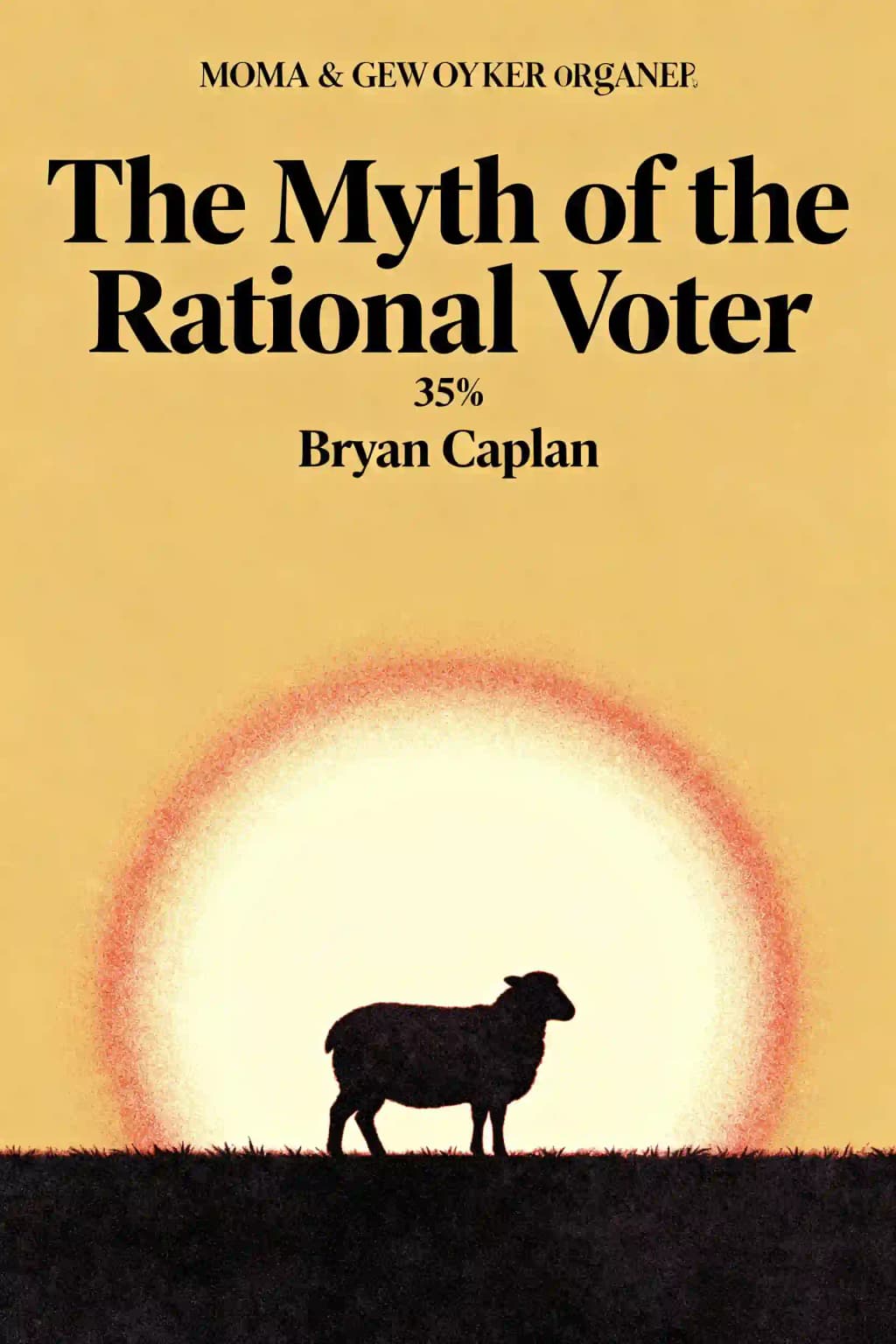
Why do voters consistently choose bad policies? Bryan Caplan's controversial masterpiece challenges democracy itself, revealing how our "rational irrationality" sabotages collective decision-making. A landmark work that transformed political economy and sparked fierce debates about the very foundations of democratic governance.
Bryan Caplan, New York Times bestselling author of The Myth of the Rational Voter: Why Democracies Choose Bad Policies, is a professor of economics at George Mason University and a leading voice in public choice theory.
Specializing in behavioral economics and democratic decision-making, Caplan’s work critiques systemic biases in voter behavior. This draws from his PhD in economics from Princeton University and his role as a senior research fellow at the Mercatus Center.
A frequent commentator on ABC’s 20/20, Fox News, and C-SPAN, he has authored influential titles like The Case Against Education and Open Borders (co-written with Zach Weinersmith), blending academic rigor with provocative insights. His blog, EconLog, ranks among the Wall Street Journal’s top economics platforms.
The Myth of the Rational Voter was hailed by the New York Times as “the best political book of the year,” cementing its status as a cornerstone of modern political-economic analysis.
The Myth of the Rational Voter by Bryan Caplan argues democracies often adopt harmful policies because voters hold systematic biases, such as distrusting free markets and overestimating economic risks. Caplan challenges the idea that voter preferences reflect informed decisions, showing how emotional attachments and misconceptions about economics distort political outcomes.
This book is essential for political science students, policymakers, and anyone interested in public choice economics. It offers critical insights for readers analyzing voter behavior, democratic inefficiencies, or the gap between expert consensus and popular opinion on issues like trade and regulation.
Yes—it was named “the best political book of the year” by the New York Times. Caplan’s provocative analysis of voter irrationality and its policy consequences remains influential in economics and political theory, making it a cornerstone for debates on democratic decision-making.
Caplan outlines four key biases:
Caplan rejects the theory that voter errors cancel out in large elections. He argues systemic biases skew collective decisions toward irrational outcomes, as voters prioritize ideology over factual accuracy when the personal cost of misinformation is low.
Rational irrationality describes voters clinging to false beliefs because there’s minimal consequence for being wrong. Unlike in private decisions (e.g., shopping), voting allows people to indulge biases without facing direct economic penalties.
He dismantles protectionist arguments, showing how voters misunderstand comparative advantage. Despite economists’ near-universal support for free trade, public anti-foreign bias fuels demand for policies that reduce overall prosperity.
Caplan suggests limiting voter influence through mechanisms like epistocracy (rule by the knowledgeable) or stronger checks on popular opinion. He advocates empowering experts to counterbalance systemic voter biases.
Both books critique systemic inefficiencies—The Case Against Education challenges credential inflation, while The Myth focuses on voter-driven policy failures. Each applies public choice theory to expose mismatches between individual incentives and societal outcomes.
Critics argue Caplan overstates voter ignorance and underestimates institutional safeguards. Some contend his solutions, like epistocracy, risk elitism and fail to address deeper structural inequalities.
“Democracies fail because they give voters what they want.” This reflects Caplan’s view that flawed voter preferences, not corrupt leaders, explain poor policy outcomes.
With rising populism and distrust in globalization, Caplan’s analysis of anti-trade and anti-immigration sentiments remains urgent. The book provides a framework for understanding contemporary political shifts toward protectionism.
저자의 목소리로 책을 느껴보세요
지식을 흥미롭고 예시가 풍부한 인사이트로 전환
핵심 아이디어를 빠르게 캡처하여 신속하게 학습
재미있고 매력적인 방식으로 책을 즐기세요
Voters aren't merely ignorant but systematically irrational.
Protectionism persists because it feels good to believe in it.
Garbage in, garbage out.
Voter ignorance runs deep.
Democracy produces suboptimal policies.
The myth of the rational voter의 핵심 아이디어를 이해하기 쉬운 포인트로 분해하여 혁신적인 팀이 어떻게 창조하고, 협력하고, 성장하는지 이해합니다.
The myth of the rational voter을 빠른 기억 단서로 압축하여 솔직함, 팀워크, 창의적 회복력의 핵심 원칙을 강조합니다.

생생한 스토리텔링을 통해 The myth of the rational voter을 경험하고, 혁신 교훈을 기억에 남고 적용할 수 있는 순간으로 바꿉니다.
무엇이든 물어보고, 목소리를 선택하고, 진정으로 공감되는 인사이트를 함께 만들어보세요.

샌프란시스코에서 컬럼비아 대학교 동문들이 만들었습니다
"Instead of endless scrolling, I just hit play on BeFreed. It saves me so much time."
"I never knew where to start with nonfiction—BeFreed’s book lists turned into podcasts gave me a clear path."
"Perfect balance between learning and entertainment. Finished ‘Thinking, Fast and Slow’ on my commute this week."
"Crazy how much I learned while walking the dog. BeFreed = small habits → big gains."
"Reading used to feel like a chore. Now it’s just part of my lifestyle."
"Feels effortless compared to reading. I’ve finished 6 books this month already."
"BeFreed turned my guilty doomscrolling into something that feels productive and inspiring."
"BeFreed turned my commute into learning time. 20-min podcasts are perfect for finishing books I never had time for."
"BeFreed replaced my podcast queue. Imagine Spotify for books — that’s it. 🙌"
"It is great for me to learn something from the book without reading it."
"The themed book list podcasts help me connect ideas across authors—like a guided audio journey."
"Makes me feel smarter every time before going to work"
샌프란시스코에서 컬럼비아 대학교 동문들이 만들었습니다

The myth of the rational voter 요약을 무료 PDF 또는 EPUB으로 받으세요. 인쇄하거나 오프라인에서 언제든 읽을 수 있습니다.
Why do democracies consistently implement policies that economists across the political spectrum agree are harmful? Take trade protectionism-a policy that economists have demonstrated for centuries hurts the very economies it claims to protect. Yet democracies worldwide maintain significant trade barriers. This paradox sits at the heart of Bryan Caplan's provocative thesis: voters aren't merely uninformed-they're systematically irrational. The standard explanations fall short. Special interests don't fully explain why harmful policies often enjoy broad public support. Voter ignorance alone doesn't capture the problem either. What's happening is more troubling-voters allow emotion and ideology to override factual information when forming political opinions. Protectionism persists because it feels good to believe in it, regardless of economic reality. This creates a dangerous externality. When you vote based on comforting but incorrect beliefs, you're not just harming yourself-you're imposing costs on everyone subject to the resulting policies. Since the psychological benefits of maintaining these beliefs are personal while the costs are shared by society, voters have little incentive to overcome their biases. When enough citizens think this way, harmful policies win by popular demand.