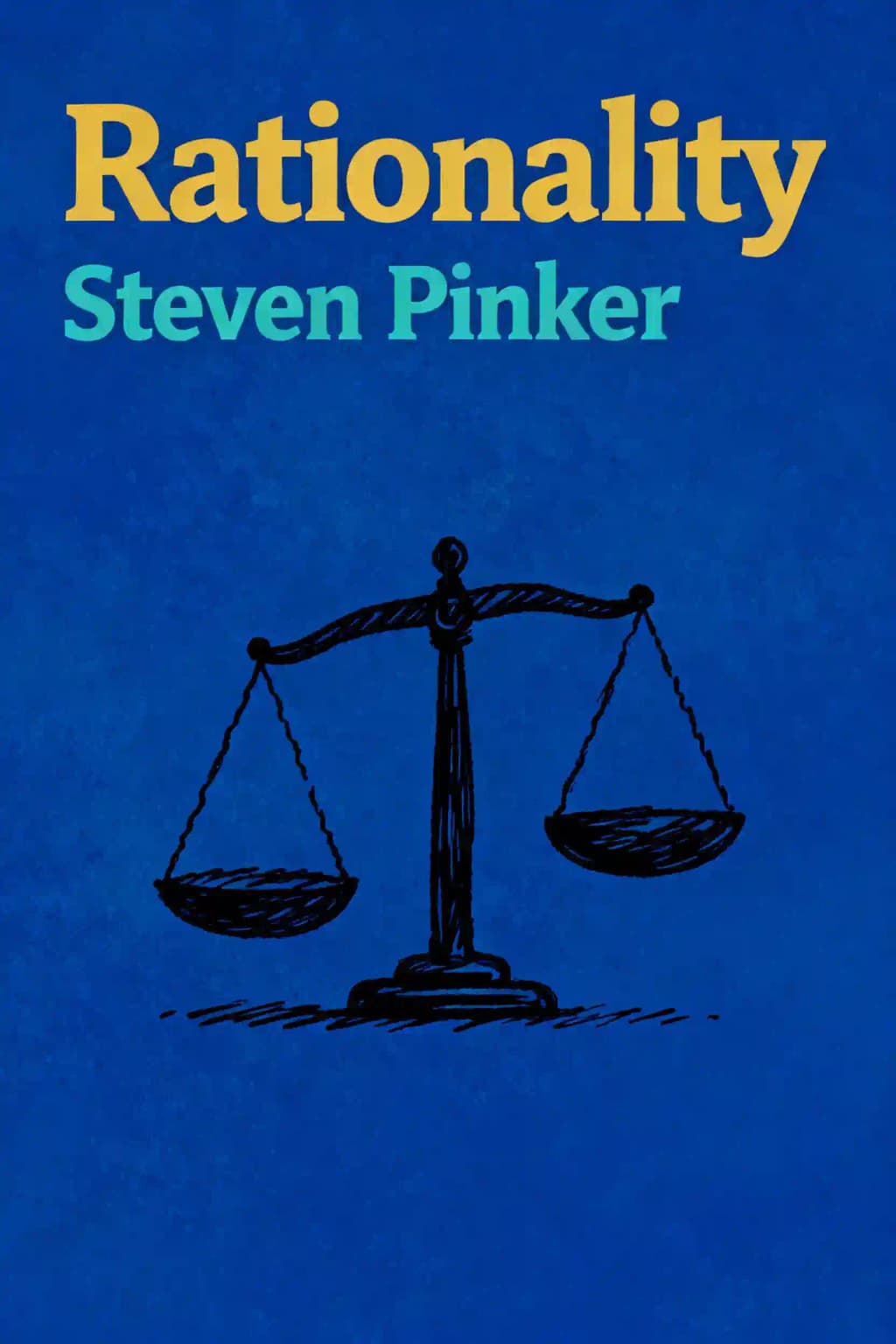
In "Rationality," Steven Pinker tackles our mind's biggest paradox: why humans capable of logic remain stubbornly irrational. Praised by Columbia's Andrew Gelman for its accessible approach to Bayesian reasoning, this 2021 bestseller reveals why rationality isn't just academic - it's our civilization's most crucial survival skill.
Steven Pinker, author of Rationality, is a renowned cognitive psychologist, bestselling author, and Harvard professor whose work explores language, human cognition, and the foundations of rational thought. A two-time Pulitzer Prize finalist for his nonfiction works The Language Instinct and How the Mind Works, Pinker bridges evolutionary psychology, linguistics, and Enlightenment philosophy to advocate for reason in modern discourse.
His books, including Enlightenment Now and The Better Angels of Our Nature, have been translated into over 20 languages and solidified his reputation as a leading public intellectual.
Pinker’s insights are rooted in his academic roles at MIT and Harvard, where he served as chair of psychology and director of cognitive neuroscience. A frequent guest on NPR, The Colbert Report, and TED Talks, he distills complex scientific concepts into accessible analysis for broad audiences. His 2022 BBVA Foundation Frontiers of Knowledge Award underscores his global influence in understanding human progress and rationality.
Steven Pinker’s Rationality examines how humans can improve decision-making by understanding logic, probability, and cognitive biases. It argues that while humans evolved rational capacities, modern challenges like misinformation require deliberate use of critical thinking tools. The book explores game theory, Bayesian reasoning, and societal applications, positioning rationality as essential for solving global issues like climate change and political polarization.
This book suits critical thinkers, educators, policymakers, and anyone seeking to navigate misinformation or improve decision-making. It’s valuable for readers interested in psychology, behavioral economics, or the science of reason, offering practical frameworks for addressing personal and societal challenges.
Yes—Pinker’s insights remain vital for countering misinformation, conspiracy theories, and polarized discourse. By dissecting cognitive biases and offering tools like probabilistic reasoning, the book equips readers to make clearer decisions in an increasingly complex world.
Pinker emphasizes epistemic rationality (aligning beliefs with evidence) and instrumental rationality (achieving goals effectively). He explores Bayesian reasoning, game theory, and statistical fallacies, advocating for these tools to address issues from climate policy to personal finance.
Pinker defines rationality as using logic, probability, and evidence to form accurate beliefs (epistemic) and make decisions that maximize desired outcomes (instrumental). He contrasts this with irrationality driven by cognitive biases or motivated reasoning.
Pinker challenges the notion that humans are inherently irrational, arguing instead that biases like confirmation bias or the availability heuristic stem from evolutionary mismatches. He stresses that rationality can be cultivated through education and critical thinking.
The book applies rational frameworks to global issues, advocating for evidence-based policymaking, scientific literacy, and Bayesian reasoning to combat misinformation. Pinker argues that collective rationality is crucial for solving climate change, inequality, and geopolitical conflicts.
Rational irrationality refers to strategically adopting irrational beliefs for personal gain, such as politicians stoking conspiracy theories to mobilize supporters. Pinker warns this undermines societal progress but notes it can be countered through institutional safeguards.
While acknowledging emotions’ evolutionary purpose, Pinker argues they often clash with rational decision-making. He advocates balancing intuition with deliberate reasoning, particularly in high-stakes scenarios like financial planning or public health.
Unlike Enlightenment Now’s focus on historical progress, Rationality delves into cognitive science tools for sustaining that progress. It complements his prior themes by addressing the mechanics of reason needed to solve modern challenges.
Some critics argue Pinker underestimates systemic barriers to rational discourse, like algorithmic misinformation or political tribalism. Others note he sidelines emotional or cultural factors influencing decisions, focusing narrowly on cognitive frameworks.
Pinker suggests practicing probabilistic thinking, scrutinizing news sources for logical fallacies, and using game theory to anticipate others’ actions. These habits improve personal decisions and foster more constructive public debates.
저자의 목소리로 책을 느껴보세요
지식을 흥미롭고 예시가 풍부한 인사이트로 전환
핵심 아이디어를 빠르게 캡처하여 신속하게 학습
재미있고 매력적인 방식으로 책을 즐기세요
Rationality is the ability to use knowledge to attain goals.
Rejecting rationality is self-defeating.
Rationality has an image problem.
Reason is the slave of the passions.
Sometimes it's even rational to choose ignorance.
Rationality의 핵심 아이디어를 이해하기 쉬운 포인트로 분해하여 혁신적인 팀이 어떻게 창조하고, 협력하고, 성장하는지 이해합니다.
Rationality을 빠른 기억 단서로 압축하여 솔직함, 팀워크, 창의적 회복력의 핵심 원칙을 강조합니다.

생생한 스토리텔링을 통해 Rationality을 경험하고, 혁신 교훈을 기억에 남고 적용할 수 있는 순간으로 바꿉니다.
무엇이든 물어보고, 목소리를 선택하고, 진정으로 공감되는 인사이트를 함께 만들어보세요.

샌프란시스코에서 컬럼비아 대학교 동문들이 만들었습니다
"Instead of endless scrolling, I just hit play on BeFreed. It saves me so much time."
"I never knew where to start with nonfiction—BeFreed’s book lists turned into podcasts gave me a clear path."
"Perfect balance between learning and entertainment. Finished ‘Thinking, Fast and Slow’ on my commute this week."
"Crazy how much I learned while walking the dog. BeFreed = small habits → big gains."
"Reading used to feel like a chore. Now it’s just part of my lifestyle."
"Feels effortless compared to reading. I’ve finished 6 books this month already."
"BeFreed turned my guilty doomscrolling into something that feels productive and inspiring."
"BeFreed turned my commute into learning time. 20-min podcasts are perfect for finishing books I never had time for."
"BeFreed replaced my podcast queue. Imagine Spotify for books — that’s it. 🙌"
"It is great for me to learn something from the book without reading it."
"The themed book list podcasts help me connect ideas across authors—like a guided audio journey."
"Makes me feel smarter every time before going to work"
샌프란시스코에서 컬럼비아 대학교 동문들이 만들었습니다

Rationality 요약을 무료 PDF 또는 EPUB으로 받으세요. 인쇄하거나 오프라인에서 언제든 읽을 수 있습니다.
In an era of unprecedented scientific achievement - where we've dated the universe's origin, decoded life's secrets, and developed COVID vaccines in record time - our public discourse paradoxically drowns in conspiracy theories and "post-truth" rhetoric. Why does irrationality flourish when we have more knowledge than ever? This paradox sits at the heart of "Rationality," which arrives as both diagnosis and potential cure for our epistemic crisis. While we've used reason to extend human lifespans from thirty to over seventy years and reduce extreme poverty from ninety to less than nine percent of humanity, we still struggle with simple reasoning problems. Consider the bat and ball puzzle: "A bat and ball cost $110 total. The bat costs $100 more than the ball. How much does the ball cost?" If you immediately thought $10, you're wrong - that would make the total $120. The correct answer is $5. Such cognitive illusions don't indicate broken reasoning but reveal how our minds prioritize socially useful interpretations over mathematical precision - much like visual illusions show how our visual system optimizes for real-world accuracy rather than technical precision.