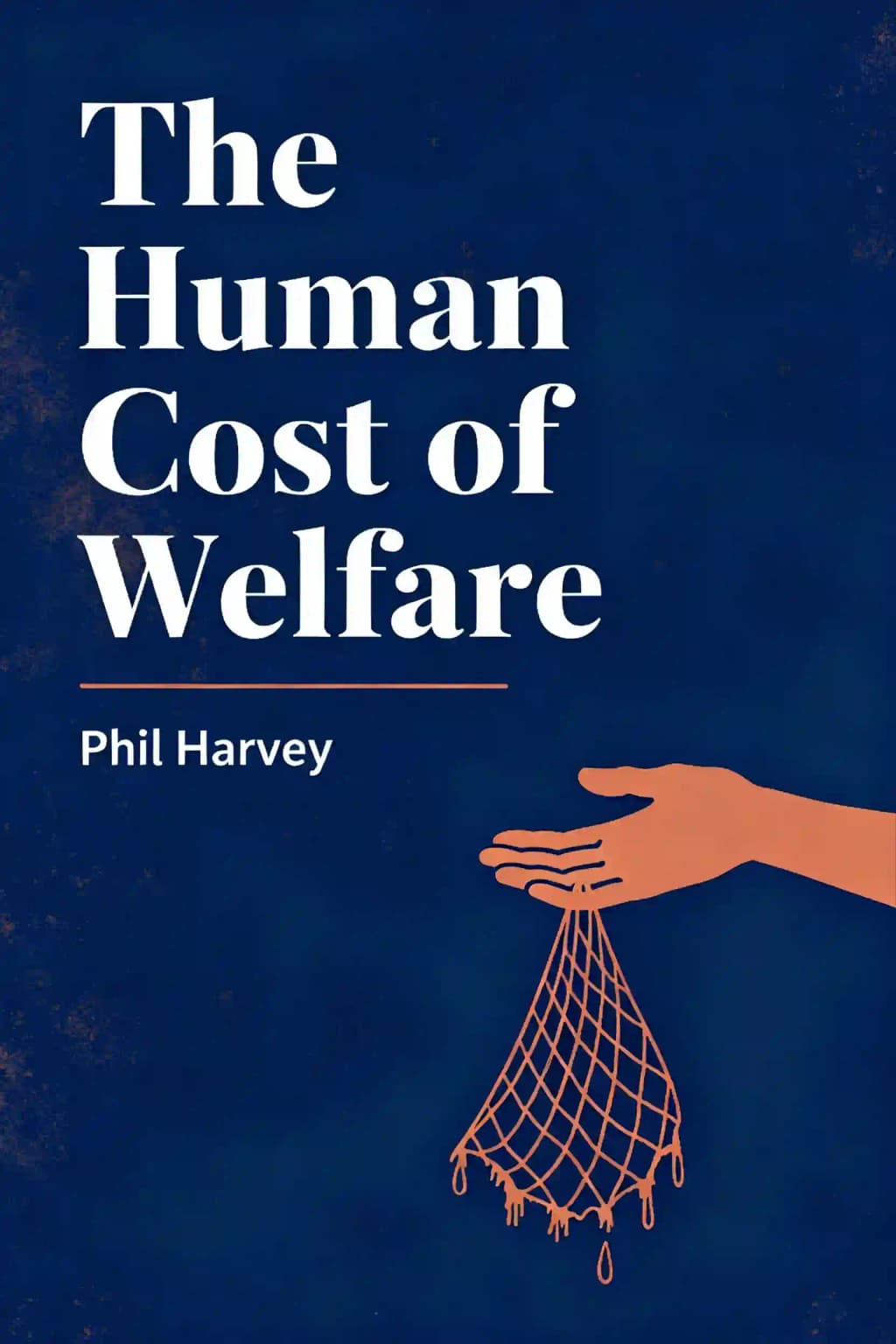
"The Human Cost of Welfare" exposes how America's welfare system traps recipients in dependency. Endorsed by former governor Gary Johnson, this eye-opening investigation features stories from 100+ welfare recipients, revealing counterintuitive truths about programs designed to help but often harm those most vulnerable.
Phil Harvey (1938–2021) was a libertarian entrepreneur and the author of The Human Cost of Welfare. He dedicated his career to advocating for individual autonomy and challenging government overreach.
A Harvard-educated philanthropist, Harvey co-founded Population Services International and DKT International. These organizations delivered family planning resources across more than 70 countries. His work, blending social impact with market-driven solutions, informs the book’s critique of welfare systems and emphasis on personal agency.
Harvey's controversial 2001 memoir, The Government vs. Erotica, detailed his eight-year legal battle defending free expression through his mail-order business Adam & Eve. It was later adapted into documentaries like Can We Take a Joke? A Pushcart Prize-nominated author, his fiction collections Wisdom of Fools and Devotional explore human motivation through unflinching narratives.
Harvey’s organizations now impact more than 50 million people annually, cementing his legacy as a disruptor of restrictive systems.
The Human Cost of Welfare critiques traditional welfare systems through a libertarian lens, arguing they often perpetuate dependency and bureaucratic inefficiency. Harvey examines unintended consequences like reduced personal agency and economic stagnation, advocating for market-driven solutions that prioritize individual empowerment over state control. The book combines empirical analysis with case studies to challenge assumptions about poverty alleviation.
Policymakers, economists, and readers interested in libertarian critiques of social systems will find this book provocative. It’s also relevant for advocates of welfare reform or those studying the intersection of government programs and individual freedom. Harvey’s accessible style makes complex socioeconomic concepts approachable for general audiences.
Yes, for its bold exploration of welfare’s unintended harms and alternatives like decentralized aid models. While controversial, Harvey’s data-driven approach and decades of philanthropic experience lend credibility. Critics argue it oversimplifies systemic inequality, but the book sparks critical dialogue about balancing compassion and self-reliance.
Harvey analyzes failed welfare expansions in 1980s India and post-2008 U.S. stimulus packages to show how poorly designed aid exacerbates poverty. He contrasts these with successful microfinance initiatives in Bangladesh and Chile, emphasizing localized, conditional support.
Unlike Murray’s Losing Ground (focused on cultural factors), Harvey stresses institutional redesign. It aligns with Sowell’s Basic Economics on market efficiency but adds firsthand philanthropic insights from Harvey’s CARE and DKT International work.
Progressives argue it underestimates structural barriers like racism and wage stagnation. Others claim Harvey’s corporate philanthropy background (e.g., Adam & Eve) conflicts with his anti-statist stance. The book’s narrow focus on economic metrics also draws fire for neglecting emotional safety nets.
With AI displacing low-wage jobs and universal basic income debates intensifying, Harvey’s warnings about perverse incentives resonate. The book’s framework helps evaluate emerging policies like gig-worker protections or conditional cryptocurrency aid programs.
Harvey’s leadership at Population Services International and DKT International shaped his focus on scalable, dignity-preserving aid. His libertarian advocacy against censorship (via Adam & Eve’s legal battles) mirrors his distrust of centralized power.
저자의 목소리로 책을 느껴보세요
지식을 흥미롭고 예시가 풍부한 인사이트로 전환
핵심 아이디어를 빠르게 캡처하여 신속하게 학습
재미있고 매력적인 방식으로 책을 즐기세요
I have to work or I'd go crazy.
The money doesn't go to the kid.
Washington State has better benefits so I moved here.
I would much rather be working, at any job, than living the way I live right now.
We effectively pay people to stay poor.
The human cost of welfare의 핵심 아이디어를 이해하기 쉬운 포인트로 분해하여 혁신적인 팀이 어떻게 창조하고, 협력하고, 성장하는지 이해합니다.
The human cost of welfare을 빠른 기억 단서로 압축하여 솔직함, 팀워크, 창의적 회복력의 핵심 원칙을 강조합니다.

생생한 스토리텔링을 통해 The human cost of welfare을 경험하고, 혁신 교훈을 기억에 남고 적용할 수 있는 순간으로 바꿉니다.
무엇이든 물어보고, 목소리를 선택하고, 진정으로 공감되는 인사이트를 함께 만들어보세요.

샌프란시스코에서 컬럼비아 대학교 동문들이 만들었습니다
"Instead of endless scrolling, I just hit play on BeFreed. It saves me so much time."
"I never knew where to start with nonfiction—BeFreed’s book lists turned into podcasts gave me a clear path."
"Perfect balance between learning and entertainment. Finished ‘Thinking, Fast and Slow’ on my commute this week."
"Crazy how much I learned while walking the dog. BeFreed = small habits → big gains."
"Reading used to feel like a chore. Now it’s just part of my lifestyle."
"Feels effortless compared to reading. I’ve finished 6 books this month already."
"BeFreed turned my guilty doomscrolling into something that feels productive and inspiring."
"BeFreed turned my commute into learning time. 20-min podcasts are perfect for finishing books I never had time for."
"BeFreed replaced my podcast queue. Imagine Spotify for books — that’s it. 🙌"
"It is great for me to learn something from the book without reading it."
"The themed book list podcasts help me connect ideas across authors—like a guided audio journey."
"Makes me feel smarter every time before going to work"
샌프란시스코에서 컬럼비아 대학교 동문들이 만들었습니다

The human cost of welfare 요약을 무료 PDF 또는 EPUB으로 받으세요. 인쇄하거나 오프라인에서 언제든 읽을 수 있습니다.
What if the very system designed to lift people out of poverty is actually keeping them there? Across America, millions of people face this contradiction daily-trapped between the security of government assistance and the dignity of work. Phil Harvey and Lisa Conyers spent years traveling the country, sitting down with over 100 welfare recipients to understand their lived experiences. What they discovered challenges everything we think we know about helping the poor. This isn't another policy wonk's treatise filled with charts and partisan finger-pointing. Instead, it's a deeply human exploration that reveals a troubling truth: our welfare system, built with the best intentions, has created invisible walls that prevent the very people it aims to help from achieving independence and fulfillment.