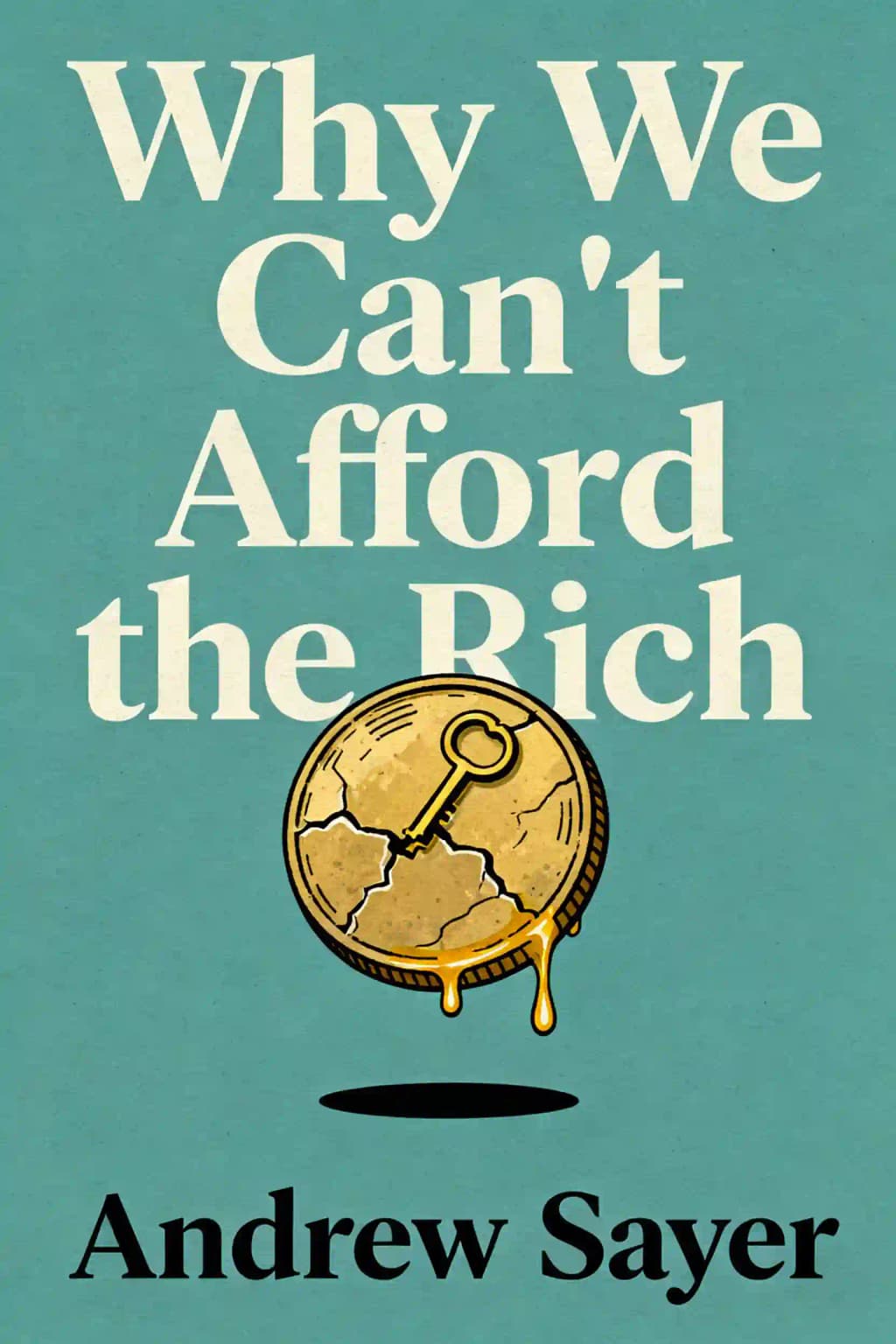
Andrew Sayer's award-winning expose reveals why the rich aren't wealth creators but value extractors, challenging Thatcher-Reagan economics with a moral argument that's sparked global debate. Wealth inequality isn't just unfair - it's environmentally devastating and democratically corrosive.
Andrew Sayer, author of Why We Can’t Afford the Rich, is an Emeritus Professor of Social Theory and Political Economy at Lancaster University, renowned for his incisive critiques of wealth inequality and neoliberal capitalism. A pioneer of critical realism in social science, Sayer merges rigorous academic analysis with accessible commentary on moral and political economies.
His career spans decades of interdisciplinary research, reflected in foundational works like Method in Social Science—a seminal text in social research methodology with over 9,000 citations—and The Moral Significance of Class, which explores ethical dimensions of economic disparities.
Sayer’s expertise stems from his post-disciplinary approach, blending philosophy, sociology, and political economy to challenge systems of power. Beyond academia, his writings resonate in public debates on economic justice, informed by his critiques of neoliberalism in Radical Political Economy: A Critique.
Why We Can’t Afford the Rich extends his legacy, offering a trenchant examination of how wealth concentration destabilizes societies. His works remain essential reading for scholars and activists alike, cementing his status as a leading voice in understanding the intersection of ethics, power, and economics.
Why We Can’t Afford the Rich argues that extreme wealth concentration stems from unearned income—like rent, interest, and speculative gains—which undermines democracy, fuels inequality, and exacerbates climate change. Andrew Sayer critiques capitalism’s structural flaws, showing how the 1% extract wealth through control of assets rather than creating value, leading to economic and ecological crises. The book advocates for redistributive policies and systemic reform.
This book is ideal for readers interested in economic justice, climate change, and critiques of capitalism. It suits activists, students, policymakers, and general audiences seeking to understand wealth inequality. Sayer’s accessible explanations make complex concepts like rentier capitalism and unearned income digestible for non-experts.
Yes. Praised for its clarity, the book dismantles myths about wealth creation and exposes systemic exploitation. It connects economic inequality to environmental collapse, offering urgent insights for today’s crises. Readers call it “nuanced” and “well-formed,” providing tools to challenge plutocratic power.
Unearned income refers to wealth gained through ownership of assets (e.g., land, stocks) rather than labor. Examples include rent, dividends, and capital gains. Sayer argues this income perpetuates inequality by allowing the rich to profit from others’ work or scarce resources, calling it “value-skimming” that harms the real economy.
The book highlights how the rich’s luxury consumption (private jets, yachts) accelerates environmental degradation. Their control of fossil fuel industries and resistance to sustainable policies worsen the crisis. Sayer warns endless growth under capitalism is incompatible with planetary limits, urging systemic change to avoid ecological collapse.
Key solutions include taxing unearned income, redistributing wealth, and public ownership of essential resources. Sayer advocates democratizing economic power, regulating financial markets, and prioritizing sustainability over growth. These steps aim to curb elite exploitation and foster equitable societies.
Sayer argues capitalism’s reliance on growth and profit incentivizes exploitation, inequality, and ecological harm. He challenges the myth of wealthy “job creators,” showing how rent-seeking and financial speculation dominate modern economies. The system’s structural flaws, he concludes, make it unsustainable and morally indefensible.
Property rights enable the rich to monopolize resources (land, housing, capital) and extract rent or interest from those who need them. This creates “inequality of opportunity,” trapping others in cycles of debt and poverty. Sayer calls for reforming ownership models to prioritize communal well-being over private gain.
Andrew Sayer is a professor of social theory and political economy at Lancaster University. His work focuses on moral economy, class, and critiques of neoliberalism. Previous books include The Moral Significance of Class and Radical Political Economy, establishing his expertise in systemic inequality.
Unlike surface-level critiques, Sayer’s book combines economic analysis with moral philosophy, emphasizing unearned income’s role in inequality. It aligns with Thomas Piketty’s Capital but adds a sharper focus on ecology and actionable reforms, making it a holistic guide for systemic change.
With wealth inequality and climate disasters intensifying, Sayer’s analysis remains urgent. The 2020s’ economic instability, corporate greed, and policy stagnation mirror the book’s warnings. Its call for moral economy reforms offers a roadmap amid ongoing crises.
저자의 목소리로 책을 느껴보세요
지식을 흥미롭고 예시가 풍부한 인사이트로 전환
핵심 아이디어를 빠르게 캡처하여 신속하게 학습
재미있고 매력적인 방식으로 책을 즐기세요
The rich aren't primarily 'wealth creators' but wealth extractors.
Landlords 'love to reap where they have not sowed.'
Interest functions as 'money's rent'.
Compound interest is mathematically unsustainable.
The system disadvantages the poor.
Why We Can't Afford the Rich의 핵심 아이디어를 이해하기 쉬운 포인트로 분해하여 혁신적인 팀이 어떻게 창조하고, 협력하고, 성장하는지 이해합니다.
Why We Can't Afford the Rich을 빠른 기억 단서로 압축하여 솔직함, 팀워크, 창의적 회복력의 핵심 원칙을 강조합니다.

생생한 스토리텔링을 통해 Why We Can't Afford the Rich을 경험하고, 혁신 교훈을 기억에 남고 적용할 수 있는 순간으로 바꿉니다.
무엇이든 물어보고, 목소리를 선택하고, 진정으로 공감되는 인사이트를 함께 만들어보세요.

샌프란시스코에서 컬럼비아 대학교 동문들이 만들었습니다
"Instead of endless scrolling, I just hit play on BeFreed. It saves me so much time."
"I never knew where to start with nonfiction—BeFreed’s book lists turned into podcasts gave me a clear path."
"Perfect balance between learning and entertainment. Finished ‘Thinking, Fast and Slow’ on my commute this week."
"Crazy how much I learned while walking the dog. BeFreed = small habits → big gains."
"Reading used to feel like a chore. Now it’s just part of my lifestyle."
"Feels effortless compared to reading. I’ve finished 6 books this month already."
"BeFreed turned my guilty doomscrolling into something that feels productive and inspiring."
"BeFreed turned my commute into learning time. 20-min podcasts are perfect for finishing books I never had time for."
"BeFreed replaced my podcast queue. Imagine Spotify for books — that’s it. 🙌"
"It is great for me to learn something from the book without reading it."
"The themed book list podcasts help me connect ideas across authors—like a guided audio journey."
"Makes me feel smarter every time before going to work"
샌프란시스코에서 컬럼비아 대학교 동문들이 만들었습니다

Why We Can't Afford the Rich 요약을 무료 PDF 또는 EPUB으로 받으세요. 인쇄하거나 오프라인에서 언제든 읽을 수 있습니다.
Here's a startling fact: between 2010 and 2018, Jeff Bezos paid an effective federal tax rate of just 1.1%, while his company's warehouse workers paid closer to 15%. This isn't an accident or loophole - it's the system working exactly as designed. The fundamental question isn't whether inequality exists, but how it persists despite democratic institutions supposedly built to prevent such concentration of wealth. The answer lies in understanding a distinction deliberately erased from modern economic discourse: the difference between earning money and extracting it. Think about your last paycheck. You traded hours of your life - your knowledge, effort, and time - for that money. A teacher shapes young minds, a nurse provides care, an engineer designs infrastructure. These activities create tangible value that didn't exist before. But what about someone collecting rent on property they inherited? Or earning dividends from stocks purchased decades ago? Or profiting from currency speculation? They're receiving income too, but without producing anything new. This distinction between earned and unearned income once formed the backbone of economic thinking. Even Adam Smith, capitalism's patron saint, recognized that landlords "love to reap where they never sowed."